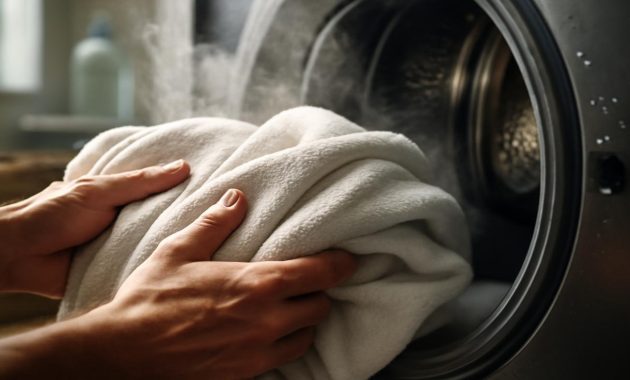
The towels looked innocent enough, stacked in their usual crooked tower at the end of the bed. They smelled faintly of lavender detergent and something you could almost call “mountain breeze” if you squinted hard enough. But when you reached for one, the truth was impossible to ignore: it felt like folding a piece of cardboard. Clean, yes. Soft, absolutely not.
If you’ve ever stepped out of a shower, skin warm and damp, only to be greeted by a towel that squeaks against you instead of wrapping you in a cozy hug, you know that tiny, domestic heartbreak. How can something smell so fresh and still feel so stiff and scratchy? You can wash them again. You can change detergents. You can add more fabric softener. But every cycle ends the same: towels that smell fine, function okay, and feel… wrong.
That “wrong” feeling is your first clue that somewhere, quietly, a tiny but crucial laundry step has been skipped. And once you understand what your towels are trying to tell you—every rustle, every stiff fold—you’ll never look at your washing machine in quite the same way again.
The Secret Life of a Stiff Towel
Hold a stiff towel in both hands for a moment. Notice how it keeps its shape instead of draping softly. Rub the surface between your fingers. It’s not exactly rough like sandpaper, but it has an uncomfortable drag, as if something invisible is coating each loop of fabric.
Now imagine what that towel has lived through. Showers after long days. Quick hand-dries in the kitchen. Hair wrapped after rushed mornings. It has soaked up soap, skin oils, traces of lotion, minerals from your water, detergent from each wash, and maybe a generous splash of fabric softener “for good measure.”
Every one of those things leaves a trail—a film—on the fibers. You can’t quite see it, but you can feel it. Over time, it stiffens the loops, weighing them down, gluing them together just enough that they lose that plush, thirsty feel. It’s like asking a sponge to soak up water while it’s already saturated in wax.
This is why your towels can smell okay and still feel harsh. The fragrance says, “I’m clean!” but the texture says, “I’m exhausted and coated in buildup.” And that brings us to the missing laundry step that quietly makes or breaks your towel game.
The Overlooked Step: True Rinsing, Not Just Washing
Most of us think of laundry in two big movements: the wash and the dry. Detergent goes in, cycle runs, we toss the damp bundle into the dryer, hit start, and move on with our day. The machine handles the rest. At least, that’s what we tell ourselves.
But there’s a crucial, often-overlooked third act tucked inside the wash cycle itself: the rinse. Not the token swirl the machine offers by default, but a deliberate, adequate rinse that actually removes leftover detergent, softener, and minerals instead of swirling them around and calling it a day.
If your towels smell clean but feel stiff, what’s usually missing is enough rinsing—either in frequency, intensity, or intentionality. You’re likely washing your towels, but you’re not truly rinsing them free of what they’ve been carrying for months or years.
Think of rinsing as your towels’ exhale. Washing is the deep inhale—water, detergent, agitation. Rinsing is when they finally get to let go. Skip a deep exhale and your towels stay tense, braced, holding everything in: detergent residue, softener films, mineral traces. No amount of scented liquid can fix what too little rinsing leaves behind.
How Buildup Happens (Even When You’re “Doing Everything Right”)
Walk through a regular laundry day. You scoop or pour detergent into the drawer or drum. Maybe, wanting extra-soft towels, you add fabric softener too. The machine fills, churns, drains, and hums through its familiar choreography. You open the door at the end: your towels smell pleasant. You’re satisfied.
But below that comforting fragrance, a slow layering has begun:
- Too much detergent for the size of the load or the softness of your water.
- Fabric softener that leaves a coating designed to make fibers feel smooth—but on towels, that coating also blocks absorbency and encourages stiffness as it builds.
- Hard water minerals (calcium, magnesium) that attach themselves to the fibers, especially in areas with mineral-rich tap water.
Each wash adds another whisper-thin layer. No single cycle seems harmful, but month after month, wash after wash, those layers compact. Imagine painting coat after coat of clear nail polish over a feather. Eventually, you’d have something shiny, rigid, and almost unrecognizable from where it started.
That’s your towel.
The irony is that the more you try to “fix” the stiffness with extra detergent or generous splashes of softener, the worse the problem gets. You’re feeding the very thing that’s making them feel wrong.
The Quiet Hero: A Deep Rinse Reset
So how do you teach an old, stiff towel to be soft again? You give it what it’s been missing: a real chance to let go. Not more scent. Not more product. A deeper rinse—sometimes several of them.
Picture this as a mini retreat for your towels, a chance to wash off everything that has been weighing them down. You don’t need fancy equipment or obscure additives. What you need is intention and a willingness to let water do most of the work.
Step 1: Strip the Buildup (Gently)
Start with clean-ish towels—the ones that already smell fine but feel stiff. You’re not dealing with stains here; you’re dealing with residue.
- Wash them again with no detergent at all. Set your machine to warm or hot water, depending on what your towels’ care tags allow.
- Add a cup of plain white vinegar to the rinse compartment or directly into the drum. Vinegar helps dissolve mineral and detergent residues and balances pH, which can relax the fibers.
- Skip fabric softener entirely. For towels, it’s more enemy than friend.
You might see a surprising amount of suds, even though you didn’t add detergent. That’s the hidden buildup finally being coaxed out.
Step 2: Rinse Again. And Maybe Again.
Once the cycle finishes, choose an extra rinse—or run a second rinse-only cycle if your machine allows it. This is the step most of us never think to prioritize, but for stiff towels, it’s transformative.
Each additional rinse is like another wave at the shore, pulling more residue back into the sea. You’re not adding anything new; you’re just letting the water carry away what shouldn’t have stayed.
Step 3: Dry with Air, Not Coating
As your towels move to the dryer, they’re already lighter than they’ve felt in months. To keep them that way:
- Shake each towel out before tossing it in. This helps open the fibers.
- Dry on medium heat, not scorching high. Overheating can make fibers feel brittle.
- Toss in clean wool dryer balls or a couple of clean, dry washcloths to help separate and fluff as they tumble.
- Again, skip dryer sheets. They work much like liquid fabric softener, leaving a coating that undermines absorbency and softness over time.
When the cycle ends, pull one towel out and run it through your fingers. You should feel more drape, more breath, less drag. It may not be hotel-plush in one go, but it should feel markedly more alive.
Quick Comparison: What Changes When You Focus on Rinsing?
| Before Rinse Reset | After Rinse Reset |
|---|---|
| Towels feel stiff, almost board-like | Towels drape and fold more easily |
| Squeaky drag when you rub them | Smoother glide, less friction on skin |
| Take longer to fully absorb water | Absorb more quickly and evenly |
| Faintly clean smell but heavy feel | Light, “empty” feel—like a fresh canvas |
Living with Softer Towels: Small Habits, Big Difference
Once your towels have had their rinse reset, keeping them soft is less about magic tricks and more about gentle, consistent habits. Think of it as learning to care for them in their language instead of forcing them to adapt to yours.
Use Less Detergent Than You Think
Most detergent caps are designed with generous lines, and it’s easy to assume more soap equals cleaner fabric. But with towels, more often equals buildup. Try using half to three-quarters of the recommended amount, especially if you have a high-efficiency washer or soft water.
If you’re nervous, watch the rinse cycle window or drum door. If you still see suds, your towels are telling you, “This is too much.”
Retire Fabric Softener from Towel Duty
You don’t have to banish fabric softener from your home, but giving it time off when towels are in the drum is a game changer. If you miss the idea of “softness,” remember: genuine towel softness comes from open, clean fibers, not slippery coatings.
That faint, more neutral smell after washing with less product can feel strange at first, but over time it begins to smell like something else: truly clean.
Respect the Rinse Button
That “extra rinse” option you’ve been ignoring? It’s your new ally. You don’t have to use it for every load of everyday clothes, but for towels, bedding, and anything that sits against your skin for long stretches, it’s worth pressing.
Think of it as an investment in comfort. One extra rinse now saves you from doing a full vinegar-and-rinse rehab later.
Don’t Crowd the Drum
When towels are jammed into the washer like a tightly packed suitcase, they can’t move freely. Without space to tumble and swish, detergent doesn’t rinse out fully, and water can’t reach every fold. Give them breathing room—enough that you can slide your hand into the top of the load comfortably.
It’s the difference between a quick splash in a sink and a long float in a lake.
Dry Thoroughly, but Kindly
Damp towels left in the machine or folded too quickly can flirt with mustiness, which tempts you to overcompensate next time with more detergent or fragrance. Instead:
- Remove towels promptly from the washer.
- Dry until fully dry, but avoid baking them at the highest heat setting for long stretches.
- Every so often, air them out in sunlight—nature’s original freshener and gentle sanitizer.
Listening to the Small Signals in Everyday Chores
There’s something quietly satisfying about solving a mystery as small and ordinary as a stiff towel. On the surface, it’s just laundry. But if you zoom in, it’s a conversation with the things that live closest to your skin.
Your home is full of these soft murmurs: sheets that feel warmer when they’re allowed to breathe, t-shirts that last longer when you wash them a touch more gently, blankets that fluff up again when you resist overloading the drum. Towels are simply the ones who speak the loudest when something’s off, scratching across your shoulders, dragging on your hands.
When you respond with curiosity instead of more product—with extra rinsing instead of extra detergent—you start to see a pattern. The solution to a lot of “not quite right” laundry problems isn’t adding something new. It’s letting something go.
So the next time you step out of the shower and reach for a towel, pay attention. Does it sigh into your hands, folding softly, ready to drink up the water from your skin? Or does it stand there, rigid and reserved, coated in the ghosts of washes past?
If it’s the latter, you know what’s missing now. Not a miracle detergent. Not a perfumed softener. Just this simple, almost humble step: a real, generous rinse.
Water in, residue out. Space to tumble. Space to exhale.
In that space, the towel you thought you’d ruined can remember what it was always meant to be: not just a rectangle of fabric, but a small daily kindness waiting quietly on the rack, ready to wrap you in softness when you need it most.
Frequently Asked Questions
Why do my towels feel stiff even though they smell clean?
Stiff towels usually mean there’s buildup on the fibers—detergent residue, fabric softener, and minerals from hard water. They can smell clean because of lingering fragrance, but still feel rough because that coating hasn’t been rinsed away properly.
How often should I do a “rinse reset” with vinegar?
For most households, doing a vinegar rinse reset every 1–2 months is enough. If you live in a hard-water area or use a lot of detergent, you might benefit from doing it a bit more often until your towels feel consistently soft again.
Will vinegar make my towels smell weird?
No—when used in the wash and properly rinsed, vinegar scent doesn’t linger. It rinses out along with the residue it helps dissolve. If you notice a strong vinegar smell afterward, run one more plain rinse cycle.
Is fabric softener always bad for towels?
“Bad” is strong, but it’s not ideal. Fabric softener and dryer sheets add a coating that can make towels feel smooth at first, but over time it reduces absorbency and can contribute to stiffness. Skipping them for towels usually leads to better long-term softness.
Can I use baking soda instead of vinegar?
Baking soda can help with odors and mild softening by balancing pH, but it’s not as effective as vinegar at dissolving mineral and detergent residues. You can occasionally use a small amount of baking soda in the wash, but vinegar in the rinse is usually more helpful for stiffness.
Does hard water really make a big difference with towels?
Yes. Hard water deposits minerals onto fabric, which can make towels feel rough and less absorbent over time. If you have hard water, rinsing well, using a bit less detergent, and doing occasional vinegar rinses can make a noticeable difference.
How can I tell if I’m using too much detergent?
If you see suds in the rinse cycle, your towels come out feeling heavy or coated, or you frequently deal with stiffness or dinginess, you’re probably using more detergent than needed. Try cutting back slowly until you find the smallest amount that still gets your towels clean.