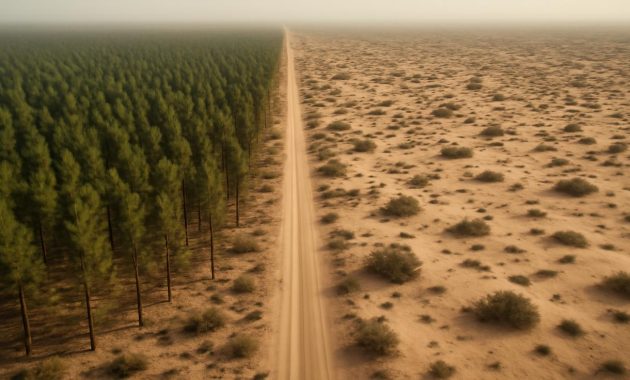
The wind comes first—a dry, restless breath that sneaks under your collar and into your throat, tasting faintly of dust and sunburnt stone. It comes rolling off the Gobi Desert in late afternoon, carrying a thin mist of sand that blurs the horizon and softens the outlines of distant hills. If you stand there long enough, eyes narrowed against the brightness, you can almost see the border between two futures: one where the desert keeps walking south, and one where a green line of trees somehow tells it to stop.
For more than four decades, China has been trying to draw that green line. They call it the “Great Green Wall” or, more technically, the Three-North Shelterbelt Program—a sweeping effort to plant billions of trees along the country’s vulnerable northern edge. On satellite images, the planted zones appear like faint smudges of darker color, stretching thousands of kilometers, a human-made buffer between farms and dunes.
It sounds heroic: a civilization-scale story of regeneration. Plant enough trees, the logic goes, and you can anchor soil, trap moisture, soften sandstorms, and rebuild shattered ecosystems. In an age of climate anxiety, the narrative is irresistible. A billion trees: the scale alone feels like hope measured in roots.
And yet, wander among some of these forests—or what passes for forests—and another story rises from the soil. Some groves stand thin and brittle, bark scarred by blowing grit. In places, the ground beneath is bare, almost sterile, shaded by a single species of tree planted in rigid rows. In the spring, when the rain is stingy, whole patches yellow and wither at once. A quiet question gnaws at the edges of the triumph: what if planting trees—at least the way it’s being done here—is making things worse?
A Wall of Trees Against a Moving Sea
The dream began in the late 1970s, after a series of brutal dust storms rolled across northern China and into cities like Beijing, turning traffic lights into dim orbs in a swirling brown haze. Crops were smothered, lungs filled with grit, and the government declared war on desertification. If the desert was advancing like a sea, then trees would be the breakwater. That was the idea.
In the following decades, an unprecedented mobilization got underway. Local officials received planting targets. Villagers were recruited to dig pits and set young saplings into the dust. Planes and trucks carried seedlings across provinces. Metrics multiplied: hectares covered, survival rates hinted at, saplings distributed. The Great Green Wall wasn’t just an environmental project; it became a national symbol of progress, a story the state could point to and say: look, we are pushing the desert back.
On the ground, the changes felt tangible. In some regions, wind speeds near the surface declined. Dust storms became less frequent. Farmers in certain counties reported better yields, their fields no longer stripped bare by every spring gale. In satellite data, parts of northern China did, indeed, appear to be getting greener.
But nature rarely accepts simple, one-directional victories—especially when it’s being asked to obey large-scale, one-size-fits-all plans. The closer ecologists looked, the more they noticed that much of this new “green” was fragile, thirsty, and astonishingly uniform. What had been marketed as forests often resembled plantations, and plantations behave very differently from wild woods when the climate leans hot and dry.
Monocultures in a Thirsty Land
Walk into one of these shelterbelts on a summer afternoon, and the orderliness hits you first. Trees stand at almost military attention—same height, same distance, same species. Rows march out in every direction like a grid printed onto the land. It’s efficient, yes, and easy to measure. But it’s also an ecological gamble.
In many areas, fast-growing, hardy species were favored: poplars, for instance, with their pale trunks and fluttering leaves; or non-native pines and other conifers that could be grown quickly in nurseries and trucked in by the million. They shot up fast, creating an immediate impression of success. From a satellite’s eye view, green is green; details don’t show up at that resolution.
Yet beneath the canopy, the ground often tells a different story. Sparse undergrowth. Few shrubs or wild grasses. Limited insect diversity. The shiver of birdsong that usually accompanies healthy forest edges is strangely muted. Monocultures, even arboreal ones, create simplified ecosystems. When a single species dominates, it shapes the soil, the microbes, the shade, and the water cycle in narrow ways. Diversity—the web of life that makes systems resilient—thins out.
In an arid or semi-arid region, that simplification comes with a cost. Many of the chosen trees are water-hungry, their roots probing deep into already-stressed groundwater reserves. In wet years, they survive. In dry years, branches die back, or entire stands go brittle and gray, leaving behind not a wall of protection but a dead monument to human intention.
The paradox is stark: trees planted to fight desertification can, if poorly matched to the landscape, accelerate it. Their roots dry out soils. Their shade suppresses drought-adapted grasses and shrubs that might have anchored the land more gently. When the trees eventually die, what remains is bare ground—often less stable than before.
Counting Trees vs. Growing Ecosystems
Part of the problem lies in how success has been measured. For years, local officials were judged by the number of trees planted and the area covered. Tens of billions of seedlings have gone into the ground across northern China, each one a tiny green tick in a vast ledger.
But a planted tree is not the same as an established tree. And an established tree is still not the same as a healthy ecosystem.
In some counties, survival rates were quietly poor. Seedlings failed, but planting targets remained, leading to repeated replanting in marginal soils. In others, survival fared better, but only because irrigation supported thirsty species that would never have thrived there without human subsidy. It was as if the landscape had been put on ecological life support.
Several scientists, both in China and abroad, began pointing out the cracks in the narrative. The program had undoubtedly achieved successes—especially in curbing dust storms—but the ecological costs were accumulating. Rather than strengthening native systems, some interventions were creating green mirages: landscapes that looked better from afar but were brittle underneath.
To understand this tension—between what appears to work now and what might fail later—it helps to compare different approaches. Imagine standing between two experimental plots at the edge of a village where the desert presses close.
| Approach | Short-Term Effect | Long-Term Risk |
|---|---|---|
| Dense monoculture of fast-growing trees | Rapid greening, quick windbreak, dramatic satellite change | Water depletion, tree die-off, low biodiversity, desert rebound |
| Mixed native shrubs, grasses, and scattered trees | Slower visible change, patchy greening at first | Higher resilience, better soil health, more stable ecosystems |
| No planting, focus on reducing overgrazing and soil disturbance | Very subtle initial results, hard to claim quick success | Natural regeneration, recovery of local species, lower long-term cost |
For officials under pressure to show rapid progress, the first option is seductive. A monoculture plantation can be photographed, mapped, quantified. It can be announced at a press conference. But if the goal is to reweave the fabric of a living landscape, the slower, messier paths of mixed planting and natural regeneration often serve better.
Water: The Invisible Currency
In the semi-desert regions of northern China, water is the only currency that truly matters. Every plant, every beetle pushing through the sand, every farmer bent over a parched field is negotiating with an atmosphere that steals more moisture than it gives back.
From the air, a million new trees look like a gain. From the aquifer’s point of view, they are a withdrawal. Deep-rooted trees pull water from layers of soil that might otherwise have fed slower, smaller plants for many seasons. Leafy canopies increase transpiration, sending precious moisture back into the sky. Where rainfall is generous, this exchange is balanced; where the climate is dry and variable, there’s little room for error.
In some parts of the Great Green Wall, groundwater levels have dropped noticeably over the years of intensive planting and irrigation. As wells deepen, villagers quietly ask themselves how long this can continue. A tree that can’t drink cannot shield a field from the wind. When drought hits—harder, more often, in a warming world—whole swaths of plantation can fail together.
Contrast that with the quiet persistence of native shrubs, grasses, and drought-adapted trees: saxaul with its gnarled, moisture-storing wood; saltbushes with tiny leaves built to waste nothing; grasses that send roots sideways as much as down, knitting sand in patient braids. These plants evolved to live on the edge of thirst. They grow outward slowly, but they do so in balance with the water they’re given.
Some experts argue that the most powerful thing humans can do in such landscapes is not to impose forests where forests have never belonged, but to give local species room to return—by easing grazing pressure, stopping unnecessary tilling, and protecting the fragile crusts of life that form on the soil surface. It’s less dramatic than lining up rows of saplings. It doesn’t make for such bold headlines. But it may, ironically, be more effective at truly slowing the desert.
When Greening Isn’t Healing
“Greening” has become a kind of shorthand for environmental progress. Satellite images are processed into color maps, and the more green that appears, the more tempted we are to assume that ecosystems are recovering. China’s northern programs often feature prominently in such global maps of “regreening.”
But greening and healing are not the same thing.
Imagine a landscape once dominated by sparse, hardy shrub-steppe, home to larks nesting under low bushes, insects burrowing through sandy soils, and small mammals darting between clumps of grass. Now picture the same land covered in a solid army of non-native trees. The hue on the map shifts from dun to emerald, but the ancient relationships between organisms—the food chains, the soil communities, the migratory stops for birds—may have been erased or deeply altered.
This is the core of what some ecologists warn about in China’s tree-planting drive: a risk that the pursuit of green cover obscures the more subtle goal of living systems. In some places, planted forests have replaced not advancing dunes but open grasslands and shrublands that were already functional, if scruffy-looking from a distance. Biodiversity can fall even as leaf area rises.
There are social dimensions too. In certain regions, large-scale planting has competed with grazing or traditional uses of the land, pushing herders to more marginal areas. In others, the emphasis on tree cover has nudged local communities away from managing their landscapes through generations-tested practices—rotational grazing, mixed cropping, water sharing—and toward standardized formulas dictated from faraway offices.
All of this doesn’t mean the entire campaign is a mistake. Some stretches of the Great Green Wall have clearly improved life, shading soils, stabilizing dunes, and anchoring villages that might otherwise be lost to dust. The point, as critics insist, is not to abandon planting altogether but to ask better questions: What belongs here? How much water is truly available? Which species will still be standing when this decade’s policies and slogans have been forgotten?
Signs of a Course Correction
In recent years, a quiet shift has begun to ripple through China’s vast greening apparatus. Researchers who once felt like lone voices—warning about monocultures and thirsty species—are now finding more receptive ears. Some newer projects emphasize “close-to-nature” forestry, using more native species and mixed stands. There is growing recognition that shrubs and grasses, though less glamorous than tall trees, are vital allies in stabilizing drylands.
In a few pilot areas, efforts focus on simply fencing off degraded land from livestock and letting nature work. Over time, seeds stored in the soil or carried by wind and birds begin to sprout. The resulting mosaic looks nothing like the tidy lines of plantation forests. Instead, it’s patchy, low, a little chaotic—a brushstroke painting compared to a sharp technical drawing. But it’s the chaos of self-organization, of systems negotiating directly with the climate and soil.
Policy documents now more often mention “quality” rather than just “quantity” of greening. The language of ecosystem services, biodiversity, and long-term resilience is becoming more common. It’s a slow turn for such a gigantic ship of state, and on the ground the legacy of earlier approaches—vast plantations already in place—will shape the region for decades.
Still, in the rustle of mixed plantings, in the shy return of birds to diversifying groves, you can sense an experiment becoming more nuanced. China’s Great Green Wall was never going to be one thing; it is too big, too spread across climates and cultures. Now, within its billions of planted stems, another story is taking root: one that asks not just how many trees can be put into the ground, but how many living relationships can be restored.
Lessons Hidden in the Wind
Stand again on that edge where sand meets soil, where the wind carries a hint of distant pine resin and the rattle of dry grass. In the near distance, rows of trees whisper, their leaves flashing silver-green against the sky. Closer to your boots, a crust of lichen and moss clings to the earth, a micro-forest barely a centimeter high. Everything here is engaged in a conversation with dryness: how to hold on to water, how not to be swept away.
The story of a billion trees slowing China’s deserts is, in one sense, a story of ambition and urgency. Faced with sandstorms that choke cities and swallow villages, humans reached for the most visible tool at hand. Plant trees. Plant more. Plant faster.
But the deeper, emerging story is quieter and more humbling. It’s about discovering that not every place wants to be a forest, that some of the strongest defenses against desertification are low and often overlooked. It’s about recognizing that the word “green” hides many different ecologies, some robust, some fragile. It’s about learning that a campaign can succeed at its narrow goals—reducing dust storms, achieving impressive statistics—and still, in important ways, fail the land.
Experts who warn that the campaign is making ecosystems worse are not arguing against hope. They are arguing for a different flavor of it: one rooted less in spectacle and more in patience, less in straight lines and more in the irregular shapes that real life insists upon. Their message, spoken in research papers and field reports and sometimes in the tired voice of a local forester who has seen saplings die too many times, can be distilled to something simple:
Plant, yes. But plant with the grain of the land. Celebrate shrubs and grasses as much as towering trunks. Count living systems, not just stems in the soil. And, perhaps hardest of all, accept that sometimes the best thing to do is step back, loosen our grip, and allow nature to lead.
As the sun drops, the wind shifts, turning cooler. Shadows of trees—some thriving, some gaunt—stretch across the sandy ground. In their lengthening silhouettes lies both a warning and a promise. We are capable of reshaping whole regions in a single generation. The question that hangs in the evening air is whether we can learn to do it in partnership with the ecosystems we depend on, rather than in defiance of them.
Frequently Asked Questions
Has China’s tree-planting campaign actually reduced dust storms?
Yes, in many regions dust storms have become less frequent and less severe compared with past decades. Large areas of planted trees and shrubs, along with other measures like improved farming practices and reduced overgrazing, have helped stabilize soils and cut down on wind-blown dust reaching major cities. However, the extent of this improvement varies by location and is influenced by climate cycles as well as human action.
Why do some experts say the campaign is making ecosystems worse?
Critics point to heavy use of monoculture plantations—large areas planted with a single tree species, often non-native and water-hungry. These plantations can deplete groundwater, support low biodiversity, and be highly vulnerable to drought and disease. In some cases, they have replaced functioning grasslands or shrublands, reducing ecological resilience even as overall “green cover” appears to increase.
Are all of the planted trees in danger of dying?
No, not all. Some plantations are relatively stable, especially where species are well matched to local conditions and water availability. However, in more arid zones, large numbers of trees have already died or are in decline due to water stress and harsh climate. The risk is highest in areas where dense planting and thirsty species were used in very dry landscapes.
Would it be better to plant shrubs and grasses instead of trees?
In many dryland ecosystems, yes. Native shrubs and grasses are often better adapted to limited water, help anchor soil effectively, and support a richer web of life. Scattered trees can still play an important role, but focusing solely on dense tree cover can be counterproductive. A mix of shrubs, grasses, and appropriately chosen trees generally offers greater long-term stability.
Is China changing its approach to combating desertification?
There are signs of change. Recent policies and projects place more emphasis on ecological quality, native species, and mixed plantings. In some areas, authorities are experimenting with natural regeneration—reducing grazing and disturbance to let local vegetation recover on its own. While older plantation-style projects still shape much of the landscape, the overall strategy is gradually becoming more nuanced and ecosystem-focused.