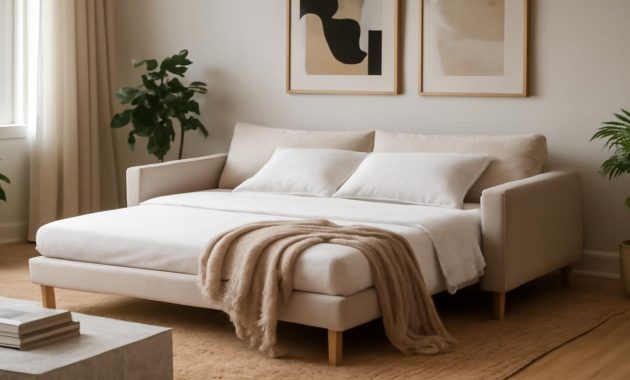
The first time I saw it, I almost walked right past. It sat there quietly in the corner of a small city showroom—no flashy tags, no giant promise of MIRACLE STORAGE or 60% OFF. Just a soft, unfussy silhouette, a linen-blend slipcover that looked like it had exhaled, and a price that made the sales assistant’s voice drop to a conspiratorial whisper. “This is the one design people keep asking about,” she said. “They come in looking for an Ikea sofa bed, then they see this… and, well, they don’t leave the same way.”
The Moment the Sofa Bed Grew Up
For years, the words “sofa bed” have carried a very specific sensory memory for most of us: the screech of a metal frame unfolding at midnight, the faint smell of dust trapped in the mechanism, the thin mattress that somehow manages to be both too soft and too hard. You can almost feel the bar digging into your spine just thinking about it.
And then there’s the other memory: the pilgrimage to the blue-and-yellow warehouse. The friendly maze. The boxes that somehow weigh as much as a small car. The unspoken agreement that if you get through assembling this flat-pack sofa bed together, your relationship might survive anything. These pieces serve a purpose, and they democratized design for a generation—but they also taught us that compromise is the cost of convenience.
Now, there’s a new wave of sleeper sofas quietly rewriting that story. They don’t scream for attention; they don’t need to. They slip into small apartments, studios, guest rooms, and home offices with a confidence that whispers, “I was designed to be lived with, not tolerated.” And at the center of this wave is a particular type of on-trend, budget-friendly sleeper sofa that’s winning over design lovers one movie night at a time.
Why Design Lovers Are Quietly Breaking Up with the Ikea Sofa Bed
Spend ten minutes in a design-forward apartment these days and you’ll notice something: the furniture is pulling double duty without making a spectacle of it. Your friend’s “couch” that turns out to be a full guest bed. Their “storage bench” that hides all the ugly-but-essential life stuff. Their “desk” that folds into the wall when the day is done.
The sleeper sofa trend fits right into this new era of quiet utility. But there’s a growing reluctance to default to the obvious big-box option—especially among people who care about how a room feels as much as how it looks. And that feeling starts with texture, scale, and presence.
This new generation of sleeper sofa doesn’t look like a compromise. It tends to have a low, grounded profile, soft bench seating instead of multiple seat cushions, and a relaxed slipcover or tailored upholstery that reads more “boutique apartment hotel” than “starter furniture.” When you brush your hand along the fabric, there’s a softness and thickness you don’t associate with bargain buys. Yet the price—this is the plot twist—stays in that approachable, sub-luxury tier.
It’s the kind of piece your design-obsessed friend texts you about: a screenshot, a blurry showroom photo, a “how is this this cheap?” followed by “I swear it looks more expensive in person.”
The Slip-In, Not Fold-Out, Revolution
Here’s where things get clever. Instead of the familiar metal fold-out mechanism, many of these sleeper sofas use a slide-and-drop or pull-out platform system. The seat either rolls or glides forward, the backrest tips down, and suddenly you’ve got a mattress-sized sleeping surface with no wrestling match required.
No clanging metal frame, no contortions to tuck in sheets. Just a simple, fluid movement that feels more like adjusting a daybed than wrestling an appliance. From a design standpoint, it’s genius: fewer visible mechanisms mean a cleaner silhouette. From a comfort standpoint, it’s downright revelatory—because the same cushions you sit on become part of the bed, and they’re actually built to support daily use, not just the occasional overnight guest.
Design fans notice this. They notice the consistency of comfort—the way the cushions are engineered to be supportive yet yielding, the way the fabric drapes rather than stretches. And they notice something else too: these new sleepers hold their own as main sofas. You’re not apologizing for them in daylight.
The Budget-Friendly Details That Make It Feel High-End
Price is usually where the fairy tale ends. You fall in love with the perfect piece, then discover it costs as much as a two-week vacation and quietly back away. But the sweet spot of this sleeper sofa trend sits in an unexpectedly kind zone: accessible without feeling disposable.
Design-wise, the trick has been stripping away everything that doesn’t matter and investing in what does. No overbuilt arms with gratuitous padding. No fussy tufting that dates quickly. No shiny chrome legs that shout “look how modern I am!” Instead, these sofas embrace a warm, under-the-radar minimalism that feels current but not trendy to the point of expiry.
You’re more likely to find:
- Soft, rounded edges rather than harsh angles
- Neutral, textured fabrics—think oat, mushroom, stone, and soft charcoal
- Removable covers (so you can actually live on the thing)
- Mattress-level sleeping space without a separate, lumpy mattress
On paper, it sounds… boring. In reality, it’s the kind of visual quiet that makes a room feel instantly calmer. The sofa doesn’t compete with your art or your rug or your plants. It lets everything else breathe.
A Sofa That Understands Small-Space Life
If you’ve ever shared a 400-square-foot apartment with another adult, a bike, and an overly enthusiastic plant collection, you understand: every piece of furniture has to justify itself. It can’t just be pretty. It has to earn the floor space it occupies.
This is where a thoughtfully designed sleeper sofa shines. It’s not just a place to watch shows and drop your bag. It’s your guest room, your reading nook, your Saturday nap destination, your home office crash site when deadlines stretch past midnight. On the best versions of these newer designs, the bed opens without requiring you to drag the sofa away from the wall. You don’t need to rearrange your entire living room every time someone stays over.
The sleeping surface is wider than a typical single but more compact than a full behemoth guest bed. For city dwellers, that’s the sweet spot: enough comfort for a real night’s sleep, but not so huge it dominates the room even when it’s folded up.
| Feature | Typical Ikea Sofa Bed | On-Trend Budget Sleeper Sofa |
|---|---|---|
| Mechanism | Fold-out metal frame | Slide-and-drop or pull-out platform |
| Look & Silhouette | Boxy, utilitarian | Soft, low-profile, tailored |
| Comfort (Sofa Mode) | Adequate for casual sitting | Designed for daily lounging |
| Comfort (Bed Mode) | Separate thin mattress on frame | Unified cushion platform, no hard bars |
| Visual Impact | Feels visibly like a sofa bed | Reads as a regular designer sofa |
The Textures and Tones Everyone’s Obsessed With
Run your fingertips across the arm of one of these new sleeper sofas and you notice the difference immediately. There’s a subtle slub in the fabric, a depth to the weave, a hint of warmth that doesn’t feel synthetic. Even when the upholstery is technically a blend, it’s leaning more toward the tactile feel of natural linen or cotton rather than that shiny, flat polyester sheen your eye can spot from across the room.
Color-wise, the palette has shifted away from the stark whites and bold primaries that once dominated budget furniture. Instead, think sun-bleached neutrals—oatmeal, barley, lichen, fog. These aren’t the sad beiges of rental carpeting; they’re the quiet tones of coastal stones and unbleached canvas. They forgive daily life: crumbs, pets, late-night red wine debates. And when you throw a rumpled blanket or a textured cushion against them, the whole thing looks casually styled instead of over-curated.
Design lovers are drawn to this because it creates an easy backdrop for experimentation. You can layer a vintage kilim rug underneath, hang a thrifted gallery wall above, or frame the sofa with jungle-level houseplants—and it all works. The piece doesn’t boss the room around; it collaborates with it.
The Way It Sounds (And Doesn’t)
You don’t realize how loud old-school sofa beds are until you spend a night on a quiet one. The absence of squeaks and rattles is a luxury in itself. There’s just the soft hushed thump as the seat glides forward, the whisper of fabric, the weight settling into place. No sharp metal edges waiting to clash aggressively with your shins in the dark.
This soundscape (or lack of it) matters more than we admit. In small apartments, every noise is amplified: the clack of a neighboring keyboard, the slam of a cupboard, the metallic shriek of furniture being forced to transform after midnight. A calmer mechanism turns an overnight setup from a production into a simple, almost serene ritual.
How It Feels to Actually Live With One
Picture a rainy Friday night. The city is wet and humming outside your window; streetlights smear softly against the glass. Your living room is small but warm: a lamp pools light over the corner, a candle flickers on the coffee table, the last of dinner’s garlic-and-lemon scent still lingers faintly in the air.
You pull off the sofa’s throw pillows with one lazy sweep, slide the seat forward, let the back ease down. There’s no choreography. No heavy lifting. Just the satisfying expansion of space where there was none. Two pillows, a fitted sheet, a duvet tossed casually over the top—and suddenly your one-room apartment has a guest suite.
The next morning, you drink coffee cross-legged on the now-bed, laptop balanced on a tray, wondering why we ever tolerated furniture that only did one job. The sofa is a bed, is a workspace, is a patch of soft ground in a city of hard surfaces.
This is what’s winning people over: not just the clever design on paper, but the small, lived-in rituals it makes easier. The Sunday afternoon naps that don’t require moving to a bedroom. The friend who texts at 10 p.m. in a panic because their train was cancelled, and you can genuinely say, “Just stay here, it’s no trouble.” The ability to host family without turning your space into a tangle of inflatable mattresses and blankets on the floor.
The Emotional Geometry of a Room
A sofa is usually the anchor of a living space—the spot rooms are quietly drawn around. With this new wave of sleeper sofas, that anchor is just… softer. Less visually heavy. Its low back doesn’t block light or sight lines. Its narrow, rounded arms stop the room from feeling constrained. Its proportions make it easy to float in the middle of a space, not just cram against a wall.
The effect is subtle but powerful. A small living room feels more like a studio in a pared-back design hotel. A home office morphs into a reading nook by day, a guest nest by night. Even in larger homes, it redefines the “spare room” from a dusty afterthought into a space that can be used daily, not just on holidays.
For design fans, this emotional geometry—the way a piece changes how you move and breathe in a room—is as important as the piece itself. They’re not just chasing trends; they’re chasing spaces that feel gentler, calmer, more flexible. And that’s exactly the niche this type of sleeper sofa fills.
Choosing Your Own On-Trend, Budget Sleeper Sofa
So how do you spot one of these design-forward sleepers in the wild, especially if you’re trying to stay on a reasonable budget and not fall for the nearest high-ticket, influencer-approved piece?
Start with the bones. Look for a silhouette that would still make sense if it never, ever transformed into a bed. If it doesn’t look like a sofa you’d happily have as your main seating, keep walking. Good proportions don’t lie.
Then, test the movement. Slide, pull, drop—whatever the mechanism, it should feel intuitive and smooth. You shouldn’t have to brace a foot against the wall or summon your most determined gym face to make it transform. Try it yourself, not just watch a salesperson do it.
Next: fabric. You want something with visual depth—a subtle weave, a tiny fleck, a soft matte finish. Run your hand across it. Does it feel plasticky, like it would cling to bare skin in the summer? Or does it feel like something you could comfortably nap against without a barrier of throws and pillows?
Finally, consider real life. Do the cushion covers zip off? Can you flip them over? Is the sleeping surface wide enough that you wouldn’t feel guilty asking a friend to spend two or three nights on it? These questions matter more than whether the product description uses the word “Scandi” enough times.
The Quiet Luxury of Getting It Right
There’s a particular kind of satisfaction in finding a piece of furniture that checks all the boxes without emptying your bank account. It’s not the loud, adrenaline-fueled thrill of a flash sale; it’s quieter. It’s knowing that every time you walk into your living room, the main character of the space isn’t just “good enough for now.” It’s right—for your body, your budget, your square footage, your eye.
In a world where furniture is increasingly content as much as object (pretty pictures, fleeting trends, viral moments), this new sleeper sofa movement feels refreshingly grounded. It’s about how something works at midnight on a Tuesday, not just how it looks on your Instagram grid at golden hour.
And that’s why more and more design lovers are quietly stepping away from the default Ikea sofa bed and leaning into this subtly smarter, softer alternative. Not because they’ve suddenly become luxury shoppers, but because they’ve realized that the real flex isn’t spending more—it’s choosing better.
FAQ
Is a budget sleeper sofa actually comfortable enough for nightly use?
Some of the newer slide-and-drop sleeper sofas are comfortable enough for nightly use, especially in studio apartments. The key is that the same high-density cushions are used for both sitting and sleeping, so you’re not dealing with a flimsy, separate mattress over a metal frame. That said, if you plan to sleep on it every night, look for models with firmer support and test them in person if possible.
Will a sleeper sofa overwhelm a small living room?
Not if you choose the right proportions. Look for a low back, narrower arms, and a length that suits your wall or intended position. Many of the newer on-trend designs are intentionally scaled for apartments and studios, so they feel visually lighter than traditional, bulky sofa beds.
Are these sofas hard to convert from couch to bed?
The modern mechanisms are typically very simple. Most slide forward and drop down in one or two fluid motions. You shouldn’t need to move the entire sofa away from the wall or remove heavy cushions. If it feels like a struggle in the store, it will feel even more frustrating at home—choose one that feels smooth and intuitive.
Can I find a stylish sleeper sofa on a tight budget?
Yes. The current trend has pushed brands to create more design-conscious sleepers at reasonable prices. Focus on clean lines, neutral fabrics, and simple mechanisms. Often the most understated models look the most expensive once they’re in your space.
What fabric is best for a sleeper sofa in a high-traffic home?
Look for durable, tightly woven fabrics with some stain resistance and a soft, matte finish. Linen-blend, performance polyester blends, and heavy cottons can all work well. Removable, washable covers are a big plus if you have pets, kids, or a lot of guests.
How big should the sleeping surface be for guests?
For occasional guests, anything around a small double or generous single can work, but if you have the space, aim for a width that comfortably sleeps one adult without feeling cramped. If couples will be staying regularly, look for a surface closer to a standard double.
Will a sleeper sofa go out of style quickly?
A simple, low-profile sleeper with neutral upholstery is unlikely to date quickly. Trends fade fastest in bold colors, extreme shapes, and heavy embellishment. Choose a calm silhouette and a soft, adaptable color, and you’ll extend the life of your piece far beyond a single trend cycle.