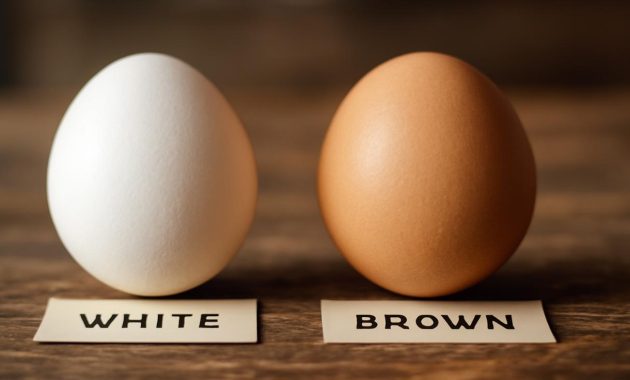
The first time I really looked at an egg, I was sixty years old and standing in the fluorescent hush of a supermarket. I’d bought thousands of them in my life, tossed them into carts on autopilot, cracked them against skillets in sleepy kitchens, watched their whites turn opaque and their yolks soften into sunrise. But I had never—honestly, never—stopped to wonder why some were white, some were brown, and why people spoke about them as if one kind was somehow nobler, richer, or more “real” than the other.
That afternoon, in the chilly aisle between the yogurt and the butter, I watched a young couple arguing quietly in front of the egg case. She wanted the brown carton—“They’re healthier, obviously”—and he reached for the white—“They’re the same thing, don’t waste the money.” They looked young enough to be my grandchildren, and they were having the exact same argument I’d had with my husband forty years earlier, long before words like “organic” and “free‑range” had started shouting at us from cardboard cartons.
I didn’t interrupt them. Instead, I reached for a carton of each—white and brown—and carried them home, feeling unexpectedly curious, even a little sheepish. Sixty years old, and only now wondering: what is the difference, really?
The Day I Realized I Didn’t Know
In my kitchen, afternoon light spilled over the counter, catching the bowls stacked by the sink and the chipped blue mug that knows my hand too well. I set the two cartons down like two small, serious questions. The brown eggs looked almost smug, their shells a warm coffee color, speckled and rustic, as if they’d grown up on a windswept hillside surrounded by wildflowers and well‑read chickens. The white eggs, in their pale uniformity, reminded me of hotel breakfasts and childhood, of my mother whisking them into cakes in our old yellow mixing bowl.
I picked one up from each carton, the way you might hold two pebbles from different beaches. The brown shell felt slightly rougher against my fingers. The white egg was smoother, colder somehow, though I knew that was my imagination. I realized I’d given these colors personalities all my life without a shred of evidence. White eggs were “factory”; brown eggs were “farm.” That was the whole story I’d been carrying around in my head.
What unsettled me wasn’t that I didn’t know the truth. It was that I’d never even thought to ask.
The Chicken Behind the Shell
I decided that sixty was as good an age as any to start asking stupid questions and refusing to feel stupid about them. So I called the nearest person I could think of who might have an opinion: my neighbor, Tom, who keeps chickens behind his lopsided barn and walks around with the peaceful air of a man who knows exactly what time the sun rises, every day of the year.
Tom laughed when I told him what I was wondering. “Come over,” he said. “The girls will explain it better than I can.”
A few minutes later, I was following him through dew‑damp grass, the smell of earth and straw growing stronger as we neared the coop. His hens bustled around us, feathered commas scribbled across the yard—some snowy white, some chestnut, some almost black with a greenish sheen. Their feet scratched at the ground in a patient, purposeful rhythm. The air smelled of hay, faint manure, and that warm, living scent of feathers and sunlight.
“See that one?” Tom pointed to a plump, russet hen with a small red comb and kind eyes. “She lays brown eggs. And that Leghorn over there—the white one with the big floppy comb? She lays white eggs.”
He stooped, reached gently into one of the nesting boxes, and placed a fresh, still‑warm brown egg in my palm. Then he reached into another, and handed me a white one. The difference was as plain as the feathers on their backs.
“It’s mostly the breed,” he said. “Not the lifestyle. Not the morals. Not their politics.” His eyes crinkled. “Just the genetics. White‑feathered hens with white earlobes tend to lay white eggs. Brown‑feathered hens with red earlobes tend to lay brown eggs. That’s it.”
I turned the eggs over in my hand, suddenly a little annoyed at every supermarket label that had ever tried to sell me a story through color alone.
The Myth of the “Better” Egg
Back in my kitchen later that day, I lined up four eggs on the counter: two brown, two white. They sat there like four tiny moons at different phases of my ignorance. I decided to do a simple experiment. I cracked one brown egg into a bowl, then one white. The shells broke with almost identical pressure, leaving similar jagged circles behind. Inside, the yolks sat round and golden, the whites clear and jellylike. If someone had switched the bowls while my back was turned, I would never have known which was which.
I sniffed them cautiously, as if one might reveal some secret through scent. Both smelled faintly of, well, egg. I scrambled them together with a little butter and salt and tasted the result, chewing slowly with a focus that would have made my younger self laugh.
They tasted exactly the same. And they were exactly the same thing: a shell of calcium carbonate, a white of mostly water and protein, and a yolk carrying fats, vitamins, and the beginnings of a possible chick that would never be born.
I sat at the table, fork in hand, and did something I’d never done before: I looked up the science instead of trusting the rumor. It turns out the color of an eggshell has no meaningful impact on its basic nutrition. A brown egg is not automatically richer in protein or vitamins than a white egg. What does matter is what the hen eats, how old she is, and how she lives. A free‑ranging hen who forages for bugs and greens may produce eggs with darker yolks and a slightly different nutrient profile—but those eggs can be either brown or white.
All those years, I’d been asking the wrong question. It was never, “White or brown?” It should have been, “How was this hen treated? What was she fed? How fresh is this egg?”
Why We Believe Color Tells the Whole Story
Once you tug on one loose thread of your own certainty, others appear. I started noticing how often I made snap judgments based on color alone. Brown bread is “healthier.” Dark chocolate is “more sophisticated.” Green packaging must mean “eco‑friendly.” And brown eggs? Obviously, they must be “more natural.”
Except “natural” is a tricky, slippery word. Often it’s a feeling more than a fact, a mood more than a measurement. Brown eggs conjure the image of a small farm, a wire basket in a sunlit kitchen, a few contented hens clucking under an apple tree. White eggs drag along the ghost of factory farms and metal cages, even if the chicken who laid that white egg spent her whole life wandering a grassy field.
I realized that my mental image of eggs—the stories I attached to their colors—had been taught to me quietly, through grocery store shelves, magazine photos, and restaurant menus that charged extra for “farm‑fresh brown eggs.” The color of the shell had become a kind of shorthand for an entire moral universe.
It felt strangely liberating, at sixty, to discover that the shorthand was wrong—or at least deeply incomplete.
What Really Changes From Egg to Egg
When you start paying close attention, the world cracks open like an eggshell. Suddenly, there are details everywhere: subtle differences in yolk color, the firmness of whites, how easily the shell chips, how an egg behaves when it hits a hot skillet.
I began, somewhat obsessively, to notice these little variations. The eggs I bought from Tom’s hens, whether brown or white, had yolks the color of late summer marigolds. They rose high and round in the pan, the whites clinging close instead of spilling across the skillet like a thin blanket. The store‑bought eggs, even the pricey brown ones from cartons adorned with pictures of red barns and dignified chickens, often had paler yolks and looser whites. The difference wasn’t moral; it was practical. Tom’s eggs were fresher, the hens better fed and less stressed.
To make sense of it all, I ended up making myself a little comparison chart that I stuck to the fridge. If my sixty‑year‑old self could talk to my thirty‑year‑old self, I’d show her that chart and say, “Stop paying for color. Pay for care.”
| Feature | White Eggs | Brown Eggs |
|---|---|---|
| Shell color source | Genetics (usually white‑feathered hens) | Genetics (usually brown/red‑feathered hens) |
| Basic nutrition | Essentially the same | Essentially the same |
| Taste | Depends on hen’s diet and freshness | Depends on hen’s diet and freshness |
| Price | Often cheaper in stores | Often pricier (perceived as “premium”) |
| Shell thickness | Varies by hen’s age/diet, not color | Varies by hen’s age/diet, not color |
Every time I glanced at that table, it reminded me that the real story of an egg doesn’t live on the outside. It’s written in the invisible life of the hen: what she pecks at, whether she sees the sky, how crowded her coop is, whether anyone ever pauses, as I did, to say, “Who are you, really?”
Learning to Ask Different Questions
I wish I could say I had some grand revelation that day in the supermarket, that learning the truth about eggshell color somehow made me wiser overnight. It didn’t. What it did do was open a small door in my thinking—a drafty little doorway where other questions started to slip in.
What else had I accepted uncritically because the packaging was convincing? What other ideas had I carried around for decades, unexamined, like that old mixing bowl inherited from my mother—useful, comforting, but never really inspected for cracks?
Once you start tugging on those threads, life becomes oddly more vivid. You look at a loaf of bread and wonder not just “white or whole wheat?” but “Who grew this grain? How was the soil treated?” You look at a label that says “all‑natural” and wonder what, exactly, that means. You stand in a field, the wind brushing cool fingers across your cheeks, and you hear the distant cluck of hens and think: none of them care what color their eggs are.
What I Tell People Now
These days, when friends come over and we make long, lazy breakfasts—eggs sizzling in cast‑iron, coffee blooming in the French press, toast popping up right as the yolks turn glossy—I find myself telling this story more often than I expect. Someone will reach into my fridge and notice both brown and white eggs inside, side by side, like neighbors who’ve finally learned how to share a fence.
“Mixed allegiance, huh?” a friend joked once, holding up one of each.
“Mixed education,” I said, and told her about that afternoon at sixty when I realized I’d been wrong, or at least incomplete, for a very long time.
Now, when people ask me which eggs to buy, I don’t say, “brown” or “white.” I say:
- Buy the freshest eggs you can.
- Support farmers, if you can, who let their hens roam and root and behave like the curious, busy creatures they are.
- Look for clear, honest labeling about how the hens are raised, and ask questions if you have the chance.
- And don’t assume that a brown shell is a halo or that a white shell is a sin.
Color, I’ve learned, is a poor substitute for curiosity.
The Quiet Gift of Late‑Life Curiosity
There is something deeply humbling about discovering, in your sixties, that you’ve been carrying a tiny misunderstanding around for decades. At first, I felt a little foolish. How could I have lived this long and not known something so basic? How many omelets had I eaten without ever wondering about the hens behind them?
But slowly, that embarrassment softened into something else: gratitude. Because if I can still be surprised by an egg at sixty—if I can still walk into a supermarket and come out with more questions than groceries—then some essential, tender part of me is still awake.
I think of my grandmother, who used to say that you can tell a lot about a person by the way they crack an egg. Are they gentle or forceful? Confident or hesitant? Distracted or present? At the time, I thought she was talking about cooking. Now I suspect she was talking about living.
To really see an egg—to understand that what looks simple and ordinary is actually a layered story of genetics, diet, care, marketing, and myth—is to practice a kind of everyday attention that our rushed lives often forget to make time for. It’s the kind of attention that notices the weight of a shell in the palm, the faint powdery bloom on its surface, the way light gathers on its curve.
I learned at sixty that brown eggs and white eggs are, at heart, the same. But tucked inside that fact was a gentler lesson: that it’s never too late to become a better observer of your own life.
If I could place a single egg in your hand today—any egg, from any hen—I’d invite you to hold it there a moment before you crack it open. Feel the coolness of the shell, the delicacy of its architecture. Think about the hen who laid it, the invisible threads tying your breakfast to a patch of earth somewhere. Remember that color is only the beginning of the story, never the end.
And then I’d say what I wish someone had told me sooner: keep asking questions, especially about the things you think you already know. Sometimes the smallest questions—like why one egg is brown and another is white—are the ones that crack your world open in the most quietly beautiful ways.
FAQ
Are brown eggs healthier than white eggs?
No. Brown and white eggs are nutritionally very similar. The hen’s diet, health, and living conditions affect nutrition far more than shell color does.
Why are brown eggs usually more expensive?
Brown‑egg‑laying breeds are often slightly larger and may eat more feed, and brown eggs have been marketed as a premium, “farm‑style” option. Those factors can raise the price, even though the egg itself isn’t inherently better.
Do brown eggs taste better than white eggs?
Taste differences usually come from freshness and what the hen is fed, not the shell color. A fresh white egg from a well‑fed, outdoor hen can taste richer than an older brown egg from a stressed, confined hen.
Is the shell of a brown egg thicker than a white egg?
Shell thickness is influenced mostly by the hen’s age, breed, and mineral intake, not shell color. Both brown and white eggs can have thick or thin shells.
What should I look for when buying eggs, if not color?
Look for signs of freshness (check dates), and if possible, information about how the hens were raised and what they were fed. Buying from local farmers or producers you trust can tell you far more than choosing between brown and white shells.