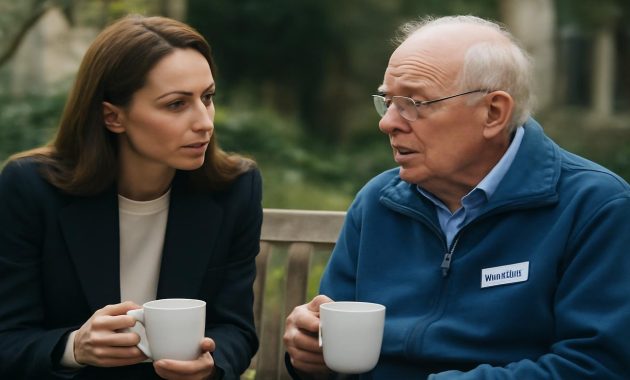
The room was warm with late-afternoon light, the kind that softens edges and quiets conversations. Chairs were drawn into a loose circle, volunteers sat shoulder to shoulder, fingers wrapped around paper cups of tea that had long since cooled. At the center of it all, not on a gilded throne or behind a lectern, but on a simple upholstered chair, sat the Princess of Wales. No sash, no fanfare, just a woman in a light sweater and a careful smile, about to talk about something that has shaped her days in ways few public glimpses ever show: chemotherapy.
A Circle of Chairs and a Shared Silence
The volunteers had arrived carrying stories of their own: hours spent in hospital corridors, long drives to appointments, late-night messages in support groups that pinged through the dark. Some supported loved ones through cancer; others had worn the wristbands and hospital tags themselves. They came to speak about care, about kindness, about what it means to stand beside someone when their body is both battleground and home.
When she spoke, the Princess did not raise her voice. Instead, she let the silence do its work. The air felt almost fragile as she began to describe sitting in waiting rooms that smelled sharply of antiseptic and over-brewed coffee, watching seconds drag along the digital clocks on the wall. She spoke of the strangeness of waking up one morning and realizing the world had neatly split into two times: “before treatment” and “everything after.”
There was nothing rehearsed in that moment, nothing of the practiced public address. She paused often, searching for the right words, as if she wanted to be certain that what she said did justice to the hundreds of thousands of people living this story quietly across the country. In her hands, she turned a tissue over and over, the way one does when there’s nothing left to straighten or adjust, just the need to keep a small rhythm going.
“Some days,” she confessed softly, “you wake up and almost forget. You open the curtains, see the familiar sky, hear the kettle, the children’s footsteps, and for a breath or two you think, ‘Maybe it was all a bad dream.’ And then the phone reminds you, or the mirror does, or you feel that wave of tiredness sweep in before breakfast, and you remember. It’s real. It’s still here.”
When Royal Schedules Meet Hospital Timetables
Royal life, as most people imagine it, moves on a clock of ceremonies and engagements, polished speeches and carefully planned appearances. Chemotherapy, on the other hand, runs on a different, unyielding calendar: blood results, infusion dates, side effects that don’t care about diaries or state occasions. In that quiet room with volunteers, the collision of those two worlds came into focus.
She described the logistics with a wry, almost incredulous smile—how the royal diary, so meticulously plotted months in advance, had begun to “bend around the treatment chair.” Engagements shifted, postponed, or reimagined entirely. Some days, the choice wasn’t between two events, but between answering emails and simply washing her hair without needing to rest afterward.
“There’s a strange guilt in it,” she admitted, and a few people nodded. “You know you are doing exactly what you must do—focusing on treatment, on family, on resting. Yet you also know that people are waiting, plans are changing, things are being rearranged because of you. And you have to keep telling yourself, again and again, that it’s all right to let life shrink for a while.”
That word—shrink—hung in the air. Responsibilities narrowed to their truest core: staying alive, being present for her children, learning to listen to a body that had, for years, been trained to endure long days and endless handshakes without complaint. Now that same body spoke up often and loudly: sit down; close your eyes; not today.
In her voice, there was no complaint, only recognition. The volunteers, many of whom had guided families through this exact recalibration, understood instantly. One described how their carefully managed work schedule had collapsed into something far smaller when their partner began treatment. Another spoke about the invisible labour of rearranging ordinary life around appointment times and uncertain energy levels, the way even Sundays began to orbit hospital days.
What Chemotherapy Really Feels Like
As the conversation deepened, she leaned forward slightly, eyes bright, as though letting the group in on a secret she had grown weary of carrying alone. Chemotherapy, she explained, is not a single feeling, not one neat adjective that slots into a press release. It is a shifting landscape of sensations, some familiar, some shockingly strange, all layered one over the other.
She talked about fatigue not as a simple tiredness, but as a “weight of wet wool” that settles over the limbs. “It’s like walking through water,” she said. “You can see what you need to do, you can even want to do it, but every step feels heavier than it used to.” The room was utterly still. More than one volunteer pressed their lips together, eyes glistening in recognition.
Then there were the quieter side effects. Foods she’d loved for years suddenly tasting metallic. The way familiar scents in her own home—flowers, cologne, even her children’s crayons—sometimes tilted sideways into nausea. “You begin to suspect that your senses are conspiring against you,” she added, half amused, half bewildered.
In the middle of this, she revealed, there are good days. Brilliant, unexpected, ordinary days. Mornings when the sunlight through the window does not spark dread but a small flutter of hope; afternoons when she can read a story on the floor and stand up again without needing a moment to steady herself. Those days are treasured and guarded fiercely, planned around with a strategist’s care.
To capture something of these ups and downs, she and the volunteers began to talk about what the weeks actually look like, beyond the headlines and hospital corridors. On a notepad, someone sketched a simple table, and, with a small laugh, the Princess helped describe the pattern that has become familiar in so many households.
| Phase | Typical Feelings | What Often Helps |
|---|---|---|
| Day of Treatment | Anxiety, hospital smells, cautious optimism, overwhelming tiredness by evening. | Company during infusion, soft clothes, a comforting playlist, small familiar snacks. |
| First Few Days After | Nausea, foggy thinking, strange tastes, emotional swings. | Quiet rooms, short walks, simple meals, no pressure to “be normal.” |
| Mid-Cycle | Glimmers of energy, cautious hope, fear of “overdoing it.” | Gentle activity, seeing a friend, creative hobbies, laughter in small doses. |
| Days Before Next Round | Anticipation, unsettled sleep, quiet dread mixed with determination. | Planning treats, honest conversations, writing questions for the medical team. |
It was not a medical chart so much as a map of the inner weather—a guide to the tides of feeling that lift and drop, lift and drop, week after week. As she traced the stages with her finger, she gave a small, rueful smile: “You almost become a student of your own good days.”
The Thin Line Between Strength and Vulnerability
Once the practicalities were laid out, something even more fragile rose to the surface: the delicate equilibrium between being strong and being honest about fear. For a public figure, whose image is stitched daily into millions of lives, this balance is a tightrope.
“People are kind,” she said carefully. “They say you are brave, that you are strong. And you are grateful. But some evenings you lie awake and think, ‘If they could hear my thoughts at three in the morning, would they still say that?’”
A volunteer smiled gently and replied that bravery never meant the absence of fear; it meant moving through it anyway, step by trembling step. The Princess listened, then nodded, her shoulders quieting as if in relief. It was, she admitted, easier to reassure others than to comfort herself. She could explain to her children, in age-appropriate words, that Mummy was having medicine to make her better. She could promise that doctors were doing everything they could. But at night, when the house softened into sleep, she faced the unadorned questions alone.
“There are moments when you grieve for a version of yourself that didn’t know any of this,” she confessed. “The version that woke up thinking about school runs and engagements and what to cook for supper, not scan results.”
It is from that place, she told the group, that kindness feels less like a nicety and more like oxygen. The text message at the right time. The friend who quietly leaves a meal on the doorstep. The stranger who writes not with advice, but with a simple, steadying line: “We are thinking of you.” In those moments, the border between royal and ordinary dissolves. She is one woman among many, held in a net of small, steadfast gestures.
The Quiet Work of Volunteers
As the conversation turned, the Princess began to ask questions of her own. How did the volunteers carry the weight of so many stories? How did they sit beside someone whose energy was draining away and still offer more of their own? Their answers sketched a different side of the cancer journey, one rarely photographed and rarely praised loudly enough.
They talked about learning to be comfortable in silence, about understanding that not every hour needed filling with cheerful chatter. Sometimes the most powerful thing you can say is nothing at all—just be there, a steady presence when everything else feels unstable. They described the art of making tea that no one may drink, of holding hands lightly so that the person can let go if they need to. They spoke of sitting with families in windowless waiting rooms when time seemed to knot and tangle.
One volunteer, softly spoken and attentive, said that you begin to measure your days not in hours, but in “little mercies”: a slight improvement in blood counts, a good night’s sleep, a day without pain. These were the things that kept them returning, after grief, after exhaustion, once more into the hospital’s revolving doors.
The Princess listened intently, her expression open and unguarded. It was clear that in their presence she found something beyond sympathy—she found peers who understood the language of oncology wards and whispered fears without translation. They, in turn, saw not a distant figure, but a woman who had joined them, however reluctantly, in this demanding fraternity of carers and patients and survivors.
Nature, Stillness, and the Long Road Back
In a moment that felt almost like a confession whispered to a friend over a garden fence, she admitted that the outdoors had become not just a preference, but a necessity. On the better days between treatments, she sought out quiet corners of gardens and parks, places where the wind could do its old, honest work of clearing the mind.
“There is something comforting about trees,” she said thoughtfully. “They mark time differently. While your days are being divided into cycles and treatments, they are just doing what they have always done—shedding leaves, growing buds, standing through storms.”
She described wrapping herself in a coat and stepping outside, even when she felt scarcely strong enough to reach the end of the path. The simple feel of cold air in her lungs, the grit of gravel underfoot, the distant chatter of birds—these small sensory details, she said, tethered her back to a world that sometimes felt as if it was receding behind hospital doors and medical vocabulary.
The volunteers understood this instinctive turning towards nature. Some spoke of gardens created outside chemotherapy units, where patients could sit beneath climbing roses and feel, for a moment, like ordinary visitors. Others mentioned walks along rivers between appointments, watching the water carry leaves downstream, a reminder that life does go on moving, even when your own seems temporarily dammed.
Healing, they agreed, is not only a medical process; it is a relational one: with family, with community, with the living world itself. In those moments outdoors, the Princess of Wales was not being photographed or watched. She was simply one more human learning to inhabit a changed body in a familiar landscape.
A Confession Shared, A Burden Lightened
By the time the tea had cooled completely and the winter light had thinned to a soft grey, the conversation had taken on the easy flow of people who had moved beyond small talk into the marrow of things. Laughter appeared, unexpectedly but naturally—a volunteer recounting a hat that refused to stay in place on a windy hospital car park, or a shared appreciation for the indignities of hospital gowns.
The Princess’s “deeply personal confession,” as the headlines might later phrase it, did not arrive in one grand revelation. Instead, it came in fragments: the nights of insomnia; the afraid-but-smiling conversations with her children; the way her hand still tightened, involuntarily, around the arm of the treatment chair when the drip began. She spoke of the fear that can arrive out of nowhere while brushing her teeth or scrolling through a family photo, a sudden wave of “what if?” that must be met, again and again, with the quieter refrain of “and if so, we will face it.”
Perhaps the most striking admission was not about physical pain, but about identity. “You start to wonder who you are if you are not constantly doing,” she said. “So much of my life has been defined by being visible, being present, being active. Treatment asks you to step back from all of that and accept that for a time, your primary work is to rest and to heal. That is much harder than it sounds.”
Heads nodded around the circle. For carers who had once been full-time employees, for patients who had been the pillars of their families, the redefinition of self during and after chemotherapy was a familiar ache. Yet there was solace in hearing a princess, whose image is so carefully constructed in public, speak plainly of that same disorientation.
In turn, the volunteers offered their own quiet wisdoms: that healing is rarely linear; that strength looks different from one day to the next; that allowing others to help can be its own kind of generosity. These were not sentiments tailored for a palace—they were truths tested in the fluorescent light of countless wards.
Why Her Story Matters Beyond the Palace Walls
When the chairs were finally pushed back and coats shrugged on, there was no fanfare, no grand closing statement. Just the soft scrape of chair legs, the murmured thanks, the gentle touch of hands at shoulders. Yet something had subtly shifted in the room. The Princess of Wales had not arrived to deliver comfort from on high; she had come to sit inside the circle, to say aloud what so many live in silence.
For those beyond those four walls, her openness matters. Not because her pain is more important than anyone else’s, but because visibility changes the conversation. When a figure so often seen in ballrooms and balcony photographs starts talking about metallic-tasting tea, about hospital corridors and 3 a.m. fears, she sends a quiet but powerful message: cancer is not something that happens elsewhere, to other people. It is here, it is among us, and it is survivable only when met with honesty, compassion, and community.
Her confession does not tidy the story into an easy arc of adversity and triumph. She made clear to the volunteers that uncertainty remains, that some questions have no satisfying answers yet. But in giving her experience words, she helps carve out space for others to do the same—at kitchen tables, in support groups, in whispered conversations at bus stops.
As she stepped outside into the fading light that day, wrapped against the chill, the evening air carried the faint smell of rain, the streetlights just beginning to bloom. Somewhere, volunteers would return to their posts, preparing for another day of quiet heroism at hospital bedsides. Somewhere else, families would sit around dinner tables, learning new languages of care and courage.
And one woman—princess, mother, patient—would return home to a life now marked by treatment cycles and hope in equal measure. Her story, shared not behind palace gates but in a simple circle of chairs, had become part of a much larger tapestry: the collective narrative of those who face chemotherapy with trembling hands and determined hearts, each finding their own way through the storm.
Frequently Asked Questions
Why is the Princess of Wales speaking openly about her chemotherapy?
She is choosing to share her experience to reduce stigma around cancer treatment, to acknowledge the reality faced by many families, and to connect more honestly with the public. Her openness encourages others to talk about their own journeys and to seek support.
Does chemotherapy affect everyone in the same way?
No. Chemotherapy side effects vary widely between individuals. Factors such as the specific drugs used, dosage, overall health, and other medical conditions shape each person’s experience. Some may continue many normal activities; others may need significant rest and support.
How can I support someone going through chemotherapy?
Offer practical help—meals, transport, childcare—and emotional presence without pressure. Listen more than you speak, avoid minimizing their experience, and check in regularly with simple, open questions like “What would help today?” rather than assumptions.
Why are volunteers so important in cancer care?
Volunteers provide companionship, practical assistance, and emotional support that complement medical treatment. They often bridge gaps between busy clinical teams and patients’ day-to-day needs, helping reduce isolation and anxiety for patients and families.
Is talking about vulnerability a sign of weakness during treatment?
Not at all. Sharing fears and difficulties can be a vital part of coping. Acknowledging vulnerability often strengthens resilience, deepens relationships, and allows others to offer meaningful help. It is a sign of courage, not weakness.