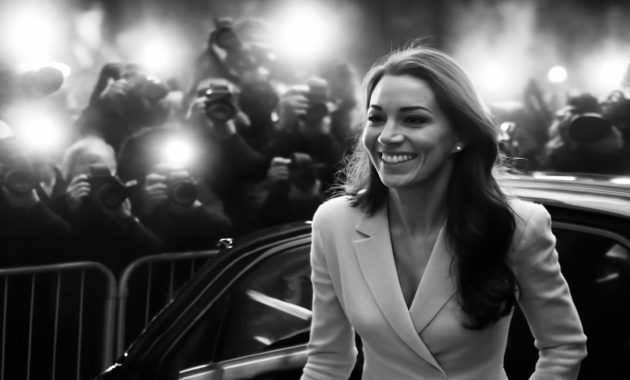
The cameras found her before she even reached the car door. A restless patchwork of lenses and lifted phones, of cheers and sharp intakes of breath, rose like a living tide around the edges of the scene. Kate Middleton, the Princess of Wales, stepped forward into the familiar, blinding choreography of public life—only this time, the stage lights felt harsher, the stakes stranger. Months of illness, secrecy, speculation, and wild rumor now condensed into a single click of a shutter, a single frame: she is back.
The First Glimpse: A Return That Never Felt Entirely Private
It began the way these things always do in the twenty-first century: not with an official statement, or an elegant TV address, but with someone’s hand reaching for their phone. Even before the palace press office could press “send” on its carefully polished words, the world was already halfway there, primed for breaking-news banners. Push notifications flared across screens, news anchors straightened their papers with a ceremonial rustle, and timelines tilted in one direction: Kate has reappeared.
Her return to public life had been trailed by a peculiar silence, a vacuum that nature—and the internet—will never leave unfilled. In those long weeks and months of absence, people projected what they wanted, or feared, or suspected. Some whispered about health. Others dissected photographs like forensic analysts. Conspiracy theorists spun elaborate storylines more gripping than prestige television. Every gap in information became a door through which speculation marched confidently in.
So when she stepped out again—poised, careful, smiling in that practiced yet undeniably human way—it felt less like a simple royal engagement and more like the climax of a serialized global drama. Strangers stared at their phones on trains and in supermarkets, replaying short clips of her waving, walking, speaking. “She looks tired,” one comment would say. “She looks wonderful,” said another. Millions of microscopic judgments layered themselves over the same thirty seconds of footage.
On one level, it was an ordinary moment: a woman returning to work after a serious illness, trying to find her footing. But nothing about Kate’s life has been ordinary for a very long time. Her reappearance became something else entirely: an event shaped as much by the hunger of the outside world as by her own decision to come back.
The Sound of Shutters: Compassion, or Just Curiosity?
The sound hit first—like rain on a tin roof. A rapid, staccato rustle of mechanical clicks, each one pinning down a fraction of a second and filing it away for sale, for sharing, for posterity. Photographers angled for the best view. Camera operators tracked her every step with the smooth, unwavering stare of polished glass. Even people who had no intention of selling anything raised their phones for an image. We know this scene so well that we barely see it anymore, and yet there is something unmistakably charged in the air when it happens.
We tell ourselves we’re watching out of concern. Is she okay? we ask friends, colleagues, strangers in comment sections. After all, she disappeared after a major health announcement. She is a mother of three young children, balancing the private chaos of recovery with the public expectation of composure. On paper, this should make her one of the most empathized-with women in the world.
But empathy is a slippery thing once it passes through screens. Compassion can sound eerily similar to appetite. “We just want to know the truth,” people say, but the truth has become a form of entertainment, pushed and pulled into shapes that must be dramatic enough to cut through the digital noise. A routine medical update rarely competes with an unverified rumor. A measured statement recedes, while a grainy video of a car pulling away from a hospital gate becomes a Rorschach test onto which millions project meaning.
And then there is the simple, unsentimental fact: Kate is content. Not just a princess, not just a patient, but a generator of clicks and conversation. Her face, fragile or radiant, worried or relieved, is traffic. Every moment she appears in public is immediately harvested by systems that reward engagement, not necessarily respect. To watch her walk from car door to building entrance is to witness the delicate seam where sympathy frays into spectacle.
Inside the Bubble: A Life Built for Display, A Body That Isn’t
What does it mean to inhabit a life shaped for display when your body is, in the most vulnerable ways, failing you? The weight of tradition, duty, and monarchy sits on Kate’s shoulders like a finely tailored coat. She married not just a man, but an institution. Her job description is unwritten but deeply understood: be seen, be steady, be reassuring. In a world that often feels unstable, she is expected to be a still point on the horizon.
Yet illness does not read job descriptions. It doesn’t spare you because your image has been carefully curated over a decade and a half. It does not care that your smile holds an entire nation’s projected ideas of resilience and grace. It brings you back to something far more basic: fatigue, fear, the slow rebuilding of strength, the necessary smallness of recovery. The quiet parts—nights of nausea, days when each step is an effort—usually belong to the private sphere.
But for Kate, privacy is a myth with ragged edges. Even her silences become public property. When she says nothing, the void is filled for her. When she finally speaks, her words are dissected, paused, rewound. She is urged to “be honest,” but only within limits that do not make others uncomfortable. She is applauded for vulnerability but must package that vulnerability in a way that photographs well and can be consumed across cultures without context.
Her return to public appearances, then, is not simply a marker of health. It is an act of performance under strange, unrelenting conditions. She must reassure people she has never met that she is coping, while protecting children who did not choose this life from a curiosity that doesn’t sleep. She must re-enter the world of handshakes and speeches and ceremonial gestures while her body is still working out what “normal” even means now.
Some might argue this is the deal she accepted. Public life, public scrutiny. But who decides how far that scrutiny may go? At what point does interest—however heartfelt it may feel—cross an invisible line into intrusion?
The Spectacle, Measured: A World Watching in Real Time
If you want to understand the scale of Kate Middleton’s return, you could go by feeling: the flood of headlines, the endless chat-show segments, the way even people who don’t follow royal news could not entirely escape the story. Or you could look at it another way—as data.
In the days and hours surrounding her first public appearance after her illness, the world’s digital heartbeat accelerated around her name. Searches spiked. Video views soared. Comment counts climbed into the tens and hundreds of thousands. The spectacle is not just a mood; it is measurable.
| Metric | Before Return | Week of Return |
|---|---|---|
| Global search interest (relative) | Moderate | Surged to peak |
| Social media mentions | Steady background buzz | Sudden multi‑platform spike |
| News articles published | Occasional updates | Wall‑to‑wall coverage |
| Video views of appearance clips | Archival interest | Millions within 24 hours |
Each spike charts more than curiosity. It records how thoroughly someone’s life can become a shared experience without their consent. People watched in living rooms and on buses, at desks and in checkout lines. Some felt genuine relief: she looks brighter, more herself. Others rewound, zoomed, and scrutinized: Was her step slower? Was that a wince or just a blink caught at the wrong time?
Media outlets framed their stories with overlapping, sometimes contradictory emotions: celebration, concern, suspicion, admiration. One article praised her courage, another questioned the palace’s transparency, a third openly rewove the rumor threads that had kept speculation alive in the months before. The spectacle had no single narrator; it was a chorus, occasionally harmonious, often discordant.
Lost in this noise is a more unsettling question: Do we actually want boundaries when it comes to public figures we care about, or have we become so used to constant access that any barrier feels like a challenge?
Who Owns the Story of an Illness?
Illness is one of the few experiences that can level us, reminding us that beneath status and role and reputation, we are—at the end of the day—bodies. Fragile, imperfect, mortal. For most people, the story of their illness is theirs to shape, or not share at all. They decide how much to tell colleagues, friends, even family. They choose which details live in the quiet interior of the self and which are spoken aloud.
Kate’s story, however, has never fully belonged to her. From the moment whispers about her health first began, her body became a topic. Strangers debated diagnoses as though mapping a fictional character’s arc. “We’re just worried,” they insisted, but worry on this scale looks very much like ownership. The public begins to feel it is entitled to the full picture, not just the outline.
When she finally spoke about her diagnosis, there was a moment—a brief one—when it seemed the world might collectively lean in and simply listen. There was a deep breath, a softening. People shared their own stories of cancer, of loved ones in treatment, of private battles pulled into the light. For a heartbeat, the global conversation felt tender.
And then, almost inevitably, the machinery whirred back to life. Analysts examined her word choice. Commentators asked why this information came now and not earlier. Outlets weighed sincerity against strategy. The line between human vulnerability and public relations became another point of debate. Even her decision to speak was transformed into content.
So who owns the story of Kate’s illness? Legally, morally, the answer should be simple: she does. Yet culturally, it has already been taken apart and reassembled into something consumable, something we can scroll past or click on, something whose emotional power can be monetized and measured. That dissonance lies at the core of the spectacle.
The View from the Crowd: Our Role in the Intrusion
It’s convenient to blame “the media”—a useful, blurry villain that can absorb all of our discomfort. The tabloids that camp outside hospital entrances. The TV crews that build coverage packages out of three seconds of new footage. The pundits who discuss her as though she were not a person but an ongoing plot twist in a very long-running show.
But the media, for all its machinery and flaws, is responding to something as old as gossip around a village well: our appetite. The quiet moment when we hover over a video and decide whether to watch. The impulse to read just one more article, just to “understand what’s really going on.” The conversation we start at lunch, wondering aloud what the palace is hiding. We are not passive in this story.
Every click is a vote. Every view tells editors, producers, algorithms: more of this. Coverage expands to fill whatever space we create for it. If Kate’s first public appearance after illness becomes a global event, it is because millions of us kept looking, kept sharing, kept talking. We saw the line between compassion and intrusion and, often without fully realizing it, stepped over it.
There is a softer, more complicated truth here: many people genuinely care. They see her not just as a royal but as a young mother confronting something frightening while the whole world watches. They remember their own waiting rooms, their own scans, their own long, dim hospital corridors. They want, sincerely, for her to be okay.
Yet caring, when filtered through the economics of attention, can start to look indistinguishable from voyeurism. We might not camp outside her home with a camera, but we will consume the images produced by those who do. We might never shout a question at her across a car park, but we’ll eagerly watch the footage when someone else does.
Could We Choose to Look Away?
Imagine, for a moment, a different version of this story. One where her return to public life is gentle, almost quiet. A brief statement, a handful of respectful photographs, a collective decision not to turn her face into a 48-hour news cycle. A world where algorithms notice that people are not, in fact, feverishly clicking, and decide there is no profit in overexposure.
Such a world feels almost unthinkable now. We live in a state of constant observation, where everything from a celebrity’s hospital stay to a stranger’s meltdown in a supermarket can be recorded, shared, and judged in a matter of minutes. The private and public do not sit on opposite sides of a fence anymore; they seep into one another through every app on our phones.
Still, the question lingers: Could we choose to look away—or at least to look differently?
Looking differently might mean pausing before we share that clip. Asking ourselves whether this moment feels offered or stolen. Listening more closely to what the person in the center of the storm is actually saying, instead of just mining their words for hidden messages. Accepting that we might not be entitled to the full, unvarnished story, no matter how deeply we feel for them.
The Human Being at the Center of the Frame
Strip away the titles, the centuries of royal tradition, the debates about monarchy and modernity, and one thing remains: in every frame, there is simply a woman who has been ill, standing in front of people who expect something from her. Stability. Grace. A sign that things will be all right.
You can see it, if you look closely enough and forget, for a moment, the noise that surrounds her. The way her shoulders rise and fall more slowly as she exhales. The fleeting glances she casts sideways—to William, to staff, to whoever is just out of shot. The small calculations behind each step: Am I walking too fast? Do I look strong enough? Am I holding together?
There is, too, the work she is trying to do—the cause she is there to highlight, the people she is there to meet. In the best moments, you can sense her intent reaching beyond the cameras, beyond her own story. She smiles at a child, listens to a parent, shakes the hand of someone who has also walked the long road through sickness. For a moment, the roles shift: she is no longer the subject, but a bridge between other, quieter stories and the world’s attention.
Yet even these interactions are not entirely safe from the pull of spectacle. They are filmed, clipped, and repackaged. They become part of the same circulating loop: her illness, her return, her appearance, her meaning. Her life, condensed into fragments for the rest of us to interpret.
It would be easy to say that this is simply the cost of royalty in the digital age. But that lets us off the hook too quickly. Because the deeper truth is that the line between compassion and intrusion is not drawn by palaces or press offices. It is drawn—over and over again—by us. By where we place our attention. By what we choose to demand, and what we are willing to leave alone.
Kate Middleton’s return to public life did not have to be a global spectacle. It became one because we made it so together: the producers who built segments around her, the editors who ran breathless headlines, the influencers who offered speculative commentary, and the millions who stopped scrolling long enough to watch.
Somewhere in the middle of all this, a woman who has been unwell is simply trying to get through the day.
FAQs
Why has Kate Middleton’s return attracted so much global attention?
Her return combines several powerful forces: the enduring fascination with royalty, the emotional weight of a serious illness, and an online culture that turns any gap in information into a story. Together, these elements make her reappearance feel like the next episode in a global drama many people have been following for years.
Is public interest in her health entirely negative?
No. Much of the interest comes from genuine concern and empathy. Many people see their own experiences of illness and recovery reflected in her story. The problem arises when that concern is amplified through attention-driven media systems, blurring the line between care and intrusion.
Don’t public figures like Kate Middleton accept this level of scrutiny as part of their role?
To an extent, yes: public visibility is part of royal life. But that doesn’t erase the need for boundaries, especially around health and family. Accepting a public role does not mean surrendering all rights to privacy, particularly during vulnerable moments.
How does social media contribute to the spectacle?
Social media accelerates and magnifies everything. Rumors spread quickly, minor updates become major talking points, and personal reactions accumulate into a global narrative. Algorithms reward content that provokes strong reactions, so material about Kate’s health and appearance is pushed to more people, feeding the cycle.
What can ordinary people do to respect her privacy?
Small choices matter. Think before clicking or sharing speculative content. Prioritize sources that treat her with respect. Accept that you are not entitled to every detail of her medical situation. And remember that behind every image is a human being navigating something far more complex than any headline can capture.