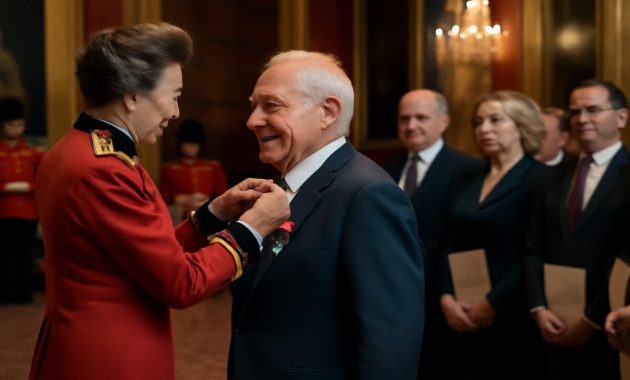
The rain had that soft, silvery look London does so well—more a shimmer in the air than a downpour—when the first guests stepped through the archway into St James’s Palace. Shoes clicked on old stone, a low murmur of voices gathered like birdsong in a walled garden, and somewhere beyond the courtyard a clock struck the hour. Today was an investiture day. Today, ordinary people in good shoes and slightly nervous smiles were here to become something else: recipients of honours, bearers of small, gleaming medals that whispered of years of quiet work. And presiding over it all, with her familiar steady presence, was The Princess Royal.
The Quiet Ritual of Arrival
What you don’t see in the official photographs is the way arrival feels. The way the temperature shifts as you move from the cool courtyard stones into the warmer, fabric-scented corridors of St James’s Palace. The hush, almost like entering a library, but softer—less about silence and more about respect. People speak in low voices, as if noise might disturb the centuries in the walls.
Families straighten ties and smooth skirts. Lapels are brushed down for the third time. A teenager awkwardly adjusts a borrowed suit jacket while his grandmother pins his father’s medal invitation card more securely in a pocket. There is laughter, but it’s the restrained kind, holding hands with pride and disbelief.
These guests—today’s newly minted MBEs, OBEs, CBEs, and beyond—have come from everywhere: hospital wards and fire stations, labs and libraries, community halls and church basements, theatres and training grounds. Some have flown overnight. Some have taken the early train, rehearsing how to bow or curtsey under their breath. They are scientists and carers, charity founders and volunteers, artists and athletes; people who have turned up, over and over again, when no one was watching.
Inside, staff move with choreographed ease, guiding guests through a long-practised dance. There’s a sense that this has all happened many times before and yet, for each person standing here, it feels shockingly new—as if the palace has been opened just for them.
The Princess Royal and the Art of Steady Presence
When The Princess Royal enters the room, the atmosphere shifts—but not in the grand, trumpeted way you might expect. It’s subtler than that. She carries with her a certain groundedness, a workmanlike royalty that matches the stories of service gathered in the room. There are no theatrics. There is simply a woman who has spent decades showing up for moments like this—ceremony as a form of respect, not just spectacle.
She is known for her commitment to duty, yes, but also for her brisk curiosity. That is what people remember most once the medals have been pinned and the cameras put away: the way she asked a precise question and listened to the answer as if she had all afternoon. A nurse who spent the pandemic on an intensive care ward finds herself recounting, in thirty careful seconds, a story she has barely yet told her own friends. A youth worker describes a boxing club that kept kids off the streets. A coastal volunteer speaks of dawn patrols in freezing winds, searching for boats in trouble.
The Princess Royal responds with the lightest of nods, the briefest of smiles—tiny gestures that, together, say: I have heard you. Your work matters. This ceremony is not pageantry laid over the top of your life. It is a lens, briefly bringing it into sharp, public focus.
The Weight of a Small Medal
Medals are deceptively light. They don’t change your skill, or the long years that came before, or the early mornings and late nights when you worked without applause. And yet, when the ribbon is settled carefully against a jacket or dress, it feels like the room tilts half a degree.
In that instant of investiture, you are no longer just the person who stayed late to lock up the community centre, the paramedic who kept going after that one awful night shift, the coach who believed in the kid everyone else had given up on. You are now, formally and publicly, someone whose efforts have been noticed; whose contribution has joined the long list of people thanked in this particular, enduring way.
For many, the moment passes in a blur. A name spoken aloud. A step forward. The Princess Royal’s voice, clear but quiet. The faint click of a camera shutter. Then it’s over, and you are walking away again, medal pinned, instructions in your head about how to turn, where to stand, how to exit without tripping over your own feet.
Later, outside in the courtyard or along The Mall, the reality catches up. This is when the hugs happen, the proper ones that crumple jackets and smudge carefully applied makeup. This is when a grown child looks at a parent with new eyes and says, “I always knew you deserved this.” When a partner’s pride finally spills over into tears.
Stories Woven into the Day
If you could peel back the formality and let the air around the palace walls speak, you’d hear a collage of stories, each one as textured as bark on an old oak.
In one corner of the reception area, a woman in a simple navy dress is explaining to an equally simply dressed man how her small-town food bank somehow turned into a network feeding thousands. “It just grew,” she says, almost apologetically. “We saw the need and we kept adding shelves, then volunteers, then delivery routes. There wasn’t really time to think about it being… big.” Today, the scale of it is finally catching up with her. So is the fact that someone noticed.
Nearby, a former athlete now in a wheelchair quietly talks about coaching disabled children into sport—how the first barrier is always belief. “They think it’s not for them,” he says. “Then you put a ball in their hands and something changes.” His medal is not just for the trophies on his own shelf, but for the hours he now spends making sure other shelves fill up too.
A teacher stands next to her older parents, who keep looking down at the invitation as though it might disappear. Her work—years spent building a refuge of learning and stability for students who have known far too much chaos—is being honoured today. Somewhere a bell rings, and she glances up, half-expecting to see a corridor full of teenagers.
A Hallway of Firsts
There is something particularly moving about seeing so many “firsts” gathered in one place. The first in a family to attend university. The first in a village to set up a charity. The first in a field to champion an unfashionable cause until, slowly, it is not unfashionable anymore.
Investiture days often bring together people whose paths would otherwise never cross. A tech innovator stands beside a community midwife. A veteran firefighter chats with a museum curator. They trade nerves and jokes about walking in the correct direction and not forgetting how to bow. They compare the strange dislocation of seeing their names printed in a formal programme instead of scribbled on a sign-up sheet or ID badge.
These conversations, light as they first seem, braid their work together into something larger. Individual acts of commitment become a collective map of service, spanning fields and postcodes, struggles and successes. The palace, for a few hours, becomes less a fortress and more a crossroads.
The Texture of Ceremony
Ceremony, at its best, is not about distance or hierarchy. It is about texture—the way sound, light, history, and human presence combine to make a moment feel weightier than the sum of its parts.
At St James’s Palace, that texture is rich and layered. Red and gold. Polished wood, cool and smooth beneath fingertips. The faint rustle of decorations on uniforms. Medals catching light in small, sharp flares. The quiet precision of staff who know exactly where everyone needs to be, and exactly when, but deliver their instructions with warmth rather than command.
Outside the ceremony rooms, a line of coats bears witness to the worlds people have stepped out of for a few hours: winter parkas from the north, raincoats from the south coast, a well-worn fleece that has clearly seen too many very early mornings. They hang shoulder to shoulder, a wardrobe of workaday lives temporarily set aside for the gleam of palace walls.
And then there is the soundscape: the rhythm of footsteps as groups are led in and out, the soft clink of medals, the sharp, surprising bubble of laughter when someone cracks a nervous joke. Over it all lies a hum of restrained excitement, like the tuned strings of an orchestra waiting for the conductor to lift their hand.
| Moment | What It Feels Like | What It Signifies |
|---|---|---|
| Stepping into the palace | A shift from everyday noise to careful quiet | Crossing from private effort into public recognition |
| Hearing your name called | A jolt of unreality, heartbeat in your ears | Your story, briefly, becomes part of national story |
| Meeting The Princess Royal | Nervous focus, then unexpectedly easy conversation | Acknowledgement from an enduring figure of service |
| Medal being pinned | A small weight, cool against fabric | Years of unseen work distilled into a symbol |
| Walking back to family | Relief, pride, and a rush of shared joy | The private circle that made public service possible |
Behind Every Medal: A Circle of Support
For every person honoured at today’s investiture ceremonies, there is a constellation of others whose names will never appear on any official list. They are present in the room nonetheless, woven into conversations and memories: the friend who said, “You should apply.” The manager who looked the other way while extra hours were poured into a passion project. The neighbour who watched the kids so that a night shift could be taken. The partner who quietly took on a little more, so that their loved one could keep going.
You see them in the glances exchanged across the room as medals are awarded, in the way a proud parent’s shoulders straighten every time a stranger asks, “So what was the honour for?” You hear them in sentences that begin with, “I couldn’t have done it without…”—phrases so common today that they almost become a chorus.
That is the paradox of honours. They are pinned on individuals, but they belong to many. What is celebrated is not heroic isolation, but the kind of sustained effort that can only happen when others quietly hold the line in the background.
What Today Really Celebrates
Strip away the formality, the palace walls, the gleaming shoes polished within an inch of their lives, and today’s ceremonies are about something disarmingly simple: people who chose, again and again, to care. To care about a neighbourhood, a coastline, a field of research, a group of children, a hospital ward, a fragile piece of culture. To care enough to stick with it when the funding ran low, when the weather turned bad, when the headlines moved on.
There is a particular kind of courage in that kind of care. It rarely looks dramatic. Most of the time, it looks like showing up on a Tuesday when almost no one else does. Like making one more phone call, filling one more form, holding one more hand. It is built not from grand gestures but from repetition.
Honours days like this lift those repetitions into view. They say: this, too, is what a country values. Not just towering achievements and headline-grabbing heroics, but the patient, unglamorous work of keeping communities stitched together, of pushing knowledge forward, of making sure no one is left entirely alone.
The Princess Royal’s presence underscores that message. Her own public life has been defined not by spectacle but by continuity—thousands of engagements, hundreds of patronages, years of turning up where she said she would. It feels fitting that she is the one to confer these medals on those whose stories echo, in their own ways, that same pattern of steadfastness.
Taking the Palace Back Home
Eventually, the crowds thin. Cars pull away from the palace, tyres whispering on damp London streets. On trains and planes and motorways, today’s recipients begin the journey back to the places that shaped the work being honoured.
In handbags and inside pockets, invitation cards are folded and unfolded, checked and re-checked, as if to confirm that this all did, in fact, happen. Medals are touched lightly, then more confidently. At some point, someone will say, “Show us, then,” and the box will be opened with the care normally reserved for family heirlooms.
Tomorrow, many of these newly honoured people will be back where they were last week: in meetings, on call, out on the road, at desks or in workshops. The palace will feel very far away. But something has changed. Not in the work itself—that will continue to be demanding, underfunded, occasionally heartbreaking—but in the story wrapped around it.
Because now, when a volunteer recruitment drive needs one more push, when a funder asks, “Does this really matter?”, when a young person looks uncertainly at the path ahead, there is another quiet sentence that can be added to the conversation: “This was recognised.” Sometimes, that makes all the difference.
To Everyone Honoured Today
So, to everyone who received honours at today’s investiture ceremonies at St James’s Palace, hosted by The Princess Royal: congratulations feels like too small a word, and yet it is the one that fits best.
Congratulations on years of effort no one saw. On the late nights when you almost gave up. On the mornings you tried again anyway. On the people you lifted, the systems you nudged, the corners of the world you quietly improved.
Congratulations on bringing your stories into that old, red-brick palace and allowing them to stand, for a moment, alongside centuries of history. On letting your families see you, not just as you are in the day-to-day bustle, but as part of something larger—a national expression of thanks.
And perhaps most of all, congratulations on the work that will follow. Because this medal is not an ending. It is a pause, a punctuation mark, a brief illumination on a path you were already walking. Once the light of ceremony fades, that path will still be there, stretching ahead. The world will still need whatever it is you do. But now, each step forward will carry the quiet knowledge that your efforts are not invisible.
As the last echo of footsteps fades from the palace corridors and the rain outside turns from silver to mist, today’s ceremonies settle into memory. The medals will find their places in drawers and on lapels. The Princess Royal will move on to other duties. And across the country, in small, unremarkable buildings humming with life, the real story will continue—made, as it always has been, by people who care enough to keep going.
Frequently Asked Questions
What is an investiture ceremony?
An investiture ceremony is a formal event where honours and awards, such as MBEs, OBEs, CBEs and other distinctions, are presented to individuals in recognition of their service, achievements, or contributions to society. It is both a celebration and a public acknowledgement of their work.
Why is St James’s Palace used for investiture ceremonies?
St James’s Palace is one of the oldest royal residences in London and remains a working royal palace. Its historic rooms and central location make it a fitting setting for occasions that blend tradition, formality, and national recognition, such as investiture ceremonies.
What role does The Princess Royal play at an investiture?
When The Princess Royal hosts an investiture, she represents the Sovereign in presenting honours to recipients. She meets each person individually, presents their award, and often exchanges a few words about their work or achievements, giving the ceremony a personal and human touch.
How are people chosen to receive honours?
Individuals are typically nominated by members of the public or by organisations familiar with their work. Nominations are reviewed by independent committees, and recommendations then go forward for approval. The focus is on sustained, meaningful contribution rather than fame or public profile alone.
Does receiving an honour change someone’s day-to-day life?
Practically, most people return to their usual roles and responsibilities after the ceremony. What often changes is how their work is perceived and supported—both by their communities and by potential partners or funders. For many, an honour boosts morale, lends weight to their cause, and inspires them and others to continue their efforts.