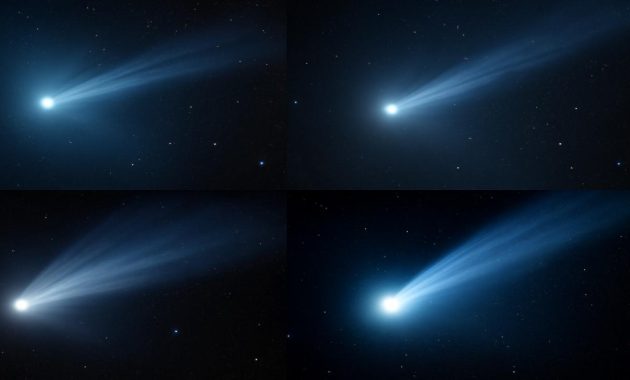
The first time the astronomers saw it, they thought the data had to be wrong. The spectrum didn’t match anything in their catalogs. The motion across the star field was slightly askew, tracing not a lazy loop around our Sun, but a sharp, skewed path—a strange, plunging arc that screamed of someplace else. Somewhere beyond our quiet bubble of planets, an object had slipped loose from its home system, wandered through the dark for uncountable ages, and now, improbably, was passing right through our neighborhood. They named it 3I ATLAS, the third confirmed interstellar comet ever found—and as the latest images begin to arrive from observatories around the world, its story feels less like science and more like a myth unfolding in real time.
A Visitor Between the Stars
On a cold, clear night, if you were standing on a remote hillside far from city lights, this visitor from another star system would look like nothing more than a faint, misty star, barely brushing the edge of visibility. You’d probably miss it unless you knew exactly where to look. But on the screens of astronomers who track its motion pixel by pixel, 3I ATLAS is anything but ordinary.
The comet’s story begins modestly enough. It was first spotted by the ATLAS survey (Asteroid Terrestrial-impact Last Alert System), a network of telescopes designed to watch the sky for anything that might be on a collision course with Earth. ATLAS wasn’t looking for interstellar visitors; it was hunting local troublemakers—asteroids, near-Earth rocks, icy bodies we’ve known, in concept, for generations.
But the orbit of this new object refused to play along. Early calculations showed that the comet was not looping back around the Sun the way a typical long-period comet would. Its path was hyperbolic—open-ended. This was the telltale sign, the cosmic passport stamp: the comet wasn’t bound to our star. It would enter, curve ever so slightly under the Sun’s gravity, and then slip away again, returning to the long, deep quiet between the stars.
By the time the scientific community recognized what they were looking at, telescopes on mountaintops and in deserts across the globe were already turning to follow the intruder. Because unlike the last two interstellar visitors—‘Oumuamua and 2I/Borisov—this one appeared early enough, and bright enough, to be watched carefully as it evolved. And that meant something precious: time to really see it.
The Global Chase for a Ghostly Traveler
Behind every dramatic space image you see in the news—those luminous blues, those razor-sharp jets, those whorls of dust—there are nights of quiet, patient work. For 3I ATLAS, that work unfolded as a global relay race. The comet was faint, fast-moving, and distant enough that few observatories could afford to ignore the chance to get a closer look.
In Hawaii, where the skies are dark and the air thin and steady, Maunakea’s big mirrors trained their gaze on the newcomer, peeling back layers of faint gas and dust around its nucleus. On the high desert plateau of Chile, an array of telescopes watched the comet in different wavelengths, from visible light down into the infrared, capturing the warmth of dust and the chemical fingerprints of ices evaporating into space.
European observatories joined in as the comet wheeled across their share of the sky. Space-based instruments, free from the blurring wash of Earth’s atmosphere, picked up the faintest whispers of ultraviolet light and subtle emissions that hinted at exotic chemistry. The result was less a single set of images and more a living, evolving portrait built frame by frame, night after night.
Coordinating all of this was a small army of astronomers huddled in dimly lit control rooms and in front of home-office screens, their faces lit ghostly blue by the data streams arriving from half a world away. For them, sleep was secondary. Orbital mechanics waits for no one. The comet would pass its closest point to the Sun and to Earth on its own schedule, and if they wanted to understand it, they had to follow.
The Spectacular New Images: A Comet in Close-Up
The newest images of 3I ATLAS are the kind that make even seasoned astronomers lean back in silence. On the screen, the comet floats against a dark field stippled with distant stars, but it’s the details that pull you in.
The nucleus itself is too small and too distant to see directly, even with our largest telescopes, but its presence is betrayed by the fine, glowing veil around it—the coma. In visible light, the coma appears as a luminous, pale greenish halo, a color often associated with diatomic carbon, a molecule that glows when exposed to intense sunlight in the vacuum of space. Embedded within this halo are faint structures, subtle fans and shell-like arcs hinting at jets of gas erupting from the rotating nucleus like icy geysers.
Stretching away from this central mist are the comet’s tails—plural, because like most comets, 3I ATLAS trails more than one. In some of the images, a sweeping dust tail fans outward, softened and slightly curved, made of microscopic grains pushed ever so gently by sunlight. Superimposed on this is a sharper, thinner ion tail, glowing electric blue in processed images taken through special filters, a stream of charged particles being yanked straight away from the Sun by the solar wind.
In some observatory composites, astronomers overlay multiple exposures taken over several hours. In these, the background stars smear into gentle arcs, tracking Earth’s rotation, while the comet’s nucleus stays fixed in the frame. The tails vibrate slightly from one image to the next, as if alive, responding to changing jets and the subtle dance of solar forces. It gives the uncanny impression that you’re watching a slow-motion time-lapse of a living thing breathing in vacuum.
The most detailed infrared observations reveal yet another layer: hidden beneath the visible glow, the dust grains themselves release a whisper of heat. This faint thermal signature helps astronomers estimate their size and composition. Some of the grains are likely older than our Sun, forged in the swirling debris disk of a long-gone star system and flung outward when giants formed or orbits shifted. Now, warmed for the first time in perhaps billions of years, they speak in photons.
The Data Behind the Beauty
Of course, these aren’t just pretty pictures. Every pixel is data, and every color is a clue. From 3I ATLAS’s images and spectra, astronomers can extract a surprising amount of detail about a comet that originates from a star system we may never visit.
Different instruments target different signatures: water vapor, carbon monoxide, carbon dioxide, complex organics, sodium, and even faint traces of more exotic molecules. By comparing the strengths of these signals, astronomers can piece together a chemical fingerprint, then lay it side by side with fingerprints from “homegrown” comets—those that orbit our own Sun.
The emerging portrait of 3I ATLAS suggests something both familiar and bizarre. On one hand, many of its core ingredients look like those we see in our own comets: frozen water, simple carbon compounds, dust grains made of silicates and rocky minerals. On the other hand, some ratios are off, out of tune with the standard patterns we’ve come to expect. Certain volatile ices appear more abundant, while others are strangely scarce. This mismatch is where the story gets interesting.
A Message in Ice: What 3I ATLAS Tells Us About Alien Systems
Every comet is a time capsule. When one forms in the outskirts of a young planetary system, it preserves the conditions of that time and place in its deep-frozen core. Our own comets tell us about the early years of the solar system: the chaos of migration, the violent collisions, the influx of water and organics that may have helped seed life on Earth.
An interstellar comet like 3I ATLAS is a time capsule from an entirely different story—a foreign prologue, written in ice. When astronomers compare its chemical makeup to our own comets, they’re essentially asking: How typical is our home? Did other star systems build their planets and comets from the same ingredients, in the same ratios, under similar conditions?
Preliminary analyses of 3I ATLAS’s spectra suggest that it may have formed in a region rich in certain volatile ices, perhaps farther from its star than most of our own comets formed from the Sun. There are hints that the radiation environment and temperatures in its natal disk may have been different too, leaving their imprint in the relative abundance of molecules.
Even the dust tells a story. The size and composition of the grains evaporating from the comet are clues to the types of collisions and aggregation events that took place in its birth system. Some grains are large and fluffy, loosely bound snowballs of fine material; others look more compact and glassy. These textures carry echoes of ancient impacts, shock waves, and the slow settling of matter in a protoplanetary disk that no longer exists.
For planetary scientists, this is gold. It’s as if a fragment of a distant world-building workshop has drifted into our lab, offering samples of materials that we would otherwise only ever see as remote smudges around faraway stars.
A Quick Look at 3I ATLAS at a Glance
| Feature | Details |
|---|---|
| Designation | 3I ATLAS (third confirmed interstellar comet) |
| Origin | Likely ejected from a distant planetary system beyond our Sun |
| Orbit Type | Hyperbolic (not bound to the Sun, passing through once) |
| Key Observatories | ATLAS survey, major ground-based telescopes in Hawaii, Chile, Europe, plus space-based instruments |
| Main Features in Images | Greenish coma, dual dust and ion tails, structured jets and arcs |
| Scientific Value | Direct sample of material from another star system; comparison with solar system comets |
Witnessing a Once-in-a-Lifetime Flyby
To the eye, the night sky seems slow and patient, but in truth it’s full of motion. Still, most of what moves does so on scales longer than our lives. Planets trace their orbits in regular loops. Comets bound to the Sun return after predictable spans. Even stars drift so slowly that you’d need centuries to notice.
Interstellar comets like 3I ATLAS are the opposite: pure transience. They blaze through once and are gone forever. For the teams watching it now, there is a palpable sense of urgency—mixed with something like awe. They know that no human generation before ours has ever knowingly studied material from another planetary system up close. They also know that once this comet recedes into the darkness, we will never see it again.
That knowledge creates a peculiar emotional weight inside observatories. There is the technical pressure—the tight schedules, the coordination of telescopes across continents and time zones, the race against weather and mechanical glitches. And there is the quieter, more personal pressure of knowing that each clear night with 3I ATLAS is unique, irreplaceable.
Astronomers often talk about “getting photons while you can,” but with objects like this, the phrase takes on a different resonance. Each photon that left the Sun, bounced from an alien iceberg, and landed on a telescope mirror is a tiny messenger from another star’s ancient nursery. To catch them is to momentarily bridge a gulf you can’t cross by any other means.
From Data to Story: Sharing 3I ATLAS with the World
Although much of the analysis of 3I ATLAS happens behind the scenes, buried in data files and code, the new images have also become a shared public event. Once the first processed views were released—those sharp, color-enhanced portraits of a green halo and streaming tails—social feeds and news sites lit up with a familiar mixture of awe and questions. What are we looking at? How far away is it? How fast is it moving? Could it hit us?
The answer to that last question is a simple, comforting no. 3I ATLAS is no danger to Earth; its path is safely distant. But its presence offers something else: a tangible sense of connection to a larger galactic story. For many who see the images, there’s an instinctive recognition that this is not just another pretty comet. It’s a representative. A wanderer.
Science communicators, educators, and amateur astronomers have seized the chance to turn this moment into a kind of cosmic teachable moment. Star parties center their telescopes where the comet should be, letting visitors peer at a faint smudge that carries a staggering backstory. Planetariums update their shows to include the visitor’s path across the sky. Classroom projectors display the multi-wavelength images, and students trace the glowing tails with fingertips on screens.
If there’s a common thread in these reactions, it’s the feeling that our solar system is less solitary than it once seemed. We are not locked in our star’s sphere like an island in black water; we are part of a slow, vast exchange of material and stories. 3I ATLAS just happens to be the most recent chapter to drift onto our shores.
What Comes After the Visitor Leaves?
Eventually, the brightness curve of 3I ATLAS will peak and fade. The comet will recede, its activity dropping as it slips away from the Sun’s warmth. Its coma will shrink, its tails will thin and dissipate, and its nucleus—still intact or perhaps fractured by its solar encounter—will head back toward the interstellar deep.
From our vantage point, it will simply grow fainter until only the largest telescopes can still find it, and then one night, even they will fail. A few more tries will be made, a few more exposures stacked and stretched in search of one last hint of the visitor, but the results will be the same: nothing but background stars and noise. The comet will be gone.
But its departure is not the end of the story—it’s only the end of our direct contact. The data gathered in these brief months will feed research for years, maybe decades. Graduate students not yet born may one day write their theses on some small quirk of its composition, or on the dynamical simulations of how it was launched from its original home.
Meanwhile, our telescopes will continue to scan the sky. The success of tracking 3I ATLAS and its predecessors will only sharpen our tools, refine our search strategies, and make it more likely that we catch the next wanderer even earlier and in greater detail. Interstellar objects may turn out to be more common than we once thought—we’ve only just learned how to see them.
And somewhere, unimaginably far away, there may be another world where their astronomers watch a faint, foreign comet glide through their sky, wondering which distant star it came from, what stories its ices carry, and whether anyone out there is doing what they are: turning a brief encounter with a piece of cosmic debris into a deeper understanding of their place in the galaxy.
Frequently Asked Questions About Interstellar Comet 3I ATLAS
What makes 3I ATLAS an “interstellar” comet?
3I ATLAS follows a hyperbolic orbit, which means it is not gravitationally bound to the Sun. Its trajectory shows that it came from outside our solar system, swung around the Sun once, and will leave forever, rather than looping back on a closed orbit like typical comets.
How is 3I ATLAS different from ordinary comets in our solar system?
In many ways it looks similar—coma, tails, outgassing activity—but its chemical ratios and dust properties show subtle differences that hint at a different birthplace. It likely formed in the outer regions of another star’s planetary system, where conditions such as temperature and radiation were not identical to those around our young Sun.
Can we see 3I ATLAS with the naked eye?
For most people, no. 3I ATLAS is faint and best observed with moderate to large telescopes and sensitive cameras. Under pristine dark skies, a skilled observer might glimpse it with high-quality binoculars or a small telescope when it is at its brightest, but it will never be a dramatic, obvious sight like the brightest comets of history.
Is there any chance 3I ATLAS will hit Earth?
No. Its orbit has been calculated with high precision, and it does not come nearly close enough to pose any impact risk. Astronomers are observing it purely for scientific interest, not because it is dangerous.
How do scientists know what 3I ATLAS is made of?
They use spectroscopy—splitting the comet’s light into a spectrum and examining the patterns of bright and dark lines. Each molecule and atom leaves a unique fingerprint in that spectrum. By comparing those fingerprints with laboratory measurements, astronomers deduce the presence and abundance of different gases and some dust components.
Why are the images of 3I ATLAS taken from different observatories?
Different telescopes and instruments see different wavelengths of light and offer varying resolutions. By combining observations from multiple observatories around the world—and from space—astronomers create a more complete picture, capturing everything from visible structure in the tails to infrared heat from dust and ultraviolet signatures of certain gases.
Will we see more interstellar comets in the future?
Very likely, yes. Our sky surveys are getting more sensitive and more comprehensive each year. As projects like wide-field survey telescopes continue to map the sky repeatedly, we expect to find more fast-moving, unbound objects like 3I ATLAS, turning rare, remarkable discoveries into a slowly growing catalog of interstellar visitors.