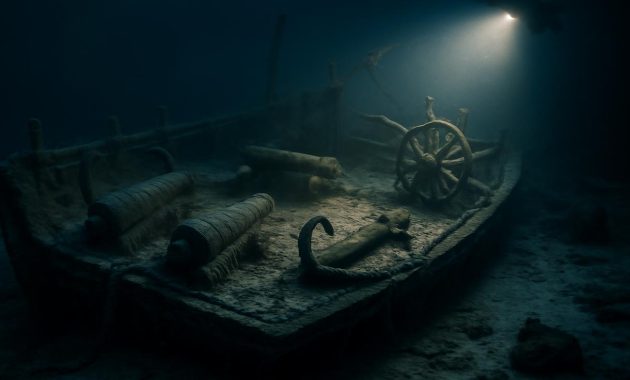
The sea gives up her secrets slowly. For centuries, sailors swore there was something out there, just beyond the last green curl of water on the horizon—a ghost of oak and iron, drifting in the blue silence off Australia’s wild southern coast. Some claimed they’d glimpsed a dark shape beneath glassy water on cloudless days. Others spoke of odd readings on sonar, of tangled nets and strange echoes. Most of those stories faded with the men who told them. But one autumn morning, as the first light poured itself over a calm Bass Strait, those old sailor tales quietly turned into a headline: after 250 years, a long-lost explorer’s ship had finally been found, lying perfectly preserved on the ocean floor, a wooden time capsule from another era.
The Morning the Past Spoke Back
The research vessel had been out for days, its crew drifting through a grid of coordinates like someone slowly feeling their way through a darkened room. The science team was tired, their coffee lukewarm, their nerves thinned by long hours of listening to the soft mechanical chatter of sonar and the endless hush of water against the hull.
Down below, in the cool, humming glow of the operations room, a row of screens threw soft light across the faces of technicians and marine archaeologists. They watched the sonar sweeps in near silence, eyes tracking the pale ribbons of seabed scrolling past—dunes of sand, scattered rock, the occasional ghostly blur of a reef. Most of the time, it looked like nothing at all. That’s how these hunts usually go: long stretches of quiet, punctuated only by the creak of the ship and the low murmur of data.
Then something shifted. A new return appeared on the sonar: a shape too regular, too deliberate, to be rock. Rectilinear lines. A length that made everyone straighten up. Someone leaned forward and resized the image. The hum of the ship’s systems seemed to drop away as the outline came into focus.
It was the unmistakable silhouette of a wooden sailing vessel, lying on its side, rigging still somehow in place, hull outline sharp against the soft contour of the seabed. There are moments, even in the rigor of science, when the room breathes in as one. This was one of those moments. No one said “we found it” at first. It felt like saying it out loud might make it vanish.
The coordinates matched the range suggested by the historical records: a British exploration ship lost in the late eighteenth century, last seen slipping into rough weather and never heard from again. For two and a half centuries, it had been presumed swallowed by storms, torn apart by reefs, reduced to splinters and legend. Instead, it had been waiting in the cold dark, nearly intact, like a message left unopened at the bottom of the world.
The First Glimpse Through Time
The sea at the surface was a mild gray-blue that day, barely touched by wind. But hundreds of meters below, where sunlight turns thin and blue and eventually fades, the past sat undisturbed. To see it, they would need eyes that could withstand that pressure and darkness. So the crew readied the ROV—a bright yellow remotely operated vehicle, all cameras, thrusters, and umbilical cables that trailed back to the ship like a silver umbilical cord.
The ROV went over the side with a careful splash, then sank steadily, its floodlights cutting a narrow path into the dim water. On the surface, the team watched its slow descent on screens. Small fish flashed in and out of the beam, silver ribbons in liquid dusk. The water grew darker. The soundscape filled with the textured static of the deep: distant clicks, the soft thrum of the ROV’s motors, the quiet rush of currents.
And then, out of nowhere, wood appeared. Not the splintered, ragged ruin of something shattered, but a hull. A real hull, resting on a gentle slope of pale sand. The beam of light slid across planks that still held their shape, blackened by centuries underwater but astonishingly whole. The curve of the bow, the trace of the stern, the ghostly ladder of the rigging—it was all there, frozen as if the crew might climb back aboard at any moment. Even the carving at the prow, worn but still distinct, hinted at the figurehead that once cut through waves under a full spread of canvas.
People in the operations room leaned in so close their noses nearly brushed the screens. One of the archaeologists, a woman whose career had been spent chasing fragments of timber and rusted bolts, simply whispered, “It’s her.” Her voice shook slightly. “It has to be.”
What stunned them most was not just that the ship had survived, but how she had survived. In the cold, low-oxygen waters off southeast Australia, the usual army of wood-eating organisms was scarce. No shipworms had chewed their way through the oak. No storms had smashed the remains against a reef. The wreck had slipped into a natural cradle—a basin of relative calm, protected from the most violent surges of the sea.
From the screens, the ship did not look like a ruin. It looked like a pause button pressed in the middle of a voyage, a vessel whose sailors had simply stepped away for a moment, leaving their world in place.
The Ship’s Story: Wind, Ambition, and Disappearance
The records back on land, yellowed with age and full of ornate, looping handwriting, tell of the ship’s final preparations. Built in the mid-1700s, she was one of the lean wooden arrows dispatched from European shipyards toward the edges of the map. Her purpose was not conquest in the blunt, cannon-flashing sense. She was an explorer: her decks crowded with strange cargo—brass instruments, star charts, casks of provisions, bales of spare canvas, oak planks, a surgeon’s chest of tools gleaming in lamplight.
On her masts, heavy sails would have snapped and boomed like great white lungs, pulling her through indifferent seas. Below deck, men shared narrow hammocks, their world narrowed to the smell of tar, sweat, woodsmoke, and salt pork. The journal of one young officer, discovered decades ago in a London archive, described those first weeks at sea in precise, admiring detail:
“The ship is sound and swift, her timbers singing in the swell. We sail toward a coast most at home on the maps as a margin—a line more imagined than known. I confess an excitement I cannot easily name.”
They were headed for the great unknown southern lands, for the uncharted bays and cliffs of the continent the British would soon obsess over. The ship’s mission was to chart, to measure, to observe—reefs, currents, winds, new species of plants and animals, and above all, safe passages. She carried botanists, surveyors, and sailors who had learned to read the sky like a second set of maps.
And then, in a few storm-torn nights recorded in fragments by other vessels in the region, her story ended. “Terrible weather in the strait,” another captain wrote. “Visibility poor. Heard no gun nor signal. Fear the worst for our sister ship.”
After that, silence. The ocean floor took her, and human memory gradually blurred the edges of her name.
A Time Capsule Locked in Salt and Silence
Now, with the ROV hovering gently beside her, the ship’s details began to resolve. The cameras edged along the hull, where copper sheathing—tarnished but clearly visible—still clung to the timbers, part of a then-revolutionary effort to protect ships from barnacles and rot. The ROV’s lights slid over a row of cannon ports, some lids ajar, others sealed as if still ready to be opened at a shouted command.
On the main deck, time had left an almost eerie neatness. Coils of rope, stiff with age, remained looped near belaying pins. The outline of the capstan stood solid at midships, its heavy frame once used to heave anchor and sail into motion. A fallen mast lay across the deck like a sleeping giant, its rigging stretched out in slow-motion collapse.
Everywhere the cameras looked, there were hints of lives interrupted: the warped but recognizable shape of a wooden bucket; the metal ribs of a lantern; a clay pipe resting in a quiet corner as if someone had set it down mid-conversation. The ship wasn’t just a wreck. It was an entire ecosystem of stories, locked away in cool darkness.
Inside, beyond the broken but still defined entryways, things looked even more surreal. In the captain’s cabin, a table lay on its side, pinned by debris, but its surface—facing the room now—still bore the faint shadow of where instruments and charts might once have lain. A brass compass was spotted, half buried in silt, its glass face broken, needle long stilled. Nearby, the ghostly outline of shelves suggested where logs and letters might still be hidden under collapsed timbers.
In the hold, stacked barrels remained in orderly rows, their lines softened by sediment, but unmistakably arranged with the tidy precision of naval logistics. Some of those barrels, the archaeologists knew, might still contain preserved food, water, or even biological samples collected on the voyage. Glass bottles—many still sealed—winked in the ROV’s light. There were whispers, too, of small personal chests, iron-bound and snug against bulkheads, that might hold uniforms, coins, tools, and handwritten records, their ink preserved by the deep’s cold hand.
To archaeologists used to working with scattered fragments, this was dizzying: a nearly complete late-eighteenth-century exploration vessel, laid out like a museum built by the ocean itself.
Reading the Sea’s Invisible Archive
Finding a ship like this changes more than a few footnotes in naval history. It redraws our understanding of how delicate, and how durable, human artifacts can be when the sea decides to keep them. The conditions off Australia’s southern coast, particularly in deeper pockets of the Bass Strait and the Southern Ocean, act like a vault for wooden ships.
Low temperatures slow decay right down. The limited presence of wood-boring organisms—especially the infamous shipworm—means the hull can remain structurally intact for much longer. Fine sediments, carried by gentle currents, settle over the wreck in thin, protective layers, cushioning it like a blanket instead of scouring it clean.
In this case, it seems the ship came to rest along a sort of submarine hollow, a soft depression shielded from the full violence of winter storms. That hollow became its sarcophagus. Over time, marine life claimed it: encrusting sponges and corals painting the timbers in subtle oranges and purples; fish using the shadowed spaces as shelter. The wreck became part of the seafloor’s living architecture.
For scientists, the ship is not just an artifact—it’s data. Dendrochronologists can study its timbers, reading the growth rings to learn where the trees were felled, what the climate was like when they grew, how shipbuilding timber was traded and chosen. Metallurgists can examine the ironwork and copper sheathing, revealing techniques, alloys, even the imperfections that crept into production in distant eighteenth-century foundries.
Then there’s what the ship carried: seeds carefully sealed in jars and boxes; preserved plant specimens collected from coasts now reshaped by cities and agriculture; notes on currents, wind patterns, seasonal storms. The ship is a snapshot not only of human ambition, but of a younger Earth—before coal and oil and industrial noise changed the background hum of the planet.
| Aspect | Then (c. 1770s) | Now (Discovery Era) |
|---|---|---|
| Ship’s Purpose | Chart unknown coasts, gather specimens, map safe passages. | Reveal historical climate, navigation practices, and daily life at sea. |
| Technology Onboard | Sextants, chronometers, hand-drawn charts, log lines. | ROVs, multi-beam sonar, 3D imaging, DNA analysis of artifacts. |
| View of the Ocean | A frontier, largely unknown, full of danger and promise. | A changing system, carefully measured, under growing pressure. |
| Environmental Impact | Localized resource use, early colonial contact. | Global warming, plastic pollution, altered biodiversity. |
The Ethics of Touching Ghosts
Finding a ship this complete raises delicate questions. Is it a research site? A war grave? A memorial? A museum that must never be moved? The crew on the research vessel knew that the moment the first images appeared, a chain of decisions would follow, not all of them scientific.
The legal framework around such discoveries is complex. International conventions on underwater cultural heritage urge in-situ preservation—leaving wrecks where they are unless there is an overwhelming reason to raise them. Disturbing a wreck can expose it to oxygen, to new bacteria, to human error. It can also disturb whatever human remains might still be there.
In many shipwrecks, no bodies are ever found—the sea reclaims them. But the space itself becomes a grave, a site of last moments. Here, a mug left rolling on the mess table. There, a pair of boots near a ladder. The ship’s final minutes, though unwitnessed by history, are etched into the logic of how objects came to rest.
So the plan, at least for now, is to let the ship continue its long sleep. The first priority is documentation: high-resolution mapping, 3D modeling, gentle sampling from the sediments nearby. The archaeologists talk about “listening first”—trying to understand how the wreck is changing on its own before making any big interventions.
Every few years, perhaps, an expedition will return, using whatever technology has emerged in the meantime. Non-invasive scanning techniques might one day let them read waterlogged journals without even unsealing them, or reconstruct a crew member’s daily path across the deck based on microscopic wear patterns and residues. The wreck will remain underwater, but the story it tells will slowly surface, piece by careful piece.
Standing at the Edge of Two Eras
What’s most striking about this discovery is how vividly it throws two ages into conversation. On the one hand, the age of sail: canvas cracking in the wind, men climbing ratlines by lamplight, captains staring up at unfamiliar constellations and scribbling notes by candle wax and ink. On the other hand, the age of circuits and pixels: glowing sonar maps, ROV joysticks, live video links beaming the image of that same ship’s deck to laptops thousands of kilometers away.
The explorer who once paced the quarterdeck, coat flapping in a cold southern wind, could not have imagined that in some far century, people would peer into his captain’s cabin without ever getting their feet wet. He would recognize the compass, the timbers, the curve of the hull. He would not recognize the quiet whir of the cameras, the muffled click of keys in a control room, the way strangers fall silent before a glowing rectangle when the past appears on-screen.
And yet, something between the two worlds rhymes. Both are driven by a restless curiosity, an urge to see what lies beyond the known map. The eighteenth-century voyagers wanted to chart coasts, to make the world legible, to open routes that would reshape empires and ecologies alike. The twenty-first-century scientists want to chart something different: how we once moved through the world, what we valued, what we carried, how we recorded and misread the planet we inhabit.
Standing at the rail of the research vessel as the sun backed down toward the horizon, one of the younger technicians later recalled a feeling of vertigo. The waves lapped quietly at the hull. Somewhere beneath them, that old ship lay in blue shadow, perfectly still. Above, the sky arched in soft pink and gold, streaked with jet contrails—modern routes scribbled over old seas. For a moment, the centuries between them felt very thin.
Why This Ship Matters Now
You might wonder, in a century crowded with urgency, what it means to spend time and resources looking for a wooden relic on the seafloor. The ice is melting. The oceans are warming. Species vanish faster than we can name them. Why does the quiet discovery of an old exploration ship matter?
Because the story of that ship is not just a maritime curiosity; it’s part of the long preface to the world we’re wrestling with today. Those voyages of exploration helped set into motion global trade networks, colonial expansions, patterns of resource extraction and cultural collision that still define economies and ecologies in the twenty-first century. Every chart drawn, every bay named, every port claimed became a strand in the web we now live inside.
The ship is a material witness to the beginnings of that era. It holds in its hold, quite literally, samples of an older climate, an earlier biodiversity, an untouched coastline. The plants collected on some forgotten beach, the animals noted in careful script, the direction of currents and winds measured before modern pollution—all of it is baseline data. A “before” snapshot against which our troubled “after” can be more clearly measured.
There’s something else, too: a lesson in humility. The men who steered this ship believed they were pushing into the unknown to bring it into the fold of the known. They saw the world as something to be catalogued, mapped, and—eventually—managed. Now we look at their ship lying quiet on the seabed and are reminded how much escapes our control, how many stories the planet writes without us, how long the memory of the ocean can be.
When you peer down into those fuzzy ROV images, watching the camera drift past the fallen mast and over the captain’s cabin door, you’re not just looking at the past. You’re looking at a mirror held up to the present—a reminder that the maps we draw, the routes we carve, the technologies we trust, are all provisional. One storm, one miscalculation, and even the most ambitious voyage can end in silence and dark water.
Frequently Asked Questions
Is the exact location of the shipwreck public?
No. To protect the site from looting and disturbance, the precise coordinates are being kept confidential by the research and heritage authorities involved.
Will the ship be raised from the seafloor?
There are currently no plans to raise the entire ship. Modern heritage practice favors leaving such wrecks in place, using non-invasive imaging and selective sampling rather than full recovery, which is risky and extremely costly.
How is the ship so well preserved after 250 years?
The wreck lies in cold, relatively deep water with low oxygen levels and few wood-boring organisms. These conditions significantly slow decay and have allowed the hull and many artifacts to remain intact.
Did anyone survive the shipwreck?
Historical records are fragmentary. No confirmed survivors’ accounts have been found, and no rescue reports mention the crew. It is generally assumed that all hands were lost, but ongoing research may yet uncover new documentary evidence.
What can scientists learn from this discovery?
Researchers can study eighteenth-century shipbuilding techniques, navigation tools, diet and health of the crew, trade routes, and even historical climate and biodiversity through preserved specimens and materials in the ship’s cargo.
Can the public see the wreck?
The physical wreck remains underwater and inaccessible to most people, but high-resolution imagery, 3D models, and virtual reconstructions are expected to be shared in future exhibitions and digital platforms.
Does this discovery change Australian maritime history?
It adds remarkable detail and confirmation to existing records about early European exploration in Australian waters, and may refine timelines, routes taken, and our understanding of how those voyages influenced later settlement and environmental change.