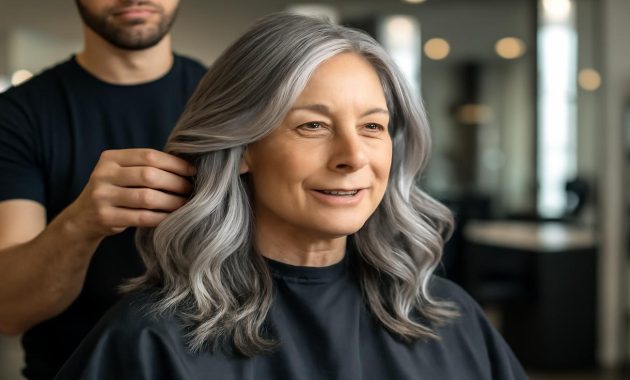
The first time I watched someone’s gray hair disappear, it happened in the quiet hum of a small salon on a Wednesday afternoon. Outside, the sky was the color of old aluminum, the kind that mirrors your mood back at you; inside, the air smelled like espresso, citrus gloss, and faint ammonia. A woman in her late fifties slipped into the chair in front of me—shoulders a little tense, jaw set the way people hold themselves when they’re trying not to apologize for aging. Strands of silver shone stark against her darker base, framing her face like accidental spotlights she didn’t ask for.
Her colorist didn’t reach for the foils. No painting on balayage sweeps, no grids of harsh lines marching over her head. Instead, he opened a bowl of warm, creamy color and a second bowl of translucent gloss, like he was setting out to make something edible and comforting. “We’re not hiding your gray,” he told her. “We’re melting it.”
Forty minutes later, I watched as the mirror revealed hair that no longer screamed I am coloring my gray! It didn’t look dyed. It didn’t look young. It just looked…hers. The whites and silvers had dissolved into soft, misty tones—pearl, mushroom, smoky blonde—blurring into the rest of her hair the way twilight blurs into night. Her face relaxed. She smiled at herself like she hadn’t in years.
This is the quiet revolution happening in salons right now: balayage fading into the background, and “melting” stepping up as the subtle, almost secret weapon for people who don’t want to fight their grays, but don’t want to surrender to them, either.
Goodbye Balayage, Hello Melt: What’s Really Changing?
For the last decade, balayage has been the reigning queen of “effortless” hair color—hand-painted streaks, sun-kissed ends, deliberate lightness. It promised low maintenance and lived-in glamour. But balayage, for all its artistry, was never really designed with gray hair in mind. Gray roots don’t blend seamlessly into dramatic lighter ends; they crash into them. And on hair with a lot of natural white, balayage can look like a patchwork quilt that’s started to unravel.
Melting steps in where balayage stumbles. Instead of high contrast, it’s about silk transitions. Instead of asking, “How light can we go?” melting asks, “How softly can we move from one shade to another?” It doesn’t prioritize brightness or drama—it prioritizes believability.
So what is melting, exactly? Imagine you’ve got three cups of paint: your natural base color, a shade just a touch lighter or darker, and a translucent tint that lives somewhere in between. Instead of slapping them on in stripes, your colorist applies them so they overlap softly, blending the borderlines until they dissolve. There’s no clear starting and ending point—just a gradient that shifts like morning light over water.
On gray hair, this is magic. The new growth—the silver sparkles that used to shout from your part line—are gently coaxed into nearby tones. Beige, mushroom, taupe, soft gold, smoky brunette, even rosy beige. The result isn’t “back to your original color from 1998.” It’s a new shade that respects the presence of gray and uses it as an ingredient, not an enemy.
The Art of Making Gray Hair Forgettable
Melting isn’t about erasing gray so much as lowering its volume. Picture your grays as a choir that suddenly started singing lead. Hair melting is like asking them to stay in the ensemble, soften a little, harmonize with everyone else. They’re still there—you just don’t notice them first.
In practice, this looks like layered subtlety. At the roots, your colorist may create a slightly deeper, natural-looking shadow—a soft echo of your original color, not a helmet. Over that goes a translucent color melt: a mix of demi-permanent shades or glosses that slip over your grays and surrounding hair like tinted glass. The mids and ends might get an even softer, brighter tone—just enough to catch the light and keep things from feeling flat.
The beauty of this process is that your eye can’t quite find where the gray starts and the color stops. There is no harsh horizontal line when your hair grows. No weekly panic appointment because the white stripe has returned. As your hair grows, the transition is so gentle you can easily stretch visits to six, eight, even twelve weeks, depending on how much gray you’ve got and how you wear your style.
And here’s the most unexpected part: melting often makes gray hair feel more luxurious to the touch. Many glosses and demi colors used in melting are low-ammonia or ammonia-free, infused with conditioners that smooth out wiry texture. Gray hair, which tends to be coarser and more stubborn, suddenly behaves—more swing, more slip, less frizz. You don’t just look softer; you feel it every time your fingers slide through your hair.
The Subtle Psychology of “Forgettable” Hair
There’s a certain kind of freedom in hair that doesn’t start a conversation. For years, the hair industry sold us drama: bold highlights, sharp contrast, big transformations. But gray hair is personal. It walks into the room before you do, it appears in every photo, it comments on your age without asking permission.
Melting responds by quietly changing the subject. People look at your face, your eyes, your expression—not the roots at your part. Your hair becomes the background music of your presence: setting the mood, supporting the scene, never overwhelming it.
Forgettable, in this context, is a compliment. It means your hair looks so naturally right on you that no one wonders what you did to it. They might notice you look rested, interesting, soft, luminous. They’re not thinking about technique. Which is how the best techniques have always worked.
Inside the Melt: How Colorists Actually Do It
From the client’s side, melting feels almost meditative. You sit, you listen to the rustle of foils that never quite arrive, you feel the gentle glide of color at your scalp, the comb pulling sections through like a quiet metronome. But behind you, your colorist is doing a small, controlled dance of timing, formulas, and brushwork.
Here’s a simple way to understand what’s happening, without needing a cosmetology license:
- Step 1: Root mapping. Your colorist studies where your gray appears most and how it flows—around the face, at the part, scattered through the crown.
- Step 2: Shadow base. A slightly deeper, natural tone might be applied at the roots, especially where gray is most concentrated.
- Step 3: Melt zone. A demi-permanent color or glaze that’s lighter or more translucent is pulled through the mids, sometimes with fingers or a wide-tooth comb to blur any lines.
- Step 4: End refinement. The ends may get a conditioning gloss in a complementary shade—cool if you want smoky, warm if you want golden.
- Step 5: Rinse and tone. The whole head is rinsed, then often finished with a universal gloss to seal in shine and unify the reflect.
The magic lies in the overlap: colors are layered, not stacked. Your gray is never simply covered; it’s negotiated with.
| Feature | Traditional Balayage | Gray Hair “Melting” |
|---|---|---|
| Main Goal | Lighten mids and ends for a sun-kissed effect | Soften and blur grays into surrounding tones |
| Best For | Low-to-moderate gray, high contrast looks | Moderate-to-high gray, natural transitions |
| Look & Feel | Visible ribbons and painted pieces | Seamless gradient, no obvious streaks |
| Maintenance | Touch-ups every 8–16 weeks, roots can be obvious on high gray | Touch-ups every 6–12 weeks, grow-out is softer |
| Relationship With Gray | Competes with it, can highlight contrast | Uses it as part of the color story |
Finding Your Melt: Shades, Stories, and Personalities
One of the unexpected joys of melting is how specific it can feel—almost like a bespoke garment sewn in color instead of cloth. You don’t walk in and ask for “the balayage everyone’s getting.” You walk in and describe a mood, a feeling, a way you want to appear to the world.
Maybe you’re drawn to “stormy afternoon” hair: a cool, smoky brunette where the grays become soft ash lowlights, like clouds moving through a deep sky. Or perhaps you want “sand dune” blonde: muted beige, hints of pale gold, your whites diffused into an overall suede-like softness. Some people embrace “antique silver,” letting their natural gray dominate while melting in just enough depth at the roots and warmth at the ends to keep it from looking flat or harsh.
With melting, grays can become:
- Highlights when gently brightened and toned.
- Lowlights when surrounded by slightly lighter blended shades.
- Texture when left partially visible, giving the hair dimension without added streaks.
It’s not just about the color of your hair; it’s about the story it tells. Hair that says: I’ve lived some life, and I know how to wear it. Hair that doesn’t pretend to be 22, but refuses to be categorized as “letting go.” Hair that lives in the same wide, beautiful middle ground where most of us actually exist.
Talking to Your Colorist: The New Vocabulary
Walking into a salon and saying, “I heard about melting on the internet, can you do that?” might get you a polite nod and a hundred follow-up questions. Colorists speak in undertones, levels, and developers—but what they really need to hear is how you want your hair to feel in your life.
Try using phrases like:
- “I want my gray to be softer and less noticeable, not completely gone.”
- “I like dimension, but I don’t want to see obvious stripes or ribbons.”
- “I’d rather come in less often, even if that means the change is more subtle.”
- “My skin pulls [cool/warm/neutral]; I want my hair to flatter that.”
If you can, bring photos—not of hair color alone, but of people whose overall mood you like. Maybe it’s the way their hair connects with their eyebrows, or how their tone plays against their eye color. Good colorists are part artist, part translator. The more clearly you share how you want to feel, the easier it is for them to choose the right melt for you.
Living With Melted Hair: Care That Feels Like Permission
Once you’ve stepped into the world of melting, day-to-day life with your hair shifts in quiet but important ways. You stop checking your part in every reflective surface, because there’s no sharp silver line staring back. You stretch time between appointments without that creeping sense of “I’m slipping.”
Caring for melted hair isn’t complicated, but a few rituals can keep the illusion soft and luminous:
- Gentle cleansing: Use sulfate-free shampoos that won’t strip your demi colors and glosses too quickly.
- Cooler water: Warm is fine, but scalding showers will fade your color faster and roughen gray texture.
- Weekly mask: Hydrating masks can calm coarse grays, keeping the surface sleek so the melt reflects light evenly.
- Tone refresh: Every 6–10 weeks, a quick salon gloss can revive your melt without a full color service.
Most of all, melted hair gives you permission to let a little imperfection in. A few brighter strands here, a darker shadow there—it all becomes part of a soft, shifting landscape instead of a battlefield you’re trying to control down to the millimeter.
When Melting Isn’t the Answer (And What That Teaches)
Not everyone is destined to melt forever. Some people try it and realize: I actually miss contrast. I want bold streaks. I want to see the effort. Others lean in the opposite direction: after a few cycles of melting, they choose to grow out their gray completely, discovering that their natural silver is, in fact, stunning and doesn’t need a thing.
Melting’s greatest gift might not be the color itself, but the middle ground it offers while you figure out what you want your relationship with gray to be. It lets you experiment without locking you into all-or-nothing thinking. It makes aging hair feel less like a problem and more like a palette.
In that way, it’s more than a trend and less than a revolution. It’s a gentle, practical adjustment in how we think about growing older: not as something to reverse at all costs, but as something to blend carefully into the person we’re becoming.
FAQs About Gray Hair “Melting”
Is melting better than balayage for gray hair?
For moderate to high amounts of gray, melting usually works better than balayage. Balayage was designed to mimic sun-lightening, not gray blending, so grays can stand out sharply against painted pieces. Melting softens and blurs the grays into neighboring tones, making regrowth less noticeable and the overall look more natural.
Will my gray be completely covered with melting?
Not always—and that’s often the point. Melting is designed to make gray less obvious, not necessarily invisible. Your colorist can increase coverage if you want, but the magic of melting comes from letting a bit of gray stay in the mix so the transition stays soft as your hair grows.
How often do I need to touch up melted hair?
Most people can go 6–12 weeks between salon visits, depending on how quickly their hair grows and how much gray they have. Because there’s no harsh line at the roots, grow-out is more forgiving. In between, a simple gloss appointment can refresh the tone without a full color service.
Can melting work on very dark or very curly hair?
Yes. On dark hair, melting usually focuses on adding a softer shadow at the root and subtle tone shifts through the mids and ends so grays blend instead of popping stark white. On curly or coily textures, melting can add incredible depth and shine, especially when paired with moisturizing treatments that define curls and reduce frizz.
Is melting damaging to hair?
When done properly, melting is often less damaging than repeated permanent root color or aggressive lightening. Many colorists use demi-permanent colors and glosses with lower peroxide levels and added conditioning agents. That said, any chemical service carries some risk of dryness, so following a good care routine—mild shampoo, conditioner, masks—is essential.
Can I transition from full gray coverage to melting?
Absolutely, and many people do. Your colorist might start by softening your root line, adding blended tones through your mids and ends, and gradually reducing the amount of solid, opaque coverage. Over a few appointments, your color can shift from “fully covered” to “softly blurred,” making the transition feel gentle instead of abrupt.
How do I know if melting is right for me?
If you’re tired of visible gray roots every few weeks, dislike harsh lines or streaks, and prefer hair that looks natural and low-drama, melting is worth exploring. Bring photos, talk honestly with your colorist about maintenance and budget, and start with a subtle change. Hair melting is less about chasing perfection and more about finding a shade of yourself that feels easy to live in.