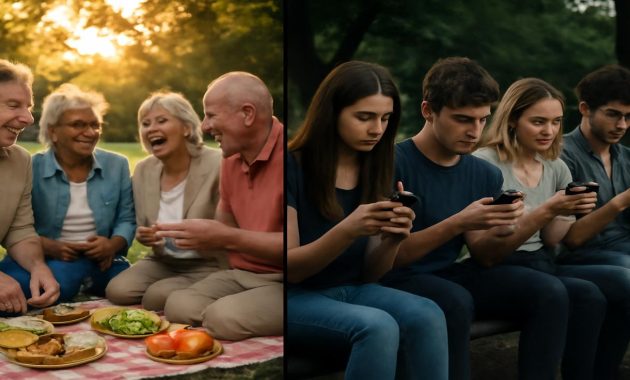
The woman on the park bench has the kind of smile that comes from somewhere deep in the ribs, not from a screen. It’s late afternoon and the light has turned that forgiving shade of gold that makes everything – peeling paint, tired faces, cracked pavements – look almost holy. She’s in her seventies, maybe, wearing a soft blue cardigan, watching pigeons negotiate over a crust of bread. Her phone, if she has one, is nowhere in sight. On the next bench over, a boy in his early twenties scrolls quickly, thumb frantic, jaw tight. Notifications blink like tiny, urgent sirens. The woman closes her eyes for a moment and tilts her face toward the sun. The boy never looks up.
The Quiet Secret Nobody Wants to Say Out Loud
There is a quiet secret hovering in the spaces between park benches, coffee shop queues, and bus seats. You can feel it on early morning trains when older people are reading newspapers or just staring dreamily out the window, while younger riders bend toward their phones like worshippers before a tiny, glowing altar. The secret is simple and a little uncomfortable:
Many people in their 60s and 70s are, in a quiet, steady way, enjoying life more than a lot of anxious, tech-addicted youth. And nobody really wants to admit it.
We are trained to worship youth. Youth is branded as the prime of life, the golden age of options and possibility. But talk, really talk, to someone in their late sixties who has made peace with themselves, and you might notice something that cuts through all the glossy narratives: a softness around the eyes, a willingness to let things be unfinished, a gentler heartbeat in conversation.
Meanwhile, many younger people – supposedly living their “best lives” – are struggling to stay present at all. Their days are chopped into notification-sized fragments. Their attention is splintered, their nervous systems on permanent alert. They live with the hum of constant comparison, of being perpetually “behind,” even when they don’t know who they’re racing.
The Age of Restless Thumbs
Walk through any city street or ride any elevator and you’ll see it: heads bowed, eyes down, fingers moving. Youth today are more connected than ever, and also more wired, more restless, more sleepless. Their lives are tracked and traced and quantified. Every step, every meal, every laugh can be recorded. Every silence feels like a waste of content.
If you are under forty, you might feel it in your own body: that subtle twitch to check your phone when a conversation lulls; the phantom buzz on your thigh when nothing has actually vibrated; the sense that a day with no photos is a day that somehow didn’t count. Your mornings may begin, not with birdsong or a quiet stretch, but with a rectangle of light and an avalanche of opinions and disasters.
For many older people, this world is something they stepped into late, not something they were born inside. They’ve seen life both with and without screens, and they can feel the difference in their bones. They scroll too, of course. Plenty of people in their 70s love their tablets and group chats and video calls. But the relationship is different. The technology is a tool, not a limb. They remember a time when silence was normal, when boredom wasn’t a crisis, when making plans meant trusting someone would show up just because they said they would.
Why the 70-Year-Old in the Garden Sleeps Better Than the 25-Year-Old in the City
There’s an old man who tends a small community garden at the edge of a suburb. His steps are slow but steady; he knows the soil the way he used to know spreadsheets and deadlines. He is retired now, and the garden is his daily pilgrimage. He talks to the tomatoes. He knows the first name of the woman who walks her dog past the gate every morning. He sleeps well.
Meanwhile, there’s a young woman in a tiny apartment in a crowded city. She has three messaging apps, two email accounts, and a growing list of unread notifications. She is constantly reachable but rarely at rest. Her workday bleeds into her evenings, and the glow of her laptop is the last light she sees before sleeping. She wakes tired.
The Body Knows Before the Mind Admits It
Older people, especially those who have made it through illnesses, losses, careers, and raising families, often reach their later years with a quiet understanding that the body is not a machine. They’ve experienced breakdowns: knees that won’t behave, backs that protest, hearts that momentarily forgot their rhythm. They’ve been forced to slow down, to notice the fine print of their own limits.
The youth, in contrast, move as if limits are an insult. They caffeinate, scroll, multitask, and grind. Their anxiety rides on top of their skin – jittery, electric. They sleep with phones on the pillow, alarms nested inside notifications. Their bodies whisper that something is off, but the algorithm never sleeps, and so, increasingly, neither do they.
Meanwhile, the older man in the garden has his own rhythm. The sun determines his schedule more than emails do. He eats when he’s hungry, not when a meeting allows. His evenings are often quiet. He can’t do everything, and that, surprisingly, lets him rest.
The Luxury of Having Nothing to Prove
Ask many people in their seventies what they’re proud of, and they might say something that doesn’t photograph well: “I raised decent kids,” or “I learned to forgive my brother,” or “I made peace with myself.” Their achievements aren’t always brandable. Their lives don’t necessarily look impressive on a screen.
And yet, this is where a hidden form of freedom lives. Older people, especially those who have stopped working, have stepped off the main conveyor belt of social expectation. There is no next promotion, no next exam, no next internship, no next big break. What’s left is the day in front of them, in all its imperfect ordinariness.
Youth, for all its radiance and possibility, can feel like one long audition. There is always something to prove: intelligence, attractiveness, relevance, ambition. Every moment can become raw material for a profile, every experience an opportunity to perform. Even relaxation becomes another item on the to-do list: “self-care,” optimized and shared.
Imagine, by contrast, the particular relief of being someone’s grandmother whose only “followers” are a handful of family members and old friends. No personal brand to maintain. No pressure to “go viral.” The joy of a good meal, a warm blanket, or a neighbor’s unexpected visit is fully allowed to be small and private and quietly wonderful.
The Calm of Perspective (And Why It’s Not Boring)
There’s a cultural myth that older people are inevitably bitter, stuck in the past, or simply bored. It’s a convenient story for a society obsessed with youth: if old age is dreary, then the fear of aging keeps us consuming, hustling, upgrading. But talk to someone in their late sixties who has lived through economic swings, political chaos, and personal upheavals, and you’ll find something that rarely appears on social feeds: perspective.
Perspective is not the same as apathy. It is not “I don’t care.” It is “I have seen this kind of storm before, and I know the sky can clear.” Older people have watched technologies appear and vanish, trends bloom and wither, certain about-to-change-everything predictions dissolve into footnotes. They’ve seen the world end on the news, and then continue the next morning with grocery shopping and laundry.
Why Small Joys Feel Bigger With Time
When you are 23, a quiet afternoon might feel like a missed opportunity. There is always somewhere else to be, someone else to meet, something more exciting just out of frame. The background noise of “not enough” hums constantly: not enough experiences, not enough photos, not enough stories to tell.
By 70, if you’ve lived even a halfway awake life, you’ve had your share of peaks and crises. You’ve had the big arguments, the career pivots, the love affairs that turned the world on its axis. You’ve known grief in its full, unedited form. And if you’re fortunate, you get to enter a season where novelty matters less than depth.
An ordinary cup of tea at a sunny kitchen table can feel extraordinary when you know how many storms it took to reach that quiet. A grandchild’s laugh can feel richer than any viral video. A walk in the park can be layered with memories: of pushing strollers, of walking with your own parents when they were still here, of earlier versions of yourself who thought life would always be big and loud.
The youth skim lightly across the surface of experiences, pulled along by a stream of updates and trends. Older people, when they are not crushed by loneliness or illness, often marinate in their moments. The flavor of life is stronger when you’ve had time to taste its full range – the bitter, the sour, the unexpected sweetness.
Why We Don’t Like to Admit Any of This
Despite all this, our culture clings to the story of youth as the pinnacle. Old age is framed as a slow fade-out, a decline, a slide into irrelevance. Admitting that many older people may actually be quietly happier than their younger counterparts feels almost like heresy. Why?
The Market Needs You to Stay Unsatisfied
An anxious, restless, perpetually scrolling young adult is a perfect customer. They are always looking for the next thing that will finally make them feel okay: the next productivity app, the next supplement, the next course, the next lifestyle hack. Their attention is for sale, and they’ve been taught that their worth depends on staying up-to-date.
By contrast, the older man who’s decided that what he really wants out of life is a comfortable chair, decent health, and time to watch the birds out his window is harder to sell to. He already has, in some modest form, what so many advertisements are promising. His contentment is terrible for business.
The Fear of Our Own Aging
There is another reason we resist this story: we are terrified of becoming old ourselves. If you’re young, it is easier to position older people as tragic or out of touch than to recognize them as portals into a future you might actually want. To imagine that your best, most peaceful years might not be your twenties but your seventies requires a radical shift: away from speed and toward depth, away from novelty and toward presence.
And then there is the reality that not all older people are enjoying life. Some are isolated, unwell, or steeped in regret. But those who are content – the ones with that soft-eyed calm on the park benches and in the garden plots – quietly challenge our assumptions. They make us ask unnerving questions like: What if all this hustling and scrolling isn’t leading where we think it is? What if we’re racing toward a future that looks nothing like the peace we secretly crave?
A Subtle Rebellion: Learning From Those Who Log Off By Instinct
You can see this rebellion in small, almost invisible gestures. The woman who still writes letters on real paper. The retiree who leaves their phone at home when they walk to the shop. The grandfather who sits on his porch each evening just to watch the light change. None of these acts would make an interesting post. And that is precisely their power.
A Different Kind of Connection
Older people often have fewer relationships, but deeper ones. They’ve lived long enough to know who will actually show up at the hospital, who remembers their birthday without a prompt, who cares enough to listen when they talk about the past. They might not have hundreds of contacts, but they have a small circle of faces that are etched into their lives for decades.
Younger people can sometimes drown in a sea of semi-friends, online acquaintances, and vague maybes. Their group chats are noisy; their actual evenings can be strangely quiet. The fear of missing out, fueled by curated glimpses into other people’s lives, can overshadow the people sitting right next to them.
A Table of Quiet Differences
Look closely, and the contrast becomes clear.
| Aspect | Many Anxious, Tech-Addicted Youth | Many Content People in Their 60s & 70s |
|---|---|---|
| Relationship with Time | Rushed, fragmented, always “behind” | Slower, cyclical, anchored in daily rituals |
| Technology Use | Constant, compulsive, fear of disconnection | Selective, purposeful, easier to log off |
| Sense of Self | Shaped by comparison and feedback | Rooted in lived experience and memory |
| Primary Pressure | To achieve, impress, and stay relevant | To stay healthy, connected, and at peace |
| Source of Joy | Big milestones, visible success, online validation | Small daily pleasures, relationships, simple routines |
Of course, these are generalizations. There are older people doomscrolling every night and young people who live gently, close to the land, barely online. But the pattern is clear enough that, if you pause and look around your own life, you’ll likely see it too.
What the Elders Know (That We Pretend Not to)
Deep down, you might already suspect what many older people have learned the long way round: that the moments which actually stay with you are rarely the ones you posted about. They are the nights you laughed so hard you almost spilled your drink, the quiet apologies, the hands you held in waiting rooms, the early mornings when the world hadn’t yet remembered its own noise.
The elders know how quickly it all moves. They know that the job that feels like everything now will one day be a story you try to remember details of. They know that the face you see in the mirror today will change, and that this is not a tragedy but a form of truth-telling. They know that no amount of digital applause can replace the feeling of one person looking you in the eyes and really listening.
Choosing a Different Story for Yourself
If there is a gift hidden in this uncomfortable comparison, it is this: you do not have to wait until your seventies to live like someone who knows what actually matters. You can borrow from the elder kind of happiness now.
You can learn to walk without your phone sometimes, to let your mind wander the way it was built to. You can decide not to turn every beautiful moment into content. You can consciously cultivate friendships that last longer than platforms and trends. You can practice enjoying something small in an almost ridiculous way – the warmth of a mug between your hands, the way late afternoon light hits a wall – purely because you are here to feel it.
The older people sitting on park benches and tending gardens are not relics of a slower world so much as guides to a way of being that could survive any technology. Their quiet joy is not nostalgia; it is a kind of courage. The courage to live at the pace of a heartbeat instead of a refresh button. The courage to let days be ordinary and still be enough.
One day, if you are lucky, you will be the older person on the bench. The question is: when you close your eyes and lift your face to the sun, will your memories feel like your own, or like a highlight reel made for someone else?
Frequently Asked Questions
Are all older people happier than younger ones?
No. Many older people struggle with loneliness, health issues, or regret. But a significant number of people in their 60s and 70s report a surprising sense of contentment and emotional stability, especially compared to their younger, more anxious years. The article focuses on this often-overlooked group and what we can learn from them.
Is technology really the main reason young people are more anxious?
Technology is a major factor, but not the only one. Economic pressure, social expectations, climate anxiety, and unstable job markets also play a role. However, constant connectivity and social media intensify comparison, reduce real rest, and make it harder to unplug from stress.
Can younger people enjoy life as much as older people do?
Yes. Age itself doesn’t guarantee happiness. What often brings older people contentment is perspective, simpler priorities, and less pressure to prove themselves. Younger people can practice these same attitudes now: valuing small joys, limiting screen time, and nurturing real-world connections.
Does this mean we should reject technology completely?
No. Technology can connect generations, support health, and bring joy. The issue is not its existence but its dominance. Older people often use technology as a tool, not as a constant background noise. The goal is a healthier relationship with devices, not total rejection.
How can someone start moving toward this quieter kind of happiness?
Begin with small experiments: go for short walks without your phone, create device-free meals, spend time with older relatives or neighbors and listen to their stories, notice one small physical pleasure each day, and allow some parts of your life to be completely unshared and undocumented. Over time, these simple practices can shift how you experience your days.