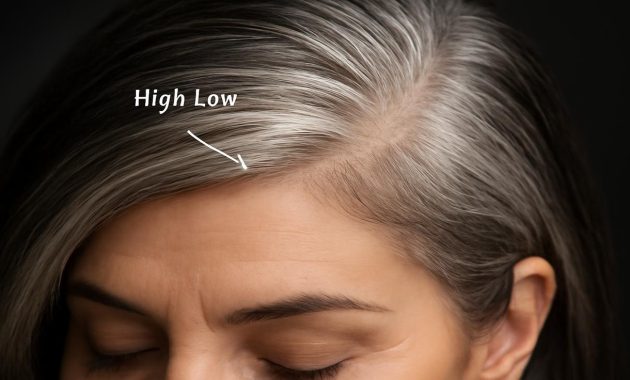
The woman in the mirror had given up pretending. That’s what she told me, at least, as she pushed a loose strand of silver away from her face and laughed in that half-guilty, half-proud way people do when they know they’re changing the rules on themselves. The salon smelled faintly of coffee and hairspray, and it was a slow afternoon—the kind where sunlight drapes itself across the floor and everyone talks a little softer. Her hair, once a uniform chestnut, had slowly surrendered to the cool shimmer of gray at the temples, threads of white catching the light like frost in early morning grass. For years she’d been chasing those roots, appointment after appointment, letting dye chase time. Today, though, sitting in the swiveling chair, she said the five words that make a hairdresser both nervous and excited: “I think I’m done hiding.”
The Quiet Revolution at the Root
Her stylist, a seasoned colorist named Clara, didn’t flinch. She’d been seeing more of this lately—clients who weren’t just tolerating their gray but wanting to actually enjoy it. The old script was simple: gray meant cover-up, pretend, maintain the illusion. But now, salt and pepper hair has become its own kind of statement—elegant, wild, lived-in, and oddly modern in a world of filters and perfection.
Still, there’s a cliff between “I’m done covering my roots” and “I like how this actually looks.” The in-between stage can feel brutal—harsh lines between dyed lengths and new growth, dull patches, random bands of color that don’t quite know what they’re doing. This is where most people panic and run back to full coverage.
“I don’t want to look like I just gave up,” the woman in the chair said. “I want it to look intentional.”
Clara smiled, tucking a comb into the curve of her hand. “Then we don’t stop coloring,” she said. “We change how we color. We work with your gray instead of against it.”
Her secret weapon? Something she calls the “high-low” balayage—an artful dance between deeper lowlights and bright, silvery highlights that curve around natural gray like sunlight through trees. It’s not a trend so much as a translation: taking the quiet arrival of salt and pepper strands and giving them context, harmony, and a story that feels deliberate.
What “High-Low” Balayage Really Means
For years, balayage has been beauty’s answer to effortless color—painted-on highlights that blend softly, avoiding the harsh demarcation line of traditional foils. But when gray enters the chat, the technique has to get smarter. High-low balayage, especially on salt and pepper hair, works like this: instead of trying to erase gray, it layers light and dark tones around it, like shadows and light in a photograph.
“Think of your gray as the sky,” Clara likes to explain. “We’re just adding clouds and sunlight in the right places so it feels like a landscape, not an accident.”
In practical terms, that means:
- High (light) pieces that echo and enhance your natural silvers—soft ribbons of cool blonde or icy beige that pick up the metallic shine of gray and make it look intentional.
- Low (deeper) pieces that anchor everything—soft browns or charcoal tones woven through to keep depth near the nape, under layers, or framing the face, so the effect isn’t flat or washed out.
The result isn’t “blonde with roots,” and it’s definitely not “gray covered up.” It’s a textured, dimensional canvas where your natural salt and pepper becomes the star of the show. You keep your character, your age, your lived-in story—but with more polish, more light play, and more of that satisfying this is on purpose feeling when you see your reflection in a shop window.
The Emotional Shift from Hiding to Highlighting
What’s quietly radical about this approach is not just technical—it’s emotional. Sitting in that salon chair, a lot of people carry old stories about what it means to go gray: that it signals decline, fatigue, invisibility. But the moment you stop coloring to erase and start coloring to emphasize, something changes.
“You can see it in their shoulders,” Clara says. “They walk in apologizing for their roots. They leave touching their hair like they just discovered a new part of themselves.”
High-low balayage doesn’t speed up the transition to full gray; it makes the journey feel beautiful instead of awkward. It softens that hard border between what your hair used to be and what it’s becoming. And in many cases, it buys you longer stretches between appointments—no more panicked visits every four weeks because your “secret” is showing at the scalp.
How High-Low Balayage Works on Salt and Pepper Hair
If you’ve been coloring for a while and your roots now come in silver, pewter, or soft white, your hair is already telling a great story—it just needs editing. High-low balayage becomes the stylist’s way of rewriting the color so that every stage of growth serves the overall look.
Here’s how a typical transformation might unfold in the chair:
- Step 1: Reading the pattern. Your stylist maps where your gray is most concentrated—temples, part line, crown, around the face. Everyone’s pattern is unique, like the way trees leaf out in spring.
- Step 2: Choosing the highs. Instead of blasting everything lighter, the stylist chooses strategic strands to lift—often next to your natural gray so the two shimmer together. These highs might be cool pearl, ash beige, or soft silver-blonde, depending on your skin tone.
- Step 3: Placing the lows. Lowlights are painted where you need grounding: under layers, around the back, or framing the face if you want more contrast. These help you avoid that washed-out look that some fear with gray, especially if you used to wear your hair darker.
- Step 4: Blending the history. Old dye on your ends may need softening or lifting a bit, so there’s no harsh line between “past color” and “present you.” Balayage is incredible for this: it feathers the old into the new, like editing a paragraph instead of starting the story over.
The magic is that there’s no single “salt and pepper formula.” Some people want a brighter, near-platinum frame around the face. Others want smoky, lived-in dimension that feels more subtle. High-low balayage is more painter’s palette than recipe card.
Subtle Structure: A Quick Look at Options
Different combinations of highs and lows can change the tone of your entire look without fighting your gray. Below is a simplified guide you could even show your stylist as a conversation starter:
| Goal | Highs (Light Pieces) | Lows (Deeper Pieces) | Overall Effect |
|---|---|---|---|
| Very soft, natural blend | Cool beige or pearl near gray | Soft mushroom brown | Barely-there contrast, low maintenance |
| Bold, modern salt-and-pepper | Icy silver highlights | Charcoal or espresso lowlights | High contrast, editorial feel |
| Warm and soft (for warm skin tones) | Champagne or soft gold | Warm cocoa brown | Gentle warmth, youthful glow |
| Low-commitment transition | Minimal highlights, mostly surface | Very soft lowlights just at band lines | Keeps a lot of natural gray, softens grow-out line |
Why Your Roots Stop Being the Enemy
There is a moment, weeks after your appointment, when you part your hair and notice something strange: those new roots you once dreaded… don’t bother you as much anymore. With high-low balayage, the whole concept of “roots showing” starts to loosen its grip.
Here’s why:
- No harsh starting line. Because your gray has been built into the design of your color, fresh growth blends into a mosaic of lights and darks instead of sitting on top like a stark reminder.
- Dimensional distraction. Your eye starts seeing pattern and texture instead of a single solid block of color. It’s like looking at tree bark—you don’t notice where one shade ends and another begins, only the richness of the whole.
- Appointments stretch further. Many clients can comfortably go 8–12 weeks, sometimes more, because there’s no sharp regrowth line screaming for urgent correction.
“We’re not erasing who you are between visits,” Clara says. “We’re building a color story that keeps writing itself as your hair grows.” The salt and pepper that once felt like betrayal becomes the continuous thread—the part that makes the look feel alive, in motion, responsive to time.
Texture, Shine, and the Shape of Your Cut
Color alone doesn’t tell the full story; cut and texture amplify the high-low effect. On softly layered bobs, silvered pieces around the face can look like moonlight caught on movement. On long waves, the palette becomes more like a slow waterfall of tones—dark to light, matte to sheen.
Natural grays often have a different texture: sometimes coarser, sometimes a bit drier. Balayage respects this by working with wider, softer sections. Highs and lows are often placed where your hair bends and curves most, so the sun seems to catch them as you move. A curl, a twist, a turn of your head—suddenly the silver at your temple or the charcoal lowlight behind your ear becomes a quiet focal point.
Living with Salt and Pepper: Care Without Obsession
Once you’ve made the leap to enhancing your natural gray instead of burying it, maintenance becomes less of a frantic race and more of a gentle ritual. You’re no longer trying to stop time; you’re just polishing it a little.
There are a few small habits that can keep your high-low balayage clear, cool, and luminous:
- Color-safe, hydrating shampoo and conditioner. Gray hair can show dryness more quickly, and your highs and lows both need moisture to reflect light. Look for sulfate-free formulas that don’t strip.
- Occasional toning. A purple or blue-toned shampoo, used sparingly, can keep silver pieces from turning brassy, particularly if you’re in the sun a lot.
- Heat protection always. Blow dryers and irons can dull both gray and color-treated hair. A light heat protectant can keep everything smoother and shinier.
- Gloss or glaze refreshes. Between big color appointments, a quick in-salon gloss can revive the sparkle of your highs and deepen your lows without fully recoloring.
But the most important shift is mental: you’re not checking your scalp every morning in the bathroom mirror, scanning for intruders. New growth isn’t a problem to be solved—it’s part of a look that keeps softly evolving.
Conversations to Have with Your Hairdresser
If you’re considering this path, it doesn’t start with, “Make me look like this Pinterest photo.” It starts with honesty. Tell your hairdresser how often you’re willing to come in, how much gray you have, how attached you are to your current shade, and what scares you about letting more of your natural color show.
Good questions to ask:
- “How much of my natural gray can we keep visible and still make it look intentional?”
- “What kind of high-low balance would suit my skin tone and lifestyle?”
- “Can we do a ‘test round’ that shifts me gently instead of all at once?”
- “What will this look like in three months if I don’t rush back in?”
A thoughtful stylist will approach your hair less like a problem and more like a landscape. They’ll talk about light, shadow, and movement. They’ll point out the streak at your temple that could be turned into a feature instead of a flaw, or the patch at the crown that could anchor deeper lowlights beneath it.
Stories Woven into Strands
Back in Clara’s chair, as the afternoon slid toward evening, the woman who had decided she was “done hiding” watched her reflection change. At first, it was subtle—small painted strands that seemed too few to matter. Then the rinsing, the towel twist, the blow-dry. As her hair fluffed and settled, a soft halo of brightness appeared around her face, catching the gold in her eyes. The darkest pieces sat underneath, giving the shape structure. And interlaced throughout, unmistakable and unashamed, her natural silver glowed like quiet lightning threads.
“It still looks like me,” she said slowly, lifting a section to the light. “Just… like the version of me who stopped running from herself.”
There was no obvious “root line,” no dramatic before-and-after shock. It looked as though this was how her hair had always meant to be, if the world hadn’t convinced her to fight it.
That’s the quiet miracle of high-low balayage on salt and pepper hair: it doesn’t try to freeze you at thirty-five, nor does it rush you into stark, all-over white. It gives you an in-between place that feels rich and full and alive—a place where each new millimeter of growth adds another chapter instead of another problem.
You step out of the salon into the late light, and a breeze lifts your hair. Somewhere between shadow and shine, between dark past and silver future, you realize that this isn’t about surrendering to age. It’s about signing a peace treaty with time—and then letting it paint right alongside you.
FAQ: Salt and Pepper Hair & High-Low Balayage
Is high-low balayage suitable for everyone with gray hair?
Most people with visible gray or salt and pepper hair can benefit from some version of high-low balayage. The exact balance of highs and lows will depend on your gray pattern, hair history, and skin tone. A good stylist can customize it so it feels natural rather than drastic.
Will this damage my already fragile gray hair?
Any lightening process can be stressful on the hair, but a careful colorist will use gentle products, smaller sections, and targeted placement to minimize damage. Often, fewer strands are colored with balayage than with all-over dye, which can actually be kinder overall. Proper at-home care (moisture, heat protection) is key.
How often will I need to touch up high-low balayage?
Because balayage is designed to grow out softly, many people can wait 8–12 weeks or more between appointments. Some stretch even longer, opting for the occasional gloss or toner refresh instead of frequent full color sessions.
Can high-low balayage help me transition from fully dyed hair to natural gray?
Yes, it’s an excellent bridge between fully colored hair and your natural gray. By adding strategic highs and lows, your stylist can break up harsh demarcation lines and create a more blended, graceful transition as your natural color takes over.
What if I decide later that I want to be fully gray?
High-low balayage doesn’t lock you into permanent color decisions. Over time, your stylist can gradually reduce the amount of coloring, letting more of your natural gray remain untouched at each visit. Because your hair has been blending all along, the final transition to fully gray often appears softer and more deliberate.
Will high-low balayage make me look older or younger?
The goal isn’t to chase youth but to enhance vitality. Well-placed highs and lows around salt and pepper hair can brighten your complexion, add dimension, and make your hair look healthier and more intentional—which many people feel reads as more vibrant, regardless of age.
How do I talk to my hairdresser if they seem hesitant about gray?
Share clearly that you want to embrace your salt and pepper rather than hide it, and ask specifically about blending, high-low placement, and low-maintenance grow-out. If your stylist seems uncomfortable with working with gray instead of against it, consider a consultation with a colorist who has visible examples of gray-enhancing work in their portfolio.