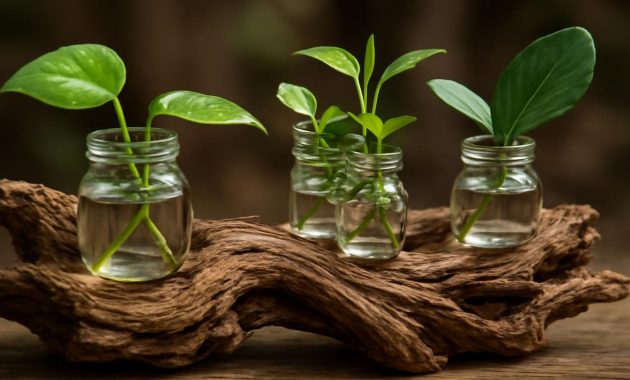
The log didn’t look like much when I first saw it—just another fallen trunk resting in a cradle of ferns and leaf litter. The forest was damp with last night’s rain, soft and dark like a held breath. A wren flicked past, scolding me for intruding, and somewhere overhead a branch gave a slow, wooden sigh. I remember nudging the log with my boot, watching a scattering of beetles vanish into secret doorways in the bark, and thinking, What a beautiful mess. I didn’t know, in that moment, that this would become my favorite thing in the whole garden. I only knew that my pockets were full of cuttings and my mind was full of schemes—and that I’ve always had a weakness for lost, broken pieces of the world that still feel alive somehow.
The day a fallen tree became a future plant stand
It started with cuttings, as so many obsessions do. Tiny green promises lined up on my windowsill: a leaning army of glass jars, cloudy with roots and hope. Every spare bottle in the house was suddenly pressed into service. Pasta sauce jars, old vases, a chipped teapot—if it could hold water and a stem, it got recruited. It was a chaotic little jungle perched above the sink, and every time I washed dishes, I bumped a jar and watched heart-shaped leaves tremble.
Propagation has a way of sneaking up on you. You tell yourself you’re just rescuing a broken pothos vine or trimming back your leggy coleus. Then you notice how fast those little white nubs swell into real roots, thick as eyelashes and just as delicate. Before long, you’re walking around the house with scissors, asking every plant, “You feeling generous today?”
The problem, of course, is where to put all those hopeful experiments. Shelves fill up. Windowsills vanish under glass. You start wondering if you can balance a water glass on the back of the toilet tank. That’s how I ended up wandering into the woods behind my house one November afternoon, thinking about light and surfaces and make-do solutions—and that’s when I saw it. The log. Or rather, a long, weathered chunk of tree that had clearly been lying there a while, comfortable in its slow return to soil.
It was smooth where bark had peeled away, and soft where moss had moved in. It bowed slightly in the middle, as if it were already practicing the role of a bench. When I crouched beside it, running my fingers over the ridges and grooves, it felt less like dead wood and more like a story that had simply changed chapters. And a thought rose, wild and certain: This could hold them all.
Seeing furniture in fallen branches
Once you start seeing potential in old wood, it becomes impossible to stop. That twisted branch? A future hanging rail for air plants. The knotty stump in the corner of the yard? A pedestal in disguise. Forests are full of what we think of as “debris,” but to plants—and to people who love them—it’s prime real estate.
When I looked at that log, I didn’t just see the outside. I saw it lined with glass jars, a green procession of propagations marching along its spine. I saw a living display that felt less like interior decor and more like a collaboration between the house and the woods. The question wasn’t could it work, but how to bring the forest home without stripping it of what it needed.
The trick with treasure-hunting in the woods is respect. That log was part of something already—shelter for insects, sponge for rainwater, nursery for fungi and tiny seedlings. I checked for mushrooms, beetle holes, and signs that it was still busy decomposing in a way the forest needed. There were a few old tunnels, a scattering of lichen, but mostly it was clean, dry, and light enough that I could lift one end and drag it toward the path. It felt like a piece the forest was done using, or at least willing to share.
By the time I wrestled it home—mud on my knees, pine needles in my hair—I already knew where it would live: near the brightest window in the living room, where the sun draped itself across the floor every afternoon. I measured the space clumsily with my arms, lugged the log indoors, and set it down. There, in the quiet tick of a settling house, the forest exhaled into the room.
Making the log ready for its new life
Before any plant stand transformation could happen, the log needed a bit of gentle persuasion. Nothing fancy. No power tools. Just a soft cleaning, a check for hitchhiking insects, and a little stabilization so my jars wouldn’t go skating off the sides.
I tipped it on its side and tapped, listening. Solid. No hollow, echoey rot that would crumble within weeks. I brushed away loose bark and soil with an old hand broom, let a few startled ants find their way out the open door, and left the log to dry fully in a corner of the porch for a few days. The rain smell faded slowly, replaced by a warmer, woody scent that reminded me of pencil shavings and sun-warmed decks.
When it was dry, I tested the flattest side against the floor. It wobbled, but only a little, like a table at a busy café. A folded bit of cork tucked underneath solved that. I decided against sanding it; I wanted to keep the wildness—the scars and cracks, the faint paths where bark beetles had traced their private calligraphy. This wasn’t going to be a polished piece of furniture. It was going to be an honest one.
Then came the best part: introducing the log to the plants.
Arranging a parade of propagations
Setting up that log felt uncannily like decorating a cake—with the difference that this frosting was alive and occasionally drooped if it didn’t like where I put it. I walked around the house gathering jars, each one a little universe of roots and water and patient growth. On the kitchen counter, they formed a sort of leafy congregation, waiting to be assigned seats.
There were pothos cuttings trailing like lazy green ribbons. Monstera deliciosa segments with their single bold leaves, like flags staked in glass. Leggy coleus, coleus everywhere, in improbable purples and sunset oranges. A few solemn philodendron hearts. A sprig of rosemary that smelled like winter evenings. And in one tiny bud vase, a hip-high piece of string-of-hearts, its roots already tangled into a fragile spiderweb.
Arranging them on the log turned out to be part art, part puzzle. The log’s surface wasn’t straight; it cupped and dipped like the back of some ancient creature. That was the charm, really. Some jars sank perfectly into small hollows, as if the wood had been waiting for them. Others needed help—a flat slice of bark underneath, a small stone bracing the curve, a narrower glass that fit the contours.
I thought about height, about leaf shape, about the way light would fall across the windows throughout the day. Taller stems at the back, trailing ones spilling toward the edges, a few dramatic leaves right at the center, catching the eye. I left pockets of empty space here and there, invitations for future cuttings I hadn’t yet met.
Before I knew it, the log had become a stage. And the plants, which had been a crowded jumble on my windowsill, suddenly each had room to be themselves.
| Plant Type | Best Propagation Method | Ideal Spot on the Log |
|---|---|---|
| Pothos & Philodendron | Stem cuttings in water | Edges, to trail gracefully down |
| Monstera & Larger Aroids | Node cuttings with aerial roots | Center, where there’s more headroom |
| Herbs (Mint, Basil, Rosemary) | Softwood cuttings in water | Sunny side of the log, easy to grab for cooking |
| String-of-Hearts & Vines | Single-node cuttings in water or soil | High points, so vines can drape dramatically |
| Succulents | Leaf or stem cuttings in soil | Shallow crevices filled with gritty mix, away from splash zones |
Standing back, I realized the log had done something my shelves never could. Instead of a flat row of jars, there was depth, layers, a sense of landscape. It looked less like an organizer and more like a riverbank that had wandered into the house and decided to stay.
Living with a piece of forest in your home
Over the next few weeks, the log slipped into the quiet rhythm of the house. Morning light would catch droplets of condensation on the glass, turning each jar into a tiny lens of brightness. By late afternoon, as the sun slid sideways through the window, the plants cast long, leafy shadows across the wood, like silhouettes from some underwater dream.
There was a new sound, too—the soft clinks of glass as I lifted jars to refresh water, the whisper of roots brushing the sides, the tiny splash if my hand wasn’t quite steady enough. In the evening, when the rest of the house hummed with screens and voices and the churn of dinner, the log remained a slow, grounded presence. A horizontal altar of green.
Visitors noticed it immediately. “What is that?” they’d ask, leaning in, peering at the ghostly tangle of roots inside the jars. And I’d tell them about the walk in the woods, the armful of fallen tree, the quiet work of turning forest castoffs into a stage for new life. More than once, someone went home clutching a cutting wrapped in damp paper towel, already dreaming up their own plant stand from a forgotten corner of the world.
Outside, the seasons shifted. Rain, snow, thaw, the wild green explosion of spring. Inside, the log stayed the same and changed at once. Some cuttings failed, yellowing and sliding into that soft defeat plants get when they simply decide, No, not this time. I thanked them and let them go. Others flourished. Hair-thin rootlets thickened, curled, and finally signaled they were ready for soil.
Every few weeks, I’d graduate a plant from the log to a pot, patting fresh earth around its base, feeling that small rush of satisfaction. With each empty space, a new cutting appeared, snipped from some other corner of the house. The log wasn’t just a display; it was a moving river of growth, a place of arrivals and departures.
Why a forest-found stand feels different from store-bought
You can, of course, buy beautiful propagation stations. Sleek glass tubes on polished wooden racks, perfectly aligned. Metal stands with geometric lines. Shelves designed to fit into awkward corners and capture the last slivers of sunlight in your home. They’re lovely, tidy, and often exactly what a space needs.
But a fallen log, or a thick limb, or a weathered board found on a forest trail or a beach—that’s a different kind of beauty. It carries the story of where it came from. Those cracks on its surface aren’t design features; they’re the memory of winters and summers layered into its skin. The curve of its back wasn’t measured and cut; it’s the way the tree once leaned toward light or bent away from wind.
There’s also a quiet magic in turning something discarded—or at least overlooked—into the highlight of a room. The log on my floor costs nothing but effort and attention. It asked me to notice, to kneel down on the forest floor and imagine a future for it that the forest itself didn’t mind giving up.
It also changed the way I looked at every walk. Suddenly, the world was full of potential: a driftwood plank that might cradle air plants, a gnarled root system that could become a sculptural stand, a section of bark curved just right to hold a shallow dish for moss. The forest started to feel less like a backdrop and more like a collaborator.
There’s a wordless satisfaction that comes from thinking, I made this from what was already here. Not by forcing it, not by reshaping it until it forgot where it came from, but by nudging it into a new role that still felt honest. The plants, too, seemed to understand. Their leaves looked right against the rough texture of the wood, as if they’d always belonged to the same story.
Tips for finding and using your own forest treasure
If your fingers are already itching to go hunting, there are a few gentle rules that make the difference between foraging and taking. The forest gives, but it also needs to keep enough of itself intact.
- Look for what’s already loose or clearly detached. Fallen branches, driftwood, chunks of trunk not deeply embedded in the soil. Avoid pieces still serving as obvious habitat—thick with mushrooms, crawling with insects, or cradling seedlings.
- Bring home less than you think you need. That massive, impressive log on the trail might be glorious, but it also might overwhelm your living room. A smaller piece can be just as charming and far easier to carry without scarring the landscape.
- Clean gently, not aggressively. A soft brush, a little time drying in a bright, covered spot, and perhaps a quick check for any remaining bugs is usually enough. Let the wood keep its imperfections.
- Match the wood to your cuttings. Broad, flat pieces? Perfect for lines of jars. Curved ones? Great for a few special cuttings and trailing vines. Heavily cracked surfaces can be tucked with shallow soil and moss for semi-planted arrangements, as long as you don’t overwater.
- Let it evolve. Your first setup won’t be your last. Rearrange as your plants grow, as you learn which spots get the best light, and as you bring new cuttings into the fold.
When you find the right piece, you’ll know. It will feel strangely inevitable—as if the wood has just been waiting for another chance at being useful, this time not as a standing tree but as a cradle for new green things.
The joy of a slow, growing centerpiece
Months after that wet November afternoon, I still catch myself pausing by the log more often than necessary. My hand drifts to a leaf I’ve already checked twice that day. I tilt a jar, squint at the pale tangle inside, and smile when I see the faint thickening of a root that wasn’t there last week. The log has become a kind of calendar, charting time in inches of growth instead of days and months.
There’s delight, too, in the small mess of it. Water rings on the wood. A stray fallen leaf caught in a crack. A faint, lingering note of forest when the room is warm. It’s not a minimalist object; it’s an honest one, and it invites you into its ongoingness. Every cutting you add is a decision, a little act of belief that this stem, in this glass, on this chunk of old tree, will find a way to become something new.
If you love propagating your plants, a found log or branch can become more than a place to put them. It can become the quiet heart of your home jungle—a bridge between outside and in, between what has fallen and what is still reaching up. All it asks is that you pay attention: to the forest when you walk, to the weight of wood in your hands, to the pale, patient roots swirling in water.
The next time you’re out under trees, boots in mud or gravel, let your eyes soften a little. Notice the shapes along the ground, the surfaces that might cradle glass, the forgotten pieces of trunk that no one else has claimed as beautiful yet. Somewhere out there, your most enchanting display stand is already lying in wait, slowly weathering, slowly readying itself for its next life—with your propagations marching across its back like a tiny forest reborn.
Frequently Asked Questions
Is it safe to bring a log or branch from the forest into my home?
Yes, if you choose wisely and prepare it. Select dry, mostly decomposed wood with minimal insect activity. Brush off soil, let it dry thoroughly in a sheltered spot, and give it a few days to ensure no hidden bugs remain. If you’re concerned, you can leave it in a garage or covered porch first, then move it indoors.
Will the wood rot or attract mold under my propagation jars?
Some gradual wear is natural, but you can minimize issues by wiping up spills, refreshing jar water regularly, and allowing good airflow around the wood. Choosing older, already-dry wood helps, as does avoiding constant puddles. If a patch gets soft or moldy, you can gently scrape or trim that area.
What kind of plants work best on a forest-found stand?
Most water-propagated houseplants do well: pothos, philodendron, monstera, coleus, tradescantia, and herbs like mint or basil. For succulents, use small soil-filled pockets rather than water jars. Trailing plants shine on the edges, while upright or larger-leaf plants anchor the center.
Do I need to treat or seal the wood?
You don’t have to. Many people prefer the natural look and let the piece age gracefully. If you want extra protection, you can use a plant-safe, low-VOC wood oil or wax, applied sparingly. Avoid heavy plastic-like sealants that trap moisture inside the wood.
Can I use driftwood or beach wood instead of forest wood?
Absolutely. Driftwood makes a beautiful, sculptural stand. Just rinse off any salt and sand, let it dry thoroughly, and check for loose, crumbly parts. Its twisted shapes are often perfect for cradling small jars and trailing cuttings, bringing a shoreline story into your plant corner.