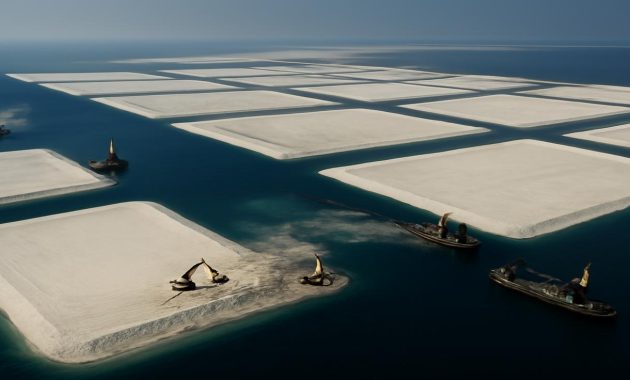
The first time you see a satellite image of the South China Sea before and after China’s island-building campaign, your brain does a small double-take. On the left: a scatter of reefs and turquoise shoals, barely more than ghostly smudges beneath the water’s surface. On the right: airstrips, harbors, neat hexagons of seawall enclosing perfect ovals of beige—land, where there used to be only waves. It looks like someone has taken a digital paintbrush and clicked “fill with sand.” Except this isn’t digital. It’s real, and it has risen from the ocean in just over a decade.
How to Build a Country Out of Sand
Picture a ship the size of a city block, its hull stained the dull brown of churned-up seabed. This is a cutter-suction dredger, the workhorse of China’s grand experiment in making land appear where nature never intended it. It drops its massive arm into the seafloor, chews through sand, silt, shell fragments, pulverized coral, and pumps the slurry up through thick pipes as wide as a small car.
At the other end of those pipes, a pale river of liquid earth pours into the shallows, billowing into the lagoon like smoke underwater. Day after day, year after year, this mechanical tide flows, raising the seabed centimeter by centimeter. What was once a treacherous reef—hazard to sailors, cradle of fish and corals—slowly transforms into a raw, shapeless lump of future territory.
China has been doing this not for a weekend project, not even for a five-year plan, but for roughly 12 years of concentrated effort. Tonnes upon tonnes of sand and crushed coral have been pumped, bulldozed, and compacted into existence. Under the drone of engines and the metallic clatter of construction, a new geography has been drafted: Mischief Reef, Subi Reef, Fiery Cross Reef—names that used to live only on nautical charts as half-submerged dangers are now recognizable as islands with runways, buildings, radar domes, even solar panels gleaming in the tropical sun.
From high above, they look almost tidy. From sea level, they are something stranger: freshly minted edges of a nation, still smelling faintly of diesel and wet concrete.
The Ocean Remembers What Used to Be There
Before the dredgers, these were not empty spaces. The South China Sea is a cradle of life, its reefs the underwater equivalent of rainforests—dense, intricate, stubbornly alive. At dawn, waves would comb over coral heads the size of small cars, where parrotfish grazed like underwater goats, nipping algae from the rock. Schools of damselfish dotted the water like confetti. Turtles rested in the shade of branching corals while reef sharks patrolled the deeper channels, all teeth and effortless grace.
To build an island here is to erase that world layer by layer. The cutting heads grind through coral skeletons laid down over centuries. Silt clouds billow outward, veiling the reef in a suffocating haze. Corals, which need clear water and light, choke. Fish vanish. Crustaceans burrow deeper, then deeper still, running out of places to hide.
Scientists in the region speak softly, almost mournfully, of what’s been lost. Each new patch of artificial land doesn’t just cover coral; it reshapes currents, alters sediment flow, and changes how waves slap against the few remaining natural reefs. In places, the water has gone from crystal to cloudy, from neon fish-swarms to a quiet emptiness broken only by the occasional jellyfish pulsing through the gloom.
And yet, even here, life is stubborn. Barnacles cling to the new seawalls. Algae slick the concrete, turning gray surfaces green and slippery. In the shadow of a runway, a small school of fish finds shelter among the rocks used to armor the island’s edge. Nature adapts, reshuffling the deck it’s been handed, even if the cards are newly made of steel and cement.
Why Build Islands in the First Place?
Strip away the haze of diesel, the turbidity of stirred-up seabeds, and you’ll find something very human underneath: power, security, resources. The South China Sea is one of the busiest shipping lanes on Earth, a watery highway for tankers and container ships carrying goods that end up in the phones, cars, and kitchen drawers of half the planet. Beneath those waves lie oil and gas reserves and some of the world’s most productive fishing grounds.
For decades, multiple countries have claimed slices of this sea, lines on maps colliding like overlapping fingerprints. Reefs and rocks, many no bigger than a city park at low tide, suddenly became strategic prizes. Who owns this patch of water? Where does one nation’s “exclusive economic zone” begin and another’s end?
China’s answer was both simple and radical: if natural territory is contested, make new territory. Turn specks on the map into solid ground. Build airstrips for military aircraft and harbors for coast guard ships. Add radar stations and lighthouses, weather sensors and communication towers. Bring in soil, plant a few shrubs and palms, hang flags, erect signs. This isn’t just sand—it’s a statement.
Over roughly 12 years, the act of pouring sand into the sea became a kind of slow-motion performance of sovereignty. Each new island, each newly extended reef, nudged the lines of presence outward. A reef barely visible at high tide could now host a runway long enough for heavy aircraft; a lagoon once fit only for fishing boats now shelters concrete piers and patrol vessels.
Sailors navigating nearby describe the new silhouettes on the horizon: once, the jagged tooth of a reef; now, the hard geometry of towers and cranes, the blinking of navigation lights, the hum of generators drifting on the wind. Countries around the sea watch and respond—sending their own vessels, filing diplomatic protests, stepping carefully around each other’s moves like players in a high-stakes game whose board is made of water.
The Hidden Arithmetic of Sand and Time
Behind the politics lies a raw physical tally. Each island is a sum of dredger-hours, fuel, engineering calculations, and the sheer weight of moved earth. A cutter-suction dredger can move thousands of cubic meters of sand in a single day. Multiply that by months, then by years, then by an archipelago of targeted reefs, and you begin to sense the scale.
On deck, engineers monitor the mixture: too much fine silt, and the island will slump and settle; too much coarse rubble, and it becomes difficult to shape. Bulldozers crawl across newborn land, their treads leaving neat lines in the damp, beige surface. Surveyors in bright vests stare at monitors and GPS devices, watching elevation profiles inch upward, transforming numbers into something you can stand on.
For the people on these crews, the work is often framed as a kind of grand civil engineering project—no different, in principle, from reclaiming land along a coastline for a new port or extending a city into the sea. Land reclamation is not unique to China; you can see its results in Singapore’s expanded shoreline, in Dubai’s palm-shaped islands, in airport runways perched on man-made peninsulas.
But there is a difference in mood, if not in method, when the project sits atop a contested reef in blue water, ringed by naval patrols and buzzing with the attention of the world. Here, every grain of sand carries a whisper of strategy.
| Aspect | Before Island-Building | After 12 Years of Sand Dumping |
|---|---|---|
| Landscape | Shallow reefs, submerged rocks, small sandbars at low tide | Permanent islands with runways, buildings, and seawalls |
| Ecosystem | Rich coral reefs, diverse fish and invertebrate life | Heavily altered seabed, fragmented or lost coral habitats |
| Human Presence | Occasional fishing boats and patrols | Permanent facilities, airstrips, harbors, and personnel |
| Strategic Role | Distant, disputed maritime features | Forward bases projecting power and presence |
Living on New Land
Imagine waking up on an island that did not exist when you were a child. The dawn light comes differently here. It glances off fresh concrete, off the glass of new windows, off radar domes and antenna masts. In the distance, the horizon is an almost-perfect line, broken only by passing ships and the heat shimmers rising from the runway.
For the personnel stationed on these outposts—soldiers, engineers, technicians—life is oddly ordinary in the midst of the extraordinary. There are mess halls and bunkrooms, laundry schedules, maintenance checklists, Wi-Fi routers humming in corners. There’s the clatter of chopsticks at dinner, the murmur of video calls home, the daily rituals that anchor any isolated post.
But step outside the compound, and the strangeness returns. Walk to the edge where the island meets the sea, and the land beneath your boots feels almost provisional, as if the right storm could remember what this place was and wash it all away. Breakwaters rise in angular rows, great concrete blocks stacked like children’s toys on a monumental scale, their only job to absorb the fury of waves.
On quiet days, the sea is a smooth, gentle turquoise, licking at the rocks. On rough days, swells slam themselves against the defensives with a hollow, booming thud that you can feel in your ribs. Every impact is a reminder: this land is an argument with the ocean, and the debate is ongoing.
Beyond the artificial shoreline, the water darkens quickly. Fish sometimes flash silver just below the surface; seabirds wheel and dive, taking advantage of the structures as perches and hunting towers. Over time, the edges of human design blur. Rust creeps in, cracks spiderweb in concrete, paint fades under the relentless sun and salt.
The Cost in Saltwater and Silence
Stand on one of those new seawalls at dusk and the view is almost hypnotic. Bands of color bleed into one another—the bruised purples of incoming night, the molten orange where the sun kisses the horizon. Ship lights blink like distant stars on the water. It is easy, in such a moment, to forget everything that underlies this quiet beauty.
Beneath you, the coral gardens that once were here are gone or severely damaged. Species that fed, bred, and sheltered in these reefs may never return in their old abundance. Local fishers from neighboring countries tell stories of catches that have dwindled, of grounds made off-limits or simply emptied out. The ocean may look the same from the surface, but its inner architecture has been bulldozed and rearranged.
Marine biologists talk about “shifting baselines”—how each generation accepts the degraded state of nature they inherit as normal. A child born today, seeing satellite images of the South China Sea, will grow up with those new islands as part of their mental map. The reefs that preceded them will exist, if at all, only in old photos and scientific reports.
Yet the ocean is not just a victim here; it is also a quiet engineer. Over time, waves will grind the edges of these islands, redistributing sand, challenging the stability of every carefully calculated contour. Storm surges, supercharged by a warming climate, will test the seawalls. Rising seas may gnaw at the margins, forcing further reinforcements, more concrete, more rock—more negotiation between water and will.
What These Islands Tell Us About Ourselves
There’s a temptation to view China’s island-building in the South China Sea as something uniquely audacious, a singular project of a single nation. But look closer, and it becomes a mirror, reflecting back a pattern much older and more widespread: when humans want more space, we take it—from forests, from rivers, from wetlands, and now, quite literally, from the sea.
Reclamation and construction on coastlines are happening all over the world. Ports expand, cities seek new land for housing, luxury resorts reach outward into shallow bays. The tools may vary, the justifications may differ, but the underlying impulse is recognizably the same. The difference here is the scale, the speed, and the way these islands knit together geopolitics, ecology, and engineering into one stark image.
They are proof of what modern machinery and centralized will can do: create brand new islands from scratch in barely more than a decade. They are also a warning about what is sacrificed along the way, and how easily the fluid, living spaces of the ocean can be turned into fixed, fortified ground.
When you look at those before-and-after satellite images, you’re not just seeing sand and concrete. You’re seeing a story about how we understand ownership, how we weigh the value of living reefs against runways and shipping lanes, how far we are willing to go to redraw the edges of our maps.
The ocean has always seemed, to land-dwellers, like a wild, untamable other. But here, in the South China Sea, we see a different idea taking shape: that even the sea can be made to hold our weight, that with enough pumps and pipes and persistence, water can be persuaded to become land. For now, the islands hold. The flags flutter. The runways gleam under the tropical sun.
Somewhere below, in the darkened spaces where reefs used to glow, the sea waits and remembers.
Frequently Asked Questions
How did China actually create these new islands?
China used large dredging vessels to suck up sand and crushed coral from the seafloor and pump it onto shallow reefs and shoals. Over time, this material was piled high enough to rise above sea level, then compacted, shaped with bulldozers, and reinforced with seawalls and concrete structures.
How long did the island-building process take?
The most intense phase took place over roughly 12 years, during which reefs that were once barely visible at low tide were transformed into permanent, fully built-up islands with airstrips, harbors, and buildings.
What is the environmental impact of this sand dumping?
The impact is severe. Dredging destroys coral reefs, smothers marine life in clouds of silt, and alters local currents and sediment patterns. This can lead to the loss of fish habitats, declines in biodiversity, and long-term damage to the health of the surrounding marine ecosystem.
Why did China build these islands in the South China Sea?
The islands serve strategic and political purposes. They strengthen China’s presence in a heavily contested area rich in shipping lanes, fisheries, and potential oil and gas resources. By turning reefs into functioning islands with infrastructure, China reinforces its territorial claims and projects military and civilian power.
Are other countries doing similar projects?
Many countries engage in land reclamation along their coasts—for ports, airports, and urban expansion. However, the scale and geopolitical sensitivity of China’s island-building in the South China Sea, on disputed reefs far from its mainland coast, make this project especially controversial and closely watched.
Originally posted 2026-03-06 00:00:00.