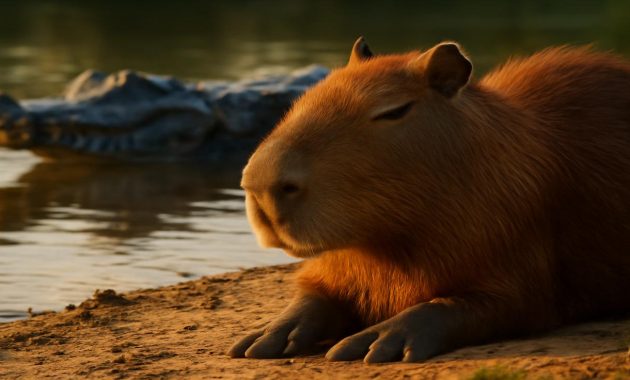
The river is quiet until it isn’t. First you notice the sound: a soft, wet chewing, like someone working through a stalk of celery one patient bite at a time. Then the shapes appear. Brown, barrel-bodied capybaras are half-submerged at the water’s edge, whiskers beaded with droplets, orange teeth grinding rhythmically on grass. Just beyond them, sinister shapes glide through the greenish water—only eyes and ridged snouts visible. Crocodiles. Close. Too close, you think. Any nature documentary logic in your head screams: This is the part where something dies.
But nothing happens.
The crocodile drifts by like a log. One capybara glances up, flicks an ear, and then goes back to grazing. Another shuffles sideways to make room, almost brushing against the reptile’s scaly flank. The predator—this ancient, famously ruthless predator—simply slides past in silence and disappears into the glare of sun on water. The capybaras keep eating, unbothered, as if their riverine roommate were just part of the scenery.
If you’ve ever seen footage from South America showing capybaras practically lounging around crocodilians, you’ve probably had the same question: why on earth do crocodiles not eat capybaras more often? Is it a friendship? A truce? A misunderstanding? Or is the truth stranger—and more practical—than any feel-good wildlife meme?
The Myth of the Gentle Crocodile
Before we go any further, it’s important to clear something up: crocodiles can and sometimes do eat capybaras. There are records of it, there is footage of it, and the anatomy of a crocodile leaves absolutely no doubt that a capybara fits squarely within its culinary capabilities. Crocodiles are opportunistic carnivores; if something meaty wanders too close, they are fully equipped to turn it into lunch.
So the better question isn’t “Why do crocodiles not eat capybaras?” but rather: “Why do crocodiles so often seem to ignore capybaras when they’re right there?” That shift in wording takes us away from fairy-tale ideas of cross-species friendship and into the gritty, fascinating realm of energy budgets, risk calculations, and the messy reality of living side by side in the same habitat.
In the wetlands and rivers of South America—where capybaras share waters with caimans and, in some areas, true crocodiles—what you’re seeing is less a peace treaty and more an uneasy, constantly renegotiated détente. It just so happens that, most of the time, both animals have better things to do than try to eat one another.
Predators, But Not Psychopaths
We have a habit of imagining predators as relentless, bloodthirsty machines. The more accurate picture is far less cinematic: predators are accountants. Every potential meal is a math problem. How much energy will it take to catch this thing? How likely am I to get injured? What are the odds I’ll succeed? And crucially: do I actually need the food right now?
Crocodiles are masters of low-energy living. They are ectothermic, meaning they rely on the sun and ambient temperature for heat rather than burning calories internally like mammals. They can survive long stretches between meals. A big meal can last them days or even weeks. Hunting if you’re not hungry is a bad bet: it burns energy, increases risk, and offers no guarantee of a payoff.
That’s the first piece of the puzzle. When you see crocs and capybaras hanging out peacefully, you might be witnessing a simple fact: the crocodiles are not in the mood to hunt. Just because someone can eat doesn’t mean they should or will eat, especially in the harsh arithmetic of the wild.
The Risky Business of Hunting Capybaras
From a distance, a capybara looks like easy prey: slow, rotund, and deliciously herbivorous. Up close, the story changes. Adult capybaras are surprisingly large—about the size of a medium dog, but stockier and heavier, often weighing between 35 and 70 kilograms. They have powerful legs, sharp teeth, and a body built for explosive sprints and sudden dives into water.
Now imagine you’re a crocodile. You’re already in the water, true, but your ideal hunting conditions aren’t “anything that moves.” You prefer ambushes on animals drinking at the water’s edge or crossing deep water where you have maximum control. A capybara standing with a group on a shallow bank, all eyes and ears alert, is not a simple target.
Group Eyes, Group Alarm
Capybaras are profoundly social. They live in family groups, sometimes large herds, dotted along riverbanks and wetlands. Their cooperative living comes with built-in security: many eyes, many noses, many ears. One individual can mess up. Twenty are far less likely to miss a lurking shape or an incorrect ripple on the water’s surface.
When a capybara senses danger, its reaction travels like an electric jolt through the group. One sharp bark—loud, abrupt, almost dog-like—and the whole troupe is instantly on high alert. If the threat seems serious, they won’t hesitate: into the water they go, or up the bank and into vegetation, in a burst of speed that would surprise anyone who assumed “world’s largest rodent” meant “slow.”
This social vigilance raises the cost for a crocodile. Ambushing a lone animal drinking at a quiet spot is one thing. Attempting to grab a capybara in front of a dozen watchful companions who will dive and scatter at the first sign of trouble is another. Even if you catch one, the chase will be short but explosive, requiring energy and precision. A miscalculation can mean a wasted burst of effort—or even injury.
Capybaras: Not Just Land Animals
Spend a little time watching capybaras by water, and your mental category for them begins to shift. They are not merely land animals that visit water; they are semi-aquatic specialists, just as at home in the shallows as they are on the riverbank. Their toes are slightly webbed. Their eyes, ears, and nostrils sit high on their heads, allowing them to swim with barely more than the top of their skull exposed.
In the same waters where crocodilians reign, capybaras have evolved as nervous neighbors rather than guaranteed victims. They don’t just flee to water—they live in it, nap near it, and mate around it. Over countless generations, river life has sharpened their reflexes, tuned their senses, and rewarded those best able to read the subtleties of crocodilian behavior.
Reading the River, Reading the Croc
Not all crocodile behavior is the same, and capybaras appear to respond to that nuance. A resting crocodile basking in the sun on a log is a very different kind of threat than one lying low in cloudy water near a game trail. Over time, animals that share a habitat develop a sort of “behavioral literacy” toward one another—a recognition of what movements signal real imminent danger and what movements can be safely ignored.
Capybaras are quick learners. In areas where crocodilians and capybaras coexist year-round, young capybaras grow up steeped in this code. They learn where crocs tend to bask, what distances feel safe, and how to distinguish a drifting, full-bellied reptile from a tense, hungry one.
The result can be surreal to a human observer: a capybara chewing calmly only a few body lengths from a crocodile, perfectly aware of the reptile’s presence, but equally aware that right now—at this hour, in this temperature, with this body posture—that crocodile is unlikely to launch an attack. It is not trust. It is a practiced, species-wide habit of risk calculation.
Abundance, Alternatives, and the Lazy Hunter
There’s another reason you see so many near-misses: in many wetlands and rivers, crocodilians simply don’t need to gamble on tricky prey like adult capybaras. Life in the water can be bountiful. Fish, carrion, birds, smaller mammals, even reptiles—many of these meals require less effort and carry less risk than wrestling a panicking, kicking, 60-kilogram rodent.
Predators tend to follow the path of least resistance. If smaller prey is abundant and easy to catch, why risk going after something big and wary? For a crocodile, grabbing a fish or a young, clumsy animal that drifts too near the surface makes more sense than launching out of the water toward a vigilant herd of capybaras bristling with nerves.
| Factor | For Crocodile | For Capybara |
|---|---|---|
| Energy Cost | High for chasing a large, alert animal. | High for constant vigilance, but shared in group. |
| Risk of Injury | Bites, kicks, or failed ambush can cause harm. | Attack could be fatal; running and diving are safer. |
| Alternative Options | Often easier prey available (fish, small animals). | Multiple escape routes (water, burrows, vegetation). |
| Group Advantage | Ambush harder against a herd with many eyes. | Early warning, synchronized escape, shared vigilance. |
In wildlife footage, those calm, sunlit moments of apparent cohabitation usually take place in seasons of plenty—warm weather, high water, abundant food. Everyone is eating well. Nobody is desperate. In leaner times, or in different contexts, that tranquility can crack. A hungry crocodilian will not hesitate to take a chance on a capybara that’s slow to react or isolated from the group.
The Quiet Power of “Good Enough”
One key to understanding nature is realizing that “good enough” often beats “perfect.” Crocodiles and capybaras don’t have to craft an ideal relationship. They simply need a dynamic that keeps both species viable. For crocodiles, a strategy of mostly ignoring healthy, cautious adult capybaras while focusing on easier prey works fine. For capybaras, a strategy of hyper-vigilance, group living, and escape over combat works fine.
This “good enough” pattern creates the illusion of something more peaceful than it is. From the human side of the riverbank, it’s tempting to tell a softer story—one where ancient monsters have learned compassion. But the reality, while less sentimental, is arguably more beautiful: a finely tuned coexistence born of countless generations of trial and error, where eating and not eating are both decisions sharpened by the same relentless pressure—survival.
Why We Love This Odd Relationship
Part of the charm of the crocodile–capybara relationship is how it defies our expectations. We grow up on nature documentaries organized around straight lines of conflict: predator versus prey, chase versus escape, winner versus loser. When we see those script lines blur—when a known predator lounges next to a known prey animal without violence—it unsettles and delights us at the same time.
Some of that delight is projection. Capybaras have become the internet’s favorite “chill” animal, a sort of gently blinking, semi-aquatic buddha. Images of birds perching on their backs, monkeys grooming them, and yes, crocodilians relaxing beside them have gone viral for years. We map our own longing for peace, tolerance, and calm onto these scenes. If a crocodile can relax next to a capybara, maybe, we joke, there’s hope for our own fractious species.
But underneath the memes lies a more serious draw: these scenes remind us that ecosystems are not staged dramas with clear heroes and villains. They’re complicated neighborhoods. Crocodiles are not mindless killers. Capybaras are not helpless snacks. They are co-tenants of a shifting, living system of mud, water, grass, and sun, where every move has a cost and every quiet afternoon is the result of a long history of invisible negotiations.
Coexistence, Not Friendship
It’s important, though, not to confuse coexistence with friendship. Capybaras don’t seek “company” from crocodilians. They seek water, grass, and safety in numbers, which just happen to overlap with the ideal habitat for crocodiles and caimans. Likewise, crocodiles don’t “respect” capybaras as neighbors. They simply respond to risk and opportunity.
Yet out of these overlapping needs, something that looks remarkably like tolerance emerges. Day after day, in countless rivers and marshes, capybaras and crocodilians share sandbanks, slip past each other in murky channels, and bask under the same hard sun. Violence is always an option, but not always the best option. In a way, that’s a more interesting story than the idea that they’ve chosen peace. Nature rarely chooses; it adjusts.
So, Why Do Crocodiles Not Eat Capybaras More Often?
Walk back to that riverbank in your mind—the one with the lazy chewing, the half-lidded croc eyes, the heat shimmering off wet fur and scales. Freeze the scene and list the invisible forces at play.
The crocodile’s belly is at least partially full. The water is warm. There are fish in the nearby shallows and smaller animals that might drift within snapping range at dusk. The capybaras are numerous, wary, and positioned near multiple escape routes—shallow water, tall grass, well-worn paths. The group’s posture is alert but not panicked; they’ve seen this crocodile, or one very much like it, every day of their lives. Nothing in the reptile’s body language suggests imminent attack. This quiet standoff is, overwhelmingly, the most likely state of affairs.
Put simply, crocodiles tend not to eat capybaras whenever the cost—energy, risk, lost alternatives—outweighs the benefit. Capybaras, for their part, sharpen those costs by living in groups, staying alert, and mastering the same water that crocodiles rule. The end result is a pattern that to us looks improbable: a predator and potential prey sharing space in apparent peace.
The spell can break at any moment. A young capybara wanders off alone. A crocodile endures a long lean spell. Water levels change, concentrating animals in smaller areas. Then the math shifts, and the old rules reassert themselves. The river remembers what it is. But most of the time, on most days, a truce of convenience holds. Teeth and hooves, scales and fur, drifting quietly under the same hot sky, too busy surviving to bother with constant war.
Frequently Asked Questions
Do crocodiles ever eat capybaras at all?
Yes. Crocodilians, especially caimans in South America, do sometimes prey on capybaras. It’s just not as frequent as you might expect from the dramatic way we often portray predators. Attacks are more likely on young, injured, or isolated individuals, or when food is scarce.
Are capybaras actually “friends” with crocodiles?
No. What looks like friendship is really coexistence driven by practical survival strategies on both sides. Capybaras tolerate crocodilians because they must share the same watery habitat, and crocodiles often ignore capybaras because it’s not always worth the effort or risk to hunt them.
Why don’t capybaras just avoid water where crocodiles live?
Capybaras depend on water for safety, temperature control, and access to lush vegetation. Water is their best escape route from many predators, including land-based hunters. Completely avoiding water would actually make them more vulnerable overall, despite the risk of crocodilians.
Are young capybaras more at risk from crocodiles?
Yes. Juvenile capybaras are smaller, less experienced, and easier to catch. Many predators, including crocodilians, target younger individuals because they require less effort and carry less risk than full-grown adults.
Do capybaras benefit in any way from sharing space with crocodiles?
Indirectly, yes. Large predators like crocodiles can help regulate populations of other species that might compete with or prey on capybaras. Also, ecosystems with crocodilians tend to be healthy, water-rich environments—which are exactly the kinds of places capybaras need to thrive.