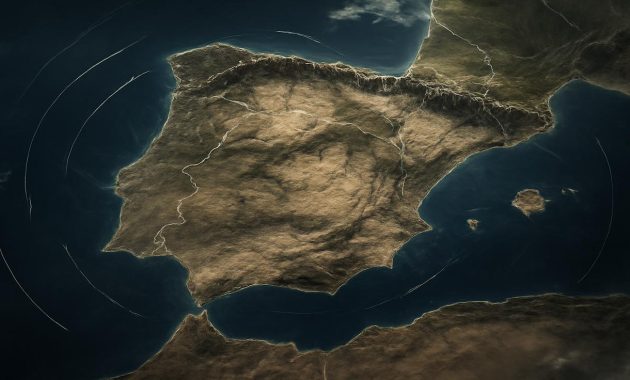
The news broke quietly, like a tremor too faint to rattle dishes yet strong enough to stir the imagination: Spain and Portugal, geologists say, are slowly turning in place. Not racing, not cracking apart in spectacular fashion—just… pivoting. A fraction of a degree here, a millimeter there. The kind of motion you’d never feel beneath your feet, even if you stood barefoot on a Portuguese cliff with your eyes closed and your palms pressed to the earth. Still, for a moment, the idea is unsettling. What does it mean when an entire corner of Europe begins a slow-motion spin? Is this the start of a grand tectonic drama, or another reminder that the planet is restlessly alive even when the surface appears calm?
The Slow Spin Beneath the Vineyards
Imagine driving across the high plains of Castilla-La Mancha, through long rows of vineyards under a sky so wide it seems to lean down and listen. The road hums, the air smells of dry grass and dust and sun-warmed asphalt, and everything feels enduring, almost permanent. In the background, a handful of satellites and high-precision GPS stations are quietly measuring the land you’re crossing—down to the millimeter.
Those measurements, combined across years, are what led geologists to a startling observation: the Iberian Peninsula, which holds Spain and Portugal like a single rough-hewn stone, isn’t just drifting along with the rest of the Eurasian plate. It appears to be rotating ever so slightly, like a slow pirouette in a geological ballet, pivoting relative to its neighbors.
You’d never know it from the olive groves or the stone villages perched on ridges. The earth feels still; the churches haven’t tilted; the ocean horizon looks as straight as ever. But high above these scenes, data traces a story written in tiny increments—motions so subtle they only become visible when stacked up over many years and processed through the patient algorithms of geophysicists.
It’s a strange feeling, realizing that the land you think of as solid ground is quietly turning. Not racing toward disaster, but shifting direction in a way that echoes deep processes carved into the planet’s crust and mantle. To the scientists who study tectonic plates, Iberia’s slow spin isn’t entirely surprising—it’s part of a long history of collision, compression, and sliding boundaries in this corner of the world. To everyone else, it sounds like something out of science fiction: a continent doing a slow dance you can’t see.
The Quiet Clash of Plates
Where Continents Whisper Instead of Roar
To understand why Spain and Portugal are turning at all, you have to zoom out—far out. The Iberian Peninsula sits at the meeting place of two massive tectonic plates: the African Plate to the south and the Eurasian Plate to the north. Where those plates meet, they don’t always collide with the furious energy that builds towering mountain ranges or explodes into daily earthquakes. Sometimes, they nudge. They grind sideways. They compress gently—or not so gently—over millions of years.
Under the waters of the Atlantic, southwest of the Portuguese coast, lies a broad, blurry region where those plates converge. It’s not a simple, clean boundary like the famous San Andreas Fault. It’s a patchwork of smaller faults and zones of deformation, a tangle of geological negotiations where the plates are constantly re-writing their agreement on who moves where, and how fast.
The 1755 Lisbon earthquake—one of the most destructive in European history—was born somewhere in this complex boundary zone. The modern city, with its bright yellow trams and tile-covered facades, grew up in the shadow of that memory. But centuries pass, and human perception drifts. On most days, Lisbon feels serenely anchored. The only motion people notice is the tide licking the edges of the city and the breeze rippling the Tagus.
Yet below the surface, the tectonic plates are still talking. They shift, strain, and settle, sometimes with sharp jolts, often with slow movements too gentle to register on a seismograph. The current rotation of Iberia is one outcome of that subtle, ongoing argument between Africa and Eurasia—a reminder that Europe’s western edge remains a living, moving frontier.
How Do You Measure a Moving Country?
Satellites, Lasers, and the Patience of Rocks
It sounds almost outrageous: claiming that an entire peninsula is turning, based on shifts as thin as a fingernail. But modern geodesy—the science of measuring Earth’s shape and motion—runs on tools that make such claims possible.
Geologists and geophysicists rely on a network of GPS and GNSS (Global Navigation Satellite System) stations cemented into bedrock all across Europe, including Spain and Portugal. These stations don’t move with buildings or soil; they are anchored deep, designed to track only the Earth itself. Each one talks to overhead satellites, constantly reporting its position. Over days, that position seems almost fixed. Over years, a pattern emerges.
To the human eye, Iberia is a single continuous landmass. To the satellites, it’s a mosaic of points that shift relative to each other in microscopic ways. By comparing those shifts to the rest of the Eurasian plate, researchers have noticed that Iberia is not simply marching along in the same direction and speed. It is twisting, ever so slowly, like someone turning a doorknob so gently the latch doesn’t yet click.
The numbers involved are tiny, but they add up. Here is a simplified look at the scales in play:
| Measurement | Approximate Scale | Human Comparison |
|---|---|---|
| Annual shift of Iberia relative to Europe | Few millimeters per year | Growth of a fingernail |
| Rotation over a human lifetime | Tiny fraction of a degree | Barely turning a steering wheel |
| GPS station accuracy | Millimeter-level | Thickness of a credit card |
| Time scale for major tectonic changes | Millions of years | Longer than all of recorded history |
When the measurements are plotted and models are run, they show Iberia turning ever so slightly counterclockwise relative to mainland Europe. This kind of motion is not unprecedented, but it is revealing. It hints that the peninsula behaves like a semi-independent block, squeezed and nudged between larger plates, responding to ancient scars in the crust and deep forces in the mantle.
For scientists, this is a puzzle worth savoring. For everyone else, it raises a more blunt question: should we be worried?
Alarm, Shrugs, and the Space Between
Why Reactions Are Splitting Like Fault Lines
When the story of Iberia’s subtle rotation trickled into the media, the reactions fell into two familiar camps. On one side, alarm: is this a sign that Spain and Portugal are in danger of big earthquakes, tsunamis, or some future collision that could reshape the map of Europe? On the other side, indifference: if nothing dramatic is happening tomorrow, why should anyone care that the ground is inching around?
The truth lives in the space between those extremes.
First, the reassurance: a slow rotation of a few millimeters per year does not mean that Barcelona is going to slide into the sea or that Lisbon will wake up on a different latitude next month. These motions are part of a long-term tectonic conversation, unfolding over millions of years. In human terms, they are background noise—important to scientists, but almost invisible to our day-to-day lives.
However, “background” does not equal “irrelevant.” Subtle motions can build stress along faults. Over centuries, that stress may be released in sudden earthquakes, just as a quietly tightening spring eventually snaps. Iberia is not on the same level of seismic risk as Japan or Chile, but it is not geologically quiet either, especially in parts of southern Spain and southwestern Portugal. Every new insight into how the peninsula moves helps refine estimates of where and how that stress might concentrate.
The alarm tends to come from imagining this motion as something new and ominous, like a sudden twist in the Earth’s behavior. In reality, though, it’s better understood as a clearer view of a process that has been going on for a very long time. Modern instruments are simply letting us see the planet’s slow choreography with new precision.
The indifference, by contrast, misses an opportunity. Understanding these tiny shifts isn’t just an academic hobby—it feeds into better building codes, smarter urban planning, and a more honest relationship with the landscapes we inhabit. To live on a moving planet and not want to know how it moves is a kind of willful blindness, like ignoring the weather because the sky looks fine today.
Living on a Restless Map
From Ancient Seafloors to Future Mountains
Walk along the coast near Sagres, at the southwestern tip of Portugal, and the cliffs tell stories that run deeper than any news headline. Layered limestone, fossil shells, ancient sediments that once settled quietly on the floor of forgotten seas—all of it now lifted, tilted, and carved by waves that gnaw at the base of the continent.
The slow turning of Iberia is another line in that story. Long before there was a Portugal or a Spain, this block of crust broke away, drifted, collided, and reattached in a complex journey recorded in its rocks. Geologists read that record like a language: old faults that have reawakened, mountains that rose where seas once were, basins that sank where peaks once stood.
In the far future—millions of years from now—the continued convergence of Africa and Eurasia is expected to reshape the Mediterranean region dramatically. Some models suggest that the ocean basin could close, that new mountain ranges might grow, and that the outline of Europe and North Africa will look as alien to future beings as the supercontinent Pangaea looks to us now. Iberia’s present-day rotation slots into that grand arc, a small but meaningful step in a saga of collision and rearrangement.
For people alive today, the most tangible implications are more modest. Certain regions might bear slightly higher seismic risks than once thought. Undersea faults may be understood with more nuance, shaping tsunami models. Coastal planning could be refined by better projections of how both tectonics and sea level will change shorelines. None of this makes Iberia uniquely endangered—but it does insist that nothing in Earth’s design is truly static.
There is a quiet awe in accepting that. Cities, languages, and borders feel so permanent, yet they rest on slabs of rock that are drifting and twisting on a molten mantle. The map in your school atlas is a freeze-frame in a film with no beginning and no end.
Finding Wonder in the Subtle Movements
The Emotional Geography of a Turning Land
It can be tempting to tuck this kind of information away in a mental drawer labeled “interesting but not urgent” and move on. Yet there’s a deeper, more personal way to sit with the knowledge that Spain and Portugal are slowly pivoting under the sun.
Stand in a plaza in Seville at dusk, when the air cools and the orange trees release their fragrance. Listen to the murmur of voices, the clink of glasses, the footsteps on old stone. Everything feels gloriously immediate: the taste of wine, the color of tiles, the warmth of conversation. And underneath, the ground is moving in its own imperceptible rhythm, unnoticed yet unstoppable.
Or picture a fisherman in Nazaré watching the Atlantic breathe, waiting for the right swell. The waves that crash at his feet are shaped by storms thousands of kilometers away and by the shape of the seafloor, which in turn is molded by tectonic processes so slow they can’t be felt. He lives his life on top of that invisible engine, just as we all do.
Knowing that Iberia is turning doesn’t necessarily change your day. But it can change how you see your place in time. Human stories—wars, revolutions, love affairs, songs—unfold on a stage that itself is in motion. Our ancestors knew the ground as something sacred yet unpredictable. Modern science doesn’t take away that mystery; it gives it new layers of detail.
When geologists talk about a “continental dance,” it’s easy to reduce that to metaphor. Yet in a way, it isn’t. Plates really are sliding, colliding, subducting, and rotating. They move to the rhythms of heat and gravity, of density contrasts and mantle convection. It’s just that the tempo is so slow we can’t hear the music directly. Instruments listen for us, then translate: a millimeter here, a strain pattern there, a subtle twist of Iberia in the grand waltz of the Earth’s surface.
Between Alarm and Acceptance
So where does that leave us, perched on a gently rotating peninsula? Somewhere between alarm and indifference, in a territory that might best be called informed humility.
We know enough to say: no, Spain and Portugal are not about to crack off and drift into the Atlantic like a wayward raft. The slow turn that geologists have measured is part of a vast, ongoing evolution. Its immediate impacts are modest, its timescale far beyond any political cycle or human lifespan.
We also know enough to value this knowledge, to support the quiet work of scientists who spend careers refining our understanding of such subtle processes. Their findings help shape building codes in Granada and Lisbon, influence tsunami preparedness along the Algarve, and contribute to a global map of risk that guides how we build and where we build.
Most of all, though, this story invites a shift in perspective. The solid ground we claim as “ours”—our countries, our cities, our ancestral lands—is part of a restless, creative planet still sculpting itself. To live here is to be passengers on a surface that never quite stops moving, even when the wind is calm and the streets are still.
Spain and Portugal are slowly turning in place. The vineyards keep growing, the waves keep breaking, the plazas keep filling at night as if nothing at all were happening. And in a sense, that’s true: this is how Earth has always been. The real change is not in the land, but in our ability to see—finally, with millimeter precision—what the planet has been doing all along.
FAQ
Is Spain or Portugal in danger because the peninsula is rotating?
No, the slow rotation detected by geologists is not an immediate threat. It happens at a rate of a few millimeters per year and is part of the normal tectonic behavior of the region. It does not mean that dramatic changes will occur within a human lifetime.
Can people feel this movement?
No. The motion is far too small and gradual to be felt. It is only detectable with highly sensitive instruments like GPS and GNSS stations that measure position changes over many years.
Does this increase the risk of earthquakes in Iberia?
The Iberian Peninsula already has some level of seismic risk, especially in the south and southwest. The rotation itself doesn’t create a brand-new danger, but understanding it helps scientists refine where and how stress might build up along existing faults.
Is Iberia breaking away from Europe?
Not in any way that matters for human timescales. The peninsula behaves as a semi-independent block within the larger Eurasian plate, but there is no sign that Spain and Portugal are about to detach and drift into the Atlantic.
Why should ordinary people care about such slow tectonic movements?
These subtle motions help shape long-term seismic and tsunami risk assessments, which inform building codes and emergency planning. Beyond safety, they offer a deeper understanding of the dynamic planet we live on and remind us that even the most familiar landscapes are part of a much larger, ongoing story.