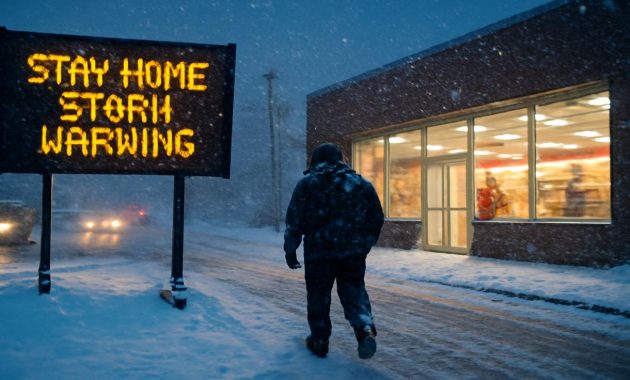
The snow starts like a rumor—soft, uncertain, drifting in slow, sideways slants through the streetlights. It’s a Tuesday evening that already feels like it’s holding its breath. Overhead, the clouds are thick as wool and the air has that bright, metallic cold that stings the inside of your nose. The weather alerts have been chiming all afternoon: “Heavy snow begins tonight… hazardous travel… avoid driving if possible.” But if you stand on the sidewalk and listen, you’ll hear a different message humming from behind the glass fronts of fast-food chains, retail stores, and office parks: “We’re still open.”
The First Flakes and the First Dilemma
On a side street just outside the downtown core, Maya zips her coat up to her chin and tugs at the edge of her beanie, watching the first flakes cling to the shoulders of parked cars. Her phone buzzes in her pocket—another weather notification, another plea from city officials to stay off the roads after 9 p.m.
She’s on the late shift at a big-box store near the highway. Her manager’s group text had come through an hour ago: “We are planning to remain OPEN as scheduled. Please do your best to report for your shift. Use your judgment and stay safe.” It’s that last line that makes Maya grit her teeth. “Use your judgment,” as though judgment can stretch into a spare paycheck, as though safety and rent are equally weighted choices.
Across town, in an office with fluorescent lights buzzing faintly overhead, Darren is clearing his desk. The windows are dark, the sky above them a gray sheet. His supervisor leaned into the doorway earlier and said, “We’ll monitor the storm. Plan on regular hours tomorrow unless you hear otherwise.” His commute is forty minutes in good weather. The forecast says eight to twelve inches by morning, maybe more if the wind shifts.
Outside, the flakes gain confidence, growing fatter and falling faster. They land on asphalt and vanish, but on the colder surfaces—porch steps, trash can lids, the hoods of idling cars—they linger, knit together, begin to build. Somewhere between the radar models, the accident statistics, the cautious language of press conferences, and the pushy emails about “business continuity,” people like Maya and Darren are being quietly handed a choice that doesn’t feel like a choice at all.
The Official Warning vs. the Open Sign
At 6:12 p.m., the city’s transportation director stands in front of a podium at the emergency operations center. Behind him, a projector shows swirling bands of blue and purple sweeping toward the region. He leans into the microphone, his voice steady but edged with urgency.
“We are expecting extremely hazardous conditions on the roads tonight,” he says. “Snowfall rates could exceed two inches per hour. Visibility will be low, and winds will cause drifting and whiteouts. If you can stay home, please stay home. Do not drive unless absolutely necessary.”
The cameras record every word. The clip will run on the evening news, circulate on social media, land in tiny rectangles on people’s phones while they’re standing over stoves or folding laundry. It will be watched by residents who have the privilege to rearrange their schedules, to work from home, to call in and say, “You know, I think I’ll sit this one out.”
But if you walk just two blocks away from the press conference, a different story is unfolding in the glow of storefronts. “Open” signs burn bright red against the softening dark. A pizza place is running a “Storm Special: 20% Off Deliveries.” The chain pharmacy has a sign taped to the door: “We’ll be here for your needs—rain, shine, or snow!” Cars creep in and out of the lot, tires already beginning to squeal on the thin, slick coating forming on the pavement.
Inside a coffee shop, the barista, Leo, wipes down the counter and glances at the clock. “We close at ten,” his manager reminded him. “Unless there’s, like, a full-on blizzard. We’ll assess.” The blizzard is precisely what the city has been promising. But “assess” means different things depending on whether you’re in charge of payroll or whether you’re counting tips to buy groceries.
Snow as a Stage: The Quiet Politics of Weather
Snow, in stories, is often a backdrop—romantic, dramatic, peaceful. But in cities and towns that lean hard on the gears of hourly work, winter storms are something else entirely. They’re a spotlight, throwing into sharp relief who gets to heed the warnings and who has to gamble with them.
As the evening settles into night, the storm begins to show its true shape. The snow is no longer hesitant; it comes down in thick curtains, swirling under streetlights like a shaken snow globe. The sound of the city softens. Tires hiss on the roads. Air brakes from a distant truck sigh into the dark. Somewhere, an ambulance wails, its red pulse smeared by the falling flakes.
On the highway’s edge, a convoy of plows lines up at the depot, orange beacons blinking. The drivers huddle in reflective jackets, breath fogging, hands wrapped around gas station coffee. Their job is officially essential. No one tells them to stay home; no one needs to. The city doesn’t move without them.
But just down the service road, in the parking lot of a 24-hour supermarket, employees trudge through deepening snow in thin sneakers and thick uniforms. Their cars are already gathering white caps on the roofs. “We’ll close early if it gets bad,” they’ve been told for the last three storms. Each time, “bad” arrived long before the locked doors and the darkened aisles.
The snow itself is indifferent. It doesn’t care whether it wraps itself around a spruce branch in the park or buries a sedan stuck at an intersection. But people have built a world where weather has a chain of command. Meteorologists warn, officials advise, executives decide, managers relay, workers absorb. Somewhere in that chain, “your safety matters” often gets lost between “we value our customers” and “we can’t afford to close.”
When the Commute Becomes a Calculated Risk
For many workers, the storm’s true danger is measured not in inches of snow, but in questions that tighten their throats: Will I get written up if I don’t come in? Will I lose this job? Can I risk a night on these roads, or can I risk a month without a paycheck? Snow becomes not just a forecast, but a test.
Imagine the drive through this storm from behind the wheel. The wipers slap back and forth on high, barely keeping the windshield clear. Snow rushes toward you in streaks, an endless tunnel of white lines, dizzying. The road markings vanish; the asphalt becomes a featureless pale band. Your world shrinks to the two red dots of taillights in front of you, if you’re lucky enough to have a car to follow.
This is the commute many workers are weighing against a supervisor’s casual “We’ll be open unless you hear otherwise.” They have heard otherwise—from the weather service, from the mayor, from the nervous prickle in their gut as they watch the snow mount on porches and window sills. But the message from their paycheck is louder, closer, more personal.
A Night That Belongs to the Snow—and to the Workers Still Out There
By 9 p.m., the storm is in full voice. Snowfall rates climb. Plows scrape down avenues, sparks flashing briefly as steel meets buried manhole covers. The city’s noise is muffled, but not gone. Out on the arterial roads, headlights stab through the white; brake lights flare as drivers inch down exit ramps that might as well be ski slopes.
At a warehouse on the edge of town, a loading dock door grinds open. Cold air spills inside, sharp and immediate. Workers in neon vests pull on gloves, preparing to help unload a truck that has somehow made its way through the storm. Their shift doesn’t stop for snow. Packages still move. Orders still need to be filled. The supply chain doesn’t care what’s drifting onto windshields.
In a small apartment across from a bus stop, a home health aide named Rosa pulls on her boots. Her patient is an elderly woman who lives three miles away and needs help getting out of bed, taking evening medications, eating dinner. There’s no debate in Rosa’s mind; she goes. “I can’t just not show up,” she tells her sister in a quick call, watching big, slow flakes paste themselves to the bus shelter glass. The bus is late. The snow is not.
Some jobs do not pause when snow falls—hospitals, emergency services, shelters. For those workers, the question isn’t whether to go in; it’s how to do it as safely as possible. But for many others, the line between “essential” and “expected” is fuzzier, shaped more by profit margins than by need.
The storm outside swallows sirens and horn blasts, turning them into distant, mournful sounds. Up and down blocks of restaurants, retail chains, salons, and offices, lights are still on. Each glowing window holds its own story of negotiation, of silent worry, of quiet resentment. Each one is a tiny, human contradiction to the official line: “Please, stay home if you can.”
Numbers Behind the Flakes: A Quiet Accounting
By midnight, snow has stacked in soft, uneven drifts. On rooftops and railings, it’s eight inches deep, maybe ten in wind-swept corners. The snowplows are in near-constant motion, carving temporary lanes through an ever-falling river of white. Yet the real calculation is happening elsewhere—in group chats, in late-night texts between coworkers, in managers’ spreadsheets and workers’ overdrawn bank accounts.
For every storm like this, there’s an invisible tally sheet of risk and loss. A worker who spins out on an icy on-ramp and has to pay for a tow. A parent who stays home and loses a day’s wages. A business owner who closes early and watches a day’s profits disappear. The weather becomes a ledger, the snowflakes tiny entries piling up in columns labeled “safety,” “income,” “duty,” “fear.”
Consider how a single storm can fracture experiences across a city:
| Perspective | What They Hear | What It Really Means |
|---|---|---|
| City officials | “Stay off the roads if possible.” | Please don’t overload emergency services with preventable accidents. |
| Business owners | “We plan to remain open.” | We can’t afford to lose a day of revenue. |
| Hourly workers | “Use your judgment about coming in.” | You’ll bear the consequences, whichever choice you make. |
| Salaried remote workers | “Work from home if needed.” | The storm is an inconvenience, not a financial threat. |
| Emergency staff | “All hands on deck.” | Your presence is non-negotiable—and vital. |
The storm reveals a kind of quiet stratification. Frost flowers bloom on the windows of warm home offices where laptops glow and meetings migrate smoothly online. A few miles away, a grocery cashier calculates whether the extra “weather pay” of a dollar more per hour is worth the black ice on the bridge they have to cross at 11 p.m.
The Thin Line Between Choice and Pressure
Listen closely to the language that surfaces during storms like this. “We encourage you to stay safe.” “We respect your judgment.” “We will not force anyone to come in.” On paper, it’s a chorus of care. But beneath each phrase lurks a set of understood, unwritten rules that workers know too well.
They know that “optional” often isn’t. That “no pressure” can transform into fewer hours next week or a slower path to promotion. They have seen colleagues subtly sidelined after “unreliable” weather decisions. The risk isn’t just on the roads; it’s in the power imbalance built into their jobs.
Snow may blanket a city in sameness, but it doesn’t land on everyone’s life the same way. For some, it’s an inconvenience, a backdrop for photos, an excuse to bake something slow and comforting in the oven. For others, it’s a gauntlet thrown down between them and their next paycheck.
Morning After: What the Snow Leaves Behind
By dawn, the city is almost unrecognizable. Cars on side streets are transformed into rounded, anonymous mounds. Trees bow under the weight of white. The early light is blue and sharp, bouncing off every surface until the world seems overexposed.
Out on the main roads, the plows have carved channels of brownish slush between walls of snow. Salt crystals crunch underfoot along sidewalks. The storm has done its work. Now the second shift begins—the cleanup, the reopening, the reckoning.
In a meeting room somewhere, a leadership team congratulates itself on “resilience” and “continuity of operations.” “We stayed open through the whole thing,” someone says, pride in their voice. Maybe they did. Maybe that’s considered a victory.
But elsewhere, the storm’s real report card reads differently. It’s a nurse who slept on a cot in a hospital conference room between shifts because driving home was too dangerous. It’s a line cook who slid through an intersection on bald tires but made it to work, then stood for eight hours on sore feet and numb toes. It’s a delivery driver who ended up in a snowy ditch and is now staring at a repair bill that will swallow the overtime they earned.
The morning news shows children building lopsided snowmen and dogs bounding through drifts. They rarely show the parking lot where employees scrape thick ice off windshields with credit cards because they can’t afford a proper scraper, or the crowded bus packed with service workers in wet coats, eyes heavy from a night of poor sleep.
Storms like this pass. The snow melts, or it doesn’t; plows push it into gray, gritty piles at the ends of lots. But the memory of who was expected to risk what lingers, even after the streets run clear.
Imagining a Different Kind of Storm Response
There’s another version of this same night that could exist. In that version, the official warnings and the business decisions echo each other instead of clashing. City leaders say, “Stay home,” and companies respond, “We’re closing early; we’ll pay scheduled hours.” Managers text, “We’ll reassess after the storm; your safety is our priority,” and mean it in ways that show up on pay stubs and performance reviews.
In that version, no one has to choose between a snow-slicked commute and a stack of unpaid bills. Buses are free during declared emergencies so essential workers aren’t punished for leaving their cars at home. Hotels near hospitals open discounted rooms for staff. Neighborhood mutual aid groups share rides and childcare. There are policies instead of informal favors; rights instead of whispered arrangements.
Snow could still fall as fiercely, piling up against doors and windows, sculpting the city into soft, unfamiliar shapes. But the moral landscape would look different. The story wouldn’t be one of individuals quietly absorbing the cost of a storm so that the gears of commerce can keep whirring. It would be one of shared risk, shared responsibility, and shared shelter.
The Next Flurry
Tonight’s storm will end. The radar loop will show the final bands spinning away to the east, leaving behind a clear, hard sky pricked with stars. Crews will finish their shifts, shuffling home tired and salt-streaked. Workers who gambled on the drive will exhale in relief—or grit their teeth at the damage done.
And a week from now, or a month from now, another alert will blink onto screens: “Heavy snow expected. Travel could be difficult to impossible. Stay home if you can.” The clouds will roll in, thick and purposeful. Somewhere, a manager will send another message: “We are planning to remain open.”
Between snowflake and sidewalk, between advisory and expectation, there is a narrow space where our choices live. The storm exposes that space, lights it up in the glow of streetlights and hazard flashers and harsh office fluorescents. The question is whether we will let the snow keep writing the same story, or whether we’ll decide that some kinds of risk should no longer belong to the most vulnerable shoulders.
For now, the flakes keep falling, patient and persistent. The streets grow quieter. In living rooms and break rooms and bus stops across the city, people look out at the white-laden world and silently weigh the same calculation: safety or paycheck. Outside, the snow does what snow has always done—blankets, softens, erases. Inside, the choice remains sharp, unfinished, waiting for a different kind of weather in the way we work and live together.
FAQ
Why do officials urge people to stay off the roads during heavy snow?
Because heavy snow drastically reduces visibility, hides ice under slush, and makes stopping distances much longer. Fewer cars on the road mean fewer accidents, less strain on emergency services, and more room for plows and salt trucks to work effectively.
Why do some businesses stay open even during severe winter storms?
Many businesses feel financial pressure to stay open, fearing lost revenue or disappointed customers. Some industries also follow a culture of “always on,” valuing continuity over caution, even when officials warn against travel.
What options do workers usually have if they feel unsafe driving?
Options vary widely. Some workplaces allow remote work or paid storm days; others offer unpaid leave or expect workers to use vacation time. For many hourly workers, the only real choice is to go in, lose wages, or risk their job security.
How can employers better support workers during major snowstorms?
They can close early or fully during declared emergencies, pay scheduled hours, allow remote work where possible, provide clear “no-penalty” policies for weather absences, arrange transportation or lodging for essential staff, and communicate decisions early and transparently.
What can individuals do to prepare for storms when they still have to work?
Keep an emergency kit in the car (blanket, flashlight, snacks, water, phone charger), check tire condition, leave early to drive slowly, use public transit if it’s safer, and communicate proactively with supervisors about conditions. Where possible, workers can also organize to push for formal weather policies that don’t force them to choose between safety and a paycheck.