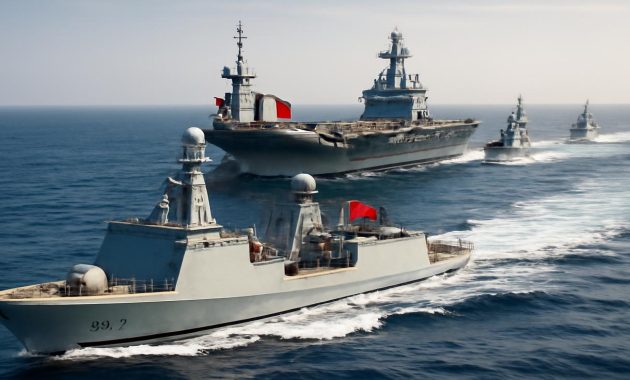
The sea was the color of burned steel when the Moroccan frigate slipped across the horizon, its angular silhouette cutting through the Atlantic haze like a quiet promise. From the cliffs near Casablanca, fishermen shaded their eyes and watched in silence, not quite knowing that the ship dwindling into the distance was carrying Morocco into one of the largest military rehearsals Europe has seen since the Cold War. Somewhere aboard, a young officer leaned on the rail, the salt drying on his lips, watching the Moroccan coast fall away and wondering what, exactly, he was sailing toward—toward France, yes, but also toward a stage where symbolism could be louder than gunfire.
Steel, Salt, and Signals
They named it a “flagship” in official communiqués, but up close, the vessel is less an abstract term and more a living, humming organism of metal, cables, and human nerves. Deck plates thrum underfoot with the vibration of engines. Radar dishes swivel like restless eyes. The faint smell of diesel drifts up through vents, mixing with the salty wind that carries the breath of the Moroccan Atlantic into every corner of the ship.
On the bridge, where the walls are filled with glowing screens and steady, distant beeps, the captain stands with his hands clasped loosely behind his back. He has sailed this route before—joint exercises, port calls, long patrols—but this time has a sharper edge. France has called its allies to assemble for its largest military drill since the old days when maps divided the world into East and West and satellites measured tension in megatons. Those Cold War shadows are supposed to be gone now, replaced by other ghosts: terrorism, cyber threats, a planet warming and fracturing at the seams. But the scale of this drill still feels like a whisper from another era.
Morocco’s decision to send its flagship isn’t simply about coordinating radar frequencies or practicing maneuvers. It is a gesture, a message sent not only across the waves but also through time. It says: We are here. We are watching. We are choosing where to stand in a world that refuses to stay still.
The Long Wake Between Rabat and Paris
At dawn on the second day at sea, half the crew lines the deck to watch a faint line of cloud that marks where the African sky meets its European counterpart. The sun lifts out of the water, pale at first, then blinding, transforming the Atlantic into a mosaic of broken glass. A sailor from Tangier slips a pair of headphones over his ears, music crackling—somewhere between chaabi and French pop—and hums under his breath. The older petty officer beside him tells him to look up, not down.
From Rabat’s stately avenues to Paris’s tree-lined boulevards runs a long, complicated story—woven from empire and independence, suspicion and partnership, arguments behind closed doors, and handshakes in front of cameras. It’s a relationship that can feel, at times, like an old ship itself: patched, repainted, but still afloat. Sending the flagship is not a routine decision for Morocco; it’s a deliberate entry into a play with a global audience.
France’s massive drill—warships, submarines, aircraft wheeling in tight formations, soldiers spilling across training grounds—aims to rehearse the unthinkable: large-scale conflict in an age that pretends it has moved beyond such things. Yet history has a way of circling back. For Morocco, joining the flotilla also means rehearsing its own role in a world of shifting alliances—European, Atlantic, African, Mediterranean—all of them tugging at its shoreline like conflicting tides.
Below deck, in a narrow compartment where cables snake along the ceiling and the air is thick with machine warmth, a technician from Agadir tightens a panel and wipes oil on his coveralls. Someone asks if he’s nervous. He shrugs. “It’s just another mission,” he says. But he looks, just a little too long, at the map pinned to the bulkhead: a rectangle of ocean crisscrossed with routes, arrows, and symbols. Just another mission that hums with history.
Why This Ship, Why Now?
The choice of the flagship is no accident. It carries the best sensors, the cleanest lines of communication, the sleekest expression of Moroccan naval ambition. To send a lesser vessel would look like politeness; to send the flagship is to speak in capital letters. It signals a willingness to be visible, accountable, and measured among peers that include nations with navies older, larger, and more heavily armed.
There’s a kind of quiet theater in these decisions. On paper, officials talk about interoperability and shared security challenges. But beneath the diplomatic script lies a current of identity. Morocco is both African and Arab, Atlantic and Mediterranean, traditional and forward-leaning. Every time its flag rises over a foreign harbor, those multiple selves travel with it.
On the open sea, however, identity condenses into something simpler: a flag in the wind, a radio call sign, the disciplined ballet of ships turning in unison. Under cloudy skies, Moroccan radar operators will watch the blips of French, European, and allied ships move across their screens in organized arcs. On the French side, officers will glance at their own displays and see Morocco’s flagship as a steady companion, a known quantity in a sea of calibrated chaos.
| Aspect | Details |
|---|---|
| Flagship Role | Lead representation of Morocco’s navy in joint operations with France and allies. |
| Drill Scale | Largest French-led exercise since the Cold War, involving multi-domain operations. |
| Strategic Message | Signals alignment, readiness, and commitment to regional and Atlantic security. |
| Training Focus | Naval coordination, air–sea integration, crisis response, and joint command structures. |
| Wider Context | Evolving security landscape in the Mediterranean, Sahel, and Atlantic approaches. |
Onboard Lives in a Moving Country
A warship at sea is a floating village—a country shrunk down and set adrift. In the mess hall, trays clatter and voices tangle in Arabic, French, and the private slang of sailors everywhere. Harira soup shares the table with piles of bread and the occasional French-style pastry smuggled from a bakery in port. In the corner, a small TV replays last week’s football highlights from the Botola league. For a moment, no one is thinking about nuclear-era drills or geopolitical choreography. They’re arguing about a missed penalty.
Nights are the most intimate. The ship’s lights dim to a quieter glow. Outside, the sea becomes ink, sprayed white where the hull cuts a path. Above, the stars—those hard, cold diamonds that mariners have trusted for centuries—burn over the Atlantic. On the forecastle, a lookout pulls his jacket tighter, breath threading out in small ghosts, and peers through binoculars. Behind him, the wake fans out like a long, milky road leading back to home.
Somewhere deep in the hull, near a humming bank of servers and consoles, a young woman in navy blue—one of the newer generation of Moroccan officers—monitors data streams. A blip appears, then settles into a known signature: another allied ship, far beyond the reach of human eyes, but as real as the bulkheads around her. She notes it, logs it, and for just a heartbeat, allows herself a smile. She is part of something larger—larger than the ship, larger even than the drill. She is part of a story of a country learning to speak more fluently in the language of global power.
Echoes of Old Confrontations
It would be easy to tell this story as a straight line: Cold War drills then, Cold War-scale drills now. But the truth is more like a spiral. During the original Cold War, the Atlantic and Mediterranean were both chessboards and minefields. Fleets from NATO and the Warsaw Pact tracked each other in tense, silent dances. Submarines ghosted beneath shipping lanes, invisible but ever-present.
Today, the adversaries are more diffuse. Threats rise from failed states, pirate skiffs, shifting alliances, and the invisible edges of cyberspace. Yet the sheer size of France’s exercise resurrects the scale of an era when generals spoke seriously of world-ending wars. That’s what gives Morocco’s participation a particular weight. It is not merely a regional actor testing its skills; it is an invited collaborator in Europe’s psychological rehearsal for worst-case scenarios.
Somewhere in Rabat, far from the ship’s pitching deck, an analyst scrolls through satellite images and incident reports. He knows that for most citizens, this exercise is a distant abstraction. But he also knows that the passage of a flagship through contested waters, under the watchful gaze of multiple nations, sends ripples through intelligence communities and chancelleries.
Currents Above and Below the Surface
As the drill unfolds, the sea itself becomes a stage. Fighter jets carve contrails across the sky—thin scratches of white dissolving in blue. Helicopters thud overhead, rotors beating a hollow rhythm that every sailor knows in their bones. On the horizon, lines of ships shift formation with choreographed precision, bows rising and falling in rough synchronicity as if answering a shared, unspoken command from the wind.
In the operations room, Morocco’s flagship listens more than it speaks. Dark screens glow with maps layered over maps: air lanes, shipping routes, simulated conflict zones. French voices crackle through the headset, joined by others—different accents all bending toward the same jargon of headings, altitudes, and time-on-target. It is an intricate choreography of trust; one misread instruction, one missed cue, and the entire dance falters.
On the surface, everything is about coordination and control. Beneath it runs another current: the quiet calculation of what this means for tomorrow. Morocco, perched at the western gate of the Mediterranean and the narrow throat of the Strait of Gibraltar, is not just attending a rehearsal; it is reminding the world that its position is not an accident of geography but a card it knows how to play.
A Conversation Without Words
When ships sail side by side, even in silence, they are talking. Their silhouettes, their flags, the way their crews move on deck—everything is a sentence. France, by mounting its largest drill since the Cold War, is speaking loudly to potential adversaries and watchful allies alike: We remember how to do this. We are not rusty. Our networks extend beyond our own coastline.
Morocco’s answer, written in the wake of its flagship, is subtler but no less deliberate: We are on this wavelength. We can plug into your systems, share your burdens, and read your signals. Yet the very act of joining also preserves a margin of independence. A ship is never more sovereign than when it is at sea under its own flag.
Later, in the cramped privacy of his cabin, a Moroccan officer will scribble notes in a small, dog-eared notebook: integration challenges, impressive maneuvers, lessons learned from French and allied crews. But in the margins, he may also write something softer: The way the French carrier glowed at night. The brief moment when dolphins, indifferent to geopolitics, raced alongside the bow, stitching a line of silver through the black water.
From Drills to Docks: What Comes Next
Eventually, all exercises end. The jets return to their bases. The last shell casings from live-fire ranges are swept up. The long lines of ships begin to disperse, each retracing a thread back to its own harbor and its own politics. As Morocco’s flagship turns toward home, the crew feels the change in their bodies—the subtle reorientation that comes with knowing that every nautical mile brings them closer to familiar shores, familiar smells, familiar arguments.
The exercise will live on in after-action reports and evaluations written in careful, understated language. On the surface, the conclusions will address coordination speed, communications resilience, response times. Between the lines, policymakers will parse something less quantifiable: Did this make us closer? Did this make us clearer about where we stand—and with whom?
For Morocco, the return journey carries not just tired sailors and worn ropes but a pocketful of intangible capital. Relationships forged over midnight watches and shared meals. Technical insights gleaned from French systems and doctrines. A stronger claim to being a security partner rather than a passive bystander in the dramas that play out on Europe’s periphery.
The Human Tide Behind the Steel Hull
Back in port, as the flagship eases alongside the quay under the watchful guidance of tugs, families cluster at the edge of the water. Children wave small flags; phones flash in the morning light. The ship, so enormous out at sea, looks oddly vulnerable now, pressed against the concrete like a beached whale temporarily tamed by ropes and bollards.
Faces appear along the rail—unshaven, sun-marked, smiling with that particular mix of exhaustion and pride that lingers after a mission well executed. On the pier, a father in a worn jacket spots his daughter in uniform on deck and raises his hand in a shy, uncertain salute. She responds with a crisp one of her own, then breaks protocol with a quick, irrepressible grin.
Somewhere in the crowd, someone will mention France, the grand drill, the Cold War comparisons. But for most, the conversation will quickly slide back to more immediate concerns: school, work, the price of fish, the football match this weekend. The massive machinery of geopolitics shrinks down, for a moment, into a story about one ship that went away and came back.
Questions That Linger Like Distant Thunder
Yet far beyond the harbor’s arms, the implications of Morocco sending its flagship to join France’s largest post–Cold War drill continue to trail across the water like a long, fading wake. In capitals and conference rooms, analysts map out scenario after scenario. What does this alignment mean for Morocco’s role in Mediterranean security? How does it affect conversations around the Sahel, migration, energy corridors, and the increasingly crowded Atlantic approaches?
On the environmental front, the sea itself carries its own questions. Massive exercises churn the water, roar through the air, and send sonar pulses into depths where whales and other creatures conduct their own ancient communications. Modern drills are increasingly forced to reckon with these invisible costs. Somewhere in the planning documents, among the diagrams of task forces and air wings, there are pages on mitigation measures, ecological impact, and restrictions designed to keep training from becoming outright damage.
Meanwhile, ordinary Moroccans sit in cafés from Oujda to Laâyoune, scrolling through news updates, absorbing headlines in a few seconds before flipping to something else. They may never see the full narrative arc of that flagship’s quiet passage through high politics, old histories, and giant rehearsals for possible futures. But in some subtle way, the country’s sense of itself shifts—just a fraction—every time its ships sail into big, serious games far from home.
A Story Still at Sea
The real meaning of this journey may not be clear for years. It lies in the accumulation of such gestures: joint drills, shared patrols, exchanged officers, long conversations on windswept decks. Today, it is framed as support for France in its most ambitious drill since the Cold War. Tomorrow, it may be remembered as one of many small steps in Morocco’s steady walk toward a more assertive maritime identity.
For now, the flagship rests in harbor, paint scuffed here and there, anchors heavy with the smell of foreign silt. But the sea is patient and persistent. Storms will roll in, calm days will return, and at some point, orders will come again. Lines will be cast off, engines will rumble awake, and the ship will turn its bow toward the open Atlantic, chasing another horizon, another story, another chapter in the long conversation between Morocco, France, and the restless waters that bind them.
FAQ
Why did Morocco send its flagship to the French military drill?
Morocco sent its flagship to underline its commitment to regional and Atlantic security, to strengthen military cooperation with France and allied forces, and to demonstrate the readiness and professionalism of its navy in a large, complex operation.
Why is this drill being compared to the Cold War era?
The exercise is the largest French-led drill since the Cold War, in terms of scale and complexity. It revives large-force maneuvers, multi-domain operations, and high-intensity conflict scenarios that were more common during that earlier period of global tension.
What does Morocco gain from joining such an exercise?
Morocco gains advanced training, improved interoperability with major allies, access to new operational practices, and enhanced diplomatic visibility. Participation also reinforces its role as a key maritime actor at the crossroads of the Atlantic, Mediterranean, and African theaters.
Does this mean Morocco is taking sides in global rivalries?
Participation signals alignment with certain partners—especially France and broader Western security frameworks—but Morocco also maintains a diversified foreign policy. Joining the drill is as much about capacity building and regional stability as it is about signaling political alignment.
Are there environmental or social concerns about such large drills?
Yes. Large exercises can affect marine life, contribute to noise and emissions, and raise questions about resource use. Modern planners increasingly include mitigation measures, but environmental groups and coastal communities often call for more transparency and stronger safeguards.