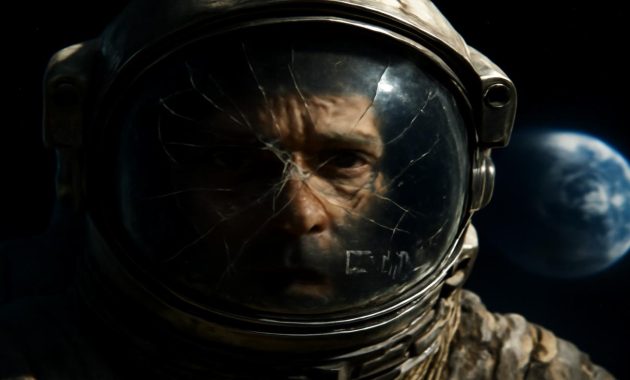
The first thing you notice is the sound that isn’t there. No rush of air past your ears, no hum of engines, no murmur of people. Just the drumbeat inside your chest and the thin hiss of your own breath—until that, too, is gone. A tear floats away from your eye, not falling, just hanging in the ink-black stillness, and for a moment you’re close enough to the ship’s hull to see your own reflection in the curved metal. A human face, pale behind a cracked visor, about to learn what vacuum really means.
You Would Die in Space in 15 Seconds (But Not the Way You Think)
We like to imagine we’re tough. We climb mountains without oxygen, dive into icy lakes, push our bodies through deserts, jungles, and storms. But the moment you step outside a spacecraft without protection, space stops being awe-inspiring and becomes something else entirely—an environment so brutally indifferent that it can strip life away in about the time it takes to sing the first line of your favorite song.
Fifteen seconds. That’s the window.
Not the movie version, where you explode into a red mist or freeze into a perfect astronaut-shaped ice sculpture. The real version is quieter, stranger, and far more unsettling. Your body will cling to life with stubborn determination, even as everything around it—and inside it—begins to fail.
Imagine this more slowly. You’re in orbit. A routine spacewalk goes bad—maybe a micrometeoroid tears your suit, maybe a seal fails, maybe a careless motion sends you drifting away from the airlock. However it happens, your suit decompresses. The pressure drops. The universe, which has been politely kept at bay by layers of fabric, metal, and plastic, steps in.
The First 5 Seconds: Your Breath Becomes the Enemy
The harshest advice you could ever receive in that final moment is also the most accurate: don’t hold your breath. Every instinct screams at you to cling to the air in your lungs, to trap it there, to own this last resource of life. But air under pressure is dangerous when the pressure outside suddenly vanishes.
If you clamp your mouth shut, your lungs become overinflated balloons. The air inside expands violently, searching for a way out. Tiny alveoli—the delicate sacs where oxygen trades places with carbon dioxide—tear open like microscopic paper bags. The damage is catastrophic, and it happens in less than a heartbeat.
If, instead, you exhale, you buy yourself a few more seconds. You let the air rush out, a last ghostly sigh into a vacuum that cannot carry sound. Your chest collapses inward slightly, not from crushing pressure, but from the absence of it. Suddenly, there is no outside force holding your body together, only the tensile strength of your own tissues.
There is no wind. No chill rush. Just nothing.
At this moment—those first five seconds—you’re fully conscious. You can see the curves of Earth below like a blue-green marble smeared with clouds. You can feel your heart hammering, flinging blood through your arteries as if it can outrun physics. But your blood is about to meet the same fate as your breath.
What Actually Happens to Your Body
Vacuum is not cold in the way we understand cold. There are almost no particles to carry heat away from you, no gust of freezing air, no icy touch. If you could somehow survive for minutes instead of seconds, your body would slowly radiate heat away as infrared light. But the immediate threat is not temperature—it’s pressure.
Your body is, essentially, a bag of water and dissolved gases held together by skin, muscle, and bone. On Earth, atmospheric pressure presses gently on everything: your skin, blood, eyes, lungs, even the saliva in your mouth. In space, that invisible hand disappears all at once.
The water in your soft tissues doesn’t boil the way a pot on a stove does. Instead, it begins to ebb into gas. The term is “ebullism”: the formation of gas bubbles in bodily fluids due to a drop in pressure. Your skin is stronger than it looks; it doesn’t rip open like a popped balloon. It stretches. Swells. You begin to puff out, not grotesquely, but noticeably, like someone who has spent an afternoon in the sun and swallowed too much air.
Any moisture exposed to the vacuum starts to flash into vapor. The surface of your tongue feels suddenly dry as spit bubbles hiss away. The surface of your eyes begins to boil—not with heat, but with the physics of low pressure. You don’t feel a burning pain so much as a violent, unnatural dryness. Your tears—if they had time to form—wouldn’t fall. They’d just hang there, trembling spheres of saltwater slowly evaporating.
Inside, the oxygen in your blood is used up shockingly fast. There’s no new supply coming in through your lungs, and your brain is fastidious about its needs. Within about 10 seconds, the blood reaching your brain is effectively deoxygenated. The lights, figuratively and literally, begin to dim.
| Time in Vacuum | What You Experience | What Your Body Is Doing |
|---|---|---|
| 0–5 seconds | Panic, forced exhale, intense awareness, no sound | Air rushes out of lungs; pressure drops; blood still oxygenated |
| 5–10 seconds | Vision narrows, colors fade, slight swelling | Oxygen in blood rapidly consumed; ebullism begins in tissues |
| 10–15 seconds | Unconsciousness; no voluntary control | Brain starved of oxygen; organs running on emergency reserves |
| 15–90 seconds | No perception; body limp, slowly swelling | Severe hypoxia; potential tissue damage, but some recovery possible if rescued quickly |
| 90+ seconds | Beyond survivable threshold | Irreversible brain damage; heart and organs begin to fail |
So when we say “you would die in space in 15 seconds,” what we really mean is this: you would lose consciousness in about 10–15 seconds. After that, your body is still technically alive for a short while—but you’re no longer present for any of it.
Death in Slow Motion: How Long Could You Actually Last?
Here’s the unsettling twist: if someone grabbed your limp body, pulled you into an airlock, and repressurized it within a minute or so, there’s a chance you’d wake up again. Shaken, injured, but alive.
We know this not just from theory, but from grim, accidental experiments. Decompression accidents in high-altitude test chambers. Pilots in faulty pressure suits. One NASA test subject in the 1960s lost pressure in a vacuum chamber and recalled, just before passing out, feeling saliva boiling on his tongue. He was repressurized after roughly 15 seconds of vacuum exposure—and survived.
Your body is remarkably resilient. It can weather brief bursts of horror if you restore its essentials—oxygen, pressure, circulation—quickly enough. Up to about 90 seconds in a vacuum, survival with varying degrees of damage is at least physically possible. Beyond that, the lack of oxygen wreaks havoc on brain tissues, the most delicate and least forgiving cells you have. After three minutes, the phrase “clinically dead” stops being reversible in any meaningful way.
Still, from inside your own experience, 15 seconds is all you get. After that, there are no more thoughts of home, no more regrets, no more wondering if someone will notice you drifting like a tiny white dot against the infinite dark.
The Silence Is the Scariest Part
We grow up surrounded by noise. Cars, birds, air conditioning, leaves dragging across pavement, the constant whisper of air against your eardrum. Space strips all that away. If you imagine yourself in orbit, your last conscious seconds are not filled with screams or explosions. They’re filled with silence, broken only by the internal thunder of your own body.
In a functioning spacesuit, you’d still hear the click of valves, the murmur of fans, the subtle vibration of your own voice moving through solid components rather than air. Take the suit away, and even that goes. No ears filled with rushing atmosphere, no howl from the void, because sound needs something to travel through—and space provides almost nothing at all.
You might see your own breath freeze into tiny crystals as it escapes, glittering in the unfiltered sunlight. You might see the colors of Earth sharpen, free from the atmospheric haze. The edge of the planet would cut like a blade through the blackness. It could be the most beautiful thing you’ve ever seen, stitched together with the quiet knowledge that it is also the last.
There is a strange intimacy in imagining your own end this way. No chaos, no collisions, no shouting. Just you, your fragile body, and the realization that for all our intelligence, all our technology, we are still a species designed to breathe one particular kind of air at one particular pressure on one small planet.
Why Science Fiction Gets It So Wrong (And Why That Matters)
Movies love drama, and nothing says drama like an astronaut popping like a balloon or shattering like glass. The reality is messier and more subtle. You don’t explode; you expand. You don’t freeze instantly; you suffocate. You don’t drift for hours while giving a heartfelt monologue; you go quiet in under 20 seconds.
Does this make the truth less cinematic? Maybe. But it makes it more human.
Knowing what actually happens changes how we think about space. It forces us to see it not as a glamorous backdrop for heroics, but as an environment that is indifferent to our stories. It doesn’t hate us. It doesn’t want anything from us. It simply is—a vacuum, a vastness, a place where life cannot take root without its own fragile bubble of support.
And yet here we are, building those bubbles anyway.
Every spacesuit, every pressure hull, every layer of insulation and control system, is a kind of defiance. Human beings stitching together miniature Earths they can carry with them: atmosphere in tanks, pressure in valves and seals, warmth in circuits and coolant loops. A human in orbit is less a conqueror of space than a careful smuggler of Earth.
Thinking honestly about the way we die out there sharpens the way we understand what it takes to live there.
The Fragile Miracle of Not Dying
When astronauts suit up for a spacewalk, they’re not just putting on gear. They’re climbing into a life support ecosystem delicately tuned to keep those 15 seconds as far away as physically possible.
The suit has to hold pressure steady—just enough to keep your bodily fluids from boiling, not so much that you can’t bend your arms. Oxygen has to flow at the right rate, scrubbed of carbon dioxide. Temperature must be controlled: sunlight in orbit can heat surfaces to hundreds of degrees, while shadows dip toward cryogenic cold. Tiny leaks, hairline cracks, faulty valves: each of these is a potential countdown to vacuum.
Inside the helmet, there’s often a faint, metallic tang to the air. A whisper of fans. The clink of tools on tethers. Your own breathing, loud and animal, a constant reminder that you are a mammal in a place that has absolutely no use for mammals.
All of that engineering is bent toward denying one simple fact: left unaided, your body cannot survive a direct confrontation with space for more than a handful of heartbeats.
We like to talk about exploration as courage, but it’s just as much about humility—about acknowledging the frailty of flesh and building the machines that compensate for it. Every safe spacewalk, every smooth docking, is a quiet victory over those 15 unforgiving seconds.
Why This Matters Back on Earth
It’s tempting to treat this as a morbid curiosity, a “what if” scenario that only matters if you’re one of the select few drifting above the planet in a gleaming station. But the story of how quickly we die in space is really a story about how precisely we’re tuned to not die here.
Half a pound more or less pressure in your car tires barely matters. Half a pound less pressure in your spacesuit can be the difference between life and the worst kind of physics lesson. A few percent change in the oxygen content of Earth’s atmosphere, and your normal walk becomes a desperate climb.
We live wrapped in a thin, invisible blanket of gases, clinging to a rock that’s just the right distance from a star of just the right brightness. Our bodies, our lungs, our blood chemistry, are all love letters to these conditions. You are, in a literal sense, built for this sky and this pressure.
So when you imagine yourself in orbit, watching the world curve away beneath you as the seconds tick down, it isn’t just a death scene. It’s a reminder of the almost absurd luck of being alive in the first place. Surrounded by exactly the right amount of air, at exactly the right weight, with exactly the right amount of sunlight pouring through it.
The vacuum outside our atmosphere doesn’t have to be malevolent to be terrifying. It just has to be what it is: a void in which life, unaided, lasts about 15 seconds.
FAQs
Would my body explode in space?
No. Your skin and connective tissues are strong enough to keep you together. You would swell noticeably due to ebullism—gas forming in bodily fluids—but you wouldn’t burst or explode.
Would I freeze instantly?
Not instantly. There’s no air to conduct heat away quickly. You would lose consciousness from lack of oxygen long before significant freezing happened. Over time, your body would cool by radiating heat, eventually freezing, but that’s a much slower process.
Can you survive space without a suit, even briefly?
For a very short time, yes—if you’re rescued quickly. You’d lose consciousness in about 10–15 seconds, but if you were brought back into a pressurized, oxygen-rich environment within roughly a minute, survival is possible, though not guaranteed.
Is it better to hold your breath or exhale in a vacuum?
You should exhale. Holding your breath as pressure drops can cause your lungs to rupture as the trapped air expands. Exhaling reduces this risk and slightly improves your chances of surviving brief exposure.
How long until you’re definitely dead in space?
Irreversible brain damage generally begins after a few minutes without oxygen. After about 90 seconds in a vacuum, the odds of revival with full brain function drop sharply. By three minutes, meaningful recovery is extremely unlikely.
Has anyone actually been exposed to vacuum and survived?
Yes, in ground-based accidents. Test subjects and high-altitude pilots have suffered brief decompressions in vacuum chambers. In documented cases where exposure lasted around 15 seconds and pressure was restored quickly, some individuals survived, often with minimal lasting damage.
Why do we say “you’d die in 15 seconds” if the body can last longer?
Because from your own perspective, those 10–15 seconds are the last you’re conscious for. After that, you might still have a heartbeat for a short time, but you’re no longer aware. It’s the end of experience, even if biology hasn’t completely shut down yet.