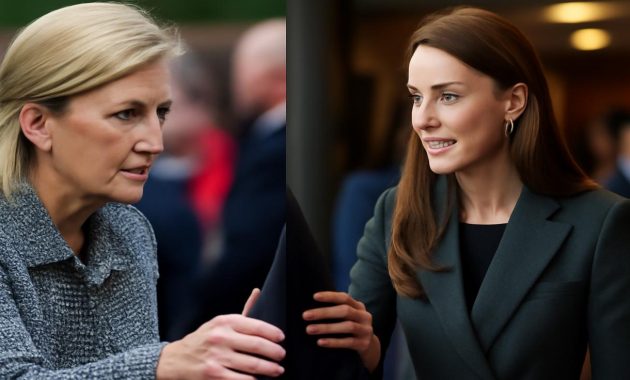
The moment passed in less than three seconds—just a soft tilt of the head, a brief glance downward, a hand that reached out when protocol might have preferred distance. Yet in those three seconds, a familiar debate flickered back to life: where, in the carefully choreographed theater of royalty, does human instinct end and royal duty begin?
A Small Gesture in a Very Big Room
It happened, as these things usually do, under the watchful eye of a hundred lenses. The hall was bright with polished marble and burnished metal, the air warm with the low buzz of conversations and the soft swish of dresses as guests shifted their weight from one foot to another. There was the familiar line of handshakes and nods, the gentle bob of small bows and curtsies, the choreography of deference that everyone in the room knew by heart.
Catherine, Princess of Wales—Kate Middleton to most of the world—was working her way along the line. Smile, handshake, hello. The rhythm of royal duty. Then a guest stumbled in emotion mid-sentence. A tremor in the voice, a quick intake of breath. You could almost feel the moment tighten, like a thread pulled too suddenly.
Instead of moving on, Kate leaned in.
It was not a grand gesture. She softened her shoulders, let the distance between them shrink, and placed a gentle hand on the guest’s arm. Her eyes dipped to meet theirs at level, not above, not beyond. The body language was unmistakable: I see you. Take a breath. It’s just us, for a moment.
Somewhere behind the cameras, someone might have been thinking: Duchesses aren’t supposed to do that. At least, not quite like that.
The Echo of Another Duchess
If the moment felt familiar, it’s because royal watchers had seen its shape before—only attached to a different woman, in a different coat, on a different day. Sophie, Duchess of Edinburgh, has long been known for this particular kind of intimacy: the quiet lean-in, the reassuring touch on the arm, the instinctive slip past the invisible barrier that usually stands between “Us” and “Them” in royal life.
For years, Sophie’s interactions during engagements have carried this quality of almost rebellious compassion. When someone falters or becomes overwhelmed, she lowers herself slightly, turns her body fully toward them, and gives the sort of focused, unwavering attention that is usually reserved for private rooms and trusted friends. It is not dramatic. It is not performative. It is, in many ways, profoundly ordinary—and that is what makes it stand out among the velvet ropes and heavy doors of monarchy.
So when Kate made a similar move—bending the usual stiffness of protocol into something more human—a familiar corner of the internet lit up. Screenshots appeared side by side. “She’s copying Sophie’s way with people,” some murmured approvingly. Others sounded less generous: “Another borrowed mannerism from another royal woman who did it first.”
From there, the conversation bloomed outward like ink in water. Was it imitation? Inspiration? An evolution of the role? Or just one woman doing the most human thing in the room without pausing to think of precedent?
Where Protocol Ends and People Begin
To understand why such a small gesture could bend the conversation so sharply, it helps to understand what “protocol” really means in this strange ecosystem of crowns and cameras. Royal protocol isn’t written in stone tablets stored in a vault. It is a constantly updated script, made of tradition and expectation and a thousand unwritten rules that everyone absorbs by proximity.
Don’t arrive after the monarch. Don’t reveal too much skin. Don’t overshadow senior members. Don’t turn your back too abruptly. Don’t get too close. Don’t hug unless the other person initiates, unless the situation demands it, unless… unless…
Yet the modern monarchy, if it is to survive in a world that can livestream every raised eyebrow, must inhabit a curious middle ground: it has to be both unreachable and relatable. Majestic and familiar. A ceremonial mirror in which a nation sees itself, and a comforting presence that feels, in fleeting flashes, like family.
Into this tension walks every working royal, carrying not just flowers and speeches and patronages but also questions: How close is too close? How human is too human?
That is where Sophie carved out a quieter, softer space—one that seemed to give Kate permission, or perhaps a template. Sophie’s style has always leaned more toward the unguarded. Her warmth feels faintly unpolished in the best way: she laughs with her eyes closed, crinkles at the corners, lets her hand stay on someone’s shoulder a second longer than a press officer might recommend.
When Kate echoes this—when she softens the line between herself and the citizen in front of her—the result feels less like theft and more like adaptation. The role is changing. And the women who inhabit it are changing it together.
A Gloved Past, an Ungloved Present
Once upon a time, distance was the point. Royals waved from balconies, riding past in carriages, gloved hands lifted against the sky. Their job was not to be understood but to be observed—to stand above the storm and represent continuity while the world beneath them shifted and reshaped.
Today, the thoroughfare of royal life is not just balcony and ballroom. It’s hospital corridors that still smell faintly of antiseptic, recovery centers with worn carpets, community halls where the tea is always a little too strong and the chairs a little too plastic. Here, waving from a distance feels almost rude. What works in a golden state carriage doesn’t quite translate to a converted gymnasium in a flood-affected town.
You can see the monarchy trying to solve this riddle in real time. William hugs a football player who’s just shared something vulnerable. Charles leans closer to a farmer and makes a joke that isn’t quite meant for microphones. Meghan, during her time as working royal, gave firm, prolonged hugs that sparked their own storms of commentary.
And then there is Kate, who has grown, slowly and very publicly, into the skin of a future queen. Her early years in the family were often described as careful: the right silhouettes, the safe colors, the tidy hair, the impeccable posture. Over time, though, something has shifted. The lines around her eyes crinkle more easily now. She crouches down to speak to children rather than expecting them to crane upward. She touches more hands, more shoulders, more sleeves.
Is this Sophie’s influence? Possibly. Or perhaps it is what happens when any person spends enough time moving through rooms full of people, listening to their losses and hopes, and realizes that ritual alone is not enough.
The Anatomy of a Gesture
If we slowed that now-famous Kate moment down frame by frame—if we watched it like naturalists observing a bird on a branch—we would see a small choreography of empathy unfolding in real time.
- The pause. She doesn’t rush the person along, even though the schedule undoubtedly begs for efficiency.
- The gaze. Her eyes hold, not flicker past them toward the next handshake.
- The angle. She leans, not towering from polite distance, but closing the physical gap.
- The touch. A hand rests lightly, unhurried, on the guest’s arm—steadying, anchoring.
It is precisely the kind of interaction that body-language analysts and social media commentators feast upon. Within hours, observations pile up: She’s mirroring Sophie. She’s channeling Diana. She’s crafting an image. Or: She just cares.
At some threshold, all of these things can be true. Royals are not exempt from influence. They observe one another, learn from what works, file away what moves people, what feels real. Sophie’s instinctive warmth may very well have shown Kate that the velvet ropes can be loosened without tearing the whole stage down.
But in the moment—the real, living three seconds when a stranger’s voice shakes and another person responds—most of that falls away. There is only one person in front of you and one answer to the question: Do I stay in my box, or step toward them?
Comparison, Controversy, and the Spaces Between
The argument that followed Kate’s gesture reveals as much about us as it does about the royals we analyze. We live in an era of split screens and instant parallels. Two images, side by side: Sophie leaning in during a hospital visit years earlier; Kate doing the same now. Arrows, circles, captions. “Copying.” “Inspired.” “Calculated.”
But human behavior rarely fits so neatly into “who did it first.” Empathy is not a trademark. No one owns the act of touching an arm gently, or lowering their voice, or bending protocol when it feels morally unnatural to keep distance.
And yet, in royal life, everything is symbol. A coat color may be read as a political statement. A necklace may be a nod—or a snub. A seating arrangement is analyzed like a chessboard. In that context, Kate’s gesture doesn’t get to remain just human; it becomes fodder for all our projections about power, femininity, inheritance, and visibility.
Sophie has long been framed as the “quiet” royal, the workhorse, the steady presence in the background. Kate, by contrast, is the inevitable future queen, the global cover star, the woman whose outfits sell out in minutes. When the more visible figure seems to adopt a trait of the less visible one, the narrative often slides toward competition instead of collaboration.
What if the story is simpler—and kinder? What if what we’re watching is a slow convergence, a shared authorship of a new royal language that doesn’t cling quite so tightly to the distance of the past?
When Rules Bend Instead of Break
“Bending protocol” sounds rebellious, like slipping out a palace window after curfew. In reality, protocol is far more elastic than it appears. There are hard lines—security basics, constitutional boundaries—and softer ones: customs that flex with personality, occasion, and era.
Take physical contact. Officially, there’s no bullet-pointed rule that says a royal cannot touch or be touched. The idea that the public should never initiate contact is more tradition than law—rooted in older notions of untouchable sovereignty. In practice, it varies. Some royals feel comfortable with a hug during times of deep personal grief or joy; others prefer the safer harbor of a handshake.
When Sophie wraps an arm around someone’s shoulder, when Kate mirrors that instinct, they’re not overturning the constitution. They’re testing, gently, how far the institution can stretch toward humanity without losing shape.
This is where the debate becomes revealing. Those who bristle at such gestures often argue that familiarity will dilute the mystique, that if a royal feels too much like “one of us,” the entire edifice of monarchy—its solemnity, its symbolic power—will begin to crumble. Others argue the opposite: that without these glimpses of unguarded connection, the monarchy will grow brittle and irrelevant, a relic in a world that increasingly demands authenticity.
In that narrow space between those two fears walks every royal woman in a smartly tailored coat, making a thousand tiny decisions: Do I kneel to this child? Do I linger with this grieving parent? Do I touch this hand longer than the cameras expect?
A Quiet Table of Influence
If we could somehow chart these choices—the moments of formality and the moments of softness—we might start to see patterns: threads of individuality, seeds of influence, shared instincts stretched over decades. Consider, for a moment, a simplified view of four royal women and their public styles:
| Royal | Public Style | Typical Level of Physical Warmth | Perceived Impact on Modern Protocol |
|---|---|---|---|
| Princess Diana | Rawly compassionate, emotionally open | High – hugs, hand-holding, close contact | Opened the door for emotional visibility |
| Sophie, Duchess of Edinburgh | Understated, steady, quietly intimate | Medium–High – arm touches, lean-ins | Normalized gentle, unshowy closeness |
| Catherine, Princess of Wales | Polished, evolving into warmer ease | Medium – increasingly hands-on in key moments | Bridges tradition with relatable modern image |
| Queen Elizabeth II | Reserved, dutiful, ceremonial | Low – mostly handshakes, formal distance | Anchored the standard formal model |
Looked at this way, Kate’s gesture no longer hangs in isolation. It becomes part of a lineage—a conversation across generations of women who have been asked to be both symbol and person at once. Diana pulled the walls inward. Elizabeth held the line. Sophie smoothed the edges. Kate moves among their ghosts, gathering a little from each.
Copying, or Continuing the Story?
There is a peculiar irony in accusing one royal woman of “copying” another when so much of their public life depends on inhabiting a role defined by predecessors. Every tiara choice, every balcony position, every nod to a previous gown is, by design, an echo.
In other fields, we rarely describe this as theft. A violinist learns by listening to older players, tracing their phrasing, then slowly bending it into something of their own. A painter absorbs the light and shadows of other canvases before finding a personal palette. A field biologist might shadow a seasoned mentor in the forest, matching their pace, watching how they kneel to read the ground, how they listen to the wind. In time, the mimicry dissolves into individuality.
Public empathy works much the same way. Kate has spent more than a decade watching other royals up close—how they enter rooms, how they leave them, what lingers in the air after they’re gone. That she might adopt Sophie’s easy physical reassurance not as a costume but as one tool among many feels, in this light, less like controversy and more like apprenticeship.
Of course, the cameras don’t film apprenticeship. They film moments. Then we, from our couches and screens, inflate those moments into verdicts. We scroll, we share, we declare: “She’s changed.” “She’s copying.” “She’s strategic.” “She’s sincere.”
Perhaps the truer sentence is smaller, simpler: She is learning.
A Gesture That Lingers
Long after the event ended, after the flowers were gathered and the microphones switched off and the coats were taken off carefully in some quiet palace room, the debate about Kate’s gesture still tapped away on keyboards and poured into comment sections.
Some praised her for softening, for becoming more visibly attuned to the emotional undercurrent of her engagements. Others insisted the move felt calculated, a performance fine-tuned for maximum relatability. A few slid into more familiar patterns of pitting royal women against one another: Sophie the original, Kate the imitator.
But somewhere out in the world, the person whose arm she touched would likely remember something else. Not the hashtags. Not the side-by-side comparison shots. Just that, in a room humming with formality and expectation, the future queen let the script loosen for a heartbeat. She looked them in the eye. She made the distance feel, briefly, less insurmountable.
In that sense, the debate about protocol and precedent and “copying” may matter far less than we think. For the person on the receiving end, it is not a constitutional question. It’s a human memory.
And maybe that is where the story of modern royalty is quietly being written—not in the rules themselves, but in the thousands of little ways their bearers choose to bend them, soften them, and, sometimes, borrow from one another to make them more liveable.
Kate’s gesture may have echoed Sophie’s. Sophie’s may have echoed Diana’s. Diana’s may have been an answer to a world that was already growing impatient with glass cases and distant waves. Each woman, in her time, stepped an inch closer to the people in front of her and, in doing so, shifted the weight of the crown ever so slightly.
The cameras caught a fraction of a second. The arguments may span days. But in between, there is the simple, steady truth of a hand on an arm, a voice dropped into gentleness, and the sound—not of protocol breaking—but of old patterns, very slowly, learning how to bend.
Frequently Asked Questions
Did Kate Middleton actually break royal protocol with her gesture?
Kate did not break any formal, written rule. Royal “protocol” is largely a set of evolving customs rather than strict laws. Physical touch and emotional warmth are increasingly common in modern royal engagements, especially in sensitive or emotional settings. Her gesture is better described as bending tradition toward a more human, modern style.
How is Kate’s behavior similar to Duchess Sophie’s?
Both women are known for leaning in physically and emotionally when speaking with people: soft eye contact, gentle touches on the arm or shoulder, and an instinct to close the physical gap during emotional moments. Sophie has been doing this quietly for years, and Kate’s recent gestures appear to echo that same warm, grounded manner.
Why do people say Kate is “copying” other royal women?
Because royal life is so documented, patterns are easy to spot. When Kate behaves in ways reminiscent of Sophie, Diana, or even the late Queen, observers often label it “copying.” In reality, roles like hers are shaped through observation and influence. It is natural for her to absorb and adapt approaches she has seen work well for others.
Is there an official rule about touching or hugging royals?
There is no strict, universal rule that forbids touching or hugging royals. The belief that it is “not allowed” stems from older traditions and expectations of distance. Today, most working royals decide case by case what feels appropriate—whether that’s a handshake, a light touch, or a hug in moments of deep emotion.
What does this gesture tell us about the future of the monarchy?
It suggests a continued shift toward a more relatable, emotionally present royal family. Small gestures like Kate’s show that future leaders of the monarchy recognize the need for warmth and human connection, not just ceremony. If sustained, this trend may help keep the institution relevant in a world that increasingly values authenticity and empathy.