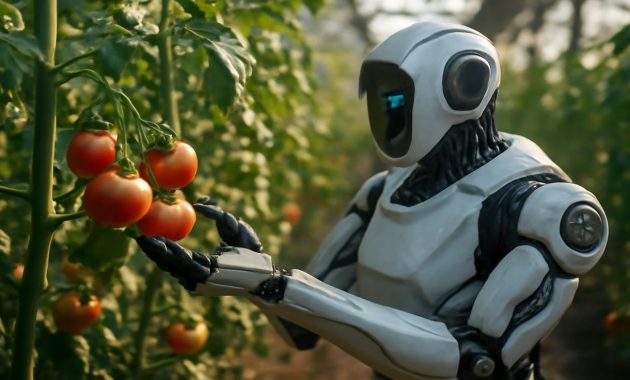
The first time you watch a tomato-picking robot pause—actually pause—before closing its mechanical fingers around a fruit, something in your brain does a double take. Out in the field, the air smells of warm earth and green vines. Bees stitch lazy arcs between yellow flowers. The sun hangs low, turning every tomato into a tiny red lantern. And there, between the rows, a robot arm hovers… and hesitates, as if it’s thinking. A camera lens blinks. A soft whirr. The robot changes angle, gently cradles the tomato, twists, plucks, and drops it into a bin with a surprisingly tender thunk. It feels, in that quiet half-second, less like a machine and more like a very fast, very patient new kind of farmworker.
The Fragile Art of Picking the Perfect Tomato
If you’ve ever grown tomatoes on a balcony or backyard strip of dirt, you know how finicky they can be. Pick too early and they’re hard and bland. Pick too late and they bruise, split, or turn mushy overnight. Store-bought tomatoes often bear the cost of being harvested by machines that don’t really understand what they’re touching—fruit that travels long distances, bred for durability more than flavor.
On large commercial farms, the stakes are higher. Harvest windows are brutally short. Labor is expensive and increasingly scarce. The heat can be dangerous. The fruit is delicate. Humans are still the gold standard at deciding which tomato is ready and which needs a few more days on the vine—but humans get tired, dehydrated, sunburned. Backs ache, hands cramp, eyes miss things when light shifts or dust blows in.
So for decades, engineers and farmers have dreamed of a machine that could do the careful work of a picker without turning ripened tomatoes into ketchup. Early attempts were clumsy: rigid claws, rough conveyor belts, blunt force solving a delicate problem. Those machines did not “think” before they picked. They simply grabbed everything in reach and let sorting lines deal with the rest. The result was speed, sure—but also waste, damage, and a lot of unripe fruit in the bin.
What’s changing now is something subtle and almost eerie: robots are getting better at hesitation. At saying, in a quiet computational way, “Wait. Not that one. Not yet.”
When a Robot Learns to Hesitate
Walk into a test greenhouse where the latest generation of tomato-picking robots are at work and you’ll notice how different the soundscape is. There’s no diesel rumble, no shouting over engines. Instead, it’s a gentle chorus of servo motors and cooling fans, the occasional hiss of pneumatics. Light filters through plastic sheeting in soft, milky beams. Between the trellised vines, robotic arms glide along rails or navigate on wheeled bases, moving with an unexpected grace.
Each arm carries a small cluster of cameras and sensors: high-resolution RGB cameras, depth sensors, and sometimes hyperspectral “eyes” that see beyond what we can. At the tip, instead of metal claws, you’ll see silicone grippers that look like soft petals or cup-shaped hands. These are built to cradle, not clamp.
What makes these robots different isn’t just the hardware; it’s the quiet storm of software behind the scenes. Before that gripper closes on a tomato, the robot’s onboard computer has already performed a small avalanche of calculations. It has:
- Scanned the cluster of tomatoes from multiple angles.
- Estimated color, size, and subtle surface textures.
- Predicted ripeness based on patterns learned from thousands of examples.
- Checked for obstructions like stems or other fruit.
- Estimated the safest angle to approach without bruising the tomato or stressing the vine.
Then comes the moment that feels like thinking: the system weighs the options. Should it pick this tomato now? Will it be more valuable in a day or two? Does reaching for it risk knocking others to the ground? In that brief pause, the robot is doing something most harvesting machines never have—evaluating, prioritizing, even planning ahead.
It’s not “thinking” in the way we do, with memories of summers past and a sense of flavor. But in computational terms, it is running a decision model that factors in ripeness, market quality, predicted yield, and plant health. It is, in a very practical, very mathematical way, thinking before it picks.
The Brain Behind the Grip
Under the glossy casing and tidy wiring, these robots carry layered machine learning models trained on mountains of data. Engineers feed them images of tomatoes at every conceivable stage: green with a faint blush, half-turned, sun-kissed red, overripe and cracking. Each example is labeled with ground-truth data: Brix (sugar level), firmness, internal quality, even consumer taste tests.
Over time, the algorithms learn associations that are hard for even experienced humans to articulate. A particular pattern of speckles might predict a flavor boost. A certain shade of red might mean “good for shipping, not for local premium.” Tiny wrinkling around the stem may signal that the tomato’s clock is ticking.
What emerges isn’t just a binary ripe/unripe classification; it’s a nuanced scoring system—how ready, how sweet, how fragile, how valuable. When the robot hesitates, it’s consulting that inner map, combining what it sees with what it has learned, and with what the farm’s management software tells it about target quality for that day’s market.
From Guesswork to Gentle Precision
On a human-run farm, picking decisions can be as much art as science. One worker might favor redder fruit, another might pick slightly early to be safe. Consistency can be elusive, especially across large crews and long days. Robots that “think before they pick” are built to bring two things growers crave: consistency and precision.
Imagine a farm manager setting a digital “ripeness policy” for the week. A cold front is coming; shelf-life will be longer. The market is paying extra for peak-color tomatoes. The software updates the robots’ decision thresholds: today, pick slightly later in the ripeness curve, but avoid any fruit with even minor surface cracks. The next morning, the fleet rolls through the rows at dawn, each robot making thousands of tiny, consistent decisions, aligned with that strategy.
The picking process itself becomes gentler. Instead of ripping clusters or shaking vines, the robot charts a path that minimizes contact. It chooses a route that lets it reach the ripest tomatoes while leaving near-ready fruits undisturbed and still attached to feed on the plant for a little longer. In some setups, the robot adjusts grip pressure based on the measured firmness of each tomato, squeezing just enough to hold, never enough to bruise.
That shift—from brute force to thoughtful touch—has practical consequences:
- Less waste: Fewer fruits hit the ground, split open, or get over-compressed.
- Higher quality: More tomatoes arrive at packing houses unblemished and at their flavor peak.
- Better use of the plant: Near-ripe tomatoes get extra time on the vine, turning sunlight into sugars.
And while all this is happening, the robots are quietly collecting data: how many fruits per plant, which sections ripen faster, where disease might be starting. They’re not just pickers; they’re scouts and scribes, writing the story of the field in numbers and pixels.
How “Thinking” Robots Might Reshape the Farm Day
Tomato fields are traditionally racecourses against time and temperature. Workers rush to beat the heat. Logistics crews scramble to move crates before the fruit warms and softens. The pressure is relentless.
Introduce robots that can work in the cool of night or the gentle hours before sunrise, and the rhythm of the farm starts to change. Instead of compressing harvest into a few frantic hours, managers can schedule picking in calmer waves: early dawn passes for top-tier ripe fruit; late-night runs to catch another batch that crossed the ripeness threshold after sunset.
With better prediction, harvest scheduling can also become more strategic. The same AI models that guide each pick can forecast ripeness across the field days in advance. That lets growers align shipments with market windows, reducing gluts and shortages. It also opens the door to new categories: “picked at perfect sweetness” labels backed by actual sensor data, or ultra-local deliveries harvested just hours before reaching nearby kitchens.
| Aspect | Traditional Harvest | “Think-Before-They-Pick” Robots |
|---|---|---|
| Ripeness Decisions | Human judgment, variable by worker and fatigue. | AI-based scoring, consistent across every pick. |
| Damage & Bruising | Higher risk with speed and rough handling. | Soft grippers, planned motion, reduced bruising. |
| Labor Conditions | Heat stress, repetitive strain, seasonal labor gaps. | Robots handle the harshest hours; humans move to oversight and care. |
| Data Collection | Manual sampling and estimates. | Continuous plant-level data with each pass. |
| Harvest Timing | Fixed schedules, weather-dependent, labor-limited. | Flexible schedules driven by real-time ripeness maps. |
What This Means for the People of the Field
Whenever a new machine enters the farm, a quiet question walks with it: what does this mean for the people already here?
In tomato farming, much of the workforce is made up of migrant laborers who know, in their hands and eyes, the living language of the plants. They understand how a slightly softer squeeze can tell you if a tomato is ready, how the scent deepens as sugars form, how to move quickly without turning ripeness into waste. There’s a real fear that robots could erase those roles, trading human skill for metal efficiency.
The more you talk to growers experimenting with these systems, though, the more the picture complicates. Many are not replacing crews outright so much as reshaping jobs. Robots take over the most punishing parts of the day: the searing midday shifts, the repetitive bending and reaching, the tasks that grind joints and sap energy. Humans shift toward roles that ask for judgment, oversight, and care.
Some workers become robot tenders—moving machines between blocks, checking sensors, intervening when plants tangle or systems misread. Others focus on pruning, training vines, scouting for disease, or managing post-harvest quality. The skill set changes: less raw physical endurance, more tech literacy and plant knowledge combined.
There are real challenges here: access to training, fair wages in new roles, and ensuring that small-scale farmers can benefit rather than be pushed aside by high-tech capital. But there is also potential for farm work to become safer, more stable, and less grueling, especially as climate extremes make open-field labor more dangerous.
Small Farms, Big Tech?
One of the central tensions in agricultural robotics is scale. Large industrial farms can more easily afford fleets of machines, proprietary software, and dedicated technicians. Smaller operations—many of which grow the most flavorful, diverse varieties—risk being left out.
Yet some robot designers are imagining a different path: modular units that can be shared through cooperatives, robots offered as a service instead of a product, or systems light enough to navigate small, intricate plots. A compact robot that harvests the most delicate tomato varieties for a cluster of neighboring farms could spread costs while preserving local diversity.
In that future, a small hillside grower might not own a robot outright but could schedule it the way a community rents specialized equipment today. The machines would still think before they pick—but they’d be thinking in service of many hands and fields, not just a single mega-farm.
Flavor, Waste, and the Climate Question
Behind all this talk of algorithms and grippers lies a simpler hope: better tomatoes. Tomatoes that actually taste like tomatoes—even when they’ve traveled. Robots that “think before they pick” could play an unexpected role in that flavor revolution.
Because they can judge ripeness more precisely and harvest at unconventional hours, these systems make it feasible to push flavor further without sacrificing shelf life. Fruit can be left on the vine longer, picked closer to true peak, then handled with greater care. For greenhouses and controlled environments, robots can help fine-tune harvest strategies to maximize both yield and taste, rather than leaning so hard toward one or the other.
There’s also the matter of waste, which is a climate issue as much as a moral one. Every bruised tomato that never leaves the packing shed represents squandered water, fertilizer, fuel, and labor—plus the emissions it will generate as it decomposes. Reducing those losses with more careful picking and better timing isn’t just good business; it’s part of making agriculture more sustainable in a warming world.
As robots move through the rows, they can also track subtle shifts that signal trouble: leaves curling in a pattern that suggests heat stress, discoloration that might be early disease, clusters of smaller fruits hinting at nutrient issues. These early warnings can help farmers adapt quicker, saving both plants and inputs. In the long run, a network of “thinking” machines across many farms could build up a vast library of climate impacts on crops, guiding more resilient practices.
Will the Fields Still Feel Like Fields?
For some, the idea of robots in tomato rows conjures a sterile, industrial future—a landscape of metal and metrics where the old intimacy between humans and plants is lost. But stand in a greenhouse at dawn, when the robots are humming quietly and the vines are thick with leaves, and the story feels more complicated.
The plants don’t seem to mind whether the hand that touches them is silicon or skin, so long as the touch is gentle. The air still smells of tomato leaves—a sharp, green scent that clings to clothes and lingers in memory. Birds still skitter along rafters. Spiders weave webs in corners untouched by wheels and rails. Somewhere in the distance, a human voice calls out, and another answers. Life on the farm goes on, reshaped but not erased.
Ultimately, the question may not be whether robots belong in tomato fields—they are already arriving—but how we choose to use them. Will we deploy these “thinking” machines only to squeeze more from tired soil, or to grow better food with less harm? Will they deepen our understanding of what plants need, or simply automate old habits? The answers will be written not in code alone, but in the relationships between growers, workers, engineers, and the land itself.
For now, what we have are robots that hesitate. Machines that pause in a sunlit aisle, scan a tomato blushing toward red, and decide—yes, today is the day. The grip is light, the twist precise, the drop careful. Somewhere down the line, that tomato might end up on your cutting board, sliced open to reveal a juice and fragrance that carry, faintly, the memory of a machine that learned to think before it picked.
Frequently Asked Questions
How do tomato-picking robots know when a tomato is ripe?
They use cameras and sensors to capture images and depth information, then run those through AI models trained on thousands of examples of tomatoes at different stages. The system scores each fruit on ripeness, quality, and sometimes predicted flavor, and only picks those that match the farm’s current settings.
Do these robots damage the plants or fruit?
They are designed specifically to reduce damage. Soft, flexible grippers adjust pressure based on the firmness of each tomato, and motion-planning algorithms choose paths that avoid bumping or pulling on vines. Field tests generally show less bruising and fewer dropped fruits than with fast manual harvesting.
Will robots replace human tomato pickers completely?
They are more likely to change the nature of farm work than erase it. Robots tend to take over the most repetitive and physically harsh tasks, while humans shift to supervision, maintenance, plant care, quality control, and data-driven decision-making. The balance will depend on farm size, technology access, and policy.
Can small farms afford tomato-picking robots?
Right now, advanced robots are still expensive and more common on larger operations and high-tech greenhouses. However, models based on leasing, cooperatives, or “robot-as-a-service” are emerging, which could make them accessible to smaller farms over time, especially if they share units or schedule them seasonally.
How could these robots help with sustainability and climate challenges?
By picking more precisely and gently, they reduce food waste and the resources embedded in lost fruit. Their constant sensing can detect early signs of stress or disease, allowing quicker, more targeted responses. And by enabling harvests at cooler hours, they help protect workers and potentially lower cooling and logistics energy costs.