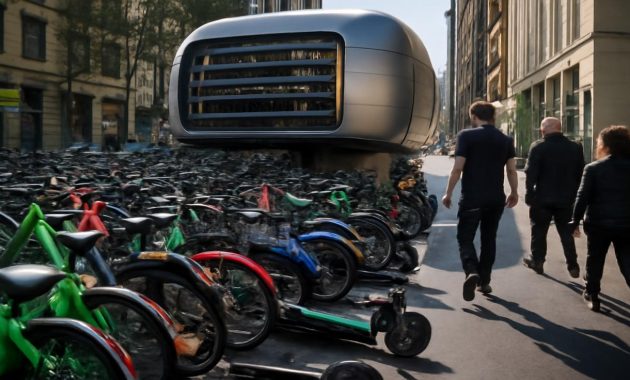
The first thing you notice isn’t the bikes themselves. It’s the tangle of colors, cables, baskets, and helmets spilling over the sidewalk like a bristling metal tide. A grandmother with a shopping trolley squeezes past a toppled e-bike. A parent nudges a stroller into the street to dodge a row of scooters. Somewhere, a delivery rider kills the throttle and glides to a stop, scanning for a space that isn’t already choked with two-wheeled machines.
This is the new soundtrack of the modern city: the soft whirr of electric motors, the click of locks, the muttered curses of pedestrians. E-bikes, once a fringe curiosity, have multiplied into a full‑blown urban ecosystem—cleaner than cars, faster than walking, more flexible than buses. They’ve also created a new kind of chaos: where do you put them all when the ride is over?
The Quiet Invasion of the Curb
Walk down almost any dense city street and you can read the recent history of mobility on the pavement. There are faded parking lines meant for cars, a bike lane that was painted on in a rush, a half-faded scooter decal, and now, clusters of e-bikes gravitating toward every lamppost, street sign, and patch of semi-legal asphalt.
The change snuck up on cities. Regulators approved dockless bike and scooter systems because they promised flexibility and speed. Riders could pick up a bike almost anywhere, ride it to their destination, and leave it nearby. No docks, no huge stations, no big upfront infrastructure. It sounded like liberation.
But in practice, “anywhere” very quickly became “everywhere, all at once.” Sidewalks began to resemble overbooked parking lots. People trying to navigate with a cane or wheelchair found their paths blocked. Storefronts lost their sightlines. Delivery vans edged closer to crosswalks because bike piles had colonized the curb.
The curb used to be a boring piece of city trivia. Now it’s prime real estate in a silent war between cars, buses, delivery trucks, ride-hail, and yes, e-bikes. And that’s where the supposed solution comes in—a fix that many planners and mayors are betting on, even as they brace for the backlash.
The Big Idea: Corrals, Geofences, and Digital Leashes
In city planning offices, a new phrase has become a kind of magic spell: “organized micromobility.” The logic is simple. If “dockless” vehicles are causing chaos because they can be left anywhere, then maybe they should not be quite so dockless anymore.
Across the world, a new model is taking shape: designated e-bike parking zones—sometimes called corrals, hubs, or bays—combined with digital rules that gently (or firmly) force riders to use them. Think of it as a hybrid between the old, rigid docked systems and the free‑for‑all of modern app bikes.
Imagine a wide, painted rectangle on the street beside the curb, ringed with metal racks. A dozen e-bikes stand neatly in a row, each slotted into place like a library book on a shelf. Your phone’s map lights up when you approach: “Approved parking zone.” If you try to end your ride a block away, the app balks. No photo, no confirmation, no trip completion. The bike may even continue billing you until you roll it back to a legal spot.
This approach has a certain tidy elegance. It shifts parking from the sidewalk to the street. It protects pedestrian space. It gives cities a way to count, regulate, and rearrange the swelling fleet of e-bikes.
And at its core, it rests on a deceptively comforting promise: chaos can be fixed by drawing better lines—on pavement and on screens.
How the “Solution” Looks on the Ground
To really picture it, stand at a busy intersection in your imagination. At one corner, there’s a bus stop with a short shelter. Next to it, a former car space has been converted into a micromobility hub. Painted chevrons mark where bikes and scooters should sit; a few brushed-steel hoops offer a place to lock personal bikes. A low sign announces, “E-bike Parking Only.”
Your app shows this in miniature: a blue square glows on the corner, marked with a bike icon. A ring of invisible geofencing outlines the parking zone. When you finish your ride, you have to line up your bike within that digital perimeter, snap a photo, and tap “End Trip.”
When dozens of these hubs dot a neighborhood, the sidewalks visibly relax. The slalom of people, pets, and parked bikes becomes less fraught. Delivery riders know where to find a spare vehicle. Residents know where to complain if a cluster grows unruly. Enforcement officers suddenly have a clear rule to enforce.
On paper, it’s a win-win-win: cities reclaim order, companies reduce fines and complaints, riders still get a mostly flexible service, and pedestrians reclaim space. So why does the air feel charged every time a new set of e-bike corrals is announced?
The Hidden Costs No One Wants to Own
The trouble is that curbs and corners are not blank spaces. Every square meter of city street already has a job—often several. Turning car parking into e-bike corrals sounds beautifully simple until you meet the drivers who no longer have a space, or the merchants who worry their customers will stop coming if they can’t pull up to the door.
For decades, political gravity has tilted toward the car. A single on-street car space is like a sacred token. It might be used by only a few cars each day, yet it carries disproportionate emotional weight. Replace that one car space with a rack that holds 12 e-bikes, and from a pure transport-efficiency angle, you’ve made a great trade. But many people don’t experience cities as equations. They experience them as routines and personal territory.
“You’re stealing our parking,” is a refrain planners hear over and over when new bike corrals are proposed. It doesn’t matter that the space is a public asset. It doesn’t matter that the same asphalt could move far more people on two wheels than on four. Locally, emotionally, it feels like a loss.
Then there’s the question of cost. Someone has to pay to:
- Install racks, paint, signage, and protective barriers.
- Maintain and repair the infrastructure.
- Reposition abandoned or badly parked bikes.
- Run and maintain the digital geofencing system.
Cities often hope the operators will swallow much of this, especially after a few years of free‑riding on public space. Operators, in turn, argue that they’re providing a climate‑friendly public service and that too many fees will kill the business model. The result is a delicate, sometimes tense negotiation—played out in council hearings, press conferences, and, occasionally, in emergency meetings after an angry tweet storm goes viral.
Who Really Gains, Who Really Loses?
There’s another layer, quieter but no less important: social equity. Not all riders use e-bikes in the same way. Some commute daily across long distances. Others rely on them for short, last‑mile hops to bus stops or train stations. Some are gig workers racing the algorithm to deliver food on time.
When parking zones are placed mostly in affluent, central neighborhoods—closer to cafes than to public housing—the benefits skew heavily. If a low‑income rider has to walk an extra five or ten minutes each way to reach a legal parking spot, the “solution” looks a lot less like progress.
There’s also a subtle, often unspoken bias in who gets blamed for the chaos. A toppled bike is more likely to be associated with the faceless “other”: the student, the delivery rider, the newcomer, the person who doesn’t “belong” on this street. Crackdowns can quickly become a proxy war over who gets to take up space in the city at all.
In this messy reality, the tidy logic of corrals and geofences starts to look less like a silver bullet and more like a careful, fragile truce. One that needs constant tending, adjustment, and political courage to keep alive.
Inside City Hall: A Policy Headache in Slow Motion
For the officials tasked with taming e-bike chaos, every decision has a ripple effect. Set too few parking zones and bikes spill back onto sidewalks. Set too many and you’re accused of wasting money, killing trees, or removing “too much” car parking. Go heavy on enforcement and you’re punishing riders; go light and you’re punished by voters.
Behind the scenes, urban staff juggle spreadsheets and maps that look more like war-room charts than public works plans. They track:
- Where complaints surge.
- How many bikes cluster around transit hubs.
- Which operators respect the rules—and which don’t.
- Accident reports involving parked bikes and scooters.
They negotiate permit conditions: maximum fleet sizes, performance targets, fines for bad parking, discounts for rides that start or end at approved hubs. And they know that every clause in those permits could ignite headlines: “City Caves to Big Tech” on one side, “War on Innovation” on the other.
It’s not just about bikes. It’s about what kind of city you want to be. Prioritizing e-bike parking—especially when it means reclaiming car space—is a statement about values: safety over speed, people over machines, shared space over private entitlement. These values are widely praised in climate plans and glossy strategy documents. But at the moment you paint over a line of car parking to create an e-bike bay, they become very, very real.
A Simple Table, A Complicated Reality
On paper, the options for dealing with e-bike chaos can be boiled down to a few core choices:
| Approach | What It Means | Upside | Downside |
|---|---|---|---|
| Do Nothing | Leave parking fully free-form with minimal rules. | Maximum rider flexibility; no new infrastructure costs. | Sidewalk chaos, safety risks, angry residents, political blowback. |
| Soft Guidelines | “Please park responsibly” campaigns, basic fines. | Cheap, quick to implement, low friction for riders. | Limited impact; relies on voluntary behavior in crowded spaces. |
| Designated Corrals | On-street parking bays with racks and markings. | Restores sidewalk space; easier to regulate and maintain. | Requires funding, removes car parking, can trigger local opposition. |
| Corrals + Geofencing | Digital enforcement requiring use of hubs. | Strongest control; predictable parking patterns. | Less flexible for riders, needs tech investment, risk of inequitable access. |
On a mobile screen, that table looks simple enough. But each cell hides months or years of negotiations, conflicts, pilot projects, and recalibrations. The city becomes a living lab, sometimes a battleground, for competing definitions of what “good” mobility even is.
The Backlash: Loud, Emotional, and Sometimes Inevitable
Every attempt to tidy up e-bike parking carries within it the seed of its own protest. Ban bikes from certain sidewalks and disability advocates might cheer—while older cyclists who rely on safer, slower paths feel pushed back into traffic. Introduce strict geofenced zones and many riders will adapt—but a vocal few will rail against “nanny state” overreach and tech micromanagement.
Businesses can be split too. Some welcome corrals near their doors, hoping they’ll bring more customers who arrive by bike. Others fear that losing a single car parking space will mean losing regulars. Neighborhood blogs and message boards light up with posts and photos: “Look what they’re doing to our street,” alongside “Finally, I can walk without tripping over handlebars.”
The intensity of this reaction often surprises officials. After all, we are talking about parking, not demolishing buildings or building highways. But in a dense city, small changes to space can trigger big feelings. The place you always used to park, the corner where you meet friends, the sidewalk where your kid learned to balance on a scooter—all of these are personal landmarks. When e-bike policy moves in, it doesn’t just move metal. It moves memories.
Some of the backlash is rational and grounded: questions about safety, fairness, and cost. Some of it is less so, tangled up with resistance to change in general. But policymakers ignore either kind at their peril. A cluster of loud objections, strategic media stories, or a well‑organized neighborhood campaign can freeze new parking zones before the paint dries.
Why Cities Push Ahead Anyway
Still, many cities are pressing forward with corrals, geofencing, and integrated micromobility zones. Not because they underestimate the backlash, but because the alternative is a slow erosion of trust in the entire e-bike experiment.
When pedestrians, especially those with mobility challenges, feel crowded out by bikes, support for low‑carbon transport can sour. When every new expansion of a bike-share fleet is met with photos of “bike graveyards” blocking crosswalks, political capital drains away. Letting chaos reign is not a neutral act; it’s a quiet choice to let the worst version of the system define the public’s perception.
The cities that seem to be navigating this best are doing a few things differently:
- They start with pilots rather than permanent changes, and they measure what happens.
- They talk openly about trade‑offs: what is lost, what is gained, and for whom.
- They treat bike parking design as part of a bigger plan: fewer cars, safer streets, better transit, more trees.
- They give communities real input on where hubs go—without giving any one group an absolute veto.
These choices don’t erase conflict, but they turn it into something more constructive: a rough, ongoing negotiation over how to share a finite space in a warming world.
Living With an Imperfect Solution
Maybe the most important thing to understand about the “solution” to e-bike parking chaos is that it isn’t a neat before-and-after story. There’s no moment when the final corral is painted, the last geofence is set, and some official announces, “We did it. Problem solved.”
Instead, cities live in a kind of rolling in-between space. Bikes multiply in response to new demand. Regulations change as operators merge, fold, or pivot to e-cargo. A new school opens, and suddenly a quiet side street becomes a daily stream of kids on small frames, looking for somewhere to lock up. A popular bridge gets a new bike lane, and demand for parking surges at one end, then the other.
Parking policy has to keep moving too. Hubs get added, removed, expanded, or reshaped. Rules soften in some places and tighten in others. Enforcement ramps up after a few too many complaints, then relaxes when a new system proves its worth.
If that sounds messy, it is. But it’s also a sign that something is working. A static city is one that has given up on serious change. A city that’s constantly tinkering with how it stores e-bikes is a city that’s still trying to move away from car domination, still experimenting with a different kind of everyday freedom.
Maybe the most hopeful image of the future isn’t a perfectly orderly row of bikes, but a scene where the disorder is gentler, kinder. Sidewalks where a grandparent and a child can walk side by side without weaving. Streets where one lost car parking space yields a dozen safe bike trips. Curbs that feel less like battlefronts and more like shared tools.
There is a solution to e-bike parking chaos. It looks like corrals on the street, digital fences on a map, and a lot of boring meetings about curb paint. It isn’t problem‑free. It stirs up political storms and exposes old habits. It makes some people angry. It pushes all of us to rethink how much space a car, a bike, or a human body deserves.
But if you listen closely, beneath the arguments and the policy jargon, you can hear something else in the hum of those little motors: the sound of a city trying, awkwardly but earnestly, to become lighter on the earth and fairer on its feet—with every carefully parked e-bike a small, imperfect step in that direction.
Frequently Asked Questions
Why are cities suddenly cracking down on e-bike parking?
Because rapid growth in shared and private e-bikes has outpaced the rules. Sidewalk clutter, blocked ramps, and safety complaints have pushed cities to act. Without some form of organization, public support for e-bikes can erode fast, even among people who like the idea of greener transport.
Are designated e-bike parking zones really better than free parking anywhere?
For most pedestrians and city managers, yes. Well‑placed hubs clear sidewalks, make it easier to enforce rules, and can actually speed up finding a bike. For some riders, especially those making short trips or serving deliveries, they can feel less convenient, which is why placement and density of hubs matter a lot.
Do e-bike corrals always replace car parking?
Not always, but often. The curb is limited, and most streets are already dominated by cars. Taking a small share of that space for e-bikes is one of the fastest ways to add safe parking without squeezing pedestrians further. The trade‑off is politically sensitive, but it can move far more people per square meter.
How do geofenced parking rules actually work?
The bike’s app uses GPS (and sometimes additional sensors) to check its location against approved parking zones. If you’re outside a zone, it can prevent you from ending the trip, keep charging you, or even reduce your “score” as a rider. Some systems require a photo to verify that you parked correctly.
What about people who can’t easily walk farther to find a hub?
This is a real concern. Inclusive systems place hubs near transit stops, clinics, senior housing, and other key destinations. Some cities allow more flexible rules for riders with disabilities or in specific areas. Equity audits and regular adjustments are essential so that convenience and access aren’t only reserved for certain neighborhoods.
Is there a way to avoid backlash when introducing e-bike parking rules?
Probably not entirely, but backlash can be reduced. Transparent communication, time‑limited pilots, visible data on benefits, and genuine local input help. Framing changes as part of a broader shift to safer, people‑centered streets—not as a standalone “bike program”—also makes acceptance more likely.
Will e-bike parking ever be truly “solved”?
Unlikely in a final, permanent sense. As cities grow and mobility tech evolves, needs will keep shifting. The goal isn’t a perfectly static system, but one that can adapt quickly, keep sidewalks clear, and support more trips by bike instead of car. In that sense, the “solution” is an ongoing process rather than a finish line.