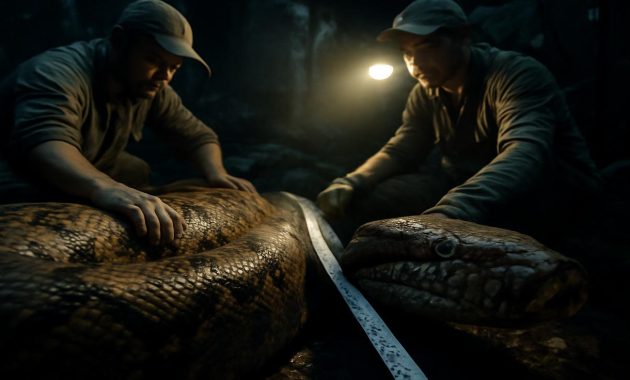
The first hint that something was wrong with the forest was the silence. No cicadas. No quarrelsome birds. No rustle of monkeys moving through the canopy. The air in the flooded valley felt thick, as if the rainforest itself were holding its breath. Then the boat nudged something in the water that wasn’t quite a log—too smooth, too deliberate in its stillness—and every person on board suddenly understood that they were not alone.
“Back it up. Slow,” murmured Dr. Inês Carvalho, the field leader. The small aluminum skiff shuddered in reverse as the outboard motor whispered them away from the shadow beneath the overhanging branches. The shadow, improbably long, simply hovered there in the greenish water, unbothered by the disturbance.
It was the third week of the survey, deep in an unnamed oxbow lake far from any village, where the map dissolved into guesswork and imagination. The team had come here chasing rumors—fishermen’s stories swapped in riverside bars, fragments of satellite imagery hinting at untouched forest, and the faint, tantalizing possibility that something extraordinary might still be hiding in the folds of the world. They were looking for big snakes, yes. But no one was prepared for how big.
The Moment the Forest Breathed Again
Their radios were silent. The nearest road was days away by boat and foot, and the sky above the canopy was turning the sallow color that precedes a tropical storm. For hours they had been gliding along a corridor of water the color of strong tea—the Rio Escondido, as they’d taken to calling it—its surface broken only by fallen branches and the occasional explosion of a startled fish.
Then the “log” moved.
“Eyes. Look at the eyes,” whispered Mateo, the team’s youngest biologist, his voice caught somewhere between fear and awe.
Just above the waterline, two dark, lidless orbs met theirs, flat and ancient as river stones. The head was massive, triangular, its scales catching fragments of cloudy daylight. As the boat drifted, the researchers could see the body extending away into the green gloom—a living cable disappearing into the flooded forest, thicker at its narrowest point than any human thigh on the boat.
“It’s an anaconda,” said Inês. She said it calmly, as if naming it could somehow shrink it back to a reasonable size. But the word hung in the air like humidity. They all knew the usual measurements. They’d studied records and museum specimens. And this animal did not fit anything they had ever seen.
The forest seemed to exhale with them. A pair of herons crossed overhead, shrieking. Somewhere in the branches, a monkey finally broke its silence. The spell was broken, but the enormity of what they were seeing had only just begun to register.
A Controlled Encounter in the Middle of Nowhere
Planning for the Impossible
This wasn’t a chance sighting. As surreal as the moment felt, the team was there under strict scientific protocols, part of a government-approved biodiversity assessment in one of the last large unexplored tracts of rainforest in the region. Every net, every hook, every scale, every vial of preservative had been logged and weighed before they left the city.
They were operating under a tight ethical framework: no unnecessary handling, no harm to animals, minimal disturbance to habitat. When you work in places like this, you’re a guest, not a conqueror. The team had spent days training for safe capture scenarios—specifically, for large constrictors—running drills in camp where someone would play the part of a giant snake while others practiced coordinated handling and restraint.
Even so, nobody had rehearsed for a snake that seemed to erase the boundary between rumor and monster.
They cut the outboard and drifted. The air filled with the soft clink of harness buckles and the whisper of nylon ropes being pulled from dry bags. The snake, perhaps curious, rose slightly in the water. Its nostrils broke the surface; the lips parted just enough to show a hint of curved teeth like polished needles.
“No sudden movements. We’re just a log, too,” said Inês, forcing a smile.
The controlled survey called for non-lethal capture whenever feasible, followed by biometric measurements, tissue sampling, tagging, and immediate release. This meant the team had to make a decision in seconds: attempt the capture, or treat it as an observational record only.
They had come all this way, through bureaucracies and storms and infected mosquito bites, for exactly an animal like this. Inês made the call.
“We go. Slow and clean. If it fights, we back off. No heroics.”
The Dance of Caution and Gravity
Approaching a giant constrictor in open water feels like stepping into a slow-motion accident you hope never fully happens. Two team members slipped over the side in chest waders, secured by ropes around their waists and anchored to the boat. The water was cool and strangely thick with decaying leaves. Every movement felt amplified—each ripple a potential invitation.
The snake didn’t flee. That, in itself, was terrifying.
As they closed the distance, its true scale began to resolve. The head alone was nearly the length of a human forearm. The body, patterned with olive and black rosettes, looked like a fallen galaxy of dark stars. The dorsal scales had a faint sheen, iridescent where the diffused light touched them, like oil on clean water.
“Tail’s over there,” someone breathed, pointing into the drowned understory where the trunk of the animal vanished between tree roots.
They used two oversized snake hooks and a padded pole, not to lift—no tool could truly lift a creature like this—but to guide and support, to keep the head angled safely away from unprotected limbs. Bit by bit, with a choreography that felt more like negotiation than capture, they drew the snake into shallower water near the muddy bank.
Once, briefly, it coiled. The water around their legs tightened. Every person in the team felt the raw, wordless power of an animal built to dismantle tapirs and caimans. Then, as if reconsidering, it relaxed again, settling like a fallen tree in the mud. The message was clear: it was allowing this, for now.
Measuring a Myth
Numbers That Don’t Seem Real
Scientific measurement is an oddly intimate act. To measure a wild animal is to cross from awe into accounting, from “how is this possible?” into “how big, exactly?” While three researchers gently stabilized the snake with body weight rather than restraint, another moved down the length with a waterproof tape measure, calling out numbers that sounded, at first, like mistakes.
“Four meters… five… six… six point eight… Still going.”
They had to reposition the snake in a loose, sprawling curve along the bank, marking each segment with flagged stakes, then straightening the tape between them like measuring a live, reluctant river. Mud sucked at their boots. The first drops of warm rain began to fall, stippling the snake’s massive coils.
When they finally reached the tail tip, the number felt like a shared hallucination: 8.02 meters from snout to tail. Over 26 feet. A fraction longer than any scientifically confirmed measurement for its species on record.
Weight was trickier. They had brought an industrial hanging scale rated beyond 200 kilograms, knowing it might never be needed. Now, rigging a sling from canvas and ropes beneath the snake’s midsection, they looked at each other with a kind of dazed disbelief. It took the full team to heave the animal even slightly clear of the mud.
The digital display blinked, then settled: 249 kilograms. Over 540 pounds. And this was without lifting the entire snake free of the ground; the reading was conservative.
The snake, through all of this, remained watchful but eerily calm. Its tongue tasted the air at intervals, a slow, methodical sampling, as if it were more curious than threatened by these small, clumsy primates fussing over its body.
A Snapshot of a Giant
They recorded everything they could: scale counts, girth measurements, eye diameter, tooth length, even the pattern of scars along its flanks—old injuries from some forgotten struggle with a caiman or rival. They clipped a tiny scale fragment for genetic analysis, slid a microchip tag beneath a thick fold of skin near the base of the skull, and swabbed its mouth for microbiome sampling.
In the dim green light under the forming storm, the animal felt less like a monster and more like a biography written in flesh: decades of quiet hunting, years of floods and droughts, the ghosts of every animal it had ever eaten inscribed in its impossible size.
The data, once compiled back in camp, would eventually condense this encounter into a neat line in a table, a few numbers in a spreadsheet. But in that moment, standing knee-deep in a remote backwater, with rain beginning to hammer the canopy and frogs tuning their voices, the numbers felt like an inadequate translation of something much older.
| Measurement | Recorded Value | Typical Large Adult |
|---|---|---|
| Total length | 8.02 m (≈ 26.3 ft) | 5–6 m |
| Estimated weight | ≈ 249 kg (≈ 548 lb) | 90–150 kg |
| Maximum girth | Over 90 cm (≈ 35 in) | 50–70 cm |
| Estimated age | 30–40+ years (approx.) | 15–25 years |
Where Legends and Data Overlap
The Long Shadow of River Stories
For generations, people living along the great rivers of the tropics have told stories of snakes so huge they could block waterways, swallow adults, or crush dugout canoes for sport. Biologists have tended to file these tales under “cultural exaggeration”—rich and meaningful, but not literally true.
Yet here, in an unnamed corner of flooded forest, a living animal had emerged that overlapped eerily with those river stories. Not a mythical serpent, not a prehistoric relic, but a very real, breathing, measurable snake whose existence nudged the upper limits of what we believed possible.
At night in camp, after the formal data were logged and backed up in triplicate, the team found themselves whispering about that overlap between myth and measurement. The snake had become “ela gigante” in their conversations—“the giant”—a presence that seemed to reframe the very forest around them. If one such animal could survive here in the age of chainsaws and dredging, what else—more fragile, less obvious—might still be holding on?
There is a tendency in modern science to smooth out the world into averages. We talk about typical sizes, usual ranges, standard behaviors. But evolution doesn’t deal in neatness. It embraces outliers, tests extremes. For reasons we may never fully understand—perhaps a particularly rich hunting ground, a genetic quirk, or simple luck in avoiding injury and starvation—this snake had become an outlier embodied.
And now, confirmed by trained field biologists, she was no longer the stuff of stories. She was a data point. A record breaker.
The Ethics of Meeting a Giant
Fear, Respect, and Letting Go
Once the numbers were taken and the tags implanted, there remained one more decision: how long to keep her under observation. The protocols were clear—minimize stress, ensure full mobility on release, observe for any immediate signs of harm or disorientation. In practice, that meant sitting with a monster and simply… waiting.
The rain had thickened into a proper storm now, drumming the water flat, turning the air white with spray. The team crouched on the bank, ponchos useless, notebooks tucked under shirts. The snake lay half submerged, nostrils just above the churning water, body lines softened by the downpour.
Fear, by then, had given way to something subtler: a kind of reverent discomfort. The human brain struggles with scale, with anything that dwarfs our usual frame of reference. In the presence of something this large, this indifferent to our existence, there’s a quiet rearrangement of perspective. The forest no longer felt like a backdrop for human activity. It felt like someone else’s house.
When they finally eased back, slipping the last supporting rope from under her coils, the snake didn’t lunge or flee. She simply began to move. A slow, unfolding, muscle after muscle waking in sequence. Mud released her like a long exhale. The water accepted her without a splash, the bulk of her body sliding beneath the surface and dissolving into green-brown depths.
For a long moment, only the head remained, watching them. Then even that was gone, leaving behind only rings on the dark water and the faint, grassy smell of crushed plants along the bank.
“That’s it,” someone said softly. “That’s the only time we’ll ever see her.”
It felt like a farewell to more than a single animal. It felt like a brief handshake with a version of the world that is slipping away—a world where age and time and enough quiet space can still create something that large and that unapologetically wild.
Why This One Snake Matters
A Giant as a Guardian of an Invisible World
On one level, a record-breaking snake is just that: a number higher than other numbers. It will appear in papers, be debated in conferences, cited in dissertations. But on another level, this discovery functions as a kind of living headline for a much larger, quieter story.
To grow this big, a predator needs a stable, generous ecosystem. It needs unbroken corridors of forest, clean water, a healthy abundance of prey, and time—years stacking on years without bullets, without dredgers, without river poison. The snake is not just a curiosity; she is an indicator that, in that remote flooded valley, the system still works.
Field biologists know this instinctively. They measure frogs in leaf litter, catalog beetles in pitfall traps, sequence fungi in soil cores, but every so often nature offers up an emissary—the sort of creature that makes headlines and captures imaginations. A giant. A record breaker. A reminder.
After their return, as footage and data began to circulate among scientific committees for verification, conversations emerged about what needed to happen next. Protection status for the area. More surveys, but not too many—enough to understand, not enough to trample. A delicate balance between curiosity and restraint.
Because the true value of this encounter isn’t that humans found a way to measure a giant. It’s that, for now, the giant still has somewhere to be.
Frequently Asked Questions
Was the snake definitely a new record for size?
Based on the team’s measurements during the controlled survey, the snake’s total length and estimated weight exceed previously confirmed records for its species. However, such records typically undergo independent verification and peer review before being universally accepted. The field data are exceptionally strong, but final “world record” status depends on formal scientific scrutiny.
What species of snake was it?
The snake was identified as a large-bodied anaconda native to South American floodplain and river systems. Precise species confirmation (for example, distinguishing between closely related anaconda taxa) will be strengthened by genetic analysis from the tissue samples collected. Morphological traits observed in the field strongly match known giant anaconda species.
Did the biologists harm the snake to get measurements?
No. The survey followed strict ethical guidelines. The snake was temporarily restrained using non-lethal methods, measured, sampled minimally (small tissue and swab samples), tagged, and released at the capture site. The team monitored the animal closely for signs of stress or injury before and after release, and recorded normal, strong movement upon departure.
Could a snake this big be dangerous to humans?
A snake of this size is physically capable of injuring or potentially killing a person, especially if surprised or harassed at close range. However, confirmed attacks on humans by large anacondas are extremely rare, and such snakes typically avoid conflict. In this case, the animal remained defensive but controlled, and the team’s training and protocols minimized risk to both humans and snake.
How old would a snake like this likely be?
Estimating age in wild snakes is imprecise without long-term data, but based on its size, scarring, and condition, the team’s best estimate places this individual at several decades old—likely in the 30–40+ year range. Its age reflects a lifetime of avoiding predation, human conflict, and major habitat disruption.
Will the exact location be shared publicly?
Typically, locations of extremely rare or vulnerable animals are kept confidential to prevent disturbance, illegal collection, or harm. It is likely that only a generalized region will be published in scientific literature, with precise coordinates restricted to conservation authorities and relevant researchers.
What happens next for this population and its habitat?
The discovery strengthens arguments for formal protection of the surrounding forest and waterways. Follow-up surveys may be conducted to assess population health, habitat quality, and biodiversity in the region. Ideally, the record-breaking snake will serve as a flagship for conservation efforts, helping to secure long-term safeguards for the entire ecosystem it depends on.