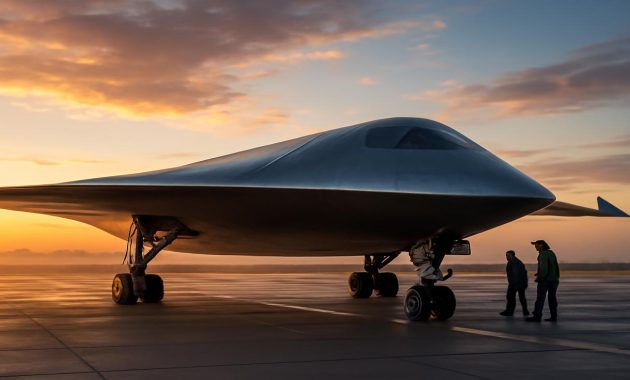
The first time you see it, your brain quietly rejects the image. It looks like a manta ray that decided to study aerodynamics: wide, winged, almost too slender to be real. A pilot sits low in the middle, half cocoon, half cockpit, and above him a propeller turns with lazy confidence, as if it has nothing to prove. The aircraft rolls down a short strip of grass, barely gathering speed. And then, almost casually, it lifts—no roar, no drama, just a whispering sigh as it peels itself from the earth and rises into the morning air.
On the ground, a small group of engineers and onlookers watch with a mixture of elation and disbelief. Because what they’re seeing should not be possible—not with this little power, not with this little fuel, not with this much efficiency. Yet there it is, stitching a quiet line across the sky over rural France, writing a new question into the future of flight: what if we’ve been doing aviation wrong for the last hundred years?
A Wing That Shouldn’t Work, and Yet It Does
To understand why this strange French aircraft is being called “impossible,” you have to unlearn almost everything you think you know about airplanes. For over a century, aircraft design has largely followed a familiar pattern: a tube of fuselage, wings bolted to the sides, a tail in the back, and enough power strapped on to make the whole thing charge through the air fast enough to generate lift. Faster, higher, louder—efficiency has often been an afterthought, something negotiated reluctantly against the demands of speed and payload.
This new aircraft, however, flips the script. It belongs to a breed of experimental machines called ultra-efficient, low-energy aircraft—prototypes that try to answer a single, audacious question: how little energy does it actually take to keep a human aloft?
The French team behind this plane claims an answer that sounds like a misprint: up to eleven times less energy than a conventional light aircraft. Not a marginal improvement, not a polite gain of a few percentage points. Eleven times. In a world where shaving off 10% of fuel burn is considered a triumph, that number lands like a thunderclap.
They didn’t get there by hacking engines or swapping fuel types. They did it, almost entirely, by reshaping the air itself.
The Art of Floating: How Nature Quietly Informed the Design
Spend some time watching large birds—vultures, eagles, albatrosses—and you start to notice something quietly humbling. They don’t flap very much. When they do, it is precise, brief, deliberate. The rest of the time they are gliding, surfing on invisible rivers of air, trading speed and altitude with the kind of thriftiness most aircraft engineers could only dream of.
The French aircraft takes that lesson to heart. Its wings are long and high-aspect, stretching out to grab as much air as possible. The wing area is generous; its weight is obsessively minimized. Every curve is tuned to coax more lift from less thrust. The result is an aircraft that flies not so much on raw power, but on finesse.
Lift-to-drag ratio—the quiet, unglamorous metric that decides how efficient an aircraft is—sits at the center of this design. Think of it as how well the wing converts forward motion into upward support versus how much the air resists the whole affair. Improve this ratio dramatically, and the laws of physics suddenly become more generous with you.
This French prototype squeezes that ratio to near-glider levels, but with the crucial difference that it’s built not just to glide, but to cruise with almost absurdly low power. Its structure uses advanced composites and clever internal bracing, carving out every surplus gram of weight. Its surfaces are so clean and smooth that air barely knows it has been disturbed. Where typical small aircraft wrestle the sky, this one slips through it.
A Cockpit Conversation with the Future
Imagine climbing into the cockpit for the first time. The door shuts with a light click instead of a heavy clunk. The canopy arcs around you like the hull of a kayak fused with the glassy dome of a greenhouse. Outside, the world is filtered through early sunlight and the cool hush of morning air.
There is no throaty engine rumble when you start up—no smell of avgas pushing its way into your sinuses. Instead, you feel a vibration like a cat purring two rooms away. The electric motor—because of course it’s electric—spins up the propeller with a mild, almost shy whir. Your headset doesn’t need to block out a roar; it just mutes a murmur.
The runway doesn’t need to be long. You advance the throttle, but “advance” feels like the wrong verb. You nudge it. The plane begins rolling, light on its feet, accelerating more like an eager bicycle than a lumbering machine. Air moves over the wings earlier than your instincts expect. The nose lifts. There’s no dramatic lurch—only a soft, rising confidence as the ground gently lets go.
Up here, the aircraft feels like it’s drawn forward by intention rather than brute force. You can throttle back to power levels that would feel laughable in a conventional plane, yet the horizon still slides by. Suddenly, eleven times less energy doesn’t feel like a number. It feels like a sensation: the sense that you’re not fighting gravity anymore, just negotiating with it.
Why Eleven Times Less Energy Actually Matters
In aviation, power is money, power is emissions, power is noise, power is weight. Cutting energy use by even a third changes design decisions, infrastructure needs, and environmental impact. Cutting it by a factor of eleven begins to redraw the map entirely.
Consider some simple comparisons between a traditional light aircraft and this ultra-efficient French design:
| Feature | Typical Light Aircraft | Ultra-Efficient French Aircraft |
|---|---|---|
| Energy Use per Flight Hour | 100% (baseline) | ~9% (up to 11× less) |
| Primary Power Source | Piston engine, aviation fuel | High-efficiency electric motor |
| Typical Cruise Noise Level | Loud, requires heavy noise insulation | Whisper-quiet, mostly propeller noise |
| Takeoff Run | Longer, needs paved runway | Short, possible from small grass strips |
| Operating Emissions | Direct CO₂ and NOₓ emissions | Zero local emissions; grid-dependent overall |
For remote communities, such an aircraft hints at clean, local air transport that doesn’t need sprawling infrastructure. For training and recreational flying, it promises drastically cheaper hours in the air and a dramatically quieter soundscape. For regional mobility, it nudges the door open to battery-electric or hybrid aircraft that actually make economic sense.
In a warming world where aviation often feels like one of the hardest sectors to decarbonize, this isn’t just an engineering puzzle. It’s a moral one. Every percentage point of efficiency clawed back from drag and weight is a few more molecules of CO₂ that never have to be released. At eleven times less energy, you’re not just being slightly kinder to the atmosphere—you’re flirting with an entirely different relationship between flight and the planet.
Designing for Slowness in a Culture Obsessed with Speed
Here’s the catch: this aircraft is not built for raw velocity. It is an ode to graceful, measured, patient flight. It doesn’t chase jetliner speeds; it lingers in the air, stretching every watt of power into distance and duration.
We live in a culture that has turned speed into a kind of worship. We celebrate minutes shaved off flight times, cruises at thirty-five thousand feet, record-breaking transcontinental crossings. But there is something deeply human in reclaiming slowness—especially when that slowness comes with an almost magical efficiency.
From the cockpit, this slowness doesn’t feel like a limitation. It feels like intimacy. You fly low enough to read the folds in the landscape, to trace the paths of rivers and hedgerows, to see cattle as individuals and not as a mottled blur. You are close enough to the weather to feel its moods: the slight bump of a thermal, the odd stillness of a temperature inversion, the polite negotiation around a cloud.
The French designers understood that by accepting a lower top speed, they could unlock an extraordinary reduction in power requirements. Lower speeds mean lower drag. Lower drag means smaller motors, smaller batteries, lighter structures. Everything cascades downward in a virtuous spiral. Instead of outrunning the air, you move with it.
In that sense, this “impossible” aircraft is not just a machine but a quiet question directed at all of us: what if the future of aviation doesn’t have to be faster, higher, more? What if part of it could be calmer, closer, less?
Between Dream and Deployment: The Hard Road Ahead
Of course, prototypes live in a fragile world. The sky is littered with the ghosts of brilliant experimental aircraft that never made the jump to widespread use. The French team behind this ultra-efficient craft knows this well. Physics may be on their side, but reality has other gatekeepers: certification, regulation, public acceptance, economics, infrastructure.
For one, battery technology remains both miracle and bottleneck. Even with extreme efficiency, storing enough energy for long flights is a game of grams and trade-offs. Every extra minute of endurance costs weight, and weight tugs back on the very efficiency the aircraft is built upon. Hybrid systems—combining small combustion engines with batteries—might bridge the gap, but they complicate what is currently a beautifully simple powertrain.
Then there’s certification. Aviation safety regulations exist because the sky, for all its beauty, is unforgiving. Proving that such a novel design is not only efficient but robust, repeatable, and safe under a wild variety of conditions takes years, mountains of data, and large financial backing. Radical ideas often move more slowly than the imaginations that conceived them.
And yet, something feels different this time. The physics are irresistible. The climate clock is ticking. Governments are beginning to nudge, and sometimes shove, the industry toward lower emissions. Pilots and passengers alike are becoming more conscious of their footprint. In that context, an aircraft that uses eleven times less energy is not a luxury—it is a potential necessity.
It’s possible, even likely, that this exact French machine will never become a mass-produced, everyday aircraft. But its DNA—the way it slices drag, sips power, hums through the air with glider-like grace—may well be spliced into the next generation of short-haul and regional airplanes, air taxis, and training fleets.
Listening to the Whisper of the Possible
Stand at the edge of a small French airfield at dusk and you might not even hear it take off. The birds keep singing. A dog glances up once, then resumes its investigation of a patch of grass. The aircraft lifts without spectacle, except for the one taking place in your own sense of what flying is supposed to sound and feel like.
For more than a century, we’ve associated aviation with noise and urgency—jet engines clawing at the sky, contrails etched in cold upper air. This aircraft whispers a different story. It suggests that flight can be light-footed, almost polite. That the sky need not be dominated only by large, fast, fuel-hungry machines, but also shared with small, slow, almost impossibly frugal ones.
In a way, it brings flying back to its roots. The Wright brothers were not chasing Mach numbers; they were chasing the simple miracle of staying aloft with as little power as possible. Across the span of a hundred and twenty years, this French “impossible” aircraft feels like an echo of that original question—updated with modern materials, electric propulsion, and a very twenty-first-century anxiety about our relationship with the Earth.
Here, efficiency is not a dry engineering metric. It is a form of respect: for the energy we borrow, for the atmosphere we move through, for the ecosystems below us, and for the future generations who will inherit both our dreams and our exhaust.
Some revolutions arrive with a roar. Others arrive on quiet wings, sipping at the world’s energy instead of gulping it, and showing by quiet example that the impossible was only a limit we hadn’t yet tested.
Frequently Asked Questions
Is this French aircraft already flying in real-world tests?
Yes, the aircraft concept has been demonstrated in flight tests, showing that ultra-efficient, low-energy flight is not just theoretical. While it’s still in a prototype and development phase, the test flights are proof that the underlying physics and design choices work in the real world.
How can it use up to eleven times less energy than a normal plane?
The energy savings come mainly from aerodynamics and weight reduction, not just from the electric motor. With an exceptionally efficient wing, low drag, a very light structure, and modest cruise speeds, the plane simply needs far less power to stay airborne. Electric propulsion then converts that small amount of energy into thrust with very high efficiency.
Could this kind of aircraft replace commercial airliners?
Not in the near term. This design is best suited for small aircraft: training, recreation, observation, and short-range mobility. However, the principles behind it—high lift-to-drag ratios, lightweight structures, and efficient propulsion—can inspire more efficient designs for larger aircraft and regional transport.
What about flight range? Aren’t electric planes limited by batteries?
Battery energy density is still a limiting factor, but because this aircraft needs so much less power to fly, it can achieve useful flight times even with current battery technology. For longer routes, hybrid systems or future battery improvements will be important. The key is that radical efficiency makes every watt-hour go much further.
When might we see aircraft like this available to the public?
Timelines depend on certification, funding, and industry partnerships. Experimental and kit versions could appear sooner for specialized users and enthusiasts. Widespread adoption in flying schools or regional transport will likely take several years, but designs like this are already influencing how manufacturers think about the next generation of low-impact aircraft.