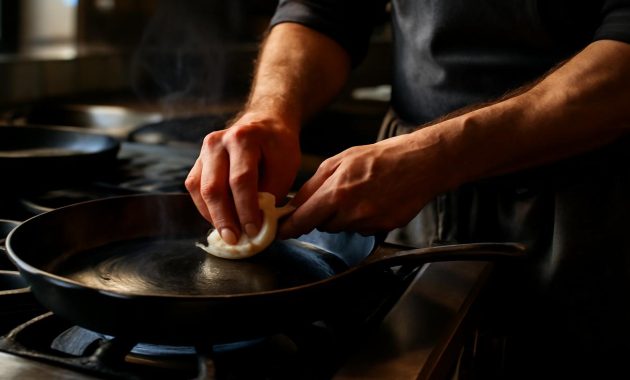
The skillet was still warm on the counter when the chef slid it toward me, black as a raven’s wing and shining like wet river stone. “Touch it,” she said. I pressed my fingertips lightly to the surface. It wasn’t slick like nonstick, not quite rough like raw iron—more like the feel of a worn leather jacket, softened by years of use. “That,” she added, “is what happens when you take your time. People rush their cast iron. But slow seasoning? Low heat? That’s where the magic lives.”
Listening to the Pan
Chefs talk about cast iron the way gardeners talk about soil. It has memory. It responds to care or neglect. It tells on you. Walk into a professional kitchen after service, and you can often spot the cook who truly loves their pans: a stack of dark, satin-finished skillets, edges glossed like pebbles in a stream, no rust freckles, no gummy patches of burnt oil.
When I started asking chefs how they kept their cast iron looking like this, I expected complicated rituals and exotic products. Instead, I heard something surprisingly quiet, almost meditative: low heat, light oil, patience. Over and over, professionals described seasoning not as a flashy, blazing-hot event, but as a gentle, steady conversation with the metal.
“Everyone wants to blast it in a screaming oven,” one line cook told me. “They crank it to 500, smoke up the house, and think more heat equals better seasoning. But you’re not searing a steak. You’re building a relationship. And relationships don’t like being rushed.”
In the low light of a closing kitchen, there’s a particular music to this routine. A burner clicks to life on the lowest setting. A thin thread of oil glides around the pan like a creek meandering through a valley. A folded towel circles the interior, wiping away excess until just a ghost of shine remains. Then the pan sits there, quietly warming, the iron slowly drinking in the oil, changing at a level you can’t quite see—but can absolutely feel over time.
The Quiet Science Behind Slow Seasoning
To understand why low-heat seasoning lasts longer, you need to peek inside what’s happening on the surface of that pan. Not just metaphorically—chemically.
At its core, seasoning is simply this: oil turns into something harder, slicker, and more durable through heat. When you heat thin layers of oil on cast iron, they don’t just dry; they transform. The fats in the oil break down and reorganize into a thin, plastic-like coating that clings to the microscopic nooks and slopes of the iron. This is polymerization—tiny molecules linking arms to form a protective, nonstick shield.
“On low heat,” explained one chef who also happens to geek out over chemistry, “those molecules have time to arrange themselves in tighter, more uniform layers. Think of it like weaving a fine fabric versus throwing a tangled net. High heat can work, but it’s chaotic. Low heat is orderly. You get a smoother film that really grips the iron instead of just sitting on top.”
High, aggressive heat pushes oil toward its smoke point in seconds. In that rush, the oil can burn before it bonds, leaving brittle, patchy, or flaky residue instead of a continuous coat. You may get fast color—a dark pan that looks impressive—but it’s like a coat of badly applied paint: it chips, peels, and sticks to your food. That’s when you start to notice strange metallic flavors, sticky egg disasters, and uneven browning.
On low heat, the process is more like slow roasting than incinerating. The oil gradually thins, spreads, and seeps into the iron’s pores. It gently rearranges into those tough, glassy layers that define a great seasoning. Each cycle adds just a whisper of protection, but over weeks and months these whispers become a quiet, durable chorus.
The Feel of a Well-Seasoned Pan
Chefs often describe the result not just in terms of appearance, but sensation. A pan that’s been rushed with high-heat seasoning might look dark, but drag a finger across it and you’ll feel tiny bumps, almost like fine sandpaper. Run your hand over a pan that’s been patiently seasoned at low heat, and it feels finer, almost silky—but with the reassuring texture of something solid and real.
“I can tell who’s impatient,” one chef joked, tipping a pan toward the light. “See that?” The surface shimmered slightly, but little dull spots broke the sheen like islands. “That’s baked-on oil, not bonded seasoning. It’ll peel. The pan looks tough, but it’s wearing a cheap coat.” She grabbed another skillet, older, heavier, the color of charcoal at midnight. Its surface caught the light in one continuous flow. “This one? Slow heat, dozens of times. It’s practically indestructible.”
The Sensory Ritual of Low-Heat Seasoning
Seasoning cast iron at low heat isn’t just about chemistry. It’s also about rhythm—sound, smell, touch. Step into a kitchen where someone is tending a pan in this way, and it feels strangely calm, even if the rest of the world is chaotic.
On the smallest burner, the pan sits like a dark moon, barely glowing with warmth. The flame hums softly, just enough to wake the metal, not enough to make it shriek. A thin film of oil—often something simple like grapeseed, canola, or flax—coats the surface. There is no dramatic plume of smoke filling the kitchen. No pan leaping in and out of a blasting-hot oven. Just a slow exhale of faint, nutty scent as the oil changes.
“You should barely smell it,” a chef told me, moving her hand over the pan as if testing a bath. “If you see big smoke, you’re not seasoning, you’re scorching.” She likened low-heat seasoning to drying clothes in the sun instead of over a fire. “Both will get them dry. But which one keeps them in good shape?”
As the pan warms, you can hear the difference too. There’s no violent crackling. No popping. Just a subtle ticking of expanding metal and the occasional whisper as the oil settles into place. If it starts to spit or sizzle, the heat’s too high. Turn it down. Wait. Let everything calm.
The moment when the oil goes from liquid sheen to bonded layer isn’t something you can easily see happening, but patient cooks sense it. The surface, once glossy, turns quietly matte. Not dull, not sticky—just softly muted, like a river stone drying in the shade. That’s when the chef reaches for a towel, wipes away any remaining excess, and turns off the flame.
Then they do something that most impatient home cooks skip: they leave the pan alone. They let it cool slowly, still and undisturbed, as if letting a story finish its last quiet sentence. That lingering warmth completes the bond, deepening what the low flame began.
Why Fast Seasoning Fails So Quickly
If low and slow is so effective, why does high-heat seasoning remain so popular? Partly, it’s the allure of speed. We live in a world that promises “ready in 30 minutes” for everything from dinner to life skills. Cranking an oven to its maximum temperature feels decisive, powerful. The extreme heat darkens the iron fast, giving the illusion of instant success.
But talk to chefs who cook on cast iron every single day, and you hear about the trade-offs. High-heat methods often leave behind a brittle top coat. It looks like seasoning but behaves more like lacquer laid on too thick. It can crack, flake, and form sticky or gummy spots as it repeatedly reheats and cools.
“You’ll see it start to bead or bubble at the edges,” said a sous chef who had spent years rescuing abused skillets from restaurant basements. “That’s not the pan’s fault—that’s rushed seasoning. The oil never properly bonded to the metal; it just baked onto itself. Give it a month of hard work and it starts coming off like old paint.”
High heat also makes it easy to overshoot the sweet spot, pushing the oil from polymerization into full-on combustion. Once it’s burning, the residue thins in some places, thickens in others, and can introduce unpleasant flavors. Worse, the rapid temperature swings can stress the pan—literally warping the iron if the heat’s uneven or the pan hits cold water too soon.
In contrast, low-heat seasoning builds more like tree rings: thin, consistent layers that stack up slowly. Each time you repeat the process, you’re not covering a mess; you’re reinforcing a foundation. The result doesn’t just look good in the moment—it holds up, service after service, year after year.
How the Pros Actually Do It
While every chef has their quirks, a familiar pattern emerges when they walk through their low-heat routine. It’s rarely complicated. What defines it is restraint.
First, they clean the pan gently—hot water, a brush or coarse salt, maybe a quick scrub with a chainmail scrubber if something truly stuck. They dry it completely, either with a towel or a short visit to a warm burner. Then comes the most important part: using less oil than you think you need.
“If you can see it pooling, it’s too much,” one cook said, holding a small bottle of neutral oil over her pan and barely letting a drop land. She tilted the skillet, letting the oil draw a thin crescent around the rim, then massaged it across the surface, up the sides, over the handle. No drips. No pools. Just a delicate shine, quickly wiped again with a paper towel or cloth until the pan looked almost dry.
Only then does the pan touch the lowest burner or slide into a warm oven—often no hotter than what you’d use to keep dinner warm while the rest of the meal finishes. Fifteen, twenty, maybe thirty minutes is enough. The goal isn’t to darken it in one go; it’s to whisper another durable layer onto the metal.
Many chefs don’t even think of this as a separate “seasoning session.” It’s woven into their cooking. After searing a steak or roasting vegetables, they’ll wash and dry the skillet, then give it a ghost-thin coat of oil and return it to low heat as they clean the station. The pan quietly seasons while the rest of the kitchen winds down. Over time, this small, consistent habit creates something that brand-new, high-heat seasoning can’t touch.
| Aspect | Low-Heat Seasoning | High-Heat Seasoning |
|---|---|---|
| Oil behavior | Gradual polymerization, uniform bonding to iron | Rapid breakdown, higher risk of burning and uneven layers |
| Surface feel | Smooth, satin-like, consistent | Can be bumpy, sticky, or flaky |
| Durability | Long-lasting, resists peeling and patchiness | Prone to chipping, uneven wear, and frequent re-seasoning |
| Kitchen impact | Minimal smoke, gentle heat, easy on ventilation | Heavy smoke, strong odors, can set off alarms |
| Best for | Long-term maintenance and everyday use | Quick cosmetic darkening, emergency touch-ups |
Seasoning as a Slow Craft
There’s a reason many chefs talk about cast iron the way people talk about well-worn boots or seasoned violins. You don’t buy one and have it at its best right away. You live with it. You cook in it. You learn its moods—the way it heats, how it holds warmth, where it tends to run hottest. And in return, it slowly shapes itself to you.
Low-heat seasoning fits this mindset. It trades the instant drama of smoking ovens for the quiet satisfaction of incremental care. Each time you warm a lightly oiled pan, you add another invisible layer to a story that will outlast you. Skilled cooks know this. The best pans in any kitchen are rarely the newest, and they rarely got that way by being blasted once and forgotten.
“My favorite skillet?” a chef told me, pulling a small, heavy pan from the rack with a reverence usually reserved for heirlooms. “It was my grandmother’s. It’s probably 60 years old. I never stripped it, never did a dramatic re-season. Just low heat, light oil, over and over for decades. It’s like cooking on memory.”
When you season at low heat, you’re not just protecting metal—you’re joining that kind of continuity. You start paying attention to small things: how much oil is truly enough, how the surface shifts from gloss to soft matte, how the pan sounds when it’s just warm versus when it’s too hot. Your skillet stops being just cookware and becomes a sort of quiet, daily companion.
In an age of disposable everything, cast iron asks something different of us: patience, repetition, trust. And low-heat seasoning is its language. Not loud, not showy, but enduring.
Bringing It Home
You don’t need a commercial kitchen or a chef’s jacket to season like the pros. You just need a burner that can go low and the willingness to slow your pace by a notch. Clean your pan. Dry it well. Rub it with the thinnest veil of oil. Set it over low heat until the metal feels warm, not raging hot, and the surface turns from shiny to gently muted. Turn off the flame. Let it cool in its own time.
Do this after a big weekend breakfast, after a weeknight stir-fry, after you bake cornbread that perfumes the whole house. Each small act is a quiet promise to the pan—and someday you’ll notice that eggs slide like they’re on ice, pancakes flip without clinging, and the iron itself seems to shrug off rust and wear like it’s made of something more than metal.
Ask a chef why low-heat seasoning lasts longer, and they’ll tell you about molecules and polymerization. But if you hang around long enough, you’ll hear something underneath the science: an understanding that some of the best things in the kitchen can’t be rushed. They’re built slowly, layer by patient layer, under a gentle flame, with a pan that shines not because it was blasted once, but because it was cared for again and again.
FAQ
How often should I season my cast iron at low heat?
If you cook frequently, a light low-heat seasoning once every few uses is usually enough. Many chefs simply do it at the end of each day or whenever the pan looks a bit dry or dull.
What kind of oil works best for low-heat seasoning?
Neutral oils with a relatively high smoke point, like canola, grapeseed, or sunflower, are common choices. Flaxseed oil can create a hard coating but is more finicky; many chefs prefer simpler, dependable options.
Can I still use my oven, or should I only season on the stovetop?
You can do either. The key is keeping the temperature moderate instead of blasting it. A warm oven on a low setting works well, as does the lowest burner on your stove.
How do I know if I’m using too much oil?
After wiping the pan, it should look almost dry, with just a soft sheen. If you see visible streaks, puddles, or feel tackiness after heating, you’ve used too much. Wipe more thoroughly and try again.
What if my cast iron already has sticky or flaky seasoning from high heat?
You can gently scrub off the loose or gummy areas with hot water, salt, or a scrubber, then start rebuilding with very thin layers at low heat. You don’t always need to strip the pan completely—steady, careful low-heat seasoning can gradually restore it.
Does cooking in the pan count as seasoning?
Yes, especially when cooking with a bit of fat. Everyday use reinforces the seasoning. Low-heat maintenance afterward simply strengthens and evens out what your cooking has already added.
Why does my pan still rust even though I season it?
Rust usually means moisture lingered—either the pan wasn’t fully dried, or it was stored in a damp place. Make sure it’s completely dry, give it a light oiling, and do a brief low-heat session before putting it away. Over time, a strong seasoning layer will make rust less likely.