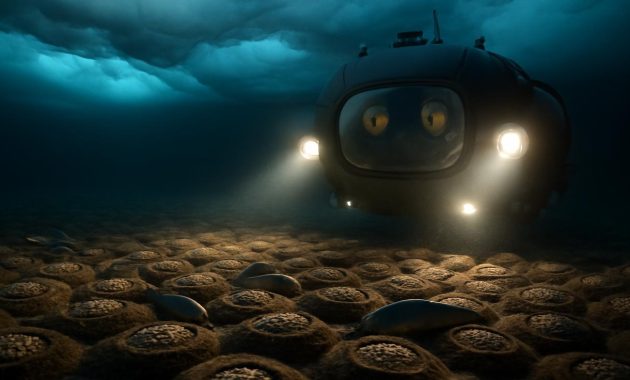
The first thing they saw was movement—soft, pulsing circles in the glow of the camera’s light, like a galaxy scattered across the seafloor. The ship floated in quiet twilight above the Weddell Sea, ice groaning softly in the Antarctic cold, while far below, a camera sled glided a meter above the bottom. Then, on the monitor, a shape appeared: a round depression, a single fish, pale against the darker background, hovering like a guardian. The crew leaned in. Another nest. Then another. Then hundreds. The seafloor unfurled as a field of craters, each one with a watchful fish in the center, each one carrying a story no one knew existed.
An Accidental Discovery in a Hidden World
No one had gone searching for fish nests that day. The research team aboard the German icebreaker RV Polarstern was in the Weddell Sea to study ocean currents, ice shelves, and the hidden rhythms that drive Earth’s climate. They were towing a camera system behind the ship—a long metal frame fitted with lights and sensors—letting it drift just above the seabed to map habitats and life in one of the least-disturbed corners of the ocean.
It was a normal pass over the seafloor. Monitors flickered with images of mud, stones, scraps of life: sponges, starfish, the occasional wandering fish. A familiar deep-sea quiet. The team knew this part of Antarctica was special, but they expected sparse life, spread thin by cold and darkness. Instead, they stumbled into something like a city.
Onscreen, the first nest appeared. A shallow bowl in the sediment, maybe 75 centimeters wide, filled with eggs—thousands of them, like a scatter of tiny glass pearls. Above them hovered a single fish, ghostly white in the light, fins fanning the water in a slow, persistent rhythm. It was a Jonah’s icefish, a species adapted to the freezing Southern Ocean with blood so clear it almost seems unreal, rich not in red hemoglobin but in special proteins that keep it from freezing.
The nest drifted past as the towed camera moved on… and then there was another. Then a cluster. Then the entire screen became patterns of circles, each with a fish and a bright halo of eggs. On the ship, conversation shifted from curiosity to astonishment. Someone started counting. Someone else called for data logs, coordinates, video captures. The team’s careful, quiet work turned into a scramble to understand what they were seeing.
The Seafloor City of Icefish
As the images streamed in and the kilometers of seafloor passed beneath the camera, a staggering picture emerged. This wasn’t a handful of nests scattered across the ocean floor. It was an immense colony, a sprawling neighborhood of fish families stitched together across the bottom of the Weddell Sea, hidden beneath hundreds of meters of ice-covered water.
Some nests were neat, circular cradles, each egg glinting faintly in the artificial light. Others were older, sometimes abandoned, the eggs missing, the guardian gone, just a faint scar in the sediment. In nest after nest, one fish hovered like a parent holding vigil, guarding, fanning, waiting.
The water here hovered just below freezing, a place of perpetual near-night where sunlight rarely reaches. Yet the nests were alive with potential. Each cluster of eggs represented thousands of possible futures, tiny bodies still forming, nerves and fins and eyes emerging from translucent jelly under the quiet pulse of cold water.
The numbers, when the team finally calculated them, were absurd. The colony spanned at least 240 square kilometers. In that space, they estimated around 60 million nests. Sixty million tiny households tucked into the seafloor, each one monitored by a single adult fish, each one a commitment to survival in a world of harsh odds.
The Icefish and Their Strange Blood
The architects of this underwater city, the Jonah’s icefish, are no ordinary fish. They inhabit waters that hover at the edge of freezing, in a sea that would lock most creatures rigid in moments. Their blood is almost transparent—no red, no classic hemoglobin pigment. Instead, they rely on dissolved oxygen in their blood and enlarged hearts and blood vessels to circulate it. It’s a quirky evolutionary gamble that works only in the super-oxygenated chill of Antarctic waters.
To see millions of such fragile-looking animals engaged in something as familiar as parenting, as building nests and defending young, felt like a secret confession from the deep ocean: even here, under thick ice and in frigid darkness, life gathers, organizes, and tries again.
Why Here? The Subtle Clues of an Antarctic Neighborhood
The colony might have been discovered by accident, but its existence is no accident at all. The Weddell Sea, tucked against the edge of the Antarctic continent, is not just a random patch of cold water. It is a dynamic engine room of the planet’s climate system—a place where cold, dense water forms and sinks, driving global ocean currents. Under its apparently quiet surface, subtle forces are always at work.
In the area where the fish nests were found, the team noticed slightly warmer water flowing near the seafloor—only a couple of degrees above the freezing point, but in the Antarctic that difference matters. Those thin layers of warmth, sliding in from the deeper Southern Ocean, may create a narrow comfort zone where icefish eggs can develop without freezing and where food for the parents stays just within reach.
Zoomed out, the colony forms a kind of mosaic: active nests packed with eggs, neighbor to neighbor; empty nests that might have hatched successfully or failed quietly; patches of fallen fish, predators, and scavengers circling the edges. It’s not a peaceful garden so much as a living, changing neighborhood, where life and death are happening simultaneously, in millions of small dramas on the seafloor.
The Scale of Life Beneath the Ice
To grasp the sheer size of what lies beneath the ice, it helps to put the numbers into perspective. Here’s a simplified look at what the researchers estimated from their surveys:
| Feature | Approximate Value |
|---|---|
| Area of icefish colony | ~240 km² |
| Estimated number of nests | ~60 million |
| Eggs per nest (average) | 1,500–2,500 eggs |
| Depth of colony | Approx. 420–535 meters |
| Water temperature near bottom | Slightly above -1.8°C (sea ice freezing point) |
Each of those nests is more than a statistic; it is the center of a tiny universe. The adult fish guarding it could have migrated long distances, burning precious energy to reach this place. Here, they invest months of their lives fanning oxygen-rich water over the eggs, scaring off would-be predators, and fasting through the Antarctic winter.
For scientists used to thinking of deep polar habitats as sparse and scattered, this density is astonishing. Imagine walking into a forest in a place you thought was a desert—and finding not just a few trees, but millions of them, stretching beyond the horizon.
Guardians, Predators, and the Web of the Weddell Sea
The nests are not isolated points of interest in an empty void. They form the backbone of a larger food web that spirals outward through the water column and ultimately reaches the surface, where seals, penguins, and whales navigate the shifting ice.
Elephant seals, for example, repeatedly dive in this region, their movements tracked by satellite tags and sensors. Their diving patterns suggest they are foraging in and around the same depths as the fish nests. It’s as if the seals know, in their own sensory way, that the seafloor here is rich with promise. They may not see the nests directly, but they dive and turn and shift their paths in ways that hint at a hidden banquet below.
Other species, too, likely tap into this resource: scavengers that consume dead fish, predators that sneak in to eat unguarded eggs, and smaller organisms that take advantage of the organic debris scattered across the colony. The nests themselves turn the seafloor into a textured, complex landscape, altering currents just enough to change how sediments settle and how food particles drift.
From the perspective of the icefish, though, the world is simpler and more immediate. Each adult is locked into a narrow circle of responsibility: keep the eggs clean, keep them oxygenated, stay alert. The parents themselves become vulnerable—easier targets for large predators, slower and more exhausted as time goes on. Parenting in the Weddell Sea is a quiet, high-stakes gamble.
A Colony Written in Time
The nests also tell a story over time. Some are filled with plump, healthy eggs. Others hold partly developed embryos, eyes beginning to darken in their translucent heads. Still others are empty, a bowl smoothed by currents, hinting at a successful hatch or an earlier failure. Together, they form a kind of living timeline written across the mud.
Scientists suspect that the fish return to this area year after year, drawn by the same subtle combination of currents, temperature, and maybe even seafloor chemistry. If that’s true, then this colony may have been forming and reforming for generations, hidden beneath the ice while the world above changed borders, technologies, and languages.
How a Chance Encounter Redefined a Landscape
The sheer improbability of the discovery feels almost like a plot twist. The Weddell Sea is vast, the pack ice thick and unforgiving. The camera system followed a narrow path across the seafloor, only a few meters wide, in an ocean basin that stretches for hundreds of kilometers. A slight change in route, a different research plan, and the colony might have slept on in the dark, unknown for years or decades more.
But that’s the thing about exploration—especially in the deep ocean. Serendipity and planning are inseparable. The team designed the survey to reveal habitats and seafloor structure, to trace how life was distributed in this icy corner of the world. When the camera first dipped into the nest field, it was doing exactly what it was built to do; the surprise lay in what the ocean chose to reveal.
Once the first astonishment faded, the work shifted to methodical documentation. Each nest was logged and mapped. Footage was reviewed, counted, categorized. Patterns emerged: denser clusters in some areas, more abandoned nests in others, perhaps linked to currents or micro-topography on the seabed. In the blinking glow of screens in the ship’s control room, a new map of the Antarctic seafloor began to take shape.
From Unknown Patch to Ecological Hotspot
Before the discovery, this part of the Weddell Sea was just another grid square on a chart—a cold, dark, likely low-productivity region beneath the ice. Afterward, it became something else entirely: an ecological hotspot, a breeding ground of global significance. Sixty million nests aren’t just a curiosity; they’re a cornerstone of the local ecosystem, a biological engine quietly powering life up the food chain.
In a world where so much of the ocean floor remains unmapped and unseen, the idea that one of the biggest known fish breeding colonies on Earth lay hidden in plain sight is both humbling and thrilling. It hints that the ocean’s ledger, the list of what lives where and why, is still very incomplete.
Fragility in a Time of Change
Antarctica has long been cast in the imagination as a place of unchanging ice and steadfast cold, but that illusion is slipping. Ocean temperatures creep upward. Ice shelves crack and calve, reshaping coastlines and altering the currents that lace through the deep. Even remote regions like the Weddell Sea are feeling the subtle tug of a warming planet.
That makes the discovery of the icefish colony not only wondrous, but urgent. This breeding ground depends on a careful balance: near-freezing water, just-warm-enough deep currents, stable ice cover above that keeps surface disturbances minimal. Shift that balance—warm the water by a degree or two, alter the circulation patterns—and the colony could be transformed.
Shipping routes are also pushing closer to the polar regions as ice retreats and seasons of open water lengthen. Areas that once were protected by sheer inaccessibility are becoming more reachable—for research, yes, but also for fishing and other human activities. The thought of trawl nets crossing a seafloor loaded with fish nests is almost unbearable once you’ve watched those ghostly guardians on screen.
Protecting a Secret City of the Deep
News of the nests has already sparked talk of protection. The region falls within a proposed marine protected area in the Weddell Sea, a kind of underwater park where industrial disturbance would be limited or banned. The discovery adds weight to the argument. It’s not just water and ice out here; it’s a nursery for millions of fish that may feed countless other animals, part of a living climate engine that the world depends on more than it realizes.
Yet protection is never guaranteed, and it’s rarely fast. International agreements in Antarctic waters require consensus, negotiation, time. Meanwhile, the nests sit in the dark, and the icefish continue their quiet rituals, unaware of the discussions taking place on distant conference tables.
What the Nests Tell Us About Ourselves
Stories from the deep sea tend to feel remote: strange creatures, strange chemistries, an alien world. But there is something familiar about a nest. A depression in the ground, a ring of stones, a cluster of eggs—these are shapes that repeat in bird colonies, turtle beaches, even the small homemade forts of children. A place cleared, defended, and dedicated to future life.
Watching the footage from the Weddell Sea, it’s hard not to feel that tug of recognition. The adult fish hovers over the eggs with a patience that looks almost like devotion. You know, rationally, that it is an instinct shaped by countless generations of evolution. Yet the emotional impact slips through anyway: here is care, in its most stripped-down, elemental form. A body staying put in a dangerous world because the next generation depends on it.
More than that, the discovery reminds us how incomplete our sense of the planet still is. We map the surfaces of Mars and the Moon with beautiful precision, yet vast communities here on Earth remain unseen. Beneath a lid of ice and cold water, a fish metropolis lived out its cycles unnoticed, until a camera passed overhead and we finally looked down at the right time, in the right place.
There’s comfort in that, oddly. The ocean is not just a tally of losses and declines; it still has surprises, still holds pockets of abundance and resilience. The icefish colony is fragile, but it is also testimony to life’s ability to carve out space in even the harshest environments.
Leaving the Colony in the Dark
When the RV Polarstern eventually turned away, the camera hauled back through the depths, the colony slipped once more into its natural state: darkness, cold, the soft whisper of currents brushing over nests. The fish remained, hovering, fanning, waiting. Above them, the ice creaked, the wind moved, and the ship’s wake faded into the distance.
The scientists carried the images home, processed them, argued over them, published them. The world briefly turned its attention to this hidden city of fish beneath Antarctic ice. And then the news cycle moved on, as it always does. But under the Weddell Sea, the story continues, quietly, nest by nest.
Somewhere in that colony, at this very moment, tiny icefish are inching their way toward hatching, eyes darkening, tails twitching, ready to burst from their eggs into the cold water. Their parents, nearly transparent in the dim light, keep watch in a world that feels—to us—like the far edge of the Earth, but to them is simply home.
Frequently Asked Questions
How were the fish nests in Antarctica discovered?
They were found accidentally during a scientific expedition in the Weddell Sea. Researchers were towing an underwater camera system to study the seafloor and ocean conditions when they began seeing repeated circular depressions filled with eggs and guarded by adult fish. Continued surveying revealed that these nests stretched across a vast area.
What species of fish builds these nests?
The nests belong primarily to Jonah’s icefish, a species uniquely adapted to Antarctic waters. These fish have nearly transparent blood that lacks the red hemoglobin found in most vertebrates, relying instead on cold, oxygen-rich water and specialized circulation to survive.
How many nests are there, and how large is the colony?
Scientists estimate that there are around 60 million nests spread across an area of roughly 240 square kilometers on the Weddell Sea seafloor. This makes it one of the largest known fish breeding colonies on Earth.
Why do the icefish choose this specific area to nest?
The nesting grounds appear to coincide with slightly warmer water near the seafloor, created by deep currents entering the region. These conditions likely offer an optimal balance of temperature and oxygen for egg development and may concentrate food sources for the adult fish.
Is climate change a threat to this fish colony?
Potentially, yes. The colony depends on stable, near-freezing conditions, specific current patterns, and consistent ice cover above. Changes in ocean temperature, circulation, and sea-ice dynamics driven by climate change could disrupt these conditions and affect the survival of both the eggs and the adults.
Are there protections in place for this area?
The nesting grounds lie within the boundaries of a proposed marine protected area in the Weddell Sea. While there is growing scientific support for protecting the region, formal international agreements and enforcement measures are still under discussion and not yet fully in place.
Can people ever visit or see this colony directly?
Because it lies hundreds of meters below the surface under Antarctic conditions, direct human visits are extremely challenging. For now, the only way most people can see the colony is through images and video captured by research cameras and submersibles. In a sense, its remoteness is both its protection and its mystery.