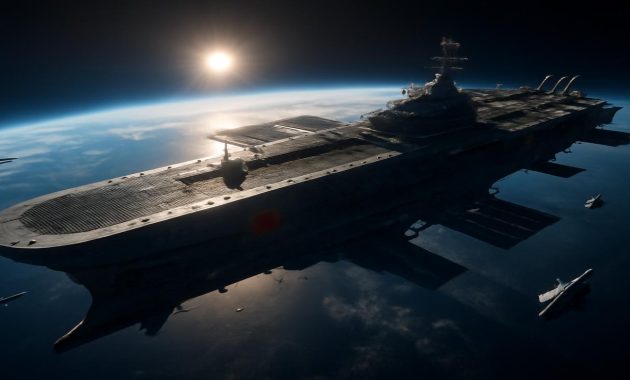
The first time you see it, your brain refuses to cooperate. It looks like something torn from a sci‑fi poster tacked above a teenage bed: a sleek, winged leviathan floating against the dark, a runway stitched across its back, smaller craft cradled beneath its spine. Yet this is no artist’s doodle; it’s China’s newly unveiled concept of a “space aircraft carrier” – a term that feels both clumsy and breathtaking, like our language is scrambling to keep up with our imagination.
What Exactly Is a “Space Aircraft Carrier”?
To understand what China has put on the table, you have to peel away the drama of the words and sit with the idea itself. Imagine a gigantic, reusable spaceplane – a “mothership” – drifting or cruising in orbit. From its belly or its back, smaller spacecraft launch like fighter jets from a carrier deck: miniature shuttles, robotic interceptors, sensor drones, maybe even kinetic projectiles one day.
In simplified terms, a space aircraft carrier is an orbital base that can:
- Serve as a mobile launchpad for smaller craft
- Refuel or rearm satellites and drones
- Act as a command hub for space operations
- Potentially conduct reconnaissance or offensive missions
China’s concept imagery and early descriptions hint at something between a colossal spaceplane and a modular space station. It’s not yet hardware poised on a launchpad, but a design vision: wings sweeping out like a manta ray, cargo bays for payloads, docking ports for smaller ships. Think less “Star Destroyer” and more “orbiting hangar with engines and claws.”
The phrase itself – “space aircraft carrier” – is no accident. It taps straight into the psychology of power. Aircraft carriers at sea are floating flags, mobile sovereignty. They show up on horizons and change the mood of entire regions. Now imagine something that plays a similar role, but far above the clouds, indifferent to borders and coastlines.
The Sensory Weight of a Machine That Never Lands
Picture it as if you were there. The carrier hangs in low Earth orbit, one edge glowing gold where the Sun kisses its wing, the other swallowed in ink. The curvature of Earth rolls beneath in slow, majestic silence: bruised blue oceans, storm systems curling like white fists, a smear of city lights simmering at night. Against this living canvas, the carrier is dark, angular, anonymous.
There is no roar in space, but you can almost feel the vibration through the soles of your feet if you imagine standing inside it. Tiny gyroscopes whir in hidden wells. Pumps shudder. Panels flex with micro-changes in temperature. Outside, robotic arms move with the eerie grace of deep‑sea creatures, shifting pods from one cradle to another.
Inside a hypothetical control deck, the light is low. Holographic displays or bright consoles pulse with telemetry: trajectories arcing like fine threads, targets blinking, satellites labeled in quiet lines of text. Operators float or strap into their stations. Buttons and switches are no longer metal and chunky; they’re flat, glassy, responsive to a fingertip that barely presses. Everything hums with the feeling that any move here might nudge the fate of machines hundreds of kilometers away.
This, more than the glossy posters and patriotic animations, is what China is pointing toward: an environment where space is not just a place you visit, but a theater you command.
China’s Space Playbook: Ambition With a Military Accent
China’s reveal of a space aircraft carrier concept doesn’t come from nowhere; it’s another bead on a long thread woven through the last two decades. While the world’s attention has bounced between Mars rovers, billionaire rockets, and streaming‑friendly space tourism, China has been quietly, methodically putting down pieces of something more structural.
They’ve built the Tiangong space station and are expanding a steady cadence of crewed missions. They’ve sent probes to the Moon, brought lunar soil home, and set their sights on Mars and beyond. They’ve experimented with reusable spaceplanes – the kind that disappear into classified silence for months before gliding back to Earth, their flight profiles hidden like a held breath.
Through all of this, there’s been a constant refrain from analysts and military planners: space is no longer a benign domain. It’s a contested high ground. Satellites are no longer just meteorology tools or television pipes; they’re the nervous system of modern warfare – GPS navigation, secure communications, missile warning, battlefield surveillance.
China’s leadership knows this. Their doctrinal thinking increasingly treats space as a “new commanding height” of strategic competition. Anti‑satellite tests, orbital inspection satellites that can sidle up to other nations’ spacecraft, jamming capabilities – these have been signposts along the way. A space aircraft carrier concept slots into that same story: a vision of not just being present in orbit, but organizing it.
Threat or Theater? Reading Between the Orbital Lines
When images of the carrier concept began to circulate, reactions split almost instantly into two camps. One sees a genuine military shift, the other sees smoke and mirrors.
The Case for a Real, Emerging Threat
From a military perspective, the logic is stark. If you can park an asset in orbit that:
- Can deploy small spacecraft on short notice
- Can maneuver to new orbital planes faster than launching from Earth
- Can repair, refuel, or reposition friendly satellites
- Can shadow or interfere with adversary satellites
…then you’ve just created a platform that bends the rules of the current game. Suddenly, space isn’t just a thin scattering of satellites drifting along; it’s a place where agile forces can stage, regroup, and launch operations.
War‑planners picture nightmare scenarios: a crisis flares on Earth, and above, a carrier in orbit quietly releases a clutch of micro‑satellites that swarm toward key assets – a GPS constellation, an early‑warning satellite, a vital communications relay. Nothing explodes in cinematic fireballs. Instead, there’s jamming, blinding, nudging, grappling. Destruction by inconvenience and denial.
For countries that rely deeply on space infrastructure – the United States, European nations, Japan, India – the mere possibility of such a capability alters the strategic calculus. You don’t need hundreds of these carriers. One or two, used cleverly, could create enough uncertainty to shape a conflict or force political concessions.
The Case for Grandstanding and Carefully Staged Show
Yet, step back and take a breath, and another interpretation emerges. Large, complex, reusable orbital platforms are monstrously difficult to build, maintain, and protect. The engineering problems alone could fill careers: thermal cycling as the craft repeatedly passes from sunlight to shadow; micrometeoroid and debris impacts; propulsion requirements for orbital changes; on‑orbit refueling infrastructure; human factors if crews are involved.
So far, China has revealed concepts, mock‑ups, and early prototypes, not an operational carrier cruising serenely around Earth. The visuals – the dramatic renderings, the bold phrasing – serve a domestic purpose too. They project technological modernity. They stoke national pride. They tell citizens: look, we are not just catching up, we are imagining beyond.
There’s also the international audience. Floating a striking, futuristic design acts as a strategic nudge. It forces rivals to respond, to divert attention and budgets, to run simulations about hypothetical threats. In that sense, even a paper space carrier can have real‑world power. It can trigger policy debates, budget requests, alliance consultations. It can cause precisely the kind of nervousness you’re feeling as you read these words.
Seen from this angle, China’s reveal is both a technology roadmap and a psychological operation: a way of shaping perceptions long before hardware is in place.
How a Space Carrier Could Actually Operate
To ground this in something more concrete, imagine a not‑too‑distant future in which one of these carriers is real and operational. It wouldn’t resemble a movie warship bristling with visible guns. It would be a hybrid creature – part station, part depot, part depot of options.
Here’s how its role could break down:
| Function | Description | Military Impact |
|---|---|---|
| Launch Platform | Deploys small satellites, drones, or interceptor craft directly from orbit. | Faster response than ground launches; surprise deployments in critical orbits. |
| Service Depot | Refuels, repairs, or upgrades friendly satellites and payloads. | Extends life of space assets; keeps key systems online in wartime. |
| Recon Hub | Hosts powerful sensors, relays data, coordinates surveillance constellations. | Improves situational awareness and battlefield targeting. |
| Interference Node | Supports jamming, spoofing, or close‑approach operations on rival satellites. | Threatens adversary communications and navigation systems. |
| Diplomatic Symbol | Highly visible flagship of national space capability. | Psychological pressure; lever in negotiations and crisis signaling. |
Now layer in the realities: any such structure would be expensive, vulnerable to debris, and potentially targetable by rival anti‑satellite weapons. It would be both a sword and a very large, very tempting shield to strike.
It’s also not only China that’s been flirting with these ideas. The United States has run its own classified spaceplane missions with the X‑37B. Private companies talk about on‑orbit refueling, in‑space manufacturing, and modular stations. The line between civil and military space, already blurred, risks dissolving entirely as these technologies mature.
Why This Moment Feels Different
So what makes this reveal stand out, beyond the sleek renderings and alarmist headlines? It’s the way it crystallizes a mood that’s been building quietly for years: the sense that we’ve slipped into a prequel to some yet‑to‑be‑named space conflict.
For much of the late 20th century, space was wrapped in a kind of mythic mist. It was NASA suits, Soviet cosmonauts, grainy moon footage, the romance of exploration. War in space lived mostly in pulp novels and Cold War fever dreams. Yet as nations have layered more and more of their daily functioning into orbit – everything from ATMs to air traffic control – the tone has shifted.
Listen to the language of new military doctrines and you’ll hear it: “space control,” “space superiority,” “resilience of space architecture.” Read dense policy documents and you’ll catch cold phrases like “left of launch” (disabling missiles before they leave the ground) and “cross‑domain escalation” (letting a problem in one domain spill into another).
Against this backdrop, China unveiling a space aircraft carrier concept feels like a mask dropping. It takes what was implied – militarized space, offensive capability – and gives it a visible, almost cinematic avatar. Suddenly the conversation isn’t just about anti‑satellite missiles or scrambling radio signals; it’s about large, deliberate machines that are meant to stay up there, watching, waiting, ready.
There is also a timing echo here. As climate shifts and resource stresses deepen on Earth, great powers are increasingly looking upward – to lunar resources, to Mars, to asteroid mining concepts. Wherever commerce and exploration go, security follows. A space carrier, real or not, is a sign that countries are already sketching out who gets to be the patrolling sheriff in those new frontiers.
So, Genuine Threat or Carefully Staged Show?
The most honest answer is uncomfortable: it’s both.
As a present‑day, fully realized weapon of war, China’s space aircraft carrier remains more vision than hardware. The engineering and logistical challenges are enormous. The timelines, even for an aggressively funded program, stretch years into the future. In that sense, it’s a show – a carefully curated glimpse of possible futures, rolled out to stir pride at home and unease abroad.
But as a signal of intent, as a waypoint on a broader strategic trajectory, it is absolutely a genuine concern. Concept studies like these don’t emerge from a vacuum; they’re anchored in quiet research, long‑term doctrine, and budget lines hidden behind bland titles. The threat is not that a single gleaming carrier appears in the sky tomorrow, but that we are rehearsing – emotionally, politically, technologically – for an era in which space becomes an openly militarized domain.
That changes how countries plan wars they hope never to fight. It shifts alliances, procurement, diplomacy. It invites new arms races in orbits where generations hoped for cooperation. It asks a haunting question: what happens when the ultimate high ground becomes just another theater for human rivalry?
Standing on a hill at dusk, watching the first stars poke through a bruised sky, you can already feel the answer edging in at the corners. Somewhere up there, a growing crowd of metal machines passes overhead, moving silently in their tracks. Some bring us weather forecasts and phone calls and financial data. Others whisper in military frequencies, stare down with tactical eyes.
One day, perhaps, among them might drift a large, dark shape with a runway etched across its back – a carrier of smaller wings and sharper intentions. Whether it’s there to start a fight or prevent one may depend less on the engineers who built it and more on the people, down here, who decide what to do when they finally have a ship in the sky that doesn’t need to come home.
Frequently Asked Questions
Is China’s space aircraft carrier already operational?
No. What has been shown so far is a concept – design studies, models, and renderings. There is no publicly confirmed, fully operational space aircraft carrier in orbit at this time.
Could a space aircraft carrier violate international law?
Potentially, depending on how it is used. The Outer Space Treaty prohibits placing weapons of mass destruction in orbit and declares space a peaceful domain, but it leaves gray areas around conventional weapons and dual‑use platforms. A carrier that supports military operations could test those boundaries.
How realistic is the technology behind such a carrier?
Pieces of the technology are realistic and already under development: reusable spaceplanes, on‑orbit servicing, modular stations, advanced robotics. Combining them into a large, maneuverable, resilient carrier platform is ambitious but not impossible over the coming decades.
Are other countries working on similar concepts?
The United States, Russia, and others have explored related ideas – reusable spaceplanes, on‑orbit refueling, and servicing hubs. While they may not label them “space aircraft carriers,” the underlying capabilities often overlap.
Should people be worried about a space arms race?
Concern is warranted. As space becomes central to both civilian life and military operations, competition is intensifying. The best counterweight to a destabilizing arms race will be updated international agreements, transparency measures, and norms that clearly define what is acceptable behavior in orbit.