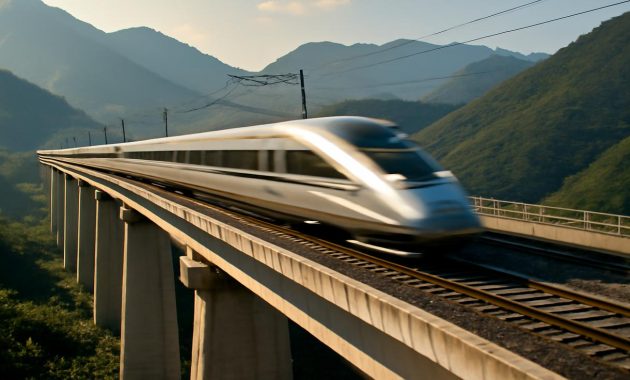
The sky over Fujian was the color of damp rice paper when the first excavator clawed into the earth. It was just after midnight, the kind of hour when most cities soften and fall inward, but this stretch of coastal China was suddenly wide awake. Sodium lamps flared to life. Reflective vests flashed like fireflies. Loudspeakers crackled with instructions. And the earth, for a brief and breathless window of time, became the stage for one of the most compressed feats of modern engineering: in just nine hours, a new rail link would be laid, connected, tested, and handed back to the trains that knit the country together.
The Night the Timetables Bent
It began with a gap—five hours of lost time. That was the punishment for anyone traveling between two bustling hubs that ought to have been closer in spirit: a coastal city swelling with new ports and high-tech factories, and an inland regional center feeding it labor, raw materials, and stories. Five hours in buses grinding through mountain switchbacks. Five hours on slower trains looping in awkward arcs, prisoners of outdated geometry. Five hours that meant fewer family visits, fewer quick business trips, more hesitation before saying, “Yes, I’ll come.”
China’s planners see travel time differently. To them, timetables are not fixed; they are raw clay. And so someone, in a fluorescent-lit office with a wall-sized map, drew a line—a straight, ambitious stroke shortening distance not just on paper, but in lived experience. A new rail connector. Only a few kilometers of track, but in the alchemy of networks, such a link could rewrite entire journeys, slicing five hours from routes that millions would take over the years ahead.
There was only one problem: that line on the map crossed a live, breathing railway, one that could not simply sleep for days while concrete cured and steel was adjusted. This was a vital artery, pulsing with freight and passengers. Shutting it down would cascade across schedules, stranding people, delaying goods, bruising the very economy the new line was meant to serve.
So the plan narrowed itself into a razor-thin window—nine hours in the dead of night. Nine hours to open the earth, lay down the new connection, graft freshly built track onto a living system, test it, approve it, and then get out of the way before dawn’s first commuter leaned against a carriage window, expecting their train to glide through as if nothing monumental had happened while they slept.
Orchestrating a Nine-Hour Miracle
There was nothing casual about that night. It felt less like construction and more like a performance, rehearsed again and again. In the weeks before, the site was a rehearsal stage. Engineers moved toy-like models of turnouts and tracks across scaled diagrams. Software simulations ran in air-conditioned rooms, predicting the pathway of cranes, the choreography of machinery, the timing of each bolt tightened and each rail clamp secured.
Everyone on that stretch of track knew their mark, their minute. A senior engineer, hair flecked with gray, carried a folded schedule in his pocket like a script. “Four oh-eight,” he would mutter to a junior colleague. “Your team starts the ballast tamping at four oh-eight. Not four ten. Not four twelve. Four oh-eight.”
When the clock struck the appointed hour, the existing line was shut down with the precision of a surgeon stopping a heartbeat on an operating table. The last pre-closing freight train trundled away; the signals flashed red. Silence hung for a moment. Then, with the sharp whistle of a site supervisor, the quiet shattered.
Excavators lunged forward, carving trenches with a raw urgency that only a nine-hour deadline can produce. Teams in orange vests moved in before the dust settled, measuring, leveling, lining the ground with the crushed stone that would cradle the steel. Cranes, their booms etched against the dim sky, swung pre-assembled track panels into place. Sparks burst from portable welders as joints were fused, the air turning smoky and metallic.
From above—if you could have hovered there like a patient owl—the whole site would have looked like a living machine. Dozens of discrete movements, each timed, each interlocking. Bulldozers reversed in carefully planned diagonals. Surveyors pivoted their instruments from point to point, adjusting by millimeters what would later carry hundreds of tons at high speed. It was improvisation only in appearance; the chaos was, in fact, a scored symphony.
The Sensory Pulse of the Worksite
Up close, the night was all sensation. The ballast stones crunched and shifted under the weight of boots and tires. The smell of hot metal wrapped itself around workers’ faces, mixing with the loamy scent of freshly upturned earth. Rail sections clanged as they were eased into position, the sound ringing out into the night like struck bells.
Communication traveled not just by radio and shouted instruction, but by gesture—a raised arm to halt a crane’s swing, two fingers rotating in the air to signal “faster,” a sweeping motion to clear a path. Ear protection muffled the details, but you could feel the rhythm, like standing too close to a drumline. Hammer blows. Engine revs. The chitter of tightening bolts. The tamping machine thudding ballast into place in a deep, resonant pattern: thump-thump-thump, pause, thump-thump-thump.
Still, there was an undercurrent of calm. This was not reckless haste. Each action was double-checked by someone who had built so many kilometers of track they could read alignment with their bones. A laser alignment device threw red lines into the shadows. Numbers were called out, marked, cross-verified. Nine hours is no time at all, but it is also enough time to do things right—if every person believes that failure is simply not an option.
How Nine Hours Shrink Five
From a purely mathematical angle, the new rail connector wasn’t long. A short segment, cleverly placed, that transformed indirect routes into near-straight lines. But networks are like rivers: a small new channel can redirect enormous volumes of flow.
The new link cut out cumbersome detours, allowing trains to bypass an older, winding section. Journeys that once zigzagged through intermediate stations could now slip directly from one line to another, like a shortcut path discovered through a forest. On the timetables, the impact was dramatic—five hours carved cleanly off a typical trip between the two key cities the connection quietly served.
If you map out the experience, it looks something like this:
| Route Aspect | Before New Link | After New Link |
|---|---|---|
| Typical Travel Time | ~9–10 hours | ~4–5 hours |
| Number of Transfers | Often 1–2 transfers | Direct or single-train journey |
| Route Pattern | Indirect, looping via older lines | More linear, via new connector |
| Passenger Experience | Long overnight hauls, fatigue | Same-day trips, less exhaustion |
It isn’t just about a number on a screen. That time saving changes the day’s emotional landscape. An old journey might have meant leaving before dawn, shoulders already tight with the knowledge that you’d arrive long after dark. Now, dawn departure becomes a midday arrival, with enough time left to walk the streets, attend a meeting, or sit through a leisurely family lunch.
For some, it means the difference between a journey they put off and one they embrace. For others, it turns daily or weekly commuting into something bearable. Looking at the vastness of China’s map, it is easy to see infrastructure as abstract lines. But when a single link can rescue five hours from a person’s week, the abstraction dissolves into the intimate.
The Human Front of Fast Construction
Inside a small apartment overlooking the tracks, a schoolteacher named Li watched the construction from her balcony that night, a blanket wrapped around her shoulders. She had been told the line would be noisy, the work intense but quick. What she hadn’t been prepared for was the sense of witnessing time being rewritten in real time.
She would later ride the first morning train that sailed over the new connector, her coffee still warm in the carriage cup holder. “It used to take me a whole day to visit my parents,” she said to a fellow passenger, the rolling countryside brightening outside. “Now, I can leave after work on Friday and be home in time to help cook dinner.”
Multiply Li’s story by thousands of similar journeys: grandparents whose visits become more frequent, students who can attend universities farther away without severing home ties, small business owners who find new customers just a few hours down the line. In boardrooms, the talk is of integration and regional growth. On the train, it’s of birthdays and market days and weekend trips.
The nine-hour push on the ground is the visible climax; the slow, steady ripple through daily life is the quieter, longer narrative that follows.
Engineering Against the Clock
Doing this kind of work in nine hours isn’t magic; it’s accumulated craft. China’s rail builders have, over years, turned rapid construction into both science and habit. The country’s sprawling high-speed network—now the largest on Earth—did not appear by accident. It is the product of standardized parts, modular designs, and a culture that understands how to compress big undertakings into narrow slices of real time without sacrificing safety.
This rail link project was no exception. Almost everything that could be built in advance was built in advance. Track panels were assembled and checked away from the live line. Switches, sleepers, fasteners—each element was pre-counted and pre-positioned. The site storage area resembled a carefully organized toolkit, not a chaotic pile of materials.
Redundancies were woven into the plan. Extra crews stood ready in case a machine failed. Backup vehicles waited off to the side like understudies, engines idling. Power supplies were doubled. Communication lines were tested and re-tested. If anything slipped, there would be another element to catch it, another path to keep the nine-hour window from shattering.
By the time the last rail clip was fastened and the ballast tamped to its final density, the sky had shifted from indigo to a faint, diluted blue. A thin line of commuters had begun to gather at a nearby station, some glancing down the tracks with the mild impatience of habit. They had no idea that the steel beneath them was newly joined, that just hours earlier it had been raw earth and intention.
The First Train Across
Before the line reopened, engineers performed a ritual that has become almost sacred in modern rail work: the test run. A locomotive, stripped of passengers but heavy with expectation, eased onto the new connection. Inside were inspectors with clipboards and tablets, eyes darting between screens and the view ahead.
The train rolled slowly at first, then a little faster, feeling for any imperfection. Under the wheels, vibrations spoke in a language these experts knew how to interpret. Slight, expected shifts here. Solid, reassuring rigidity there. Instruments confirmed what intuition already declared: alignment was true, joints were clean, geometry was sound.
By the time the first passenger service of the morning came through, the line had already been christened. People boarded their trains, eyes on their phones, bags at their feet, unaware that they were gliding over a place that had, only a few hours before, been crowded with workers and machines under hard white lights.
Outside the cordoned-off zone, the crews gathered for a final debrief. Some sat on low stools, wiping grime from their faces. Others simply stood and stretched, vertebrae popping back into place after a long night of focused labor. A thermos of tea was passed around, hands wrapping gratefully around the hot metal. The sense of relief was quiet but deep. Nine hours. No overruns. No major snags. And five hours of future travel time saved for every person who would pass through.
What It Means to Move Faster
Stories like this one slot into a larger narrative about speed in China—not just in trains, but in the very way change arrives. Cities sprout metro lines in a few years. Bridges leap across estuaries in record times. Whole districts seem to rearrange themselves between one visit and the next. To visitors, it can feel disorienting, almost dizzying.
But under the headline-friendly pace are quieter questions: What does it mean when travel time shrinks this fast? What happens to the texture of distance when five hours of rattling motion and roadside scenery collapse into a short, efficient glide?
On one hand, there is liberation. Villages and towns once separated by awkward, all-day journeys find themselves pulled closer. Regional economies tighten, allowing talent and capital to flow more easily. Carbon-heavy car trips and long-haul bus rides can be replaced by cleaner rail journeys. Time, our most irreplaceable currency, is returned to people in great, invisible handfuls.
On the other hand, there is a subtle recalibration of how we think about space. What used to be “far” becomes “doable in an afternoon.” Commuting horizons expand. Homes and workplaces drift farther apart. Choices multiply, but so do expectations. Your parents may now reasonably ask why you don’t visit more often. Your boss may assume a same-day turnaround for meetings several hundred kilometers away.
In that sense, the nine-hour construction burst and the five-hour time saving it yields are part of a deeper human story: the constant redrawing of our mental maps. We map the world not just by coordinates, but by effort. When effort shrinks, our world expands. The distance between a port city’s cranes and a mountain town’s market day shrivels, and new stories begin to flow between them—goods, yes, but also ideas, fashions, accents, and dreams.
A Glimpse of the Future in the Present
For many outside observers, tales of China building a crucial rail link in nine hours sound almost mythical—like something from a near future, dropped early into the present. But on that damp, electric night when the excavators dug, the welders sparked, and the timetable bent, it was not myth. It was sweat, logistics, and an unromantic number of spreadsheets coming together in a rare, concentrated burst.
No one standing trackside at dawn could see all the invisible journeys that would be altered by that night’s work. Yet they were already written, in a way—school reunions no longer skipped, business ventures now viable, emergencies met in time rather than too late. A tiny seam in the national network had been stitched, and through it, life would pour.
When the last worker finally walked away from the cooled rails, the night’s clamor fading behind them, the line itself said nothing. It just waited, quiet and gleaming, for the next train. The miracle of it is not that it was built so fast, but that from that morning onward it would ask nothing more from us than a ticket, a seat, and a destination. The complexity, the intensity, the nine-hour race against the clock—those would soon be forgotten, folded into the ordinary magic of getting from one place to another a little sooner than yesterday.
Frequently Asked Questions
How can a rail link built in nine hours be safe?
The nine hours refer to the final on-site integration work, not the entire project. Most components—track panels, switches, foundations—are designed, manufactured, and tested in advance. On the night itself, crews follow meticulously rehearsed procedures, multiple inspections, and a test run before passenger trains are allowed through.
Does a short connector really save five hours of travel time?
Yes, in networked systems like railways, a small new segment can have a big impact if it removes detours, bottlenecks, or indirect routings. By allowing more direct journeys and eliminating transfers or long loops, even a short connector can shave several hours off end-to-end travel times.
Is this type of rapid construction unique to China?
Other countries also perform intensive overnight rail works, but China has scaled this approach dramatically thanks to standardized designs, large specialized workforces, and long experience with high-speed and conventional rail expansion. The combination makes such compressed construction windows increasingly common.
What are the main benefits for passengers?
Passengers gain shorter trips, fewer transfers, and more flexible schedules. What was once a full-day or overnight journey can become a half-day trip, making it easier to visit family, attend business meetings, or commute periodically between cities.
Does faster construction mean lower quality?
Not necessarily. Quality depends on design standards, materials, and inspection procedures, not just time spent on-site. By prefabricating elements, rehearsing workflows, and building in redundancy and testing, crews can achieve both speed and high quality. The emphasis is on doing more preparation beforehand so the on-site window can be as short and efficient as possible.