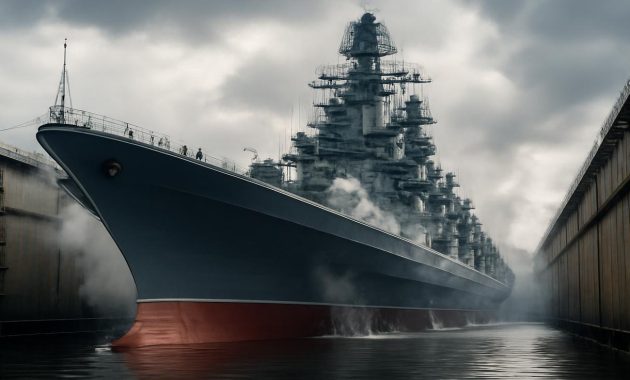
The ship returns before you ever see her. You feel her first—through the soles of your feet on the quay, in the subtle, rising tremor that rolls across the harbor like a distant storm. The water darkens. A low thrum presses into your chest. And then, out of the morning haze, the nuclear giant appears: 28,000 tons of steel and weaponry, sliding home with the unhurried confidence of something that has outlived its doubters.
For more than a quarter of a century, she was a rumor, an unfinished promise, a line item in defense budgets and a punchline in political arguments. Some said she would never sail again, that the world had moved on from big, bristling surface warships. Others insisted that if she ever did return, she would be a relic, a Cold War monster wandering a digital-age ocean.
They were all wrong.
The Sleeping Giant in a Rust-Streaked Drydock
Up close, the first impression is not power, but scale. Standing at the base of the drydock in those early refit years, when she was more carcass than warship, you had to tilt your head until your neck hurt just to see her bridge. The hull towered over you like a cliff, streaked with rust and primer, pocked with missing plates, openings, scaffolding. Gulls wheeled overhead, bold enough to perch on exposed radar masts.
For long stretches in the 1990s, the ship hardly resembled a vessel at all. She was a construction site wrapped around a memory—her nuclear heart long dormant, her cables cut, her compartments half-stripped. Men in hard hats moved through her like ants inside a felled tree, hauling out old wiring by the kilometer, measuring, grinding, welding. Sometimes, it felt less like refitting and more like archaeology.
She was born in another age, when navies dreamed in tons and megawatts and the horizon was a place to dominate physically, not just electronically. Her original designers imagined her as a sea-going fortress, a guardian for ballistic-missile submarines, a hunter of carrier groups. Back then, she carried analog dials, green screens, and a labyrinth of thick copper veins pulsing through every deck.
By the time the welders’ torches flared to life for her second act, that world had faded. The Soviet Union whose flag she was built to serve no longer existed. The blueprints guiding her revival were decades-old paper maps, stained with pencil and coffee, now being translated into digital formats by engineers younger than the ship herself. Those engineers would spend the better part of their careers coaxing this leviathan across the gap between centuries.
Inside the 25-Year Maze
The refit was supposed to be long. No one imagined it would become a saga.
On paper, the plan was straightforward: tear out the aging electronics, overhaul the twin nuclear reactors, replace obsolete missile systems with more modern teeth, and turn a Cold War queen into a 21st-century predator. In reality, every steel plate and bulkhead held a surprise. Old cabling routes didn’t match their records. Compartments had been modified on the fly during the chaotic final years of the Soviet era. Parts designed in factories that no longer existed had to be reinvented from scratch.
There were years when work slowed to a crawl. Budgets sagged under competing priorities. Political winds shifted. Newspapers ran photographs of the half-gutted ship rusting at the pier, a towering symbol of stalled ambition. Former officers, who once walked her passageways in the crisp certainty of youth, came back in civilian clothes and stared up at their old ship, unsure if they were visiting a patient in a coma or a monument being quietly abandoned.
Yet inside the hull, in echoing compartments lit by portable lamps, the transformation never stopped entirely. One welding team finished their careers on her; another generation took their place. Engineers learned her systems the way you learn a difficult language–with mistakes, revisions, and the occasional breakthrough that left everyone grinning under their respirators.
An entire nervous system was rewired. Old analog combat terminals gave way to digital workstations. New air-defense systems demanded new sensors, new data lines, new cooling routes. The nuclear reactors, those compact suns buried deep below the waterline, were opened, inspected, modernized, and sealed again with almost ritual care. It was surgery at the planetary scale—slow, methodical, unforgiving of haste.
The Numbers Behind the Myth
Seen from a distance—usually in photographs framed for drama—she looks almost abstract: a long, lean hull crowned with towers and antennas, missiles nested like spears along her flanks. But step into her world of stairwells, compartments, and narrow catwalks, and the statistics begin to feel human again.
| Feature | Approximate Detail |
|---|---|
| Full Displacement | 28,000 tons of steel, electronics, and ordnance |
| Length Overall | Roughly two and a half football fields |
| Propulsion | Twin nuclear reactors driving steam turbines |
| Endurance at Sea | Measured more in years than weeks, limited by food and crew, not fuel |
| Armament | Layers of long-range anti-ship, anti-air, and anti-submarine weapons |
| Crew | Hundreds of sailors, officers, and specialists operating around the clock |
These are not just numbers; they are lived realities. Each ton of displacement is a frame someone welded. Each meter of length is another corridor for a sailor to clean, another route to memorize in case of fire or flood. Each layer of weaponry is a team of humans, drilled until muscle memory replaces thought, moving as one organism when alarms howl through the steel.
The Day the Reactors Breathed Again
There is a specific silence that fills a ship just before her reactors come back to life. The work noise fades—no more grinders, no more shouted orders echoing off steel. People move differently, more carefully, aware of the invisible line they are about to cross. Screens flicker to life in control rooms that sat dark for years. On the pier outside, the air feels oddly expectant, like the final seconds before a launch.
When the reactors are restarted after such a long sleep, it is not a cinematic moment of levers thrown and engines roaring. It is a slow, measured waking. Temperature readings rise by fractions. A hum creeps back into the ship’s bones, so subtle at first that only those who have listened to such things for decades notice it. The engineers’ eyes stay fixed on dials and monitors. Voices are low, precise, almost ceremonial.
Somewhere far below, deep enough that the weight of the ocean presses from every side, the core brightens. Neutrons dance again in tightly controlled fury. Pumps spin up. Steam begins to flow through miles of piping, a man-made circulation system reasserting itself after a generation of dormancy.
On deck, the transformation is almost invisible. The ship does not jump or shudder. She simply becomes alive again. Power is no longer drawn from umbilical cables snaking over the pier; it pulses from within. Lights burn steadier, stronger. Elevator motors respond with new confidence. Radars and combat systems, once running on test feeds, now have the surging, steady electricity they were born for.
For the crew—many of them too young to remember her first life at sea—the change is almost emotional. They are no longer caretakers of a dormant hull. They are sailors aboard a ship that could, at a word, slip its lines and go anywhere on Earth with an ocean to cross.
Old Bones, New Teeth
Refitting a warship after more than 25 years is an act of selective forgetting and deliberate remembrance. Some parts of her had to be timeless: the skin of the hull, the deep structural ribs, the armored citadels protecting her most delicate organs. These are the bones, and you do not casually rewrite the skeleton of a 28,000-ton animal.
But her weapons, sensors, and brain—the systems that decide what she sees, how she fights, even how she navigates through a world thick with satellites and surveillance—could not simply be polished and reused. They needed to be reimagined.
Gone were many of the chunky, analog control stations bursting with dials. In their place: banks of flat displays, digital command consoles that can pour radar plots, sonar traces, satellite data, and intelligence feeds into the same shared picture. Where once a particular radar and weapon might form a brittle one-to-one partnership, the refitted ship is built on networks: sensors talking to multiple systems at once; data fused and filtered before a human commander ever sees it.
Her anti-air defenses are layered now like a living canopy. Far out, at the very edge of what the horizon allows, long-range missiles wait for high-flying intruders. Closer in, more agile systems watch for sea-skimming threats and supersonic darts. At the final, desperate ring lie guns and close-in defenses built for the last seconds of warning, when metal and fire meet within sight of the naked eye.
Her anti-ship and anti-submarine roles also changed flavor. In her youth, she was cast as a carrier-killer, a ship that might have dueled with entire strike groups. The modern ocean is busier, more networked, and also more chaotic. Swarms of smaller threats, unmanned vehicles, stealthier submarines—each demanded new ways of listening, tracking, and, if ordered, killing.
And yet, for all the modernity, the refitted ship is still unmistakeably herself. From certain angles, her silhouette still carries the swagger of Cold War excess: missile canisters bristling along the deck, an island structure piled high with sensors like a steel mountain. This is not a discreet, hidden predator. This is visible power, the kind that sends a very old message across the sea: we are here, and we are not afraid to be seen.
Life Aboard a Floating City of Steel
Warships are often described by their hardware, but their true nature lives in mess halls, engine rooms, cramped bunks, and long, fluorescent-lit corridors. A 28,000-ton nuclear cruiser is not just a weapons platform; it is a small, constantly moving town.
Walk her decks on a quiet night watch, and the noise is a layered murmur. Somewhere below your feet, twin reactor rooms purr with regulated intensity. Ventilation systems sigh through ductwork threaded like veins through every space. In combat information centers, low voices trade bearing numbers and range data, the language of a game that never ends. In the galley, the smell of industrial coffee lingers long after the last pot has burned down to tar.
Her size gives her crew something rare at sea: space. There are still tight bunks and narrow ladders, of course—steel does not stretch just for comfort—but there are also rooms for maintenance shops, gyms, storage that would make smaller ships jealous. Dozens of specialties coexist under one steel roof: nuclear engineers and radar techs, cooks and medics, missile officers and deckhands scrubbing salt from the rails.
In the early refit days, the crew was a skeleton team, a caretaker cadre ensuring she did not simply rot away at the pier. Those sailors knew her as a quiet giant, dark passageways lit by flickering work lights, air thick with welding fumes and the metallic tang of new paint. For them, the ship was in constant disassembly, parts always being removed, inspected, replaced.
Today, her crew moves with a different energy. Drills snap into being at unpredictable hours: fire on the mess deck; flooding simulation in the forward compartment; missile launch exercise at dawn. Doors that once hung open and unfinished now slam shut in practiced sequence. The ship is never really asleep—only resting, watchstanders always on duty, sensors always open to the ocean’s secrets.
Young sailors who once saw her as an intimidating maze now trace mental maps through her decks with ease, knowing exactly how many ladders stand between their bunks and their battle stations. The ship has, over the years, learned them as well. Each scuffed step, each worn handrail polish, is a record of human presence etched into the metal.
A Reputation Reborn
When word first spread that this old nuclear colossus would finally return to sea, the reactions were mixed. Some analysts scoffed. The ocean, they argued, now belongs to stealth, to satellites, to networks of lean, nimble vessels and unseen submarines—not to towering, conspicuous giants with missile farms on their backs.
And yet, when she finally eased away from the pier under her own power, the world watched. So did the satellites. There is a certain defiance in sending such a ship back into blue water. It is a message not only about capability but about intent: an assertion that presence matters, that a visible symbol of reach and resolve still has weight in a world of invisible code and orbiting eyes.
Over time, as she stretched her legs again on long deployments, the narrative shifted. Reports from distant seas spoke of a ship that, for all her age, radiated a kind of gravitational pull. Smaller vessels diverted to shadow her. Maritime patrol aircraft detoured for a closer look. Other navies measured her new sensor ranges, her response times, the patterns of her escorts.
Fear, at sea, is seldom theatrical. It is quiet, analytical. It lives in the calculations of range rings and missile flight times, in the knowledge that if things go bad quickly, there is a 28,000-ton problem on the horizon that must be accounted for in every plan. Her reputation now is less about bluster and more about weight: a recognition that this ship, old bones and new teeth, can still dramatically change the shape of a fight.
Why Bring a Giant Back at All?
Behind the steel, behind the engineering triumphs and the political theater, lies a more human question: why did so many people invest so many years to bring a single ship back to life? Why not cut their losses, scrap her, and design something new and sleek for the modern age?
Part of the answer is practical. Nuclear-powered surface ships, especially ones of such size, are rare and difficult to replace. Their ability to remain at sea for long periods without refueling, to carry an impressive variety of weapons and sensors, and to serve as command hubs for entire task groups makes them stubbornly valuable. Starting from a hull that already existed—even a tired one—offered a kind of rough, cost-saving shortcut to a level of capability that would otherwise take many more years to build.
But another part of the answer is psychological. Nations form attachments to icons—in steel, in stone, in stories. Certain warships become more than assets on a spreadsheet. They become proof of something: of national continuity, of engineering prowess, of naval tradition that stretches back beyond current administrations and current anxieties.
This 28,000-ton colossus is, in many ways, a floating argument that the past is not easily discarded. She carries the DNA of an earlier era, yet she sails in a present obsessed with speed, subtlety, and software. Her very existence challenges the notion that big, visible power has no place in the gray zone confusion of modern geopolitics.
As she moves now across the world’s oceans, cutting white scars into the water with her steady nuclear-driven stride, she drags a wake of questions behind her. How long will such giants still matter? Are they anchors tying us to an outdated vision of naval power— or are they anchors of a different kind, holding certain regions of the world in a precarious balance simply by being there?
Out on the open sea, though, all those debates fade into the horizon. Sailors on her bridge still scan the water with binoculars. Engineers still log the steady hum of reactors far below. Radar screens still bloom with contacts—merchant ships, fishing boats, aircraft, the ever-present background noise of human movement across the planet.
For now, she is back. After more than 25 years in the half-light of drydock and pier, this nuclear titan once again feels the long, slow rhythm of the swell under her keel. To stand on her deck as the sun sinks and the ocean turns the color of forged steel is to understand something about persistence: about metal that refuses to rust into memory, about people who keep showing up with welding torches and wrenches and new ideas until the impossible quietly becomes the inevitable.
There will be a final voyage someday. Steel ages, reactors reach the end of their safe lives, and the sea is patient in its claim on all things. But that day is not today. Today, somewhere beyond the line where sky meets water, a 28,000-ton nuclear colossus pushes west or east with unblinking purpose, reactors burning invisibly, wake trailing for miles, her name once again spoken with a careful respect in war rooms and on bridges around the world.
Frequently Asked Questions
Why did the refit of this warship take more than 25 years?
The refit stretched over decades because it combined deep technical complexity with shifting political and economic conditions. Engineers had to modernize nuclear reactors, replace obsolete Soviet-era electronics with modern systems, and redesign weapon and sensor suites, often recreating parts from scratch. Funding cycles, industrial challenges, and changes in strategic priorities repeatedly slowed progress.
What makes this 28,000-ton ship so feared?
Its fearsome reputation comes from a combination of size, endurance, and layered firepower. Twin nuclear reactors give it immense range, while its missiles and air-defense systems can threaten aircraft, ships, and submarines over long distances. As a command and control hub, it can coordinate other forces, making it a centerpiece of any task group it joins.
Is this kind of large nuclear warship still relevant today?
Yes, though its role has evolved. Modern conflicts emphasize information warfare, networks, and precision weapons, but a large, heavily armed, long-endurance ship still offers valuable presence and deterrence. It acts as a visible symbol of power and a flexible platform for air defense, sea control, and command operations.
How does nuclear propulsion change the way the ship operates?
Nuclear propulsion allows the ship to operate for many years without refueling, limited primarily by food, maintenance needs, and crew endurance. This gives planners enormous flexibility in deployment length and routing. It also provides high, sustained power for sensors, weapons, and high-speed transit when required.
What is daily life like for the crew on such a vessel?
Life aboard is a mix of routine and readiness. Crews stand watches, perform constant maintenance, and drill regularly for emergencies and combat scenarios. There are cramped bunks, shared mess halls, and long hours, but also a strong sense of community. The ship functions as a floating town with its own rhythms, traditions, and hierarchies, all wrapped in steel and set against an ever-changing ocean.