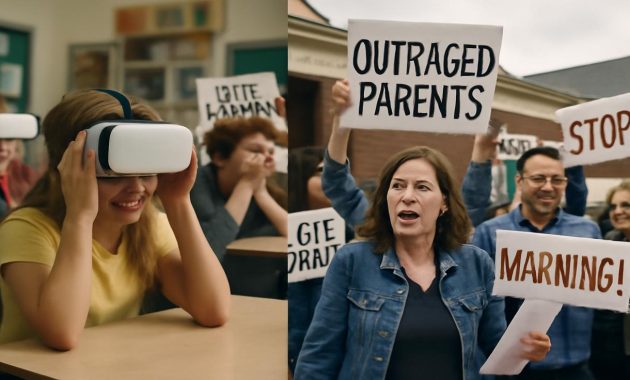
The first thing you notice is the silence.
It settles over the classroom like a heavy blanket, muting the usual shuffle of sneakers and whisper-sung jokes. Twenty third-graders sit perfectly still at their desks, each one wearing a sleek, black virtual reality headset. Small hands grip plastic controllers. Mouths hang open. No one fidgets. No one asks when lunch is.
From the doorway, the parents can’t see what their children are seeing. Only the teacher can, watching a mirrored display on the smartboard at the front of the room. On-screen, a village smolders. Smoke drifts across a gray sky. Somewhere, just off camera, there is the sharp crack of gunfire. A child in pixelated rubble screams for a mother who doesn’t answer.
“This,” the principal had assured them at last week’s parent night, “is the future of education.”
Now, as one father grips the doorframe and another mother swallows hard against an unexpected lump in her throat, not everyone is so sure.
A New Kind of Field Trip
When the district announced its new virtual reality history program, it was packaged like a glossy travel brochure. No more boring textbook paragraphs or faded timelines taped above the whiteboard, they promised. Instead, children would “step directly into the past,” building empathy by experiencing history “through the eyes of those who lived it.”
The company behind the program pitched it as an “immersive empathy engine.” Students would “walk” through ancient cities, stand among civil rights marchers, visit immigrant tenements, and—this was the part they said with particular pride—“understand the human cost of war” by navigating digitally reconstructed battlefields and bombed neighborhoods.
At first, it sounded thrilling. A few parents reminisced about clunky overhead projectors and grainy VHS documentaries and admitted, grudgingly, that maybe this was an upgrade. Some even posted excitedly on social media: My kid’s going to study history through VR! So cool.
But the promotional materials had tucked a crucial phrase into the middle of a paragraph: “some simulations may contain realistic depictions of conflict, injury, and distress.” It looked harmless in a PDF. It felt very different when eight-year-olds were standing amid rubble while digital shadows ran and fell and did not get back up.
“I Thought It Would Be Like a Museum”
“I thought it would be like a museum,” says Lila, mother of a third-grader who participated in one of the first VR sessions. “You know, like walking around and reading labels, seeing historical places. I did not picture my kid hearing people scream.”
Her son, usually exuberant after school, had come home quiet that day. He didn’t want his snack. He didn’t want to talk. After dinner, he woke up from a nightmare crying about “being stuck under a building.”
“He’s never even seen a PG-13 movie,” she adds. “We monitor everything. Then at school, without me even knowing, he’s thrown into a virtual war zone.”
Other parents echo her shock. Several say they didn’t realize how intense the simulations were until their children began retelling scenes in fragmented, haunted bursts: a man without an arm stumbling past, an explosion that made desks in the real classroom vibrate through haptic feedback, a child-avatar clutching a lifeless shape on the ground.
One father scrolls through the email the school sent out before the program launch, his thumb moving slower each time. “This,” he says, holding up the screen, “says teaching perspective. It doesn’t say, ‘We’re going to surround your child with digital carnage so they’ll care more about world peace.’”
| Group | Main Concern |
|---|---|
| Parents | Psychological harm, nightmares, age appropriateness, lack of informed consent |
| Teachers | Pressure to adopt new tech, limited training, managing emotional reactions in class |
| Administrators | Staying “innovative,” budget justification, responding to backlash |
| VR Company | Proving effectiveness, expanding adoption, defending “graphic realism” as essential |
| Child Psychologists | Long-term impact, desensitization, blurred line between learning and trauma |
Inside the Headset
Ask the school why they thought this was a good idea, and they’ll talk about research. They’ll mention studies suggesting that VR can boost empathy when people are placed in another person’s shoes. They’ll talk about engagement, about how a roomful of fidgety children suddenly leans forward and pays rapt attention when the headset goes on.
What they won’t tell you—because very few people actually know yet—is what happens in the hushed interior of a child’s mind when virtual shockwaves rattle a classroom desk.
“It Felt Real, But Not Real”
Kids describe the experience in language that’s as disjointed as it is revealing. “It felt real, but not real,” one student says. “Like a movie you’re standing inside.” Another admits, “I knew it was fake, but my heart was still going crazy.” A third shrugs and says, almost casually, “It was just a game, but with sad people.”
That last comment makes several adults in the room shift uneasily.
Is that the first hint of desensitization critics warn about? Or simply a child’s clumsy attempt to categorize something new and overwhelming with the closest familiar word—game?
Inside the headset, the visuals are startlingly detailed: dust motes catching the light, torn fabric on a fleeing figure, the tremor of a nearby explosion sending virtual debris into the air. The sound is directional and layered—distant crying, shouted commands in another language, the low menacing ripple of engines overhead.
For an adult, it’s intense but survivable. For an eight- or nine-year-old, whose brain is still learning how to sort real from imagined danger, the body reacts as if the threat is real. Adrenaline spikes. Muscles tense. Breath shortens. When the headset finally comes off, the classroom reappears—but the nervous system doesn’t reset quite as quickly.
The Line Between Empathy and Exposure
Supporters of the program insist that confronting children with the harsh realities of history is the entire point. “We’ve sanitized war for too long,” says one curriculum designer. “We show them maps with arrows, dates on a test, and a couple of black-and-white photos of soldiers. Then we’re surprised they don’t understand why war is tragic, why peace matters.”
In theory, immersing students in the perspective of civilians caught in conflict could deepen their capacity for empathy. Feeling the fear of a family hiding in a basement, hearing the tremor in an evacuee’s voice as planes roar overhead—these are moments designed to move beyond statistics and into lived experience, even if that experience is digitally constructed.
“Empathy Is Not a Horror Show”
But child psychologists who specialize in trauma see a different risk. “Empathy is not a horror show,” one psychologist says flatly. “We don’t have to scare children to teach them to care about others.”
She explains that while empathy can be nurtured through stories and perspective-taking, graphic or overwhelming material can trigger anxiety, intrusive thoughts, and avoidance. Younger children, especially, are more vulnerable to confusing virtual experiences with actual memories, or at least with something so vivid it clings like one.
“When a child tells me, ‘I keep seeing it when I close my eyes,’” she adds, “it almost doesn’t matter that it ‘wasn’t real.’ The brain is responding as if it happened, because in a very real sensory way, it did.”
There’s also the question of repetition. If students are repeatedly exposed to graphic scenes “for learning,” some experts worry that their emotional response might dull over time. Not because they’ve learned wise detachment, but because constant activation of the fear-response system can drive the brain to numbness as a protective mechanism.
“We call it desensitization,” the psychologist says. “And once that sets in, showing them more graphic content doesn’t build more empathy. It just pushes them further away from feeling anything at all.”
Teachers Caught in the Crossfire
While headlines focus on furious parents and defensive administrators, teachers are the ones navigating the uncomfortable middle ground. Many are intrigued by the idea of immersive learning; they became educators to light up young minds, after all. But they’re also the ones holding a child’s hand when the VR headset comes off and eyes brim with tears.
Training, or Trial and Error?
Several teachers say the “training” they received before launching the program amounted to a single afternoon demonstration and a user manual. There was little discussion, they say, about emotional safety, debriefing strategies, or how to recognize when a student was becoming overwhelmed.
“They showed us how to calibrate the headsets,” one teacher says wryly. “They didn’t show us how to calibrate our students’ hearts.”
In the first week, one child ripped off the headset mid-simulation, sobbing. Another sat stone-still, then suddenly asked in a strangely flat tone, “Are we going to die too?” A quiet, usually composed girl began chewing the neckline of her shirt—a nervous habit her teachers had never seen before.
After each session, teachers were encouraged to lead “reflection circles,” where students could talk about what they’d seen and how it made them feel. But when thirty hands shoot up and thirty different emotional reactions spill into the room, the minutes evaporate quickly.
“I became a triage nurse for feelings,” one teacher says. “Half the class was shaken; the other half was making jokes or shrugging like it was nothing. Both reactions worried me.”
Consent, Control, and the Quiet Kid in the Back
In the swirling storm of outrage and defense, a quieter question hums underneath: how much say should children—and their parents—have over what goes into their minds under the banner of “education”?
The school sent out opt-out forms after the first wave of complaints. But many parents say that’s backwards; they want an opt-in system for anything involving graphic content or intense emotional experiences. They want to know exactly what their children will see and hear, not just be told that it will be “age appropriate” and “supervised.”
There’s also the matter of social pressure. Even if a child is technically allowed to opt out, will they? Will they choose the quiet desk in the corner while twenty classmates gasp and flinch inside their digital worlds? Will they risk the inevitable: “You missed it, it was so crazy, why didn’t you do it?”
The quiet kid in the back—the one who absorbs everything but says little—might be the one most affected, and the least likely to raise a hand and say, “This is too much for me.”
Who Decides What’s “Too Much”?
Teachers are now being asked to make split-second judgments: which student can handle the rubble and screams, and which can’t? Should a child with a history of anxiety participate? What about a student whose family fled a real conflict, for whom sirens and explosions are not just history but memory?
Without clear, evidence-based guidelines, these decisions become subjective and inconsistent. One teacher might gently steer a child away from the headset; another might encourage them to “be brave” and “remember it’s not real.”
“We’re gambling with their inner worlds,” says a veteran teacher who has quietly chosen not to use the war simulations at all, sticking instead to more peaceful historical modules. “If I’m wrong, I can’t undo that.”
Reimagining How We Teach Hard History
None of this is an argument for hiding reality from children forever or painting history in pastel colors. Wars happened. Atrocities happened. People suffered and still do. Shielding kids completely, some argue, can produce a different kind of ignorance—one that leaves them ill-equipped to understand the world they’re inheriting.
But there’s a wide canyon between age-appropriate truth-telling and dropping an eight-year-old into the sensory blast radius of simulated violence.
Other Ways to Build Empathy
When you talk to educators and psychologists who specialize in social-emotional learning, they describe gentler, slower routes to empathy—ones that don’t require haptic vests or photo-realistic shrapnel.
- Reading or listening to first-person stories about children who lived through historical events, with time to pause, ask questions, and process emotions.
- Role-play activities where students imagine being a child in another era or country, but with guardrails that avoid graphic violence.
- Art projects where students create responses to what they’ve learned—letters, drawings, simple memorials—that focus on care and solidarity.
- Carefully curated documentary clips that are honest but not overwhelming, shown with adult explanation and reassurance.
VR itself isn’t the villain. Imagine virtual visits to peaceful pre-war towns, bustling markets, or classrooms in other countries—experiences that build curiosity and connection without plunging children into terror. Imagine simulations that gently contrast “before” and “after” a conflict through symbolism rather than graphic carnage.
“We can use immersion to awaken wonder, not just shock,” one educational technologist suggests. “The question is, which emotional levers are we choosing to pull—and why?”
What Happens Next?
At the school board meeting, the auditorium is packed. Parents clutch printed articles about childhood trauma. A representative from the VR company clicks through a polished slideshow. A panel of local mental health professionals sits stiffly at a folding table, water bottles lined up like a small defensive wall.
One by one, people step up to the microphone.
A veteran, his voice rough with memory, says, “I didn’t go through the real thing so my kid could go through a fake version at eight years old.”
A social studies teacher points out that her students are more engaged than ever and that some have written moving reflections about “never wanting anyone to live in a war again.”
A quiet mother, twisting her wedding ring around her finger, recounts her daughter’s new fear of loud noises since the VR session. “Fireworks used to be fun,” she says softly. “Now she wants to stay inside.”
The room buzzes with competing truths, each one valid in its own frame. Yes, the program made some children think deeply about war’s cost. Yes, it also left others more anxious, more withdrawn, their sleep splintered by new nightmares. Yes, VR can be a powerful tool. Yes, power is exactly what makes it dangerous if wielded clumsily.
As the night wears on, words like “pause,” “review,” and “reconsider” mingle with “progress,” “innovation,” and “preparing students for the future.” No one uses the word “experiment,” but it hangs in the air like the faint smell of smoke after fireworks.
Because that’s what this is, in the end: a live experiment on young nervous systems, conducted in real time, with stakes no one can fully calculate yet.
Outside, as the meeting breaks and parents drift into the parking lot, the school windows glow a warm, ordinary yellow. Inside those classrooms, tomorrow and the next day, spelling tests will be taken, lunches traded, glue sticks uncapped. The ordinary rituals of elementary school will march on.
But for many families, something fundamental has shifted. The assumption that school is always a safe container for the mind has cracked a little. The trust that “they know what’s best” has been replaced by a more urgent question:
Who gets to decide how much reality a child can bear—and what tools we use to show it to them?
Frequently Asked Questions
Is virtual reality always harmful for young children?
Not necessarily. Many VR experiences are gentle, exploratory, and educational—like virtual museum visits or space explorations. The concern in this case is specifically about graphic, war-focused content and how immersive, intense scenes may overwhelm developing minds.
What age is considered “too young” for war-related VR content?
There is no universal cutoff, but many child development experts recommend extreme caution with graphic or highly realistic depictions of violence for children under 12. Younger children have more difficulty separating “virtual” danger from real danger, and may be more prone to anxiety and nightmares.
Can VR actually increase empathy in students?
Some early research suggests that carefully designed VR experiences can boost empathy by helping people perspective-take. However, it’s less clear how this works with children, and whether highly graphic or traumatic content may backfire by causing distress or emotional numbing instead of compassion.
What should parents do if their child is upset after a VR history lesson?
Listen calmly to what your child describes, reassure them that they are safe now, and validate their feelings (“It makes sense you felt scared; it looked very real”). Watch for persistent nightmares, new fears, or changes in behavior. If distress continues, consider consulting a child psychologist and discussing concerns with the school.
How can schools teach difficult history without causing psychological harm?
Schools can focus on age-appropriate storytelling, guided discussions, and non-graphic materials. They can use VR for non-violent, context-building experiences (like visiting historical sites before or after war) and consult child development experts when designing or choosing content. Most importantly, they can involve parents in decisions about emotionally intense curricula and provide clear options to opt in or out.