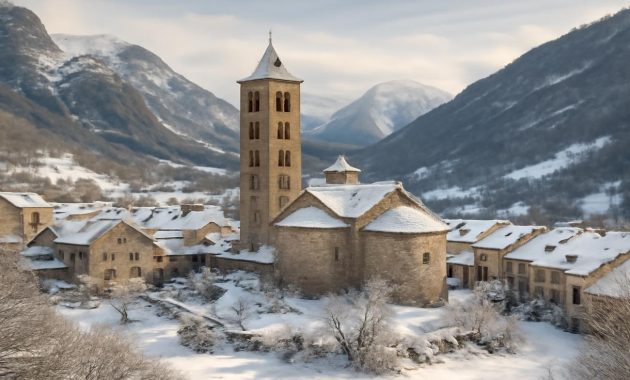
On some winter mornings in the Pyrenees, the world does not so much wake up as appear, as if freshly painted in white. The mountains of Huesca, in the Aragonese north of Spain, do this disappearing act better than most: they swallow the noise, soften the outlines, and then slowly reveal a village clinging to a slope, a ribbon of smoke rising from chimneys, and the stony silhouette of an 11th‑century church standing watch like an old shepherd above a flock of roofs. This is the kind of village that makes you slow your step without realizing it, that makes your breath cloud not just from cold but from a sudden, quiet awe.
Finding a White Dot on the Huesca Map
The first time you hear about a “most picturesque snowy village” in Spain, your thoughts probably sprint to the high Pyrenees of Catalonia or the polished resorts of the Sierra Nevada. But the village in question lies more quietly, tucked into the province of Huesca, where winter doesn’t feel curated for visitors—it feels lived-in, weather-beaten, and entirely authentic.
The road that leads here snakes beside rivers that flash silver between black trunks of bare trees. As you climb, the world narrows into a canyon of rock and snow. Mobile reception thins, conversations drift in and out like the radio signal, and the air adopts that metallic taste that means true mountain cold. Somewhere above, lost in a quilt of cloud, you know there are peaks surpassing 3,000 meters, but the village itself keeps its altitude modest, perched just high enough to wear snow like an annual festival costume.
What makes this village stand out isn’t just the way snow piles on its slate roofs or how icicles fringe its eaves. It’s the sensation of entering a place that has grown up around a single stone heart: a Romanesque church from the 11th century, monumental in presence even if humble in dimensions. Every lane, every house, seems to orient itself naturally toward this ancient landmark, as though the church were not simply a building but the story spine of the place.
You notice it first from a distance, a tower or sturdy nave breaking the line of roofs. Closer up, it begins to dominate your sense of direction. No matter which alley you turn into, a corner of its apse or a slice of its bell tower appears at the end, calling you back like a compass needle drawn to north.
The First Footstep in Snow
Arriving here in winter is not a grand entry. You do not sweep through archways or roll along big parking lots. You edge into the village gingerly, tires crunching over compacted snow or slush, the engine’s last growl fading as you step out into an almost physical quiet. The first sound you really register is the soft squeak of your boots pressing into fresh powder.
The village is a handful of narrow lanes stitched between stone houses. Their walls are thick, their windows small, glazed with that wavy glass that seems to hold decades of winters in its surface. Logs are stacked beneath overhangs, a practical sculpture of next week’s warmth. Doors, painted in blues and reds, stand out against the greys and whites of the landscape, like bright words in an otherwise monochrome poem.
The scent of woodsmoke threads the air, mingling with the faint, sharp aroma of snow-covered pine. Somewhere, a dog barks once, and the sound feels almost indecently loud. A woman passes you, wrapped in a dark coat, a woven basket on her arm; she nods without slowing, years of winter walking having taught her that the cold is best handled in motion.
You realize, after a few minutes, that your pace has matched the village’s rhythm. There is no rush here, especially not in winter, when tasks are dictated not by the clock but by daylight and temperature. And then, around a quiet bend, the village’s secret reveals itself more fully: stone steps, worn at the center by centuries of soles, rising towards the church that has watched all these winters come and go.
The 11th‑Century Heart of Stone
The church looks older than anything else in sight—older than the cracked beams, older than the cobbles under your boots, older even than the snow-laden pines on the surrounding slopes. Its Romanesque design is all about solidity and simplicity: thick walls, small arched windows, a sober bell tower. Nothing here was built to impress a distant court. It was built to survive.
Push open the heavy wooden door, and winter falls away as if you’ve stepped not into a building but into another century. The air inside is cool but still, unbothered by wind. Stone pillars rise like tree trunks in a petrified forest. The single nave gathers the sound of your footsteps and returns it in soft echoes, as though the walls have grown used to whispers and are careful not to break the habit.
Light enters through narrow, high windows—pale winter light, strained and softened. It spills across the chancel, illuminating worn carvings whose details time has chosen to blur just enough to invite the imagination. Here, a crouched figure in an archivolt; there, the simple geometric rhythm of chevrons and circles. This is not the flamboyant baroque that dazzles many Spanish cities. This is faith rendered in stone with a mason’s restraint and a shepherd’s patience.
Somewhere above, in the bell tower, hangs a bell that has shouted through blizzards and fogs for almost a thousand years. It has called villagers to worship, marked weddings and funerals, and warned of avalanches or invading armies. Its voice, when it rings, is not pretty in the way of a tuned orchestra; it’s rough, resonant, layered with age. Hearing it, you feel a continuity that defies both the isolation and the snow outside. Whatever storms come, this sound says, we have been through others before.
Step closer to the altar and you may find a small, gilded altarpiece added in later centuries—a delicate counterpoint to the sturdy stone. Candles smolder in red glass holders, their flames dancing even when there is no apparent draft. A faint scent of old wax and incense clings to the walls, a reminder that this is not a museum but a living church, where villagers still raise their eyes from the hardship of mountain seasons toward something above the peaks.
Villagers, Rituals, and the Rhythm of Snow
Outside, life curls around the church like a cat around a warm stove. The villagers of this Huesca outpost have long learned that winter is less a season to be endured than a partner to be negotiated with. They stack their wood in autumn with a precision that would make engineers proud, seal their windows, repair their tiled roofs, and fill their larders with jars whose labels are unnecessary—everyone knows which grandmother makes what.
In the village bar—because there is always a village bar—winter conversation gathers under low beams. Boots stamp snow off at the door, gloves are dropped on tables alongside steaming cups of coffee or small glasses of deep red wine. Maps appear, and plans for routes on snowshoes or skis are drawn. But the talk often returns to the familiar: the snowfall this year compared to the great storm of some remembered decade; the snowplow that took too long to arrive; the way the church bells sounded especially clear last night when the temperature plummeted.
The church calendar shapes winter here as much as the weather does. On a feast day, footsteps gather again on those stone steps as villagers, cheeks flushed from cold, slip inside to light candles. Children squirm in pews while older men kneel with the stiffness of joints that have lifted too many hay bales. Outside, the snow keeps falling, and yet, within those walls, time feels held in a quiet equilibrium.
Even the most ordinary tasks take on their own ceremony. A man carrying firewood pauses to shift the load and glances up, as if by habit, at the church tower. Two teenagers, snow-dusted from a spontaneous downhill run, stop at the door to make the briefest sign of the cross before racing on. The building’s presence is like gravity; it doesn’t need to shout to be felt.
Winter Textures: Stone, Snow, and Silence
What truly makes this village feel like the most picturesque snowy corner of Spain is the way textures and sounds mix into a sensory landscape. Stone and snow, in constant conversation, tell a story of endurance and transformation. Icicles hang from the church’s eaves like crystal organ pipes. Snow settles in the grooves of carved capitals, highlighting patterns you might otherwise miss.
Silence here isn’t empty. It’s full of tiny sounds: the muffled thump of someone knocking snow from boots; the distant mechanical hum of a snowplow on the main road below; a raven calling once, twice, as it hops along the church roof, black against white. At dusk, the village lights come on one by one—a lamp above a doorway, the warm rectangle of a kitchen window—and the church, now floodlit by a discreet lamp, becomes a pale lantern anchored against the surrounding dark.
On some evenings, the sky clears brutally, and stars spill in a frost-bright abundance city dwellers can barely imagine. The Milky Way draws a faint, milky line above the bell tower, while Orion appears to lean on the mountains. You stand there, exhaling steam, and the universe feels both infinitely large and intimately close, as if the cold has rubbed the distance thin.
When Travelers Arrive with Wide Eyes
For visitors, arriving here isn’t about “ticking off” a destination. It’s an invitation to temporarily join a rhythm. Travelers step from cars with cameras in hand, but the fierceness of the cold often commands their attention first; fingers fumble with buttons, breath quickens, eyes sting as dry alpine air cuts through city-soft lungs.
Soon enough, though, the village begins to work its quiet magic. People find themselves speaking more softly without really knowing why. They trail fingertips along stone walls, take too many photos of the same angle of tower and roof, charmed by the way light bounces off snow. Children test the depth of snowbanks, delighting in the fact that for once, they can throw a snowball almost as high as the church windowsills.
Many come for the surrounding mountains—to ski nearby slopes, to strap on snowshoes, to follow frozen riverbeds upstream. But they return from these excursions to the same comforting image: the church rising from its blanket of white, a fixed point in a day full of movement. In the evening, when the temperature drops sharply and the streets empty, a few silhouettes still crunch past, drawn by curiosity or a desire to feel just once more that strange mix of stillness and time that waits behind the church door.
A Quiet Guardian of the Pyrenees
There is a particular kind of beauty that emerges where harshness and care meet. This Huesca village is no gentle valley resort. The mountains can be dangerous, the roads treacherous, and winters unforgiving. Yet the care people have invested here—embodied above all in their 11th‑century church—softens the edges.
Romanesque churches across the Pyrenees often share a family resemblance: sturdy proportions, semicircular arches, thick bell towers marking human presence against wild horizons. What sets this one apart is how inextricably it is woven into village life. It does not sit grandly apart; it rises from within, a guardian that has grown from the same stone as the houses around it.
Look closely and you will see that its walls are not perfect. Stones vary in shade and size. Repair work from different centuries leaves faint seams, like scar tissue on skin. In winter, these imperfections only enhance its character, the snow making a high relief of every bump and crack. This is not a monument sealed in time. It is a living building that has adapted to new roofs, new bells, electric light, and modern villagers’ quieter schedules, while still holding firm to its original heartbeat.
Small Details, Long Memory
For all its stone and snow, what lingers most after you leave the village are often the smallest details. A carved stone cross above a doorway half-hidden under snow. The way a set of footprints curves around the church at dawn, then disappears into a grove of leafless trees. The memory of a candle’s flame flickering against a Romanesque arch while outside, flakes wheel past the window like migrating birds.
Even the way people talk about the place carries a kind of reverence without sentimentality. Ask a local, and they may shrug off the notion that they live in the “most picturesque” anything. For them, the village is simply home, with all the practicalities and frustrations that implies—blocked roads, burst pipes, heavy shoveling. Yet when the conversation shifts to the church, their tone changes almost imperceptibly. Pride slips through in small ways: a mention of a recent restoration, the story of a grandparent’s wedding there during a legendary snowstorm, the insistence that “it has always been there and always will be.”
That confidence is, of course, partly illusion—nothing is truly forever. But standing in the village square as twilight folds over the mountains, watching the church’s stone slowly adopt the same soft blue hue as the snow, it’s hard not to feel that illusion as a kind of comfort. Some places, it seems, hold time not by freezing it but by teaching it to move more slowly.
Practical Glimpses of a Snowy Village Stay
Although this village feels timeless, it is not unreachable. Part of its charm is how it balances seclusion with just enough practicality to welcome travelers who come respectfully, seeking not nightlife but a change of pace and landscape.
Imagine a short winter stay here, shaped by simple routines: a warm drink in the bar at first light, a walk up to the church while the snow still glitters untouched in side alleys, an afternoon spent tracing the outlines of nearby peaks or visiting other Romanesque chapels scattered along the valleys. In the evening, you might share a hearty stew in a small dining room, the windows fogged by steam, while outside the church tower stands in quiet, moonlit relief.
Below is a compact snapshot of what a day or two in such a village can feel like, captured in a simple table designed to read comfortably on a mobile screen.
| Moment | What You Experience |
|---|---|
| Early Morning | Blue‑grey light on the church tower, crunch of first footsteps in fresh snow, smell of woodsmoke. |
| Late Morning | Exploring narrow lanes, tracing stone details on 11th‑century walls, listening to distant bells. |
| Afternoon | Short mountain walks, snowshoeing or simply watching clouds drift over the Pyrenees ridges. |
| Twilight | Village lights flickering on, church bathed in soft yellow glow, smoke rising into indigo sky. |
| Night | Deep silence broken only by a single bell, stars spilling over the bell tower and snowy roofs. |
In a world that often races from one attraction to the next, there is something almost radical in choosing a place like this Huesca village for a winter escape. The main “activity” becomes paying attention: to the way snow softens every edge of stone, to the way an 11th‑century church can feel both grand and deeply human, to the way cold air can strip away mental noise as effectively as it reddens cheeks.
When you finally leave, tires rolling cautiously down the winding road, the village shrinks in your rearview mirror to a scatter of roofs and, inevitably, that small but indomitable silhouette of a bell tower. The snow will melt, the seasons will turn, and yet somewhere up there in the Aragonese Pyrenees, on some other wintry dawn, the bells will ring again, and the most picturesque snowy village in Spain will wake once more under its white cloak, the old church standing exactly where it has always stood—quietly, stubbornly, beautifully.
FAQ
Is this snowy village in Huesca only worth visiting in winter?
Winter highlights its storybook charm, but the village has a different appeal in every season. Spring and summer reveal green pastures and wildflowers around the church, while autumn wraps the stone houses in gold and rust. The 11th‑century church remains the focal point throughout the year.
Can visitors enter the 11th‑century church?
In many similar Pyrenean villages, the local parish church is open for certain hours or during services. Access can vary by day and season, so it’s wise to check locally on arrival or respect any posted schedules on the church door.
Is the village suitable for families?
Yes. The compact streets, slow pace, and car‑light alleys can be ideal for families, especially with children who enjoy snow. Warm clothing and care on icy surfaces are essential, but the setting is calm and welcoming.
Do you need special equipment to explore in winter?
Within the village itself, sturdy waterproof boots and warm layers are usually enough. For nearby trails or higher routes, snowshoes or winter hiking gear may be necessary, and local guidance is recommended when conditions are harsh.
What makes this village stand out compared to other mountain destinations in Spain?
Its charm lies in the close embrace between everyday village life and a monumental 11th‑century Romanesque church, all framed by dependable winter snows. Instead of a polished resort atmosphere, you find a lived‑in mountain community where history, stone, and snow quietly share the same narrow streets.