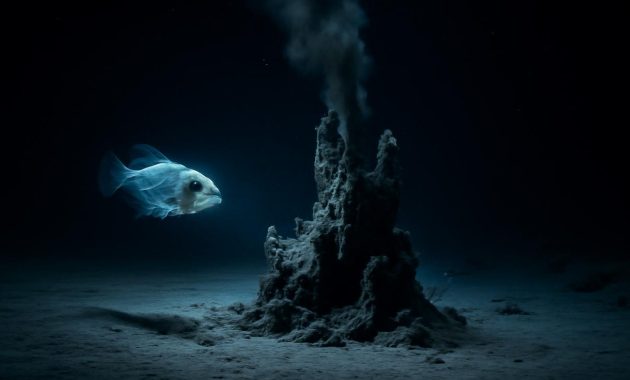
The cable hums softly in the dark, unfurling into an ocean so deep it might as well be another planet. Above, the research vessel rises and falls on a heaving Pacific swell; below, 10,000 meters of black water press down with the weight of an entire mountain range. On the ship’s monitors, the live feed flickers—static, then shadow, then a pale cone of light cutting through underwater night. No one on board is talking much. After five weeks at sea and two failed descents, the crew has learned that the deep doesn’t give up its secrets easily.
The Descent Into Nowhere
The remotely operated vehicle—just “the ROV” to the team—drops past the last glimmer of sunlight in minutes. At 200 meters, blue fades to indigo. At 500, even that is gone. The world outside the camera becomes a drifting tunnel of darkness, disturbed only by the occasional snowstorm of marine particles, the slow rain of the ocean’s dead and dying.
On screen, meters tick downward: 1,000… 3,000… 7,000. The ship’s control room smells faintly of instant coffee and electronics, that metallic tang that lingers when machines are working harder than they’d like to. A grad student leans closer to the monitor, as though proximity might will the imagery into sharper focus. A senior scientist, her hair pulled into a tired knot, murmurs depth readings under her breath like a quiet prayer.
They are headed for the hadal zone, the deepest region of the ocean, named after Hades—the underworld. The numbers alone don’t do it justice. Down there, the pressure is more than a thousand times what you feel at sea level. Imagine an entire elephant perched on your thumbnail. That, roughly, is the constant hug of the deep.
At around 8,000 meters, the ocean reminds them who’s in charge. The ROV shudders as it passes into a denser, colder layer of water; a warning light blinks amber on the control panel. The pilot, a man with the permanently squinted eyes of someone who has looked at too many screens and too many horizons, eases back on the controls, adjusts the buoyancy, breathes.
“We’re okay,” he says quietly, more to himself than anyone else. “She’s holding.”
Outside the ship, the ROV becomes a lone, glowing insect falling through an airless night. The world narrows to the light beam and whatever drifts through it—ghostly transparent jellies, threads of marine snow, the occasional startled fish flashing bioluminescent blue as it bolts from the glare.
At 9,800 meters, the pilot slows the descent to a near hover. The sediment of the trench floor looms somewhere below, invisible until—finally—it doesn’t. A flat, gray-brown plain blooms into view, featureless and fine as talc, with tiny ripples etched by ancient currents.
They have arrived on the bottom of one of Earth’s deepest trenches—near 10 kilometers beneath the ocean surface. No sunlight has ever touched this place.
The First Glimmer Of Something Strange
At first, there is almost nothing to see. The hadal floor looks desert-dry on camera, a monotone landscape framed by darkness. The ROV’s lights sweep slowly, revealing only the fine haze of disturbed silt. But life here is subtle, like a whisper in a crowded room—you have to learn to listen for it.
Then something moves.
A pale shape, barely discernible against the sediment, wriggles in the light and disappears beneath a puff of mud. The pilot freezes the vehicle, backs off slightly, repositions the light to a softer angle. A few seconds later, another movement—a translucent, ribbon-like creature, thin as a strand of hair, undulates out of the disturbed ground, curls, and slips away.
“Pause the feed,” someone says.
They rewind a few seconds, then play at quarter speed. There—just for a heartbeat—the animal comes into focus. Not a worm. Not quite a shrimp. Something in-between. Something that doesn’t match any of the quick-reference charts taped to the control-room wall.
But that’s not the unexpected find. Not yet.
The ROV moves on, the lights swinging slowly like headlights on a remote dirt road. More ghostly shapes appear—strange amphipods, tiny sea cucumbers, microbial mats that look like frost on the seafloor. All of it fascinating, yes, but not entirely unanticipated. Life in deep trenches has been documented before, though never this deep, never quite like this.
And then the camera catches the line.
At first, it seems like a trick of the light—an unusually straight shadow crossing the sediment. The pilot adjusts the angle. The shadow brightens into something solid, something reflective. A long, narrow object stretches across the frame, partly sunken into the mud, a faint glint running along its upper edge.
“Is… is that a cable?” a voice asks, incredulous.
The room goes quiet. On the monitor, the ROV approaches the object carefully, like a cautious animal inching toward something unfamiliar. The lights intensify. Details emerge.
It is a thin strand of plastic filament, coated in sediment, looping across the seafloor like a forgotten scar. It bends and curves in lazy arcs, then disappears beneath a small ridge of mud, only to emerge again farther on. Another pass of the camera reveals more: tangled knots where the filament has twisted on itself; tiny flecks of blue and white embedded in the soft, gray ooze.
Plastic. Ten kilometers beneath the ocean surface.
Finding The Unthinkable At The Ocean’s Deepest Edge
The team knew, of course, that pollution had reached the deep sea. Microplastics have been found in Arctic ice, in the bellies of whales, in the guts of fish hauled from thousands of meters down. But knowing something in the abstract—the way you know there are stars you’ll never see—is different from watching it glow on your screen in real time.
“Record everything,” the lead scientist says, her voice now steady but edged with disbelief. “Zoom in. Get as much coverage as we can.”
The ROV glides along the filament. The camera lingers on its surface. Small amphipods cling to it like hikers on a narrow ledge. A nearly transparent sea cucumber undulates over it, leaving a faint trail in the silt. Here and there, the filament disappears beneath a white, fuzzy layer that turns out—under higher magnification—to be a dense community of microbes, their collective presence giving the plastic a strange, living sheen.
What at first looks like an intruder begins, disturbingly, to resemble habitat.
The unexpected find is not just that plastic has reached the hadal zone. It’s that life has already moved in.
The scientists watch as tiny organisms graze along the filament’s length, nibbling at whatever organic film has grown there. When they take a sample later—using a delicate manipulator arm to snip a section and place it into a sealed container—they’ll discover a thriving “plastisphere”: bacteria, archaea, and other microbes, all assembled on a human-made island in the deep.
Their genetic analyses, weeks later in a brightly lit lab on land, will show something even stranger. Some of these microbes carry genes that suggest they can break down complex hydrocarbons—potentially including plastic. Others show sequences that hint at heavy-metal resistance, and still others at entirely novel metabolic pathways, ways of making a living in this crushing blackness that no one has ever seen before.
But that revelation begins here, in the dim control room, as the ROV lamp glances off plastic where there should only be rock and silt and ancient, undisturbed quiet.
Life On A Plastic Island In The Dark
The ROV spends hours mapping the surrounding trench floor. It finds more than anyone on board wants to see. A crumpled fragment of what looks like packaging material half-buried in the mud. A threadbare length of fishing line looping between small stones. Microscopic analysis of sediment cores will later show that the mud itself is shot through with tiny shards of plastic, each piece worn down by time and current but still unmistakably human in origin.
And yet, everywhere they find plastic, they also find life.
Back onboard, under the strained glow of the ship’s lab lights, the team begins examining their samples. Beneath high-powered microscopes, the plastic fragments transform from dull debris into teeming micro-landscapes. Filaments of bacteria cling to them in dense mats, forming structures that look like miniature forests. Single-celled organisms glide along their edges. Tiny worms burrow through the biofilm, leaving delicate tunnels behind.
Out here, in the remotest darkness the ocean can offer, life is pragmatic. It settles where it can, on whatever surface stays put long enough. In the past, that might have meant volcanic glass, shards of rock, the fronds of a rare deep-sea sponge. Now, increasingly, it also means us—our stray nets, our lost lines, our fraying bags, and spiraling microfibers.
One micro-biologist on the team, running almost entirely on adrenaline and bad coffee, begins to notice patterns. The microbial communities on plastic aren’t quite the same as those on natural sediments collected nearby. Certain bacteria appear only on the plastic pieces. Some of them are distantly related to known species that can process oil and other pollutants. Others have no close relatives that anyone has cataloged before.
This is the unanticipated twist: the deep ocean, often framed as a pristine refuge, is now home not just to our waste, but to new ecosystems that owe their existence to that waste.
It is both awe-inspiring and quietly horrifying.
The Silent Spread Of The Plastisphere
The scientists know that plastic doesn’t simply fall straight down through the water like a sinking stone. It drifts, catches currents, rides the great conveyor belts of the ocean. Some pieces stay near the surface for years; others become weighted with algae and organic debris and slowly spiral toward the depths. Along the way, they gather passengers—bacteria, algae, larvae, tiny crustaceans—forming floating micro-reefs that can travel across entire oceans.
What they hadn’t fully grasped, until now, was how far those rafts could go—and how profoundly they could shape the deep seafloor once they arrived.
When the team plots out their findings later, the pattern is unmistakable. Plastic is not evenly scattered like a dusting of snow; it clumps, gathers in low spots, catches in subtle depressions and folds on the seafloor. Each clump becomes its own world, its own experimental playground where evolution can try out new combinations of genes and lifestyles, far from the influence of light or surface seasons.
In a way, the plastic acts like artificial reefs do in shallower waters, attracting life that might otherwise stay dispersed. But unlike a purpose-built reef, this is accidental architecture—random, chemical-laced, and potentially toxic.
Sitting at a cluttered table in the ship’s mess hall, the lead scientist sketches a rough diagram on a paper napkin: currents above, sinking particles in the middle, plastic fragments spiraling down, and at the very bottom, a dotted line across the trench floor studded with what she labels, half-jokingly, “PIs”—Plastic Islands.
Later, in more formal presentations, she’ll give them a different name. But the image stays with her: a map of the deep not defined solely by geology and ancient tectonic scars, but by the invisible hand of human consumption.
What The Deep Is Trying To Tell Us
By the end of the expedition, the team has collected hours of video, dozens of plastic samples from nearly 10 kilometers down, and enough sediment cores to keep several graduate students busy for years. They have also, each in their own way, begun to grapple with what it means.
One evening, as the ocean turns steel-gray and the wind kicks up whitecaps, two of the younger researchers stand at the rail, watching the waves batter the ship’s hull. The conversation drifts, as it has many nights, between wonder and grief.
“I mean, it’s incredible,” one says, pulling her jacket tighter against the spray. “We found life where no one expected it. New genes, new metabolisms, maybe even new chemicals we could learn from.”
“Yeah,” the other replies quietly. “It’s incredible. But it’s incredible the way a forest growing out of an abandoned mine is incredible. You can be amazed by the resilience and still wish the wound hadn’t been there in the first place.”
In the weeks and months that follow, as data turns into papers and conference talks and headlines, that duality never quite goes away. Some stories will focus on the potential: deep-sea microbes that might help us break down plastics more efficiently, or synthetic biology tools inspired by organisms that thrive under pressure that would crush a submarine. Others will highlight the darker side: plastic fibers found in the deepest amphipods, chemical additives detected in hadal sediments, a planet so thoroughly touched by human activity that even the most remote trenches bear our fingerprints.
To make their findings easier to grasp, the team compiles a simple overview:
| Observation | Details From The Expedition |
|---|---|
| Depth Reached | ~10,000 meters in a Pacific trench (hadal zone) |
| Plastic Types Found | Filaments (likely fishing line), fragments, microplastics embedded in sediment |
| Associated Life | Dense microbial biofilms, amphipods, worms, small invertebrates using plastic as substrate |
| Key Discovery | Novel “plastisphere” communities and genes potentially involved in plastic and pollutant breakdown |
| Implication | Human pollution has permeated Earth’s deepest habitats, reshaping ecosystems and evolution |
Laid out like this, the story looks almost clinical. Bullet points. Rows and columns. But behind each line lives a sensory memory: the low buzz of the ROV’s winch, the way the ship seemed to lean into the wind on the roughest nights, the shimmer of plastic on a seafloor no sunlight has ever seen.
A Planet With No “Away” Left
The unexpected find beneath 10 kilometers of water is not just a scientific curiosity. It is a message about scale. For generations, humans treated the ocean as a kind of infinite “away”—the place where things disappeared. Trash barges dumped their contents off distant coasts. Storm drains funneled city runoff into bays and estuaries. Fishing gear was lost and replaced, lost and replaced, the ocean bottom assumed to be a blank slate where such things would vanish into irrelevance.
But nothing truly disappears on a finite planet. It just moves—rides currents, sinks, drifts, transforms. A plastic bottle tossed aside in a city can be shredded by sunlight, nibbled by fish, broken down into confetti, swept into mid-ocean gyres, and eventually find its way into a trench so deep that its existence once seemed theoretical.
That same bottle might, over years, become the foundation for a tiny community of microbes, a stepping stone for larvae in the dark, a carrier for chemical additives, a sliver lodged in the gut of an amphipod that has never seen the sky.
By the time we find it again, glowing ghostlike on a grainy monitor, it is both familiar and utterly changed: our invention, remixed by the deep.
Listening To The Deep Future
In the end, this is not a story of villains and heroes, but of entanglement. Our lives, from the synthetic fibers in our clothes to the packaging around our food, are linked to places most of us will never see. The hadal trenches are not distant in the moral sense, even if they are nearly unreachable in the physical one. They are part of the same planetary system that breathes for us, feeds us, and shapes our climate.
The scientists who watched that first filament of plastic appear on screen aren’t naive about solutions. They know there is no easy way to vacuum the trenches clean, no magic technology that can rewind the centuries of material we have already spread across the globe. But they also know that attention changes things. Stories change things.
Once you have seen plastic at 10,000 meters, “throwing something away” stops feeling like a complete sentence.
Some of the microbes they discovered may one day help us design better ways to break down plastics or inspire new, less persistent materials. Some will simply expand our sense of what life can be, how far it can stretch the definition of habitable. All of them, in their quiet, microscopic persistence, are already adapting to the world we’ve made.
The question that lingers, like the last echo of the ROV’s winch after it’s hauled back on deck, is whether we can adapt as quickly—whether we can learn from the deep not just as a source of data and novelty, but as a mirror. Ten kilometers beneath the ocean surface, scientists made an unexpected find. It was plastic, yes. It was new life, yes.
But more than anything, it was us—our presence, our reach, our shadow—etched into the darkest places on Earth.
Frequently Asked Questions
How deep is 10 kilometers in the ocean, really?
About 10,000 meters is close to the maximum depth of Earth’s oceans, comparable to the deepest parts of trenches like the Mariana. At that depth, pressure exceeds 1,000 times atmospheric pressure at sea level, and no natural sunlight penetrates.
How did plastic manage to reach such extreme depths?
Plastic debris can float for years, breaking into smaller pieces as it travels. Over time, it accumulates organic matter, becomes heavier, and sinks. Ocean currents and the constant downward rain of particles help carry microplastics all the way to the seafloor, even into hadal trenches.
Is the plastic itself supporting new forms of life?
Yes. The plastic acts as a hard surface in otherwise soft, muddy environments. Microbes colonize it, forming biofilms that attract other tiny organisms. These “plastisphere” communities can differ significantly from those on surrounding natural sediments.
Does this mean plastic pollution is permanently part of deep-sea ecosystems?
For practical timescales, yes. Many plastics degrade extremely slowly in cold, dark, high-pressure environments. While some microbes may help break them down over long periods, the material and its chemical legacy will likely persist in the deep for centuries or longer.
Can we clean up plastic from such deep parts of the ocean?
At present, large-scale cleanup of hadal trenches is not realistic. The depths are difficult, dangerous, and expensive to access, and disturbing the seafloor could harm fragile ecosystems. The most effective approach is preventing more plastic from entering the ocean in the first place and redesigning materials to be less persistent and less harmful.