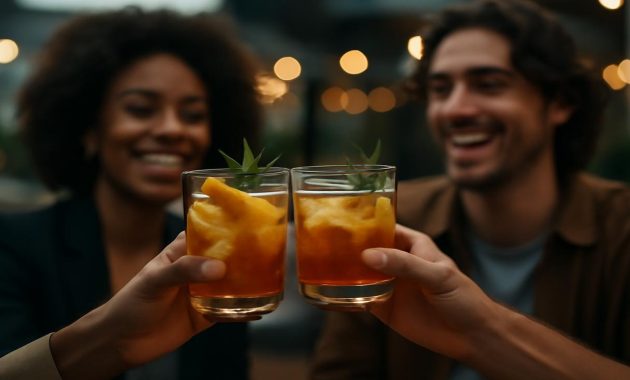
The can cracked open with a soft sigh, releasing a bloom of scent that seemed oddly familiar yet disorientingly new. Not sharp like beer. Not burning like hard seltzer. Something greener, quieter—like crushed basil and orange peel after rain. At the lakeside picnic table, surrounded by friends nursing ciders and IPAs, Mia tilted the pale, humming liquid to her lips and thought, This feels like a tiny rebellion. The aluminum in her hand was cold; her cheeks were warm from the late-summer sun, not from alcohol. The label didn’t say “lager” or “rosé.” It said “Cannabis Spritz. 2 mg THC. 2 mg CBD.” And in the small, almost invisible print: “Alcohol-free.”
A dragonfly skimmed the water. Somewhere behind them, someone popped a champagne cork. Mia swallowed, waited for the familiar burn that never came, then smiled. The moment was the same—a toast at the edge of the day, the soft glow of being with people she loved. But the path there felt radically different, and unexpectedly, a little bit hopeful.
The Quiet Rebellion in a Cold Can
If you spend time in nature long enough, you notice how change actually happens. Not in sudden, dramatic flips, but in tiny, stubborn adjustments: a plant creeping its roots around stone, a river bending its way through rock one season at a time. Our relationship with alcohol is starting to look a lot like that slow, persistent river. For decades, alcohol has carved the main social channel—first dates, birthdays, funerals, Tuesdays. Then, almost silently, another current began to form.
It started with seltzers and “mindful drinking” hashtags. Then came non-alcoholic craft beers, “dry January,” and bar menus with mocktail sections longer than the wine list. And now, there’s something even stranger trickling into our fridges and coolers: cannabis drinks—sparkling waters, tonics, teas, and “social sips”—that buzz without the booze, high without the hangover, ritual without the wreckage.
At first glance, these shimmering cans and bottles are just another wellness trend. But listen closely—in dispensaries, on hiking trails, at backyard fire pits—and you’ll hear the same surprise threading through the conversation: I didn’t think I’d ever find something that could actually replace my drink. For some, this is a lifestyle tweak. For others, especially those trying to loosen alcohol’s grip, it looks a lot like a lifeline.
The Strange Comfort of a Familiar Ritual
For people trying to drink less or not at all, the hardest part often isn’t the alcohol itself; it’s the ritual. The clink of ice in a glass, the small ceremony of unwinding the cap, that first cold sip at the end of a long day. There’s something primal in that moment—like crossing a threshold from “doing” to “being,” from alert to exhale.
Cannabis drinks slide into this space with a kind of quiet precision. They borrow all the choreography of alcohol—labels, glassware, the slow savoring—but rewrite the script of what actually happens inside your body. Many are low-dose, like 2 or 5 milligrams of THC, meant to be sipped over time rather than slammed. You still have something to hold at the campfire, something to raise at a wedding, something to uncurl your shoulders when the sky outside your office window has finally gone dark.
They are, in other words, social by design. Not the secretive gummy in a pocket or the hidden vape you sneak in the bathroom. These are beverages made for visibility—bright cans, botanical flavors, playful names. They say, out loud and on the table: I’m choosing a different way to feel okay tonight.
| Aspect | Typical Alcohol Drink | Typical Cannabis Drink |
|---|---|---|
| Primary Active Ingredient | Ethanol | THC and/or CBD |
| Onset Time | 5–15 minutes | 10–30 minutes (fast-acting emulsions) |
| Common Next-Day Effects | Hangover, dehydration, fatigue | Mild grogginess (strain & dose dependent) |
| Addiction Risk | High, with physical dependence | Lower, primarily psychological; still possible |
| Overdose Consequences | Potentially lethal (alcohol poisoning) | Extremely uncomfortable but rarely life-threatening |
What the Body Knows (Even When We Don’t)
The body, like a forest, keeps score. Years of heavy rain carve gullies. Years of heavy drinking carve their own channels too—through the liver, heart, brain, sleep, mood. Whether or not we call it alcoholism, many of us quietly live in a landscape shaped by alcohol: the dull headaches shrugged off as “just getting older,” the restless 3 a.m. wakeups, the creeping anxiety we blame on work or the news.
Alcohol is everywhere, normalized to the point of invisibility. Wine o’clock memes, office happy hours, beer after a long hike—little invitations tucked into almost every social corner. Yet the science is increasingly blunt: there is no fully safe level of alcohol consumption. It’s linked with higher risks of cancer, liver disease, accidents, depression. It hits different bodies differently, but it never really leaves us untouched.
Cannabis drinks are not a magic cure. They are not health tonics in disguise. But they rearrange the risk landscape in ways that matter, especially for people who feel trapped between “I don’t want to drink like this anymore” and “I don’t know how to belong without a drink in my hand.” Low-dose THC beverages can offer a softer arc—an onset that doesn’t crash the nervous system, an evening that doesn’t end with a spinning room or a blank space where conversations should be.
The liver, relentlessly at work under our ribs, notices the difference. Cannabis is processed differently than alcohol and doesn’t carry the same direct burden on liver tissue. Sleep, though not always perfect with cannabis, can be deeper and less fragmented than alcohol’s brittle, chemically sedated kind. For some, anxiety eases rather than explodes. For others, it can spike—another reminder that this isn’t a one-size-fits-all solution, but a tool that needs thoughtful, personal calibration.
Dosing Like You’d Pack for a Backpacking Trip
Imagine you’re packing for a three-day backpacking trip. You wouldn’t bring your entire kitchen or 20 pounds of snacks just because “more might be better.” You’d pare down, test, choose just enough. Responsible cannabis drinking works the same way. A 2 mg THC drink is like a light day pack: something you can carry comfortably, maybe even forget it’s there. Five milligrams? Still manageable for many, but getting heavier. Ten or more? That’s the fully loaded expedition pack; some will shoulder it fine, others will topple.
Unlike alcohol, which most people roughly understand in terms of “one drink,” cannabis dosing is still unfamiliar terrain. Too much THC can mean spiraling thoughts, racing heartbeats, a sense that time has stretched into something uncomfortably elastic. That said, modern cannabis beverages are increasingly engineered with fast-acting emulsions, giving a clearer sense of effect within 10–30 minutes. That shortens the guesswork and lets people “sip to a feeling” rather than accidentally catapulting themselves into discomfort.
The healthiest stories emerging around cannabis drinks sound less like “getting wasted” and more like “finding a gentler edge.” A musician who traded her nightly wine for a 2 mg spritz and wakes up clear-headed for morning rehearsals. A middle-aged dad who moved from four beers a night to one cannabis tonic on weekends only. These are micro-adjustments, but like the river, they reshape the bank over time.
Social Landscapes in Transition
On a late autumn evening, in a dim, plant-filled bar on the edge of a city park, the menus read like field guides. There’s a “Forest Tonic” with juniper and pine, alcohol-free. A beetroot shrub with ginger and lime. Then, on the back page, a short, almost shy section: Cannabis Cocktails (THC-infused, no alcohol). A table of friends negotiates: Who’s driving? Who has to be sharp in the morning? Who’s just tired of feeling lousy after “just a couple of drinks”?
Socially, cannabis drinks are changing more than just what we put in our glasses; they’re nudging at the deeper myth that alcohol is the only reliable conductor for connection. When people can show up, share something mood-shifting, and still stay present—still remember the jokes, the stories, the curve of the moon on the walk home—relationships can start to feel different. Less fog. More continuity.
In nature, edges are where things get interesting—the border of forest and meadow, shore and sea. We’re in an edge moment now, culturally, with alcohol on one side and an emerging ecosystem of alternatives on the other. Cannabis drinks occupy a particularly charged patch of that edge. For some, they’re a bridge: an easier, more socially acceptable way to leave alcohol behind without stepping entirely into sobriety. For others, they’re a new problem waiting to happen, another substance that could turn from ally to adversary if used without care.
Not a Free Pass, but a Second Chance
It’s tempting to paint cannabis as the “good plant” against alcohol’s “bad drink,” but nature resists such flat storylines. Nightshade, after all, is a plant too. What matters is dose, frequency, intention, individual biology, and the social soil everything grows in.
Cannabis carries its own risks: dependency for some, increased anxiety or paranoia for others, potential impacts on developing brains, interactions with medications, and absolutely real impairment when driving. To pretend otherwise would be to replace one harmful myth (“Alcohol is harmless if you can handle it”) with another (“Weed is always safe because it’s natural”).
Yet even acknowledging those risks, a pattern emerges: where cannabis drinks are available, some people are quietly choosing them instead of alcohol, especially in low doses, especially in contexts where they used to feel they had no choice but to drink. Emergency rooms see far too many alcohol poisonings; lethal cannabis overdoses remain vanishingly rare. Families wrecked by alcohol-fueled violence, accidents, and chronic illness are far more common than those shattered by cannabis alone.
In that context, cannabis drinks are less a free pass and more a second chance—a harm reduction strategy, a compromise with a culture that still equates “fun” with “chemically altered.” They don’t require perfection or abstinence to start helping. They just ask, quietly: What if there were another way to take the edge off tonight?
Where the Wild and the Social Meet
Walk through a campground at dusk in a state where both alcohol and cannabis are legal, and you’ll notice an interesting gradient. At some sites, coolers crack open, beer bottles clink, someone laughs a little too loud, and by 11 p.m., the voices are slurring toward argument or obliviousness. At others, you’ll catch the herbal whisper of vapor or the faint citrus of cannabis seltzers, voices mellow but coherent, a board game still in full swing, guitars tuned instead of tipped over.
These are not rigid categories—people mix, match, experiment. Yet a pattern emerges in the stories of those turning to cannabis drinks more often than to beer or wine: deeper engagement with the moment. The forest at night feels more alive, not less. The kayak feels steadier. The stars are something to follow, not to stagger under.
Nature has always been a quiet witness to our experiments with altered states. From the first fermented fruits to the modern microdosed mushroom chocolate, we’ve been animals drawn to substances that shift our perception. What’s new is the self-awareness creeping in alongside that impulse: a growing desire not just to escape, but to feel good and function well, to wake up with enough clarity to remember the birdsong that greeted us at dawn.
Rituals That Point Forward, Not Backward
In many Indigenous and traditional cultures, plant-based intoxicants are woven into ritual with intention and restraint. The point isn’t numbness; it’s connection—between people, with the land, with the unseen. Alcohol, in its industrial, globalized form, often bulldozed that nuance. Drink to forget. Drink to get through. Drink to endure.
Cannabis drinks offer a chance—even if only a small one—to rebuild drinking rituals that point forward instead of backward. A THC-spiked herbal tea shared around a winter solstice fire, where the goal is to linger in stories, not obliterate them. A single sparkling cannabis tonic at a rooftop gathering, followed by water and a clear-headed bike ride home. A lakeside afternoon where the buzz hums low and steady, and nobody topples into the water because they misjudged their tenth beer.
This isn’t purity. It isn’t moral superiority. It is, perhaps, an evolutionary nudge: a move toward intoxicants that are easier on the body, kinder to the mornings, more compatible with long-term aliveness. We’ll still make mistakes. We’ll still overdo it sometimes. But the path, if we choose it carefully, might damage less as it winds forward.
Listening for the Future in a Fizz
Back at the lakeside table, Mia finished her drink slowly, watching the light change as the sun folded itself behind the pines. She felt something—soft, buoyant, her worries roped off just enough to breathe around them. Not the glassy bravado that came with whiskey, not the heavy bloom of wine behind her eyes. More like a lens gently refocused.
Later, as her friends refilled their cups with beer and rosé, she reached for another cannabis spritz, then paused. She realized she didn’t actually want it. The moment had already arrived; the ritual had done its work. She felt present, not pushed. That small act—stopping at one—might not mean much on its own. But stitched into a hundred evenings, it could alter the whole tapestry of her life.
That is where cannabis drinks open their most unexpected path in the fight against alcohol: not in sensational headlines or overnight cures, but in these quiet, accumulative moments of choice. In the steadying of hands that once reached automatically for another round. In the mornings when people wake without dread. In the relationships mended because someone could finally be there, fully, night after night.
Change, like a river, doesn’t announce itself. It just keeps moving, seeking a gentler way forward. In the soft fizz of a cannabis drink, in the recalibrated rituals of our shared evenings, we can hear, if we listen, the faint but growing rush of a different future.
FAQ: Cannabis Drinks and the Shift Away from Alcohol
Are cannabis drinks completely safe?
No substance is completely without risk. Cannabis drinks avoid many dangers of alcohol—like liver damage and alcohol poisoning—but they can still cause anxiety, impaired coordination, and psychological dependence for some people. They are not recommended for pregnant or breastfeeding individuals, people with certain mental health conditions, or anyone taking medications that interact with cannabis.
Can cannabis drinks help someone quit alcohol?
For some, cannabis drinks can act as a harm reduction tool, easing the transition away from alcohol by preserving the “ritual” of drinking without the same physical toll. However, they are not a medical treatment for alcohol use disorder. Anyone struggling with addiction should seek professional support and consider cannabis, if at all, only within a broader recovery plan.
Will I get a hangover from cannabis drinks?
Many people report little to no traditional hangover after cannabis drinks, especially at low doses. Some may feel groggy or a bit foggy the next morning, depending on the product, dose, and individual sensitivity. Hydration, timing, and moderation all matter.
Is it safe to drive after having a cannabis drink?
No. Cannabis impairs reaction time, judgment, and coordination, even in drink form. You should never drive, cycle in traffic-heavy areas, or operate machinery after consuming THC, regardless of whether you “feel fine.” Wait several hours, and follow local laws and guidelines on impairment.
How do I choose a dose for my first cannabis drink?
Start low and slow. For many beginners, 2–3 mg of THC is a gentle entry point. Wait at least 60–90 minutes before considering more, since effects can build over time. Pay attention to how your body and mind respond, and avoid mixing cannabis drinks with alcohol until you thoroughly understand your individual tolerance—if you ever mix them at all.