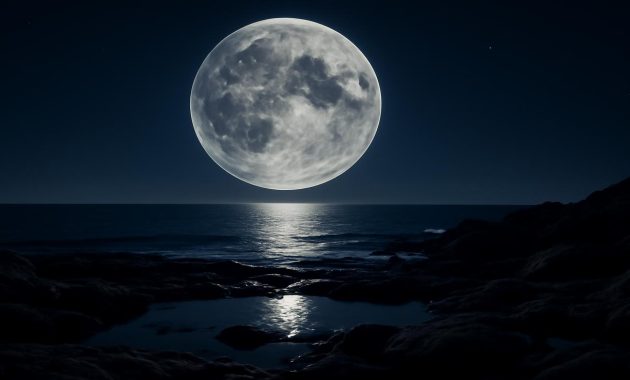
The first time I saw the moon through a telescope, I remember the shocking nearness of it. The craters were sharp, the shadows long and blue, like frozen waves across a pale stone sea. It felt less like looking into space and more like staring at a neighbor’s front porch. But what the telescope didn’t show—and couldn’t—was that this familiar neighbor is quietly walking away. Inch by inch, year by year, the moon is leaving us. And with its slow escape, something else is shifting too: our days, our tides, and the secret rhythm of life on Earth.
The Moon, Slipping Away One Inch at a Time
If you stepped outside tonight, tilted your head back, and watched the full disk of the moon lift over the horizon, you’d swear it hasn’t changed in thousands of years. It rises, it sets, it tugs at the tides and lights up the clouds with that same gentle, silvery glow. Ancient poets, sailors, and shepherds knew this face. It comforts us with its constancy.
But the constancy is an illusion. Lurking beneath the calm choreography of the night sky is a slow-motion parting. Each year, the moon drifts about 3.8 centimeters farther away from Earth. That’s roughly the rate at which your fingernails grow. Undramatic, unhurried, almost tender in its slowness.
And yet, scale matters. When you stretch that tiny annual retreat across millions of years, the story changes from one of gentle motion to one of profound transformation. The moon that hovers above us now is not the moon that first rose over the primeval oceans. It used to loom larger, pull harder, and carve deeper tides into the shores of a much younger, more restless planet.
We know this not from imagination, but from exquisitely precise experiments. During the Apollo missions, astronauts left behind small, mirrored panels on the lunar surface. Today, scientists fire laser pulses from Earth, bouncing them off those mirrors and timing how long they take to return. The delay, measured in fractions of a billionth of a second, tells us the exact distance to the moon, down to the millimeter. The data are clear: the moon is on a slow but steady escape trajectory.
So why is it leaving? The answer starts with water, friction, and the complicated love story between Earth’s spin and the moon’s orbit.
Tides, Friction, and a Planet That’s Slowly Catching Its Breath
Imagine Earth as a great turning wheel of rock and ocean, spinning once every 24 hours. Now picture the moon, smaller and more distant, tugging subtly but insistently on that fluid layer of oceans that wraps our world. The result is a pair of bulges—tidal humps of water—that are pulled slightly ahead of the moon’s position as Earth rotates.
This offset is crucial. Those displaced swells of ocean water exert a drag on the planet’s rotation, like a giant hand brushing against a spinning wheel. That drag creates friction. Friction turns some of Earth’s rotational energy into heat—and, just as important, it transfers the rest of that energy to the moon.
You can think of the process as a cosmic trade: Earth is slowly giving up some of its spin so the moon can move outward into a higher orbit. Like an ice skater stretching their arms to slow down, our planet is lengthening its day as the moon’s distance grows.
This tidal tango is not just a pretty metaphor; it’s a measurable engine of change. Geological records, written into ancient rocks and corals, reveal that Earth’s days used to be much shorter. Fossil corals from about 400 million years ago bear daily growth rings that record not just how old they were, but how many days fit into a year at that time—about 400. The year was the same length then, but the days were only about 21.8 hours long.
Now, with the moon farther away and the tidal friction somewhat gentler, we live under a 24-hour sky. But even this sacred number is sliding, ever so slightly. Each century, our day lengthens by about 1.7 milliseconds. You’d never notice it sitting at your desk or watching the sun set, but over deep time, that extra sliver of time adds up.
Longer Days: An Almost Invisible Stretching of Time
“Does it really matter if the day lengthens by a couple of milliseconds?” you might ask. On a human scale, not much. Your calendar won’t fall apart, you won’t gain an extra nap, and the sunrise will still feel stubbornly early on Monday mornings.
But imagine rolling the cosmic clock forward tens or hundreds of millions of years. Those tiny increments become hours. The sky turns more slowly. The dance of dawn and dusk rewrites itself. If a time traveler stepped onto Earth a billion years from now, they might find a day closer to 30 hours long. Our entire sense of morning and night would be different—longer stretches of light, longer swaths of dark.
Life, of course, would adjust. It always has. Plants and animals are experts at tuning themselves to the tempo of their world. Consider the forest at dawn: birds sing on cue, leaves unfurl toward the first rays of the sun, insects warm their wings. In the ocean, countless microscopic organisms rise toward the surface at night and sink again by day in a vast vertical migration timed with luminous precision. All of it is choreographed to the length of the day and the pull of the tides.
Changes in day length can subtly shape biological rhythms. Circadian clocks—the internal timekeepers inside everything from moss to humans—are tuned close to 24 hours, but not perfectly. They adjust using cues like sunrise, sunset, and temperature. As days gradually stretch over geological eras, evolution nudges these clocks forward too. Ancient microbial mats that grew under 18-hour skies, or early land plants that first crept out beside roaring, moon-ruled tides, lived by a rhythm that would feel alien to us now.
We are inheritors of a particular tempo: a 24-hour song with the moon as one of its quiet composers. And that song is still changing.
How the Moon Has Sculpted Life’s Rhythms
Stand on a rocky shore during spring tide and you can feel the moon’s influence with your whole body. Waves heave higher, crashing closer to your feet. Salt spray thickens the air. The moon’s gravity doesn’t just move water—it helps draw certain creatures into being.
Many coastal species rely on the tides like clockwork. Grunion fish slide up beaches to spawn on nights when the tides will best cradle their eggs. Horseshoe crabs climb the sand in shimmering masses timed to high tides and the phases of the moon. Some worms, coral polyps, and other marine animals synchronize their reproduction with lunar cycles, releasing eggs and sperm during just a few nights when the tide, the moonlight, and the currents align perfectly.
Early in Earth’s history, when the moon was closer and the tides more extreme, this daily drama was far more intense. Imagine titanic tides rushing in and out across barren shorelines, leaving behind warm, shallow pools that baked in the sun. Those pools may have been tiny reaction chambers, concentrating molecules in ways that encouraged life’s chemistry to begin. The moon, in pulling the sea up and letting it fall back again, might have helped stir the first batches of living matter.
As the moon drifted outward, the tides softened and the daily extremes eased. Life followed. The intricate timing of reproduction, feeding, and movement along coasts evolved hand in hand with the moon’s gradual retreat. What we see today—gentler tidal ranges than in the deep past, and the exquisite lunar timing woven into marine behavior—is just the current chapter in a very long relationship between water, light, and gravity.
Tides in a Future With a Distant Moon
Now picture a far-future shoreline. The moon hangs a little smaller, a subtle shrinking in the sky that you might sense more than see. The tides still come and go, but their reach is slightly less dramatic. Salt marshes expand where once the water lunged higher; tidal flats grow quieter, less violently washed.
This is not a sudden transformation. It’s a whisper stretched across eons. The moon’s growing distance will gradually weaken its pull on our oceans, making tides smaller overall. Coastal ecosystems, that live-or-die zone between high and low tide, will slowly adjust to that gentler rhythm.
Even now, tides are not solely the moon’s doing. The sun also contributes its own gravitational tug. When sun and moon line up—during new and full moons—their pulls combine to create spring tides, the strongest ones. When they form a right angle, their pulls partially cancel, forming neap tides, the mildest. Over immense time, as the moon moves farther away, the sun’s relative influence on the tides will grow stronger.
On human timescales, the most dramatic tidal changes we worry about come not from the moon’s slow departure, but from sea level rise, storms, and shifting climate. Yet quietly beneath those urgent concerns, the lunar drift continues, adjusting the boundary conditions of our coasts in ways so slow they’re almost philosophical rather than practical—for us, anyway.
A Quiet Shift in Our Cosmic Geometry
The moon’s distance isn’t only about tides and day length; it also shapes one of the most iconic sights in human history: the total solar eclipse. Right now, we live in a peculiar moment when the moon and the sun appear almost exactly the same size in our sky. That’s just a coincidence of geometry. The sun is about 400 times larger than the moon and also about 400 times farther away. The result is an exquisite match: the moon can perfectly cover the sun’s disk when their orbits line up.
As the moon recedes, that perfect alignment is doomed. Millions of years from now, future sky-watchers—if there are any—will see only annular eclipses, the sun forever peeking out as a blazing ring around a too-small moon. Totality, that brief and holy darkness that has pulled humans and animals alike into stunned silence, will vanish from the repertoire of earthly experiences.
The moon’s spell over Earth is thus not just gravitational. It’s visual, emotional, cultural. Lovers have sworn vows under its glow. Farmers tracked seasons by its phases. Indigenous communities and storytellers around the world have given it names—Wolf Moon, Harvest Moon, Hunter’s Moon—and woven it into their myths. As it slips away, nothing about those stories breaks. But it is striking to realize that our folklore, too, is written in a temporary sky.
What the Numbers Look Like (And Why They Feel So Strange)
It can be hard to wrap your mind around changes that are real yet nearly imperceptible. Sometimes it helps to see them laid out plainly. These numbers, drawn from scientific measurements and geological evidence, show how the Earth–moon relationship has changed and will continue to do so over enormous spans of time.
| Timeframe | Moon–Earth Distance (Approx.) | Length of One Day on Earth | Tidal & Sky Effects |
|---|---|---|---|
| ~4.5 billion years ago (soon after formation) | Much closer; possibly less than half current distance | About 5–10 hours | Huge tides, rapid rotation, moon looked much larger |
| ~400 million years ago | Closer than today | ~21.8 hours | Stronger tides, ~400 days per year |
| Today | ~384,400 km | 24 hours (on average) | Moderate tides, perfect solar eclipses possible |
| 100 million years in the future | A few thousand km farther | A few minutes longer than now | Slightly weaker tides, fewer total eclipses |
| Billions of years in the future | Significantly farther; no more total eclipses | Potentially ~30 hours | Smaller tides, changed day-night rhythm |
These figures are estimates, of course. The rate at which the moon moves away can change over time, depending on the shape of the ocean basins, the arrangement of continents, and how efficiently tidal energy is dissipated as heat. Still, the overall pattern—a slowing Earth, a retreating moon, and a shifting tapestry of tides and days—is rock solid.
A Slow Story We’re Lucky to See
In a universe full of explosions, collisions, and sudden cataclysms, there’s something oddly comforting about the moon’s quiet departure. It is not a crisis. It is not a threat hovering on the horizon of our grandchildren’s lives. It is simply motion, written in the grammar of gravity.
Step outside on a clear night and find the moon climbing through the dark. You might catch it flirting with thin clouds, or hanging low and golden above a field, or casting a silver road across the sea. It looks eternal, but now you know: it’s moving. Almost imperceptibly. Almost politely.
If you watch long enough, the wind might pick up and you’ll feel the air shift. Somewhere far away, waves are responding to the same invisible pull that has guided them for billions of years. The tides rush in, slide back, and remake the edges of continents grain by grain. Your own heartbeat, your sleep, the timing of your hunger, even the seasonal tilt of your mood—these, too, sway in subtle ways to the turning of Earth and the comings and goings of light.
We live inside this grand clockwork, guests at a slow-moving festival we can only partially see. The moon is our partner in the dance, stepping back a little more each year, making room, changing the tempo.
One day, long after we’re gone, the shoreline will be quieter, the days a little longer, and the moon a little smaller in the sky. But tonight, it’s still here—close enough that its light pools on your windowsill and spills across your floor. Close enough to remember that even the most steadfast things in our lives are in motion, changing in ways too gentle for the naked eye but astonishing when seen through the long lens of time.
Frequently Asked Questions
Is the moon drifting away dangerous for life on Earth?
No. The moon’s drift is extremely slow and has been happening for billions of years. Life has evolved under these changing conditions. On human timescales—thousands to even millions of years—the effects are subtle and not directly dangerous.
Will we ever lose the moon completely?
In theory, if you project far enough into the future, the moon could continue to drift outward. But well before it could escape Earth’s gravity entirely, the sun’s own life cycle will dramatically reshape the solar system. The moon slowly drifting away is not something that threatens to leave us “moonless” in any timeframe we need to worry about.
How do we know the moon is moving away?
Scientists use laser ranging experiments. Lasers are bounced off reflector panels left on the moon by Apollo astronauts and later missions. By measuring the time it takes for the laser light to return, researchers calculate the distance to the moon with remarkable precision and can track its slow retreat.
Does the moon’s drift affect our clocks and calendars?
Indirectly, yes, but not in a way you’d notice day to day. As Earth’s rotation slows, the length of a day increases by tiny amounts. To keep our timekeeping aligned with Earth’s actual rotation, scientists occasionally add “leap seconds” to coordinated universal time. Your wall calendar, however, doesn’t need to change.
Will total solar eclipses really disappear in the future?
Yes, but only after many millions of years. As the moon moves farther away, it will no longer appear large enough in the sky to completely cover the sun’s disk. At that point, only annular eclipses—where a ring of the sun remains visible—will occur. For now, and for many millions of years to come, total solar eclipses will remain one of Earth’s rarest and most astonishing spectacles.