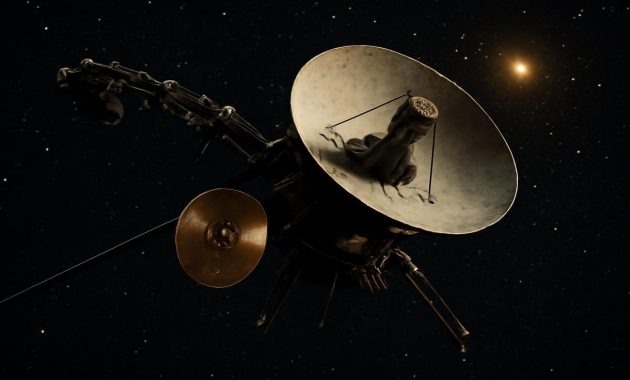
On a quiet night, when the power flickers and the house settles into its creaks and sighs, there’s a kind of silence that feels almost cosmic. You step out into the dark, look up, and the stars look back with their usual indifferent glitter. Somewhere far beyond that icy pinprick of Jupiter, past the ghostly domain of Pluto, past even the imagined borderlands of our solar system, an aluminum-and-gold emissary built in the age of bell-bottoms still hums in the dark. It’s older than many of the people alive on Earth. It’s slower than our phone processors by any sensible measure. And yet, after nearly fifty years of travel, Voyager 1 has quietly redrawn our sense of distance itself.
The Day the Numbers Stopped Making Sense
For most of us, distance is lived in what our legs, our cars, or a plane can manage. A walk is meters, a commute is kilometers, a long-haul flight is thousands of miles and a lot of pretzels. Our bodies know what those feel like: the burn in a calf muscle, the ache at the back of the neck on a transatlantic red-eye. Even a trip to the Moon, for all its impossible glamour, has a neat figure attached—about 384,400 kilometers, three days in a cramped capsule. The human mind can at least put that on a mental shelf labeled “huge, but maybe imaginable.”
Voyager 1 shattered that shelf long ago, somewhere between Saturn’s rings and the darkness beyond. It kept going long after its original mission ended, after its photo albums—those iconic images of Jupiter’s storms, Saturn’s halo, the family portrait of planets—were snapped and filed away in textbooks. The spacecraft simply continued, like a marathon runner who never got the memo that the race ended ten laps ago. Now, after roughly half a century of relentless motion, the numbers attached to Voyager 1’s location no longer feel like distance at all. They feel like something else—like a new unit for measuring awe.
When Kilometers Lose Their Grip
Sit with this for a moment: Voyager 1 is more than 20 billion kilometers from Earth. The figure fluctuates by tens of thousands of kilometers every minute, because that’s what happens when you move at about 17 kilometers per second continuously for decades. You could try speaking that number out loud, but it doesn’t land in the body the way “ten miles” does. It just passes through you like static.
Scientists anticipated this problem long ago, which is why space introduces its own scales: the astronomical unit (AU), the light-minute, the light-hour, the light-year. Voyager 1 crossed 100 AU from the Sun. It’s well over a light-day away from Earth now—meaning, if the spacecraft could shine like a star, the light leaving it right this moment would not reach our eyes until tomorrow.
On paper, that’s tidy. In the gut, not so much. So we reach for metaphors instead, like a hand groping along the dark wall of a hallway. Imagine a globe the size of a classroom. Shrink the Sun down to a bright marble in the center. The Earth now is a dust grain floating a meter away. The Moon orbits that grain like a speck that almost isn’t there. Jupiter, a slightly bigger bead, orbits several meters out. Neptune lurks near the far wall, a small cold dot by the classroom door. Voyager 1? It’s down the hallway, past the lockers, out the school entrance, halfway across your town and still walking.
Even that image grows useless as the distance scales grow. The spacecraft has outpaced our metaphors. It moves in numbers that outstrip our rooms, our highways, our Earthly horizons. This is the quiet revolution Voyager 1 has performed: it has pushed human measurement to a point where the old units, the ones that underpinned everything from caravans to jetliners, feel too small, too domesticated.
The Long, Thin Thread Back Home
On any given day, if you’re listening to the right NASA feeds or reading the right mission logs, you might stumble onto a phrase like: “Signal received from Voyager 1 with a round-trip light time of 45 hours.” In the bland cadence of engineering-speak, there is something deeply, almost painfully human at work. We are still talking to this thing.
Picture the scene at a deep space communications complex. Giant white radio dishes lean toward a patch of sky that, to you or me, looks no different than any other—just a scatter of anonymous stars eking out their ancient glow. But buried in that clutter, for a narrow window of time, is Voyager 1’s whisper. The spacecraft’s transmitter is weaker than a refrigerator light bulb; its signal reaches Earth as the faintest trembling in the noise of space. Engineers tune into that quiver and pull it out, decode it, translate it into data and graphs that scroll across screens.
There’s a delay, of course. Radio waves and light move at the same speed. So a one-way message now takes well over 20 hours to arrive. Ask Voyager 1 a question today, and you will not hear its answer until after tomorrow’s coffee. Cause and effect, that most basic rhythm of our lives—flip a switch, see light; press send, get a reply—breaks and reassembles itself on an alien timescale. Even time’s familiar snap-back effect loosens, stretched out across dozens of hours, thousands of Earth diameters.
Distance You Can’t Drive, Only Wait For
It’s tempting to think of this in terms of mechanical distance: how far, how fast, how many kilometers. But what Voyager 1 really teaches is patience as a unit of space. The distance between us and that tiny, brave machine isn’t just a number; it’s a waiting game. We’ve grown used to a universe that refreshes at the cadence of an app. Voyager 1 lives at the cadence of the cosmos.
Here is a strange and humbling thing: a human, any one of us, could still fit comfortably inside the original clean room where Voyager 1 was assembled. You could stand beside its bus-sized frame, lay a hand on its aging golden insulation. Your shoulders would brush against the same structure that has now left the Sun’s influence behind. In a literal sense, we are smaller than the spaceship we made; in a cosmic sense, we are much, much smaller than where it now resides.
Yet that long thread of radio between Earth and Voyager 1 ties us together. Our curiosity, encoded in pulses of radio, continues to chase after it. The ship’s responses—data on magnetic fields, cosmic rays, the subtle breath of interstellar space—come back like postcards from a region of reality we had only imagined. The delay itself becomes meaningful. It’s not just distance measured in kilometers; it’s distance measured in unanswered questions hanging in the dark.
Across the Invisible Border
Every map needs an edge. For centuries, the edge of the known world was an ocean line scribbled onto parchment. “Here be dragons,” the cartographers would warn or tease. The solar system has its own hazy frontier, not marked by dragons but by the thinning, fraying reach of the Sun’s power. Our star breathes out a stream of charged particles called the solar wind. That wind carves a vast, invisible bubble in the surrounding interstellar gas—a protective cocoon we call the heliosphere.
Inside the heliosphere, everything still feels—magnetically speaking—like the Sun’s domain. Outside it, space is governed by the broader galaxy. For decades, scientists modeled that boundary, argued over its exact shape and distance. Then, in 2012, Voyager 1 slipped through the heliopause—the place where the solar wind’s dominance gives way to the interstellar medium. For the first time, one of our machines crossed the edge of the Sun’s weather and sailed into the river of the galaxy itself.
From Solar Neighborhood to Galactic Backroads
Imagine standing by a lake as it narrows into a river and finally pours into the open sea. The water looks similar, but the rules change: waves take on new patterns, currents shift. Voyager 1 has performed this transformation in plasma and magnetic fields instead of water and shorelines. Its instruments have recorded the jump in cosmic rays, the change in particle density, the subtle flip in magnetic orientation that said: “You’re not in the Sun’s backyard anymore.”
When we say “after 50 years of travel, Voyager 1 changes the distance scale,” we mean more than that it’s really far away. We mean that it has forced us to think of distance in terms of borders we didn’t know we could cross. Before Voyager 1, interstellar space was a concept best left to painters and speculative writers, a background haze in planetarium domes. After Voyager 1, it is data. It’s charts and numbers and logs of particle counts ticking away on monitors in windowless rooms on Earth.
Here is a small, disarming table that tries to place Voyager 1’s journey next to distances we use every day. It doesn’t quite succeed—that’s the point.
| Journey | Approximate Distance | Voyager 1 Perspective |
|---|---|---|
| Typical city commute | 20 km | Covered in about 1 second |
| New York to Tokyo flight | ~10,800 km | About 10 minutes of Voyager travel |
| Earth to Moon | 384,400 km | About 6 hours of Voyager travel |
| Earth to Sun (1 AU) | ~150 million km | A bit over 3 months of Voyager travel |
| Voyager 1 from Earth (today) | 20+ billion km | Nearly half a century of continuous motion |
Even neatly aligned in rows, those figures strain comprehension. Our tables, like our metaphors, are cramped against the immensity of what this aging spacecraft has done. Voyager 1 has turned the question “How far is far?” into something that requires not just numbers, but new kinds of imagination.
The Golden Record and the Human Scale of Distance
Think back to the late 1970s. In a world of rotary phones and analog hiss, a small team of dreamers crafted something we now call the Golden Record. Bolted to the side of Voyager 1 is this phonograph record wrapped in gold-plated copper, designed as a cosmic greeting card. It carries Mozart and Chuck Berry, greetings in dozens of languages, the sound of surf and rain and thunder, a mother’s kiss to her child, a brain wave recording of a woman thinking about falling in love.
There’s an almost childlike sincerity to it: if someone finds this, here is who we were. Projecting that kind of message out into the galaxy presumes that space is not just a vacuum to traverse but a kind of ocean that might someday carry our bottle to another shore. Voyager 1 is now the messenger that has gone most deeply into that ocean, hauling our tiny anthology of Earth behind it.
When “Far Away” Becomes “Never Coming Back”
Consider what distance means here. No one is going to retrieve Voyager 1. No rescue mission will swing by and refuel it, no towing service will drag it back into the warm glow of home. It is traveling on a one-way trajectory so elongated that, given enough time, its destination becomes more philosophical than physical. It will outlive our languages, most likely our nations, perhaps our species. In a few billion years, the continents on Earth will have re-arranged themselves entirely while Voyager soldiers on, a mute and frosted token of a civilization that once looked up and asked whether it could touch the stars.
With each passing day, the measurement of “how far away it is” separates itself more from any experience we can fold into our bodies. You can visit a mountain, wade into an ocean, fly across a hemisphere. You cannot do anything with twenty or thirty billion kilometers except accept them. Voyager 1 has turned distance into a kind of permanence. It is beyond retrieval, beyond recall. Its increasing remoteness is less a line on a chart and more a slow fade into myth.
And yet those numbers keep ticking upward in the logs. Engineers still calculate trajectories; they still plan thruster firings to keep the craft’s antenna aimed at Earth. As long as there is power in its decaying nuclear heart, as long as its instruments can warm themselves against the cold, Voyager 1 will keep sending back traces of what it encounters. Distance has become not just how far it has traveled, but how long it has kept the conversation going across an expanding gulf.
Living with a New Distance Scale
How do you live on a small blue planet knowing that your technological child has long since escaped the gravitational echo of home? One way is to treat it as background knowledge: an impressive fact in a trivia game, a paragraph in a schoolbook. Another is to let it seep a bit deeper—to allow Voyager 1 to quietly rewire how you think about your own life’s geography.
Stand by a river in your town; listen to its muted chatter over stones. Watch birds arrow south in autumn, tracing ancient sky roads. Feel the pull of a horizon line you’ll never quite walk all the way to. Our ancestors mapped those same sorts of boundaries at human speed, setting sail or saddling horses to see what lay beyond the ridge, the reef, the desert.
Voyager 1 is our continuation of that story, but stretched so far that the old language of “over there” and “very far away” no longer fits. Distance, in the Voyager era, is not just miles to be crossed; it’s a measure of how much of the universe has moved from magic into measurement. We now know, in data points and radio wave squiggles, what it feels like to pass from the Sun’s intimate bubble into the greater galactic tide. We have turned interstellar space from a fantasy setting into a place an object we built is currently occupying.
In doing so, Voyager 1 has broken our traditional distance scales. A journey used to be a thing with a return ticket or at least a destination—a port, a summit, a marker stone. Voyager’s destination is best defined not by arrival but by departure: it is always receding, always away. Its legacy isn’t where it’s going but how far it has already gone, and how that distance keeps growing, ticking like a strange new clock on the mantle of human history.
One day, its power will ebb past usefulness. The instruments will wink out, one by one, like cabin lights on a ship slipping below the horizon. The last thing it sends will cross the void with the same unhurried speed of light, arriving on Earth hours later to a waiting team who will, perhaps, know as they decode it: this is the final postcard. The silence that follows will not mean the journey has ended—only that we’ve lost the ability to measure its distance in the old way, with signals and replies. After that, Voyager 1 will keep traveling in a more absolute sense of “far,” one untroubled by our need to count.
But even then, in classrooms and conversations, in the quiet moments when someone looks up and tries to imagine what “out there” really means, Voyager 1 will still be doing its quiet work. It will have finished changing our distance scale from something you can step off with a ruler or drive in a day, into something that reaches into the deep night and refuses to end where our imagination once did.
Frequently Asked Questions
How far is Voyager 1 from Earth right now?
Voyager 1 is more than 20 billion kilometers from Earth, and it is getting farther away at roughly 17 kilometers per second. That distance increases by many thousands of kilometers every minute, putting the spacecraft over a light-day away from us.
Is Voyager 1 still communicating with Earth?
Yes, as long as its power source and instruments continue to function, Voyager 1 sends back data via the Deep Space Network. However, each message takes over 20 hours to travel one way, so communication is slow and carefully planned.
Has Voyager 1 really left the solar system?
Voyager 1 has crossed the heliopause, the boundary where the Sun’s solar wind gives way to the interstellar medium. In that sense, it is in interstellar space. However, it is still within the broader gravitational influence of the Sun and has not passed beyond the distant Oort Cloud of comets.
How fast is Voyager 1 traveling?
Voyager 1 travels at about 17 kilometers per second relative to the Sun, or over 60,000 kilometers per hour. At that speed, it would cross the distance from Earth to the Moon in roughly half a day, if it were pointed in that direction.
What is on Voyager 1’s Golden Record?
The Golden Record contains sounds and images meant to portray the diversity of life and culture on Earth. It includes music from different traditions, greetings in many languages, natural sounds like waves and thunder, and images showing life, science, and human society.
How long will Voyager 1 keep working?
Voyager 1 is powered by radioisotope thermoelectric generators that gradually lose output over time. Mission planners expect that most instruments will be shut down within this decade to conserve power, and eventually even the basic communications systems will cease, leaving the spacecraft to drift silently.
Why does Voyager 1 change how we think about distance?
Voyager 1 has traveled so far and for so long that everyday measures like kilometers and miles no longer feel meaningful. Its journey pushes us to use light-time, astronomical units, and even philosophical ideas like patience and irretrievability to describe distance, expanding our sense of scale beyond anything most humans will ever directly experience.