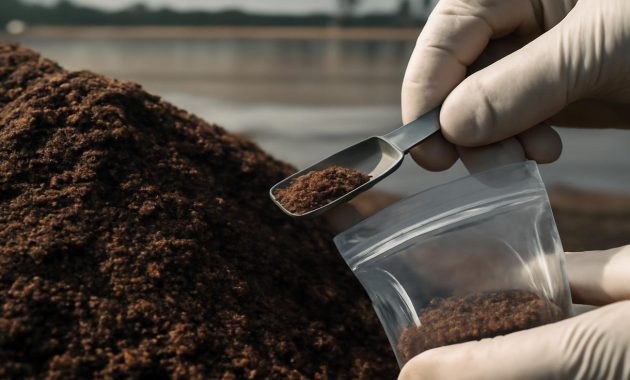
The trucks used to arrive before sunrise, groaning under their own weight, and leave behind mountains of gray dust that nobody wanted. The dust looked tired—exhausted, even—as if it had already lived its useful life inside a furnace somewhere, pulled from the Earth, burned, crushed, melted, and finally discarded. For decades, it settled into windblown piles on the edges of towns, in the quiet corners of steel mills and fossil-fuel power plants. It coated boots, lungs, and skylines. People called it waste, slag, fly ash. Nobody called it treasure.
The Secret Inside the Dust
There is a particular silence to industrial waste sites early in the morning. The air tastes faintly metallic. Underfoot, the ground doesn’t feel like soil; it feels like history that has been burned and ground down. When geochemist Elena Morales first walked across one such ash field behind a decommissioned coal plant, she wasn’t thinking of treasure chests or sunken ships. She was thinking of magnets.
Not the small gray rectangles stuck to your fridge, but the powerful rare-earth magnets that live invisibly inside wind turbines, electric vehicles, smartphones, MRI machines, and fighter jets. Modern life is studded with them. Without them, our devices weaken, our motors stutter, our energy transition limps. And almost all of the rare earth elements needed to make those magnets—neodymium, dysprosium, praseodymium, terbium—are mined, refined, and controlled in a handful of places on Earth, mostly far from where they are actually used.
On paper, the rare earths sounded plentiful. Their name is misleading: they’re scattered throughout the planet’s crust. But they’re dispersed in such low concentrations that turning them into usable materials is messy, expensive, and often toxic. It means ripping up landscapes, carving open hillsides, mixing ores with acids and solvents that seep into water and soil. The places that bear the scars of this industry have names, too, but they’re rarely printed on the devices that depend on them.
And so, as global demand for rare earths climbed, people like Morales began searching for alternatives. Could we find these elements somewhere closer, somewhere already dug up, already broken apart—somewhere we had overlooked? Her answer, and that of a growing number of scientists around the world, was hiding in plain sight: in the ghostly gray dust of our own industrial past.
Industrial Waste, Reimagined
It started with idle curiosity and a handheld X-ray fluorescence scanner. Morales and her team spent long days in hard hats, wandering through the backyards of coal-fired power plants and steel mills, pointing the instrument at old ash piles and slag heaps. Ash from burned coal, steelmaking slag, red mud from aluminum refineries—materials that once flowed like lava or billowed like storm clouds, now hardened into crusts and dunes.
The scanner beeped in short, insistent chirps as it read the elemental signature of each sample. Iron. Calcium. Silicon. And then, unexpectedly, the letters they were looking for: Nd. Dy. La. Y. Rare earths, in concentrations sometimes higher than those of active mines.
Coal ash, that powdery residue left after coal is burned for electricity, turned out not to be just a nuisance to be buried or ponded. In some regions, especially where coal seams had quietly absorbed trace minerals from ancient seas and volcanic eruptions, the ash carried rare earth concentrations high enough to make scientists stop and stare. Slag from steel production and the bright-red tailings of bauxite processing told similar stories. These were, in effect, accidental ores—rocks we had already dug up, heated, smashed, and concentrated without realizing that something even more valuable was along for the ride.
The idea that the world’s largest additional source of rare earths might be wrapped inside the by-products of old industries feels almost like a plot twist. The waste that once symbolized the dirty past of fossil fuel power is now being recast as a resource that could power a cleaner future. It is as if the industrial age left behind not just scars, but seeds.
The Chemistry of a Second Chance
Of course, finding rare earths in the waste stream is only the opening chapter. Extracting them is another story altogether. Rare earth elements rarely appear as shiny nuggets; they cling to other minerals, tucked into microscopic crevices. To coax them out, researchers are turning to chemistry that tries—this time—to be kinder.
Traditional rare earth processing often involves strong acids, abundant waste, and environmental headaches. But chemists working with coal ash and slag have room to experiment. These materials are already considered waste, and they have different mineral structures than untouched ore. That means new approaches are on the table: mild organic acids, bioleaching with microbes, chelating agents that selectively bind to rare earth ions like tiny claws.
In some pilot plants, vats of ash are being gently stirred with solutions that look no more threatening than weak tea. Over time, rare earth ions slip into the liquid, leaving most unwanted elements behind. In other labs, bacteria are recruited to do the work. These microbes have evolved over millions of years to interact with metals in their environment; now they’re coaxed to help nudge rare earths into solution, one ion at a time.
From there, engineers use membranes, solvents, and precipitation reactions to sort and purify the mix. The steps echo traditional metallurgy, but with a modern twist: the aim is to close loops, minimize toxic leftovers, and keep both the workers and the watersheds safer than the first age of rare earth mining ever did.
From Monopolies to Many Small Mountains
The geopolitical part of the story is less romantic, but no less important. For years, the global supply of rare earths has been dominated by a few large producers. A single country refining most of the world’s rare earths means that trade disputes or policy shifts in one capital can ripple into factories, car plants, and wind farms half a world away. Engineers lose sleep over the thought of a magnet shortage.
But industrial waste doesn’t respect national borders in the same way. Coal power plants exist—or once existed—in dozens of countries. Steel mills line riverbanks from the American Midwest to Eastern Europe to East Asia. Aluminum refineries, phosphate fertilizer plants, mineral sand processors: each leaves behind tailings that, increasingly, are being checked for hidden value.
Instead of a few giant mines, the future rare earth landscape could look like thousands of smaller “urban deposits”—ash ponds, slag mountains, red mud lakes—scattered across the industrial map. Each site might contain only a fraction of what a major mine produces, but together they add up. They spread risk. They shorten supply lines. They give countries that once simply imported magnets a chance to become resource producers without blasting open new hillsides.
Some policy makers now talk about “critical minerals independence” with a quiet, newfound optimism. If a nation has a history of burning coal, making steel, or refining aluminum, it may suddenly discover it has a legacy resource as well: rare earths locked in past pollution. Tension eases slightly when the world’s magnet supply is not chained to a single point of failure but supported by a web of modest, local recoveries.
How Waste Stacks Up Against Traditional Ores
The numbers tell their own story. In many coal regions, ash samples show rare earth concentrations on par with lower-grade conventional ores—sometimes higher. Similar promise glimmers in other waste streams. For a sense of perspective, consider a simplified snapshot:
| Material | Typical Total Rare Earth Content | Key Notes |
|---|---|---|
| Conventional rare earth ore | ~0.05% – 0.2% | Requires primary mining; high environmental impact if unmanaged. |
| Coal fly ash (select deposits) | ~0.02% – 0.15% | Already mined and processed; often stored in ponds or landfills. |
| Steel slag (certain types) | Up to ~0.1% | By-product of steelmaking, historically used as aggregate or dumped. |
| Red mud (bauxite residue) | Variable, sometimes 0.05%+ | Highly alkaline tailings; large volumes stored worldwide. |
These are simple figures, but they highlight a crucial point: industrial waste can match or approach the ore grades that the mining industry has long considered workable. Add to that the fact that these materials are already on the surface, already crushed and ground, and the appeal grows. There is no need for blasting, tunneling, or hauling tens of thousands of tons of rock out of a mountain. The ore is the waste.
The Landscape Learns to Heal
None of this erases the harm that industrial waste has already caused. Coal ash ponds have leaked into rivers, steel slag piles have altered soil chemistry, red mud has breached dams in catastrophic spills. The past cannot simply be recycled into something shiny and new. But reimagining waste as a resource opens a door: what if cleaning up and extracting value could happen together?
Picture an old ash pond on the edge of a town. For years, it has been something people drive past but rarely discuss—a dull smear of gray behind a chain-link fence. Now, trucks and modular processing units arrive, not to dump more material, but to take some away. Workers in reflective vests move deliberately, sampling, testing, treating. Instead of merely capping and forgetting the site, the ash is gradually processed, the rare earths recovered, and the remaining minerals stabilized or repurposed as construction material.
The process won’t always be neat or quick. Some ponds are too contaminated with other toxins to be simple projects; some are too small or too remote to be economic. But in many cases, there is a convergence of needs: communities want safer land and water, governments want domestic supplies of critical minerals, and industries want reliable inputs for high-tech manufacturing. Rare earth recovery from waste sits at this crossroads.
On a planetary scale, the concept is even more compelling. Humanity has already reshaped the surface of the Earth in pursuit of energy and materials. Mines, roads, factories, refineries: all of them have left behind residue. Instead of launching another wave of mining in untouched ecosystems, we can first turn back to the legacy of our previous waves and ask: what have we thrown away that still has work to do?
People at the Piles
For the people working at these sites, the transformation is tangible. A coal plant that once only emitted carbon and ash might now host a small clean-tech hub, where chemists, engineers, and technicians test extraction methods and refine processes. Former plant workers learn how to operate filtration units and separation columns instead of pulverizers and boilers.
Morales likes to tell her students that they’re not just scientists—they’re translators. “We’re learning to read what the waste is saying,” she explains. Each site has its own accent, its own mineral dialect. An ash pond from a lignite-burning plant in one part of the world will behave differently than the compact slag from a blast furnace in another. Some respond well to organic acids; some need tailored mixtures. Some make separation easy; some are stubborn and require a second, third, or fourth attempt.
In this way, recovering rare earths becomes less like running a single factory and more like tending a global patchwork of local projects. The skills are portable, but the recipes must be adjusted. The story of rare earths shifts from one of singular, distant mines to one of many small collaborations between people and battered landscapes, each learning how to heal in its own way.
A Future Built on Leftovers
If this vision holds, the phrase “largest source of rare earths” will come to mean something different. Instead of pointing to a single monstrous pit mine or remote desert basin, it may refer to the aggregate of countless waste sites—ash hills, slag terraces, red mud lakes—that collectively outstrip traditional ore deposits. In terms of sheer tonnage of potentially recoverable material, the industrial age has given us more than we knew.
But scale is not the only reason this matters. There is a deeper, almost philosophical shift embedded here. For most of our history, we treated materials in straight lines: dig, use, discard. Waste was a final state—a graveyard of usefulness. Now, rare earth recovery from industrial leftovers hints at a more circular story. It suggests that what we call “end of life” for a material is often just the end of our imagination.
Nothing about this shift is guaranteed. It depends on continued research to make extraction cleaner and cheaper; on regulations that encourage companies to recover rather than simply bury; on honest accounting of environmental risks and benefits. It hinges on communities deciding that they want their local ash pond or slag heap to transition from silent liability to active participant in a global energy transition.
Still, it’s hard not to sense a quiet symmetry. The coal that once powered our first industrial revolution, leaving behind ash and emissions, could now indirectly fuel the next one by donating its trace rare earths to wind turbines and electric motors. The steel mills that once hammered rails and bridges into place could, through their slag, help build lighter, more efficient vehicles and generators. Even the red mud that stained landscapes around aluminum refineries, a by-product of a metal central to modern infrastructure, may yet feed the magnets that keep our future grids humming.
On a cool evening at one former coal plant, as the sun drops behind the skeletal outline of old transmission towers, the ash field does not look romantic. It is still a scar, still a reminder. But somewhere beneath the crusted surface and the footprints of scientists lies a new kind of promise: not of endless growth, but of learning to live more intelligently with the materials we have already disturbed.
In the end, the lesson is simple enough to fit in the palm of a hand, in a pinch of gray dust. The largest new source of rare earths may not require us to tear fresh wounds into untouched mountains. It may be waiting in the quiet corners of our own past, in the waste we thought we were done with—until we realized it still had one more story to tell.
Frequently Asked Questions
Why are rare earth elements important?
Rare earth elements are essential for high-performance magnets used in wind turbines, electric vehicle motors, smartphones, medical imaging, and many defense and communication systems. Their unique magnetic and optical properties make many modern technologies more efficient and compact.
Are rare earth elements actually rare?
Chemically, they are not truly rare; many are as abundant as copper or nickel in the Earth’s crust. What makes them “rare” is that they are seldom found in high concentrations, so mining and refining them economically has traditionally required large, complex, and often polluting operations.
How can industrial waste contain rare earths?
Coal, bauxite, iron ore, and other raw materials naturally contain trace amounts of rare earth elements. When we burn coal or process ores for steel and aluminum, those trace elements don’t disappear—they become concentrated in the resulting waste streams like fly ash, slag, or red mud.
Is extracting rare earths from waste better for the environment than mining?
In many cases, yes. The material is already mined, crushed, and stored, so there is no need to open new pits or move massive amounts of rock. With careful chemistry and good waste management, the environmental footprint can be significantly lower than that of conventional rare earth mining and processing. However, each site must be evaluated to avoid creating new pollution problems.
Could this completely replace traditional rare earth mining?
Industrial waste recovery is unlikely to eliminate the need for all primary mining, especially as demand for rare earths grows. But it can provide a substantial supplementary supply, reduce dependence on a few large mines, and buy time to develop better recycling and alternative technologies.
What types of industrial waste are most promising?
Coal fly ash, steel slag, and red mud from aluminum production are among the most studied. Some phosphate fertilizer wastes and mineral sand tailings also show promise. The exact potential varies widely by region, depending on local geology and industrial history.
When will products using rare earths from waste be common?
Pilot projects and demonstration plants are already operating in several countries. Over the next decade, as technologies mature and regulations support cleaner supply chains, it is likely that a growing share of rare earths in magnets and electronics will come from industrial waste and, eventually, from recycling of end-of-life products as well.