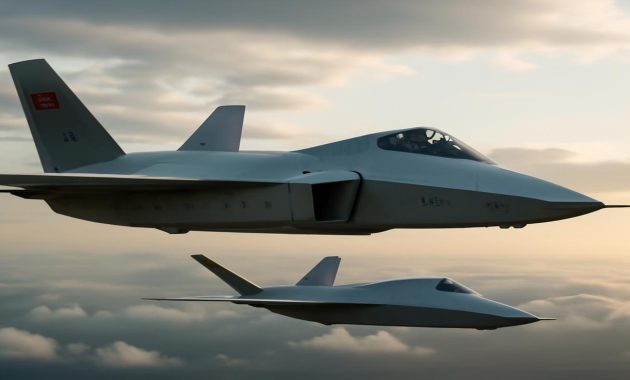
A winter haze hangs over Ankara’s flight line, the kind that blurs edges and turns metal into shadow. Ground crews move like bundled silhouettes around a sleek, sharp-nosed aircraft still wrapped in primer paint and secrecy. This is Kaan, Turkey’s next-generation fighter, its wings beading with fine droplets of frost. But today, it’s not just the fighter that’s drawing stares. Off to the side, another aircraft waits—smaller, lighter, almost predatory in its stance. It’s unmanned, all angles and intent, the kind of machine that looks less like a tool and more like a companion. In the cold morning air, as turbines spin up and cables are checked one last time, the idea becomes impossible to ignore: Turkey isn’t just building a fighter jet. It’s building a partnership—between human and machine—that it hopes will rival the best France has to offer.
The Age of Wingmen: From Romantic Myth to Robotic Fact
For more than a century, the word “wingman” carried a certain romance. Two pilots flying side by side. One protecting the other’s blind spots. A quiet trust built on shared danger and crackling radio calls. Now, that old word is being reforged in circuits and composite materials. Wingmen of the future don’t breathe, don’t tire, and don’t fear. They are unmanned combat air vehicles—loyal wingmen—designed to fly, fight, and sometimes fall in place of the human at the center of it all.
France has been walking this path with deliberate, almost understated confidence. As it looks beyond its Rafale fighter program, Paris has been sketching the outlines of an ecosystem where a new manned fighter will fly with a small pack of advanced drones at its side. These “remote carriers,” as European planners like to call them, are built to extend eyes, reach, and firepower deep into hostile skies. The French vision is polished, well-funded, and EU-woven: clean mockups, measured timelines, quiet test flights.
Turkey’s story is different. It’s louder. Hungrier. Less polished at the edges. Where others talk about concepts and sketches, Turkey rolls prototypes onto hot runways and lets them roar.
The Kaan fighter is the country’s bid to join the exclusive club of nations fielding fifth-generation, stealth-capable aircraft. But increasingly, the real story isn’t Kaan alone. It’s what will fly beside it. Because as other European nations look to their drones and France whispers about its own air-combat ecosystems, Turkey has unveiled a partner for Kaan that signals something very clear: it’s ready to go toe-to-toe with the French vision of future airpower.
Kaan Finds Its Match: The Rise of Turkey’s Loyal Wingman
Step closer to the tarmac in your mind for a moment. Kaan stands there like a predator at rest: angled air intakes, stealthy lines, a cockpit canopy catching the pale winter light. Now picture its unmanned partner, smaller but no less deliberate—an aircraft shaped not by the curve of a pilot’s spine but by algorithms and software, a design honed to be expendable yet lethal.
This is Turkey’s vision for the ideal partner: an unmanned combat drone—an advanced loyal wingman—that will fly in formation with Kaan, extend its reach, and share its risks. The concept is simple, but its execution is anything but.
Unlike conventional drones that circle quietly over distant battlefields, this wingman is meant to dive into the harshest air defenses, slip through radar nets, and work hand-in-hand with its manned leader. It can scout, jam, decoy, and, when ordered, strike. To a pilot strapped into Kaan’s cockpit, this partner isn’t just another sensor feed; it’s another presence in the sky, a force multiplier that changes how the pilot thinks, plans, and survives.
Turkey has been rehearsing for this role for years. Its aerospace industry cut its teeth on high-endurance surveillance UAVs and combat-proven strike drones. Now, it’s taking everything it has learned—about autonomy, data links, cost, and combat realities—and feeding it into a single purpose: to build the most capable and accessible wingman it can, one that can stand in the same conversation as what France is quietly crafting for its own future fighter programs.
In that sense, the unveiling of this ideal partner isn’t a single event. It’s the convergence of years of experience, of battlefield lessons learned in dusty, distant conflicts, now distilled into a sleek, hard-edged machine that’s expected to keep pace with a fifth-generation jet.
A Quiet Competition in the Skies Over Europe and Beyond
On the surface, Turkey and France don’t seem like obvious rivals. One is a NATO heavyweight with a long-established aerospace pedigree and a fighter export success story in Rafale. The other is a fast-rising defense industrial power that’s turned its relative isolation into a kind of creative stubbornness. Yet when you look at the next generation of air combat, it’s impossible not to see them shading into each other’s airspace.
Both countries are chasing roughly the same dream: an integrated air-combat family where a high-end manned fighter does not fly alone. Both are designing drones that can accompany those fighters into hostile airspace, share targeting data, and strike in coordination. Both are weaving electronic warfare, stealth, and networked operations into this tapestry. And both hope to export not just individual platforms, but entire concepts of airpower.
France leans on decades of fighter heritage, EU funding, and a patient, deliberate development rhythm. Turkey leans into speed, combat testing, and the momentum of a defense industry that has gone from aspirational to disruptive in less than a generation. When Turkey unveils an ideal partner for Kaan, it’s not merely announcing a drone. It’s planting its flag in a contested future: a future where buyers might choose between a French-led ecosystem of next-gen fighters and remote carriers, or a Turkish-led universe of Kaan and its loyal, lethal wingmen.
Inside the Partnership: How a Jet and a Drone Learn to Trust Each Other
The bond between Kaan and its wingman isn’t built on shared glances or hand signals across a cockpit. It’s built in streams of compressed data, encrypted handshakes, and machine learning models trained to anticipate what a pilot needs often before the pilot consciously knows it.
Imagine Kaan flying fast and low toward a defended area. Radar warnings flicker. On the display, the pilot sees more than just blips and icons. He sees the ghostly outline of his unmanned partner racing ahead, slipping into the edge of radar coverage. From there, the wingman can stitch together a clearer picture of the battlespace—enemy emitters, missile launchers, fighter patrols—and feed that image back to Kaan in real time.
The unmanned partner might carry decoys, releasing them at just the right moment to soak up incoming missiles. It might switch into jamming mode, turning its slender frame into an electronic shield that distorts hostile radar beams. Or it might stay silent, stealthy, holding a pair of precision weapons under its wings until Kaan quietly tags a target for it to strike.
This relationship requires more than basic autopilot. It demands a kind of digital intuition. The wingman has to understand formations, threat levels, timing. It must know when to break formation and when to close ranks. Above all, it has to operate within a spectrum of autonomy that reassures the pilot: this machine is not out of control, nor is it a burden. It is a partner whose risks can be carefully dialed up or down.
That human-machine relationship is where Turkey is pouring some of its boldest thinking. With each flight test, with each software refinement, it’s trying to answer subtle questions: How much freedom should the unmanned partner have? At what point does help become noise? How do you design trust into lines of code?
| Aspect | Turkey’s Kaan Ecosystem | France’s Future Fighter Ecosystem |
|---|---|---|
| Core Manned Fighter | Kaan next-gen stealth fighter | Future fighter to succeed Rafale |
| Unmanned Partner Role | Loyal wingman for scouting, strike, decoy, and jamming | “Remote carriers” for sensing, strike, and electronic warfare |
| Development Style | Fast, iterative, combat-driven testing | Deliberate, consortium-based, long-horizon planning |
| Export Ambition | Highly competitive, cost-focused market reach | Premium, politically anchored defense partnerships |
| Industrial Motive | Strategic autonomy and rapid climb up the tech ladder | Sustaining a long-standing aerospace leadership role |
In the cockpit, that table would never appear. But the reality it describes is what a future pilot will feel: the difference between flying a powerful solo jet, and flying at the center of a small, intelligent swarm.
Why This Matters Far Beyond Ankara and Paris
It’s easy to treat programs like Kaan and France’s future fighter as distant, sterile things—aerospace showpieces meant for airshows and defense expos. But beneath the gloss, they tell a deeper story about how nations see themselves in the decades ahead.
For Turkey, the Kaan–wingman pairing is a statement of arrival. A country that once imported most of its advanced combat aircraft now wants to sell them, and not just as individual machines, but as complete systems that promise sovereignty and technological leverage to their buyers. Each flight of Kaan and its partner is a quiet declaration: Ankara intends to sit at the big table of airpower, not as a junior partner, but as a designer.
For France, the stakes are just as existential, though framed differently. Its future fighter and loyal wingmen are about continuity—maintaining Europe’s ability to field world-class airpower without depending entirely on the United States. The French-led ecosystem is meant to keep European industry alive, inventive, and independent. In that light, Turkey’s parallel climb is both a challenge and an opportunity: competition at Europe’s edge that tests assumptions and spurs innovation.
For the rest of the world, the outcome of this quiet contest could shape what air forces look like from North Africa to Southeast Asia. Will emerging powers align with the French school of carefully curated, high-end partnerships? Or will they be drawn to a Turkish model that offers agility, rapid delivery, and an already-proven pedigree in unmanned operations?
On the Flight Line: A Glimpse of the Future
Return, for a moment, to that cold Ankara morning. A light breeze scrapes across the concrete. Somewhere, a hangar door rumbles open. Technicians in reflective vests shepherd visitors to a safe distance as engines wind up from a low growl to something physical, something you feel in your chest.
Kaan moves first, nosing toward the runway with the slow, deliberate roll of a big cat conserving its energy. Its unmanned partner follows, almost shyly at first, then aligning itself just behind and offset, the classic wingman’s position. There’s no pilot inside that second fuselage, no helmet glint, no mirrored visor. But as they line up for takeoff, the formation still feels… right.
The sensory details pile up: the shimmer of exhaust heat distorting the horizon, the rising thunder as engines push against memory and air, the sudden absence of weight as both machines leap from ground to sky. Side by side they climb, sunlight catching the flat panels and sharp chines of their stealth-driven geometry.
From the ground, they look like a pair of raptors learning to hunt together. From inside Kaan’s cockpit, the pilot sees data: altitude, airspeed, a ghost icon marking the unmanned partner, the live feed of its cameras, the changing symphony of radar and threat overlays. Somewhere in that mosaic, a new kind of trust begins to form—tentative, cautious, but real. This is no longer just a machine under remote control. It is a presence that can think within boundaries, act within a plan, and absorb danger that would otherwise fall on the human.
Far to the west, in quiet French test ranges, similar flight profiles are being rehearsed. Manned jets and companion drones learning the same language of spacing, timing, and roles. Different flags on the tails, similar questions in the minds of engineers and pilots. How close can the wingman fly? How fast can it react? How much initiative should it have when things go wrong?
The sky, indifferent to politics, hosts their experiments without comment.
Beyond Hardware: A Battle of Stories
In the end, what might separate Turkey’s Kaan and its ideal wingman from France’s own future fighter and remote carriers won’t only be specs on a slide—range, payload, stealth metrics, cost curves. It will be stories.
Stories that Turkish officials will tell to potential buyers about resilience, independence, and proven combat performance of unmanned partners in real conflicts. Stories that French officers will share about interoperability, European solidarity, and the refined balance of humans and machines honed over years of joint development.
A smaller air force, weighing its limited budget, will listen. They’ll imagine their own pilots stepping into that cockpit, their own landscapes framed by those canopies, their own names painted on those fuselages. They’ll picture that loyal wingman on their own radarscopes, diving ahead of their jets into the unknown.
What they choose will ripple outward, shaping alliances, doctrines, and even how future wars might be deterred or fought. A world where Kaan and its partner proliferate widely will feel different from a world anchored on a French-led ecosystem. The air over strategic chokepoints, fragile borders, and contested seas will hum with different signatures, different algorithms, different assumptions about who or what should take the first risk.
For now, though, the story remains unresolved—an unfolding chapter written in jetwash and software updates.
Shadow, Speed, and Silent Calculations
As twilight falls on the same runway that greeted the morning’s frost, Kaan and its wingman return from another test sortie. Their approach lights blink softly in the darkening sky, twin beads of motion gliding in tight synchrony. What they bring back is more than flight hours. It’s data—mountains of it. Every minor correction, every turbulence-induced twitch, every second of sensor fusion and formation keep is recorded, dissected, fed to engineers hunched over screens deep into the night.
In those labs, the true race between Turkey and France unfolds in quiet, fluorescent-lit rooms. It’s a race of software refinement, of autonomy rules, of real-time threat assessment models. The metal you can photograph; the code you cannot. Yet it’s the code that increasingly defines how these machines will behave when the air gets thick with danger.
Turkey’s ambition is evident in every line of that code. To build not just a capable unmanned aircraft, but an ideal partner—one that a future Kaan pilot will think of almost as a second self, an extended reach of their own will and intent. France chases a similar ideal, though under different banners, in different alliances. Both are trying to choreograph the same dance between human intuition and machine precision.
Standing at the edge of that runway, watching the two silhouettes grow larger as they descend, you can almost feel the scale of what’s at stake. This isn’t just about whose aircraft can fly higher or stealthier. It’s about whose idea of partnership between human and machine will define the next era of the sky.
As the wheels kiss the tarmac with that soft, smoky bounce, there is a sense—fleeting but real—that we’re watching the early steps of a new kind of aviation. One where no pilot flies truly alone, and where nations prove themselves not only by what they can build, but by how gracefully they can teach their creations to fly together.
FAQ
What is the Kaan fighter?
Kaan is Turkey’s next-generation stealth-capable fighter jet, designed to operate in high-threat environments. It aims to offer advanced sensors, low observability, and networked combat capabilities similar to other fifth-generation aircraft.
What does “loyal wingman” mean in this context?
A loyal wingman is an unmanned combat aircraft designed to fly alongside a manned fighter. It supports the main jet by scouting, jamming, acting as a decoy, or carrying weapons, often taking on the riskiest tasks to protect the human pilot.
How is Turkey competing with France in this area?
Both Turkey and France are developing ecosystems where a manned next-gen fighter works closely with advanced unmanned aircraft. Turkey’s Kaan and its ideal wingman concept are emerging as a direct counterpart to France’s future fighter projects and their “remote carrier” drones.
Why are manned–unmanned teams important for future air combat?
Teaming fighters with unmanned partners increases survivability, expands sensor coverage, and multiplies striking power. It allows pilots to push deeper into defended airspace with reduced risk, as drones can take on the most dangerous roles.
Will these systems be available for export?
Both Turkey and France intend to export elements of their future air-combat ecosystems. Details will depend on politics, partnerships, and technology-sharing policies, but export ambitions are a major driver for both programs.
Does this mean piloted fighters will disappear soon?
No. Piloted fighters are expected to remain central to air forces for decades, but they will increasingly be surrounded and supported by unmanned teammates, changing how missions are planned and fought.
What makes Turkey’s approach distinctive?
Turkey’s approach is notable for its speed, combat-driven development, and emphasis on cost-effective, exportable systems. Its experience with operational drones is feeding directly into how it designs the ideal wingman for Kaan, positioning it as a bold challenger to more traditional European programs.