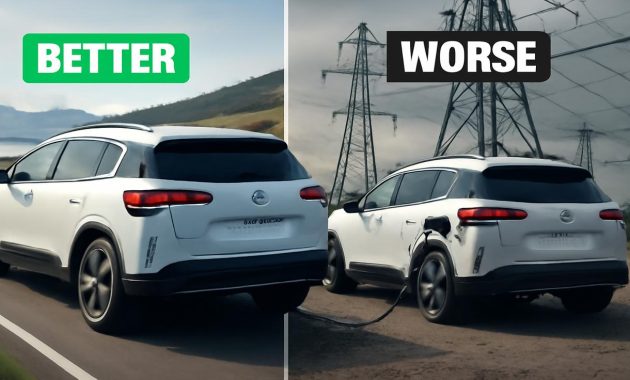
The rain had just started when the first fully electric Citroën C5 Aircross glided silently into the cobbled square. No diesel clatter, no petrol purr, just a faint whisper of tires on wet stone and the soft click of wipers tracing half-moons across the windscreen. A woman with a shopping bag turned to look, not because it was loud, but because it was so eerily quiet. The car rolled to a pause beneath a dripping plane tree, its LED eyes glowing a cool, bluish white, and for a second it felt like the future had arrived a few minutes early, unsure where exactly to park.
When a Comfort Icon Swaps Its Heart
The C5 Aircross has always been a bit of an oddball in the SUV world, and that’s partly why people love it. It’s the quirky French aunt in a sea of stoic German cousins—a little softer, a little stranger, unapologetically focused on comfort rather than cornering speed. For years it hummed along with combustion engines or as a plug-in hybrid, lulling its passengers on that famous Citroën “magic carpet” ride while sipping fuel with respectable restraint.
Now, for the first time, the C5 Aircross goes fully electric. No backup engine. No half measures. Just electrons, batteries, and motors. On paper, it’s exactly what the moment demands: cities tightening emissions, drivers craving quiet, and an automotive industry all but stampeding toward zero tailpipe emissions.
But parked at a curb in the real world, with people still arguing about range in coffee queues and on school runs, the question hangs in the damp air: is this fully electric leap the making of the C5 Aircross—or the beginning of its identity crisis?
The First Silent Drive: A New Kind of Citroën Calm
Slide into the driver’s seat and the car greets you, not with a roar, but with an absence. The kind of silence that makes you notice other things: the faint buzz of the ventilation, the fabric texture under your fingertips, the subtle beeps of the infotainment waking up. The C5 Aircross has always traded on its interior as much as its exterior lines, and electrification doubles down on that idea.
Hit the start button and nothing “starts” in the old sense. The dashboard confirms readiness with graphics and a glowing battery icon. Outside, rain streaks across the bonnet, forming wavering reflections of the LED daytime running lights. You roll away, the electric motor delivering instant, syrupy torque. In city streets, the SUV feels light on its feet, eager even, as if it has shed some invisible weight of mechanical complexity.
The famed Citroën suspension—those Progressive Hydraulic Cushions—are still there, quietly absorbing potholes, speed bumps, and tarmac scars. But something has changed. Without the background thrum of an engine, you hear the dull thud of the tires more clearly, the whisper of wind around door mirrors, the clack of stones spat up from wet asphalt. It’s as if someone turned down the soundtrack and turned up the sound design.
Yet the effect is soothing rather than disappointing. The fully electric C5 Aircross becomes a rolling cocoon, a moving living room on wheels. Electric power doesn’t erase its identity; if anything, it nudges it closer to the original promise: comfort above all else.
Power, Range, and the Math of Everyday Life
Of course, a car is not just a feeling; it’s also numbers. Battery capacity, range estimates, charging times—these have become the new horsepower figures people trade in comment threads and dealership waiting rooms.
Citroën aims the electric C5 Aircross squarely at real-world family life rather than bragging rights. That means enough range for school drop-offs, commutes, weekend trips, and the occasional spontaneous detour for ice cream, without requiring a mathematical degree every time you glance at the remaining percentage.
To put things into a simple snapshot, imagine a typical mid-sized electric SUV spec sheet for a model like this:
| Feature | Electric C5 Aircross (Conceptual Spec) |
|---|---|
| Battery Capacity | Around 50–60 kWh usable |
| WLTP Range | Approx. 300–400 km (real-world often lower) |
| Charging (DC Fast) | 10–80% in about 30–35 minutes (ideal conditions) |
| Charging (AC Home) | Full charge overnight (7–11 kW wallbox) |
| Power Output | Roughly 135–160 hp equivalent |
Numbers like these don’t break records, but they don’t need to. The question is simpler: does it do what an everyday SUV needs to do, with enough buffer that you’re not gripping the steering wheel in range anxiety whenever rain, cold, or a traffic jam appears?
In most urban and suburban rhythms, yes. Plug it in at home overnight, and your “tank” is full every morning. There’s a quiet joy in that ritual—the cable click, the soft glow of the charging light, the knowledge that while you sleep, tomorrow’s kilometres are quietly flowing into a box of lithium hidden under the floor.
The Soul of a Citroën: Lost or Reimagined?
For a brand with such a peculiar, pioneering history—hydropneumatic suspensions, DS silhouettes that looked like spaceships, dashboards that sometimes felt like art projects—the shift to full electric power might raise a different question: does this make the C5 Aircross more generic, or more authentically Citroën?
Electric platforms can flatten character if designers aren’t careful. Without the mechanical drama of a big engine or the distinctive sound of a turbo spool, some EVs can feel like they’ve all taken the same vow of silence. The danger is a smooth, efficient sameness.
Yet the C5 Aircross still looks like a Citroën. The signature light signatures, the rounded rectangles, the gentle curves—there’s still a softness to the shape, a slight refusal to conform to the aggressive, angular language many SUVs speak now. Open the door and that French quirk continues: chunky yet inviting seats, fabrics that feel chosen rather than default, colour accents that quietly whisper, “We didn’t forget to have fun.”
The ride, too, keeps its distinct twist. You notice it when you hit a patch of broken road. Where some EVs, weighed down by their batteries, crash and thud, the electric C5 Aircross does something subtler. The suspension breathes. There’s a first, gentle give, then a second, softer catch, as if the car is editing the harsh edges out of the world before they reach your spine.
Maybe this is where the heart of the question lives: not in whether the C5 Aircross is electric, but in whether it still feels like a Citroën. In its quiet focus on comfort, its playful textures, its slightly eccentric way of being in the world, the answer leans towards yes. The soul isn’t lost; it’s been rewired.
For Better: The Quiet, Clean Side of the Story
There’s an undeniable “for better” column in the electrification ledger. It starts, most obviously, at the tailpipe—a tailpipe that now does nothing at all. No fumes curling invisible into city air, no idle vibrations at traffic lights, no cold-start cough on a winter morning. For people living in dense urban areas, this matters in ways that are more than symbolic.
Inside, the benefits multiply. The silence of electric drive changes the tone of every journey. Conversations in the cabin feel less shouted over mechanical noise. Children doze more easily on long trips. You notice the rhythm of windshield wipers, the soft whir of climate control, the hiss of rain. It’s not just quieter—it’s calmer.
Then there’s the economics of electricity. In many regions, running costs favour EVs dramatically, especially if you can charge at home on off-peak tariffs. The idea of “filling up” while your car sleeps is one of those small but transformative conveniences you don’t fully appreciate until you’ve lived with it. No more detours to fuel stations on the way to work, no fumbling with petrol caps in icy wind.
Maintenance, too, becomes simpler—no oil changes, fewer moving parts, brake wear reduced by regenerative braking that gently slows the car while topping up the battery. An electric C5 Aircross promises to be less needy, more patient, a companion that simply asks for a plug and a bit of your driveway.
For Worse: Weight, Range, and the Edges of Convenience
But every gain brings shadows. The fully electric C5 Aircross, like most EVs, carries its battery like a heavy secret under the floor. That mass has to be managed. Citroën’s engineers work hard to hide it, yet physics doesn’t fully disappear. In quick lane changes or tight corners, you feel the weight; it’s composed, but not exactly nimble. This has always been more of a cruiser than a dancer, and the electric version leans further into that personality.
Range, too, is a double-edged sword. Around town, it’s generous, almost luxurious: hundreds of kilometres available, rarely fully used. But stretch its legs on a cold, wet highway day, with a full family and luggage, and that neat WLTP figure starts to erode. Headwinds, low temperatures, higher speeds—they nibble away at the projected distance, and you find yourself eyeing charging icons more often than you once eyed petrol prices.
Charging infrastructure can turn a peaceful Sunday drive into a minor expedition. In places with dense networks of fast chargers, the experience is almost seamless: coffee, restroom break, back to a topped-up battery. In areas where chargers are rare, busy, or temperamental, the romance fades quickly. The C5 Aircross, no matter how comfortable, becomes only as convenient as the cables and stations that support it.
And there’s cost. Electric SUVs, including a fully electric C5 Aircross, are unlikely to be the cheapest tags in the showroom. While lower running costs and incentives help, the upfront price still feels like a hurdle for many families, especially those used to the straightforward, affordable practicality of earlier combustion models.
Living With It: The New Daily Rituals
Picture a weekday morning. The street is still groggy, curtains half-drawn, bins waiting for collection. You step outside, the air crisp, a faint tang of damp leaves lingering from the night’s rain. The C5 Aircross sits at the curb or on the driveway, a thin sheen of condensation pearling on the glass, the charging flap clicked shut after a night’s silent refuelling.
You unplug, coil the cable with a practiced flick, toss it into the boot. Inside, the cabin is pre-warmed because you scheduled it from your phone while making coffee. The glass is clear, seats are toasty, and you didn’t burn a single drop of fuel to make it so. On dark winter mornings, this feels a little bit like magic.
As you glide through the neighbourhood, the SUV’s bulk moves with surprising grace. The electric motor’s instant shove helps you squeeze into gaps, merge onto faster roads, and pull away from junctions with confidence rather than drama. Children in the back negotiate who gets which USB port, the suspension quietly flattening the world beneath you.
On the return trip, with groceries rustling in the boot and a faint smell of baguette or takeaway drifting through the cabin, the remaining range ticks down but never feels dangerously low—if your patterns are predictable and your planning realistic. If you commute moderate distances and charge regularly at home or work, the fully electric C5 Aircross simply becomes another appliance humming in the background of your life, asking less attention than your smartphone.
It’s when life spills beyond routine—impromptu road trips, late-night detours, rural excursions—that you feel the gap between the old world and the new. Where once a fuel station could appear anywhere, glowing like a beacon on the horizon, now you’re scanning for icons on a screen, weighing kilowatts against kilometres, recalculating in your head. For some, this mental arithmetic becomes second nature; for others, it’s an unwelcome chore that sours the spontaneity of the open road.
So: For Better or for Worse?
Standing beside the fully electric Citroën C5 Aircross as evening settles and city lights flicker on, the answer isn’t simple—and maybe it shouldn’t be.
For better, because it amplifies what Citroën has always done well: comfort, quiet, a certain softness in a hard-edged world. Electric power suits its relaxed personality. The whisper-quiet drive, the strong yet gentle acceleration, the feeling of a rolling lounge more than a roaring machine—all of this feels like a natural evolution rather than a forced conversion.
For worse, because batteries are still heavy, infrastructure is still uneven, and long-distance spontaneity still demands planning that most combustion drivers never had to consider. The price of admission, both financial and psychological, is not trivial.
But the C5 Aircross has never been a car for people who want what everyone else has. It’s for those who are willing to trade sharp handling for plushness, conventional aesthetics for something a little stranger, loud assertions for quiet confidence. In that sense, going fully electric doesn’t betray its DNA—it distills it.
So perhaps the real question isn’t whether the electric C5 Aircross is better or worse, but whether we are ready to meet it halfway: adjusting our habits, embracing new rituals, accepting that the future hums more than it growls. For some, that’s a bridge happily crossed. For others, it’s a step too far, too soon.
The Citroën waits under a streetlamp, condensation beading along its flanks, battery slowly sipping from a nearby charger. Somewhere in the background, a traditional engine clears its throat and rumbles away, leaving a faint trace of exhaust in the air. The contrast is stark, almost theatrical. One world fading, another quietly arriving. The C5 Aircross, now fully electric, stands right at that threshold—neither villain nor hero, just a softly spoken messenger of what comes next.
FAQ
Is the fully electric Citroën C5 Aircross suitable for long road trips?
It can do long trips, but they require more planning than with a petrol or diesel version. You’ll need to map charging stops, account for weather and speed affecting range, and be comfortable waiting 20–40 minutes at fast chargers during longer journeys.
Will the electric version feel slower than the petrol or diesel models?
In everyday driving, it often feels quicker. Electric motors deliver instant torque, so pulling away from junctions or overtaking at moderate speeds can feel more responsive, even if top speed or outright power figures aren’t dramatically higher.
How does the ride comfort compare to the non-electric C5 Aircross?
The comfort remains one of its strongest points. The extra battery weight is well managed by Citroën’s suspension, and the lack of engine noise actually enhances the sense of calm, even if road and wind sounds become slightly more noticeable.
Is it more expensive to own than a combustion C5 Aircross?
Upfront, usually yes. However, many drivers find total cost of ownership lower over time due to cheaper electricity versus fuel, reduced maintenance, and potential tax or incentive benefits, depending on where you live.
Who is the fully electric C5 Aircross best suited for?
It suits drivers with regular daily routines, access to home or workplace charging, and a preference for comfort over sporty dynamics. Urban and suburban families, or commuters who value a quiet, relaxed drive, are likely to get the most from it.