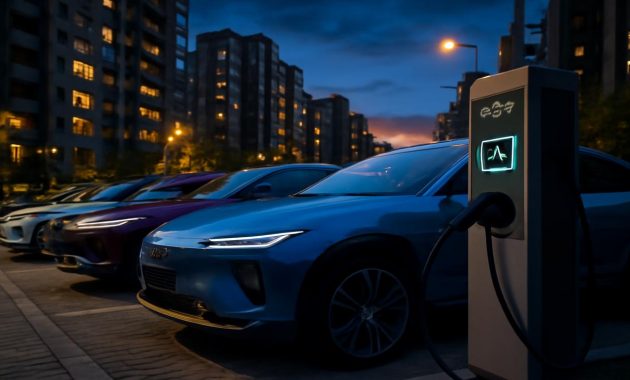
The rain starts in a thin, silvery mist over Shanghai, soaking into the neon and glass before anyone really notices. Down in an underground parking garage, it drums softly on the ramp as one car after another glides in—nearly all of them silent, nearly all of them electric. A driver named Liu edges his compact white EV into a space, the car whispering to a stop. Above him, in his apartment, his wife is boiling water, lights are on, the air purifier hums softly. What Liu doesn’t really think about—not yet—is that one day soon, the battery under his feet might be the reason his apartment never goes dark.
The Night the Cars Kept the Lights On
On a hot August evening in southern China, the air feels heavy enough to drink. The city is a lit-up maze of highways and high-rises, air conditioners and elevator shafts all pulling greedily on the grid. Somewhere inside a power control room, a wall of screens glows with graphs and maps that spike and dip like frantic heartbeats.
A storm is rolling in. Lightning forks across the sky and, a few minutes later, a transmission line somewhere in the hills trips offline. In most places, the next chapter is predictable: a region goes dark, traffic signals blink out, elevators stall, people peer out from high-rise balconies into a suddenly darker city.
But this time, the blackout doesn’t come.
On those glowing screens, another pattern flickers to life. Software pings thousands of parked cars—electric vehicles scattered across parking garages, curbside chargers, office lots. Not moving, not honking, just sitting there with batteries big enough to power entire households, and they’re all connected.
Within seconds, electricity doesn’t just flow into the cars. It flows out of them.
The building where you’re reading this scene, if it happens a few years from now in China, might keep its lights on because a bunch of commuters’ cars downstairs quietly stepped in as miniature power plants. It sounds like science fiction, and a decade ago it might have been. Today, it’s a roadmap. And nowhere is that roadmap being drawn more aggressively than in China.
China’s Quiet Electric Revolution
Walk through a Chinese city at dusk and you feel it before you see it. The air is less oily, less tangled with exhaust than it used to be. The traffic hums instead of growls. The familiar “vroom” of gasoline engines is slowly being replaced by a softer sound: tires slipping over asphalt, electric motors sighing into motion.
China’s streets are turning electric at a speed the rest of the world is still trying to fully comprehend. By 2024, more than half of all new cars sold in some major Chinese cities are electric or plug-in hybrids. In certain neighborhoods of Shenzhen, it’s harder to spot a gasoline taxi than an electric one. Delivery vans, buses, ride-hailing fleets—so much of what moves now runs on batteries.
This isn’t just about consumer preference or quirky car designs with giant touchscreens. It’s about scale, the kind that changes entire systems. When millions of cars on the road all carry large rechargeable batteries, a strange thing happens: the national vehicle fleet starts to look less like a group of machines and more like a mobile energy reservoir, spread out across the map like beads on a string.
In that reservoir, China’s planners see something transformative: backup power for entire neighborhoods, even entire cities, hiding in plain sight in office parking lots and apartment basements.
The Cars That Breathe Electricity
Most people think of an electric car as a one-way device: plug it in, charge it up, drive away. A cleaner version of the old gas station ritual. But engineers in China—and in a handful of other countries—are pushing the idea further, toward what they call V2G: vehicle-to-grid.
At its simplest, V2G means your car isn’t just a thing that eats electricity. It can feed it back, too.
Imagine this: it’s 7 p.m., dinner time. Kids are doing homework, the TV is on, rice cookers are steaming in thousands of apartments stacked one on top of another. It’s peak demand, and historically, this is the most expensive, dirtiest time for a grid to operate, when coal plants or gas turbines whir into overdrive.
But now, your EV sitting downstairs is fully charged. You’re not going anywhere until tomorrow morning. So the system asks: “Mind if I borrow a little?”
In a V2G world, your car quietly starts sending power back into the building or the neighborhood grid. Maybe it gives up 10% of its battery over an hour or two—power you’ll never miss, but which, when multiplied by thousands of cars, becomes a serious energy source. When electricity demand falls again later at night, or when the wind starts blowing strongly out on distant turbines, your car charges back up, ready to take you to work at 7 a.m. with no one the wiser.
Many of the latest Chinese EVs already come prepared for at least part of this future. There’s a phrase that shows up in their brochures: vehicle-to-load, or V2L. It means they can power things outside the car—an outdoor movie night, induction cookers on a camping trip, power tools at a rural work site. A few models already go further with vehicle-to-home (V2H) or experimental V2G, capable of sending power back through compatible chargers into a building’s circuits.
Sitting in a Guangzhou café one evening, you might see it in action in the most unceremonious way: a food truck parked at the curb, its grill and lights running off the battery of the EV parked right behind it. No generator noise, no diesel fumes. Just a quiet, rolling battery doing a job that used to require its own machine.
What China Wants from All These Batteries
Behind these small scenes is a much bigger story. China is adding more solar panels and wind turbines than any other country on Earth. Fields of blue photovoltaic glass run toward the horizon in the deserts of Gansu and Qinghai. Offshore, in the choppy waters of the East China Sea, enormous wind turbines turn, their blades longer than an Airbus wingspan. At noon on a clear spring day, some regions find themselves practically flooded with cheap, clean electricity.
But the sun sets. The wind falters. The grid still needs a steady, predictable flow of electrons. Without that, lights flicker, factories stall, subways and data centers stutter. To solve this, you can build giant stationary batteries, carve out hydrogen storage, pump water uphill into dams—or you can realize that your cities are already swimming in lithium-ion, parked under fluorescent garage lights.
China’s vision is simple in theory and wildly ambitious in practice: treat electric cars as part of the energy system, not separate from it. Let them soak up surplus solar at midday, then help smooth out demand in the evening. Use them like a flexible, movable sponge for renewable energy.
| Aspect | Traditional Grid | Grid with EV Integration |
|---|---|---|
| Main Power Source | Coal, gas, large dams | Renewables plus millions of EV batteries |
| Role of Cars | Energy consumers only | Both consumers and providers |
| Peak Demand Handling | Fire up extra fossil fuel plants | Draw from parked EVs and stationary storage |
| Reliability During Outages | Static; local blackouts common | EVs can power homes, critical services |
When you spread this over tens of millions of vehicles, the numbers start to bend the imagination. Even if only a fraction participate, the potential backup capacity rivals that of entire national power systems in smaller countries. It’s as if every apartment block in Shanghai, Chengdu, or Wuhan quietly gained its own small power station in the basement, on four wheels and with leather seats.
Living with a Car That Powers Your Home
In a new development on the edge of Nanjing, there’s a high-rise complex that feels, from the inside, like a mild science fiction movie set. Each parking space on the lower levels has a bidirectional charger—meaning it doesn’t just feed power into the car; it allows power to flow back out. Residents sign up for an energy plan that links their home meter with their car’s battery.
One evening, a resident named Chen steps out onto her small balcony, nursing a cup of jasmine tea. The city glows in the haze. She glances back at the smart display on her wall. It shows where her apartment’s electricity is coming from: a little from the rooftop solar above the building, a little from the grid, and—highlighted in a soft blue—a steady stream from her car downstairs.
She hadn’t driven much that day. Her battery is at 80%, more than enough for tomorrow’s commute. The system did the math long before she got home. It knows her habits: how often she drives, how far, what she’s comfortable with. The software has decided that from 7 to 9 p.m., her car can safely donate a slice of its stored energy back to the building. In return, Chen pays less for power overall. On some days, when a local industrial park needs help balancing sudden demand, the price signal spikes and she actually earns a bit—hardly a fortune, but enough to feel like the car is working for her even when it’s parked.
On a different week, when a typhoon threatens the region, the system flips its behavior. Storm warnings trigger a message on her phone: “We’re keeping your battery full for the next 48 hours in case of outages.” Her car becomes an emergency lifeline. If the grid goes down, her fridge, lights, Wi-Fi router, and a fan could keep running for hours, maybe days, sipping power from the car outside like it’s a very large, very quiet generator.
All of this requires an invisible dance of agreements and safeguards. The car’s battery is protected from overuse. Safety margins are enforced. The automaker has certified that frequent, shallow cycling won’t wreck the pack. Grid operators have guardrails to avoid pulling too much energy at once. To Chen, it shows up as comfort and an occasional discount on her bill. Behind her walls and under her feet, though, software is choreographing a ballet of electrons that spans the neighborhood.
The Hurdles on the Road Ahead
For all the elegant visions and glossy marketing videos, there is no magic here. Just a pile of very hard problems being worked out in real time.
There’s the hardware challenge: bidirectional chargers that are affordable, reliable, and safe. Most of today’s charging points only deliver one-way power; flipping that requires new designs, new standards, and sometimes new building wiring. Then there’s software—making sure thousands or millions of cars can respond to grid signals within seconds without tripping over one another.
There’s also the human factor. Drivers have to trust that their car won’t be an empty husk in the morning when they’re late for work. Automakers have to be sure that extra cycling won’t decay their batteries faster than expected, triggering warranty headaches. Utilities have to learn to treat cars as partners, not just loads.
China, with its characteristic top-down coordination and appetite for rapid experimentation, is leaning into these challenges. Pilot projects in cities like Shenzhen, Hangzhou, and Beijing are testing different models: apartment complexes where residents opt in as a group, company fleets that earn money by stabilizing the local grid, bus depots that double as emergency power hubs during outages.
Walk into one of these depots late at night and it’s strangely serene. Rows of electric buses stand under sodium lights, quietly drinking in energy from the grid. On certain days, when a neighboring industrial district suddenly needs help, some of those same buses reverse the flow, feeding power back while no passengers are on board. The depot becomes a breathing lung for the grid—inhale, exhale, charge, discharge.
From Curiosity to Cornerstone
Zoom out, and the story of China’s electric cars is rapidly becoming more than just a story about transportation. It’s a story about how societies choose to build their invisible foundations: the things that keep the lights on, the elevators working, the hospitals humming at 3 a.m.
In the 20th century, power systems were built like one-way rivers. Massive plants at one end, passive consumers at the other. Electricity flowed downhill, metaphorically, from faraway coal fields and dams into homes and factories that had no say in the matter. Your meter spun, and that was that.
Today, those rivers are turning into webs. Roofs make power. Factories curtail or ramp up in response to market signals. Batteries, big and small, soak up excess and release it later. And in China’s experiment, personal cars—the most personal of machines after our phones—are being invited into that web as active players.
You can almost feel the cultural shift. In the showroom of a new EV brand in Chengdu, the salesperson doesn’t just talk about acceleration, range, and screen size. They casually mention that the car can power an entire hotpot party outdoors, or keep your grandparents’ house running during a storm. The battery becomes not just a ticket to the highway, but a promise of resilience.
For now, the vision is still uneven. Rural areas are catching up more slowly. Older buildings need retrofits. Many drivers will never bother opting into grid-support schemes. But the direction is unmistakable. Each year brings more vehicles capable of giving back, more charging stations ready to talk both ways, more grid operators comfortable with the idea that somewhere out there, in a shopping mall parking lot, a hundred cars are quietly helping them keep everything stable.
On another rainy night in Shanghai, the underground garage where Liu parks his car hums with quiet potential. Overhead, fluorescent lights reflect on wet concrete; the sound of tires hissing fades into the distance. He taps his key card, the charger clicks. Data and current begin to flow. Somewhere on a distant server, another tiny mark appears: one more battery now plugged into the country’s pulsing electrical life.
He doesn’t need to think about the algorithms, the standards, the national plans. For him, the car is a way to get home, a way to save a little money on fuel. But in a not-so-distant tomorrow, when summer heat waves press against the grid and millions of air conditioners roar to life, his car—and hundreds of thousands like it—may quietly stand between comfort and blackout, between fragile and resilient.
China’s streets are filling with electric cars. The deeper truth is that its grid is filling with them too.
FAQ
Can an electric car really power a home?
Yes, if the car and charger are designed for bidirectional use. Many newer EVs in China already support powering appliances directly (V2L), and pilot projects are enabling them to feed electricity back into home circuits or the grid.
Does using my EV to power my home damage the battery?
When managed properly, the impact on battery life is small. Systems typically use conservative limits, avoid extreme charging levels, and rely on shallow charge–discharge cycles that batteries handle well. Automakers design their warranties with this in mind for vehicles marketed with V2G or V2H capability.
Will my car still have enough charge when I need to drive?
Smart V2G systems track your driving patterns and maintain a minimum reserve, often set by you. If you usually need 30% battery for your daily trips, the system might never discharge below, say, 50%, leaving a comfortable cushion.
Is this happening only in China?
No. Other regions, such as Europe, Japan, and parts of North America, are also testing or deploying vehicle-to-grid projects. However, China’s huge EV market and fast build-out of charging infrastructure give it a unique opportunity to scale the idea quickly.
What do drivers gain by letting their cars support the grid?
Drivers can benefit through lower electricity bills, direct payments or credits from utilities, improved local grid reliability, and backup power during outages. In many cases, these benefits come with little change to daily driving habits.