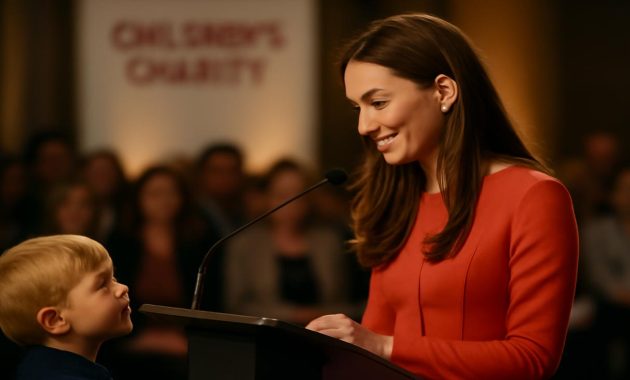
The room is quiet in that heavy way that comes just before a storm of feeling. Camera lights glow softly. A few people shuffle papers, clear throats, lean forward in their seats. And there she is—Catherine, Princess of Wales, standing at the podium in a simple outfit that somehow makes the moment feel more intimate than royal. Her voice, when it comes, is gentle but steady. Not the clipped, ceremonial tones of a palace speech, but the warm cadence of a mother, a listener, a woman who has seen something she cannot unsee and now refuses to look away.
She starts not with statistics, not with protocols, but with a story—her own quiet awakening to the invisible architecture of early life. The things we absorb before we can talk, the way the world feels before we know its name. And suddenly this isn’t just a royal engagement. It feels like a living room conversation that just happens to be watched by millions.
The Princess, the Podium, and the Quiet Power of Vulnerability
There’s a particular hush that follows someone who doesn’t often talk about themselves—and then chooses to. Catherine has long been admired for poise, for composure, for the kind of measured presence that is expected of a future queen. But in this speech, her posture holds something different: a softness, a deliberate willingness to be seen not just as a symbol, but as a person.
She talks about early childhood development not like a campaign, but like a discovery that rearranged the furniture in her mind. She recalls conversations with parents in playgrounds, nurses in underfunded clinics, teachers trying to hold entire futures together with little more than patience and photocopies. She remembers sitting on tiny plastic chairs in preschools where the carpet smells of crayons and spilled milk, staring at hand-drawn pictures pinned to walls, and thinking: This is where everything starts.
There is something disarming about the way she positions herself—not above, but alongside. She admits, without flourish, that she knew very little about the science of the early years when she first became a mother. That the learning curve felt steep, at times isolating. That for all the privileges of her life, motherhood still arrived with a freight of doubts: Am I doing this right? Is this moment going to echo in my child’s future?
In a world that expects its royals to be polished and impermeable, that small confession of not-knowing is louder than any fanfare. It is a bridge. And on the other side are millions of parents—exhausted, hopeful, worried—who recognize the feeling instantly.
The Science Beneath the Story
Some speeches about children sound like charity leaflets. This one does not. Catherine steps into the realm of neuroscience and psychology, but she carries the science like a lantern, not a textbook. She talks about how the brain in the first five years of life is building connections at a rate that borders on the miraculous—more than a million new neural links every single second. She pairs each fact with an image we can feel: a baby’s fingers curling around a parent’s thumb, a toddler wobbling through a first step, a preschooler’s earnest questions tumbling out over breakfast.
She explains that it’s not just food, shelter, and safety that shape a child—it’s the texture of daily emotional life. A warm voice. A face that lights up when the child enters the room. The way adults respond to cries and curiosity, frustration and wonder. Each response, she says, is like a brushstroke on the canvas of the developing brain. Over time, those strokes become patterns, and those patterns become tendencies: towards trust or suspicion, resilience or withdrawal, calm or constant alarm.
As she speaks, you can almost see it: synapses crackling like tiny constellations, making maps of the world based on the simplest interactions. A mother humming while folding laundry. A father kneeling down to look a child in the eye and really listen. A caregiver who notices the quiet child in the corner and gently invites them into the game.
But Catherine doesn’t romanticize it. She acknowledges the hard stuff—the nights when patience runs out, the days when work and worry leave parents frayed and snappish. The reality that so many families are holding on with fingertips: money short, support networks thin, mental health fragile. What she insists on, over and over, is that early support for families is not “nice to have.” It’s infrastructure. As critical as roads and hospitals, only more invisible.
When the First Years Echo Across a Lifetime
What makes her speech resonate far beyond royal circles is not just that she’s a public figure saying the right things—it’s that she’s stitching together a story most of us recognize in fragments. She draws a line from a baby’s earliest experiences to the kind of teenager they might become, the type of adult they might grow into, the way they might handle stress, conflict, and love.
She speaks softly but clearly about how unresolved early stress can show up as anxiety, depression, difficulty controlling impulses, or a struggle to trust others. Not as a sentence, but as a risk. And then she does something powerful: she expands the story from individual families to whole societies. Early childhood, she suggests, is not only a private matter—it’s a public one. The stability of communities, the strain on health systems, the cycle of crime, the persistence of inequality: all of it, in part, traces back to how we treat the earliest years.
Listening to her, you feel the ground of the conversation shift. This is no longer about “parenting advice.” It’s about the blueprint of tomorrow’s citizens. The tone is not alarmist; it’s quietly urgent. Not scolding parents, but questioning systems. Why are we more comfortable repairing damage later than nurturing potential from the start?
Royal Spotlight, Everyday Rooms
There’s an irony in a princess talking about ordinary living rooms, tiny kitchens, crowded nurseries—and yet that is exactly what makes this moment feel unusual. When Catherine describes a parent taking a deep breath before responding to a tantrum, or a grandparent reading the same dog-eared book for the fiftieth time, the image isn’t gilded. It’s plain, everyday life. The kind of life that, in most news cycles, is considered too quiet to matter.
But she insists it does matter. She talks about how small moments accumulate like pebbles in a jar, gradually weighing the scales either towards security and confidence or towards chronic stress. She honors the unseen work—the 3 a.m. feedings, the dash between childcare and night shifts, the emotional labor of trying to remain calm when finances or relationships or mental health are anything but.
In that light, her own role becomes stranger and more interesting. She is both removed from and entangled in the realities she describes. She will never stand in line at an overstretched city clinic. She will never choose between paying for childcare and paying the rent. And yet she is choosing, very deliberately, to plant her public identity in this field: early childhood, the fragile hinge between what could be and what will be.
It would be easy to be cynical, to hear any royal speech as performance. But there’s a small tremor in her voice, here and there, when she talks about what she’s seen. The parent who confessed they had no one to talk to. The child whose behavior was dismissed as “difficult” when it was really a plea for safety. The teacher who looked at her with tired eyes and said, “We are doing everything we can, but it’s not enough without support at home.”
Those details feel lived-in, not scripted. They smell of real hallways, real schoolyards, real tearful conversations. And that’s where something interesting happens: the royal spotlight stops being the story, and begins to simply illuminate what was already there—millions of families, quietly holding the future in their arms.
From Palace Walls to Shared Responsibility
One of the most striking threads woven into Catherine’s speech is the insistence that this is not a “women’s issue” or a “mother’s issue.” It is a human one. She calls for fathers, grandparents, coaches, employers, policymakers—everyone—to recognize themselves as part of a child’s early ecosystem.
She invites businesses to consider how family-friendly policies ripple out into society: flexible hours that let a parent attend a school meeting; paid leave that allows bonding instead of burnout; mental health support that recognizes that caring for children requires adults who are not collapsing inside. She nudges governments to look beyond short election cycles and invest in long-term early years strategies—programs that may not win quick headlines, but quietly reduce suffering for decades to come.
And then she turns, again, to the simple, humble acts that require no government budget: noticing a struggling parent instead of judging them; offering to listen instead of advise; building small pockets of community where isolation might have taken root.
In describing this web of shared responsibility, she’s not just making a political point. She’s sketching a kind of cultural shift—a revaluation of care itself. Early childhood development stops being a private test parents either pass or fail. It becomes a landscape we all help to tend.
A Personal Mission Wrapped in Public Duty
If you listen closely, beneath the policy implications and the science, there is a more intimate current running through Catherine’s words: the stubborn tenderness of a mother trying to carve out space for gentleness in a loud and hurried world. When she speaks of the first years “shaping the rest of our lives,” it doesn’t sound remote. It sounds like someone who has sat on a nursery floor, toys scattered around, realizing that these small, repetitive days are building something far larger than they appear.
She doesn’t go into detail about her own children—there’s a boundary there, carefully protected. But she lets just enough light through for us to glimpse her as a parent standing in the same bewildering, beautiful labyrinth as everyone else. The balancing act of public duty and private bedtime stories. The knowledge that her children’s lives are both uniquely scrutinized and profoundly ordinary in their emotional needs.
What feels new is how openly she connects her personal awakening to the shape of her public work. She is not championing early childhood because it is fashionable, or because it offers easy photo opportunities with adorable toddlers. She is doing it, she suggests, because once you understand how much is at stake in those first years, it becomes almost impossible not to.
In that sense, her speech is less a performance and more a kind of reckoning: with the limits of her influence, with the responsibility of her platform, and with a simple, unglamorous truth—if we want healthier, kinder, more resilient adults, we must start where life is still tender and easily bruised.
Why Her Words Land Far Beyond Royal Watchers
Not everyone follows royal news. Many actively avoid it. Yet this speech has a way of slipping past those familiar defenses. Part of that is timing—we live in an age of exposed fault lines: mental health crises, overstretched services, fractured communities. People are hungry for conversations that don’t just diagnose the problems in adulthood, but trace them back to their roots.
Part of it, too, is tone. Catherine doesn’t talk down, doesn’t scold, doesn’t preach idyllic images of perfect parenting. She speaks instead of trying, of learning, of paying attention. Of being willing to admit that we didn’t know something, and then letting that new knowledge change us.
More than anything, what lingers after the speech is a feeling of being gently summoned—to care, to notice, to ask better questions about what children and their caregivers need. Her title may be royal, but the work she is championing happens in utterly unroyal places: bus stops, social housing flats, rural clinics, overstretched nurseries, crowded parks.
In a world that too often treats children as future consumers, future workers, future everything, Catherine’s insistence is quietly radical: they are not just “the future.” They are people now. The way we welcome them into the world—emotionally, socially, structurally—is one of the purest reflections of who we are.
A Small Table of Big Truths
To understand why her message resonates so deeply, it helps to see how these themes line up—what begins in science, flows through personal experience, and lands in collective responsibility.
| Key Idea | What It Means for Children | What It Asks of Us |
|---|---|---|
| First years build the brain | Fastest period of brain growth; experiences form neural pathways that shape lifelong behavior and wellbeing. | Value early moments as foundational, not trivial; support nurturing care from the start. |
| Relationships are architecture | Consistent, loving relationships help children feel safe, curious, and able to learn. | Invest time and attention, not perfection; be emotionally present, not flawless. |
| Stress leaves traces | Chronic, unbuffered stress can shape how children see themselves and the world. | Reduce pressures on families; build support around parents instead of blame. |
| It’s everyone’s business | Children thrive in communities that value care—at home, in schools, workplaces, and public life. | See yourself as part of the early years ecosystem, whatever your role. |
Listening for the Quiet After the Applause
When the speech ends, there is applause, of course. Cameras flash. Headlines are drafted. Clips are shared and reshared, discussed, dissected. But the real meaning of what Catherine has said will live—or fade—in places that never make the news.
It will live in the moment a tired parent, remembering her words about small connections, chooses to put down their phone and listen to a child’s tangle of thoughts before bed. In the way a manager, hearing her call for shared responsibility, reconsiders how flexible their workplace can be for caregivers. In the quiet resolve of a policymaker who dares to champion early years programs even when the payoff won’t show up in the next election cycle.
It may live, too, in the relief of parents who have carried private shame about their struggles and suddenly realize: this isn’t just about me. This is a bigger story, one that includes history, systems, support—or the lack of it. Catherine’s speech does not erase those burdens. But it puts language around them, and shines a respectful light on the sheer effort it takes to raise a human being well.
In the end, the most powerful thing about her words might be their ordinariness. She is not offering a miracle solution, no glossy promise that love alone can fix everything. She is inviting us into the slow, humble work of paying attention to the very beginning of life—and to the adults who accompany it.
There is a line, unspoken but woven through every part of her message: If we truly believe children matter, our choices must start to look like it. Beyond royal circles, beyond fleeting headlines, that is the challenge she leaves hanging in the air. Not a royal decree, but a deeply human question: what kind of world are we building in the way we hold its youngest members?
FAQ
Why is Kate Middleton focusing so much on early childhood development?
Catherine, Princess of Wales, has spent years meeting families, educators, and experts. Through that work—and through her own experience as a mother—she’s become convinced that the first years of life shape mental health, relationships, and resilience in profound ways. Early childhood has become the central theme of her public role because she sees it as a root cause behind many social challenges.
Is her message only relevant to parents of young children?
No. While parents and caregivers are central, her message is that early childhood is everyone’s responsibility. Employers, policymakers, neighbors, extended family, and community organizations all help create the conditions in which young children and their caregivers either thrive or struggle.
What does she actually want people to do differently?
She’s calling for both personal and systemic change. On a personal level: more attentive, nurturing relationships with children and more support instead of judgment for parents. On a systemic level: policies and services that make it easier for families to access mental health support, quality childcare, stable housing, and time to bond with their children.
How does early childhood development affect adults later in life?
Research shows that early experiences influence how the brain handles stress, relationships, learning, and emotion. Secure, nurturing early environments are linked to better mental health, stronger social skills, and greater resilience. Chronic, unbuffered stress in early life can increase the risk of mental health difficulties and other challenges later on.
Is this just a public relations project for the royal family?
Public figures always operate in a space where image matters, but Catherine’s long-term, consistent focus on early childhood—backed by partnerships with researchers and practitioners—suggests something deeper than a passing initiative. Her work is helping bring serious, evidence-based conversations about the early years into mainstream public attention, which can benefit families far beyond royal audiences.