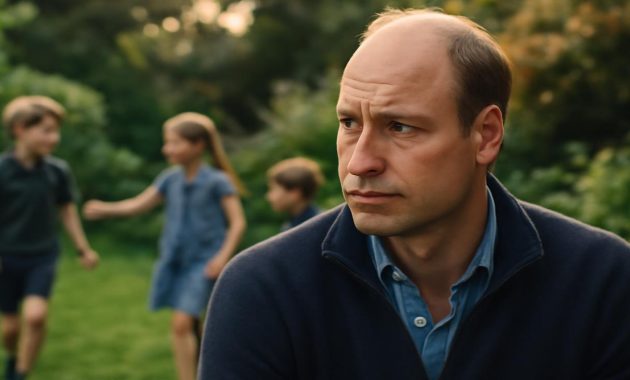
The winter air over Windsor carries a particular kind of quiet – not silence exactly, but a muffled hush that makes every footstep sound more deliberate. On an overcast afternoon, Prince William walks the gravel path behind the castle, hands buried deep in his coat pockets, head slightly bowed as if listening more to the crunch beneath his shoes than to the distant hum of royal life unfolding just beyond the walls. It has been an unforgiving season for the monarchy, a season of hospital corridors and headlines, of family strain and public expectation. But out here, among bare trees and restless crows, his thoughts stop performing and start sounding like something else: the inner voice of a son, a father, a man quietly wrestling with how to be all of those things while the world insists he must first be a prince.
The Weight of a Title, the Tug of a Home
There are moments, William admits, when the weight of his title feels almost physical — like a cloak laid across his shoulders that he never quite asked to wear. Yet he rarely talks about it in those terms; it wouldn’t feel right, not when duty and privilege are so tightly bound together. What he speaks about more openly these days is something more ordinary, and more complicated: how to get home in time for the bedtime stories when the diary is inked with ceremonies, hospital visits, and high-stakes conversations about the future of the Crown.
He has learned that the public face of duty is made up of clear, tidy moments — a carefully worded speech, a handshake, a photograph outside a charity centre. But the private cost comes later, on nights when the house is finally quiet and the questions arrive. Was he present enough at the hospital? Did he say the right things? Did he miss too much of the evening back at home? When you are both heir to the throne and father to young children, the ledger of your days never quite balances.
It is in this gap — between what is expected and what is possible — that the past months have unfolded. With the monarchy facing an especially challenging period, the demands have steadied into something relentless. The King’s health, the scrutiny over every decision, the shifting public mood: all of it has drawn Prince William more deeply into the role he has spent his life moving towards, but never so quickly as now.
Private Worries in Public Hallways
Inside the softly lit corridors of royal residences and hospitals, the air often smells faintly of antiseptic and lilies. This is where royal life most closely resembles ordinary life — the slow passing of time while waiting for updates, the clatter of tea cups in side rooms, the strange comfort of routine in the face of uncertainty. William’s footsteps through these spaces are no more important than anyone else’s; anxiety flattens hierarchy.
He has spoken, in carefully chosen yet unmistakably human ways, about those long days when a member of the family is unwell and the world is watching. The cameras see him step out of a car, straighten his tie, press his lips into that familiar, composed line. They do not see the way he scrolls through messages from home in the backseat, checking if homework has been finished, whether someone remembered to feed the dog, trying to be present in two places that feel emotionally miles apart.
There is a particular kind of tightening around his eyes when he describes the conflict of those days. You sign a visitor’s book with your full title, then send a quick text about picking up more cereal. You read a briefing on constitutional protocol, then remember you promised to help build a Lego fortress on Saturday. The proximity of the ordinary and the monumental can be dizzying.
And yet, he insists, it is his own family life that keeps him tethered — not away from duty, but within it. It reminds him of who he is beneath the uniform of expectation. It turns abstract words like “service” and “continuity” into something softer and more grounded: being someone your children can trust, someone they know will try, however imperfectly, to show up.
Small Rituals in a Large Life
What William rarely reveals in public, but hints at in gestures and anecdotes, is that much of his balancing act relies on small rituals. A school run squeezed between briefings. A quick breakfast together before he steps into a day of carefully stacked engagements. A rule — not always achievable, but earnestly tried — that phones are put away during family dinner, even when the outside world hums with breaking news.
He has learned that young children do not care what the day’s headline was. They want to know if you’ll sit on the floor and listen to them talk about the drama of the playground or the triumph of a newly learned word. In those moments, the gilded rooms and the seriousness of state matters melt into something wonderfully, stubbornly normal. It is there, perhaps, that his candid reflections feel truest: William is a man living in a palace and operating within an institution centuries old, yet still pacing the same nighttime circuits as countless parents — bedroom to bedroom, light switch to light switch, checking on sleeping children before finally exhaling.
Duty Redefined: From Ceremony to Care
The monarchy, he seems to suggest through his actions and his words, can no longer survive on ceremony alone. The age of purely symbolic royalty is thinning at the edges; people want something more human, more visible in the everyday. This is where William’s candidness about balancing duty and family becomes more than just a personal confession. It’s a quiet, gradual redefinition of what royal responsibility means.
His engagements in recent months have carried an extra layer of resonance. A visit to a cancer charity is no longer just an item on the official schedule; it’s threaded with personal experience and unmistakable empathy. When he sits with families in waiting rooms and listens to their stories, there is a shared understanding that illness does not respect status, and fear sounds the same in every accent.
He talks more now about mental health not as an abstract campaign topic, but as something that runs through his own life. The strain of uncertainty, the pressure of needing to be publicly composed while privately worried, the mental arithmetic of what to share and what to guard — these are themes that cross the boundary between palace and terraced house, castle and city flat. In acknowledging them, he shifts duty from a distant, ceremonial word into something that looks remarkably like care.
| Aspect | Duty | Family |
|---|---|---|
| Time | Scheduled months in advance, often non‑negotiable | Unpredictable, needs flexibility and presence |
| Emotional Load | Public composure, symbolic reassurance | Intimate care, honest vulnerability |
| Visibility | Under constant media scrutiny | Carefully protected, kept mostly private |
| Measure of Success | Public response, institutional stability | Trust, love, and everyday connection |
In the slim space between these columns is the life he’s trying to lead. There are days when the duty side wins almost every square. State occasions, major health updates, constitutional briefings — the diary leaves little room for Lego forts or muddy football in the garden. But there are other days when he quietly draws a line, scaling back appearances to be where he feels he must be most: at home, keeping the rhythm of ordinary family life beating in the background of extraordinary public change.
Inheriting Not Just a Crown, but a Story
Prince William does not talk about the future throne in grand, sweeping phrases. If anything, he approaches it with the steady caution of someone who knows that crowns are not just metal and jewels, but stories — ones that carry weight, expectation, and precedent. He has watched, from the vantage point of a son and a grandson, how those stories can exalt, distort, and at times wound the people who wear them.
The modern monarchy cannot be understood solely through portraits and processions; it unfolds just as much across kitchen tables and private family discussions. William grew up through intensely public grief and televised transition. Those memories are not just part of his personal past; they shape the undertone of his present decisions. He is careful now, sometimes even understated, about how much of his inner life he allows the world to see. But when he does speak candidly — about struggle, about balance, about worry — it feels sourced from that younger self who learned very early that privacy is precious and that empathy is not weakness, but ballast.
In many ways, what he is trying to inherit is not just a role but a more sustainable version of it: a monarchy that can bend without breaking, that can admit frailty without collapsing under the weight of its own myth. Family, in that sense, is not a competing force to duty but its testing ground. If he can hold both together in his own life, even imperfectly, perhaps the institution can learn to do the same.
When the Cameras Turn Away
The true test of balance always happens when no one is keeping score. On a rain-dark evening at Adelaide Cottage, the clatter of plates and the low hum of family chatter may sound almost ordinary from the outside. A dog barks in the garden. A light in an upstairs window flicks on, then off again. Somewhere beneath that roof, conversations unfold that no court circular will ever record: how was your day; did anything worry you at school; are you excited, nervous, tired?
In these everyday exchanges, William is not the Prince of Wales. He is just “Papa,” negotiating bedtime extensions and negotiating screen time, trying to make sense of a child’s tears after a bad dream or a scraped knee. It is here, perhaps more than at any state ceremony, that the future of the monarchy quietly evolves. Children who know their father is listening learn a different version of authority — one that makes space for emotion instead of simply overriding it.
He has hinted that this domestic sphere is where his resolve is both challenged and restored. Family life is not a refuge of perfection; it’s a place where he can be wrong, apologise, learn. There is a freedom in being allowed to be imperfect somewhere, in a life where the outside world expects poise and composure at every turn.
These off-duty moments also act as a counterweight when national responsibilities intensify. After a difficult public engagement, there is something grounding in stepping onto a Lego brick left on the stairs, or being pulled into a game mid-thought. The palace and the playground collide, and for a brief moment, the scale of the day shifts back to something more manageable, more human.
The Sound of a Changing Institution
Listen carefully, and you can hear the monarchy changing not in grand declarations but in smaller sounds: a prince talking openly about mental health; a future king acknowledging how hard it can be to leave home for a late engagement when children’s pyjamas have just appeared; apologies, adjustments, small acts of refusal when the diary demands more than a family can reasonably bear.
William’s candidness about this balancing act is not a performance of relatability; it’s a signal that the institution cannot afford to drift too far from the emotional realities of the people it serves. In a time when public trust is earned, not assumed, the sight of a royal figure openly navigating the same tensions as countless working parents — elderly parents’ health, young children’s needs, the pressure of demanding jobs — becomes quietly significant.
There will always be those who argue that royalty must remain distant to remain effective, that mystique is part of the bargain. But the last few years have shown that distance can fracture a family and mystique can turn brittle under the glare of a digital age. In his own measured, sometimes hesitant way, William seems to be walking a narrow path between tradition and transparency, revealing just enough to remind people that behind the titles are fallible, feeling humans, without stripping the role of all its symbolic power.
A Future Built from Ordinary Evenings
On nights when the sky over Windsor is clear, the castle’s silhouette cuts cleanly against the stars. The building has watched centuries of royal dramas come and go — wars, abdications, coronations, scandals, reinventions. In that long view, this current period will one day be just another chapter. But for the man walking those gravel paths, making his way from public duty back toward the quieter glow of home, it feels anything but abstract.
The monarchy he is stepping toward will not be sustained by ceremonies alone, nor by carefully cultivated distance. It will, in no small part, be shaped by the kind of father he manages to be while the world watches him become a king. His candid reflections on balance are not a side note to the story of his future reign; they are the early blueprint.
He knows, perhaps better than most, how swiftly life can tilt — how cameras can arrive before a family has even found words for its shock; how a wave from a balcony can never fully explain what the people behind it are living through. And so he measures his days now not just in engagements completed, but in conversations had at kitchen tables, in moments when he chose to stay home instead of adding one more appointment, in quiet drives to school or walks through the garden.
The air outside is still cold as he finally turns back toward the lights, the day’s responsibilities temporarily behind him, tomorrow’s already gathering. Somewhere inside, laughter carries down a corridor, thin but distinct. For all the centuries of ritual stretching out behind and ahead of him, the path that matters most in this moment is simply the one that leads him home.
Frequently Asked Questions
How has Prince William spoken about balancing duty and family?
He has increasingly acknowledged, in interviews and public remarks, that balancing his royal responsibilities with being a husband and father is challenging. He frames this balance as an ongoing effort rather than something he has perfected, emphasizing the need to be present at home while also stepping up during demanding moments for the monarchy.
Why is this period considered especially challenging for the monarchy?
This period has been marked by health concerns within the royal family, increased public scrutiny, and ongoing debates about the relevance and role of the monarchy in modern society. These pressures have required senior royals, including Prince William, to take on more visible and emotionally demanding roles.
Has Prince William reduced his royal duties to focus on family?
Rather than simply reducing duties, he has tried to prioritize and adjust them. At times, he has scaled back or rearranged engagements to be more present for his children and to support his family during times of illness or stress, while still fulfilling key public and constitutional responsibilities.
How does William’s approach differ from previous generations?
While previous generations often maintained a more formal distance between public duty and private life, William is more open about emotional strain and family demands. He places greater emphasis on mental health, open communication, and modeling a more relatable, hands-on style of parenting within the royal context.
What does this mean for the future of the monarchy?
William’s candid approach suggests a future monarchy that is more transparent, emotionally fluent, and visibly family-centered. If sustained, this could help bridge the gap between a centuries-old institution and a public that increasingly expects authenticity, accountability, and humanity from its leaders.