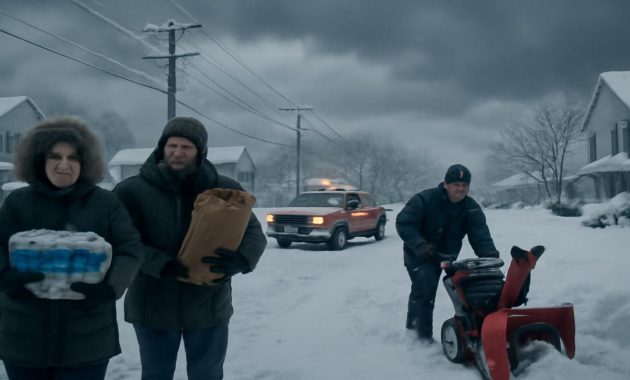
The first flakes arrive almost shyly, drifting past the streetlight as if testing the air. You notice them the way you notice a whisper in a crowded room—subtle, persistent, impossible to ignore once you’ve tuned in. By midnight, that whisper will become a full-throated roar. Somewhere far above the rooftops and bare trees, an atmosphere already wound tight is about to loosen its grip and pour itself toward the ground. The warning has been issued; the numbers feel almost unreal. Up to 60 inches of snow. Five feet. Almost as tall as a human being. And all of it could fall by the end of the weekend.
The Calm Before: Towns Bracing for a Whiteout
By Friday afternoon, the sky already looks different—flatter, heavier, a lid pressed down over the horizon. You can feel the town holding its breath. Parking lots are crowded not with weekend shoppers but with people moving quickly, carts piled with staples: bread, milk, canned soup, batteries, pet food. The grocery store’s sliding doors hiss open and shut in a rhythm that feels like the pulse of low-grade anxiety.
On the edge of the parking lot, a line forms at the gas station. Drivers stand beside their cars, collars turned up, watching the digital price readout tick upward, their thoughts elsewhere. Inside, coffee steams in paper cups. A small TV over the counter loops the same weather map: swirling colors coiling over the region, the presenter’s hand describing arcs of snow bands like a conductor signaling a stormy crescendo.
The forecast has a way of turning abstract numbers into something tangible, almost physical. “Winter storm warning in effect from Friday evening through Monday morning,” the announcer says, voice measured but edged with gravity. “Total snow accumulations of 24 to 60 inches possible in higher elevations. Winds gusting up to 45 miles per hour. Travel could become nearly impossible.”
Words like “impossible” and “life-threatening” grab hold of you, even if you try to remain calm. You find yourself checking flashlights, digging out candles, hunting for the snow shovel under the bikes and lawn chairs in the garage. Neighbors call across driveways, comparing notes—“You got your generator ready?” “We’re filling the bathtub tonight, just in case the pipes freeze.” There’s a quiet choreography to it all, as if everyone has slipped into a role they remember from other storms, other winters.
But this one feels bigger. The meteorologists keep repeating the same phrase: “historic potential.” You catch yourself glancing upward more often, as if the sky might provide some sort of reassurance. It doesn’t. It just waits, low and gray and gathering.
Inside the Storm: When Snow Becomes a Force
The first real band of snow arrives under cover of darkness. One moment, the street is wet and black; the next, a curtain of white sweeps in, suddenly thick, as if someone turned up the dial. The flakes, at first delicate, knit together in swarms. They tap softly against windows, land on porches, and begin to erase familiar edges—the curb, the top step, the curve of a parked car’s wheel well.
By midnight, the world has transformed into something both beautiful and faintly menacing. The streetlight glows in a shimmering cone, and inside that glow, the snow seems to fall in all directions at once, driven by sudden gusts. The wind finds every gap in the siding, every crack in the window frame, whistling and muttering its way into the house. The storm has a voice now, low and restless.
Somewhere out there on the interstate, taillights vanish into a blur as plows grind their way along, orange beacons bobbing like small resolved stars in the whiteout. Forecasters had warned that by late night, travel would become “extremely difficult to impossible,” words that now feel like an understatement. Ridges of snow build across the asphalt, drifting higher with each gust. Truckers look for the next exit, the next safe pull-off, listening to CB chatter turning grim—jackknifed rigs, disabled cars, exit ramps blocked by drifts.
At home, you stand by the window with the lights off, the better to see outside. The neighborhood has softened into rounded shapes, sound muted under the growing weight of snow. Yet even in that muffled quiet, you can hear the hulking scrape of the town plow as it lumbers past, throwing a wave of white higher than the hoods of parked cars.
The numbers from the weather service keep climbing. Three inches. Six. Ten. The radar colors brighten over your region, lavender and deep blue swirling tighter. In higher elevations, the snow is piling up even faster, stacking in feet instead of inches. The word “blizzard” becomes less a possibility and more a description of what’s already unfolding.
| Timeframe | Expected Snow | Wind Gusts | Travel Conditions |
|---|---|---|---|
| Friday Evening | 1–4 inches | 20–25 mph | Slippery, deteriorating |
| Overnight Friday | 6–12 inches additional | 25–35 mph | Very hazardous, limited visibility |
| Saturday | 12–24 inches additional | 30–45 mph | Potentially impossible travel, drifting snow |
| Sunday | 6–20 inches additional (higher in mountains) | 20–35 mph | Intermittent whiteouts, slow improvement |
When the Lights Go Out: The Quiet Peril of Power Loss
By dawn, the storm has settled in with the stubbornness of something that has no intention of hurrying. Trees bend under the accumulating weight, branches sagging like tired arms. The snow clings to every twig and telephone wire, thick and heavy, beautiful from a distance—and dangerous up close.
The first power flicker feels almost like a prank. The house blinks off, then on again, digital clocks winking back to life in a flash of red numbers. You tell yourself it was just a blip, that the grid will hold. But as the wind rises, a low cracking sound threads through the air, like knuckles popping. A branch, somewhere nearby, is making a decision it can’t unmake.
Then it happens: a sharp snap, a flash of light, a soft boom rolling across the snow-filled street. The lights vanish, this time for good. The furnace sighs into silence. The hum of the refrigerator, the low mechanical heartbeat of modern life, cuts out. In its place comes a dense quiet, broken only by the relentless hiss of snow against the windows.
For the first few minutes, there’s a strange novelty to it. You light a candle, then three more. The house takes on a different personality in the flickering glow—warmer, in a way, yet also more vulnerable. You can feel the cold beginning its slow advance. Every time someone opens the door, a shiver of air curls through the rooms.
Across the region, reports multiply: hundreds without power, then thousands, then tens of thousands. The snow’s sheer weight pulls lines down, topples poles. Linemen huddle in trucks, peering out through wind-battered windshields, plotting the safest way to restore a grid that creaks and groans under the onslaught.
Without power, the meaning of the storm changes. It’s no longer just an impressive display outside your window; it’s now in conversation with your daily life. Your frozen foods become a ticking clock. Your phone battery becomes a finite resource, a slender lifeline to weather updates, to local alerts, to the worried text messages of friends and family checking in.
The Human Weather: How Communities Breathe Through a Blizzard
In the middle of a storm that threatens to bury roads and darken neighborhoods, something else surfaces: the remarkable, often quiet ways people respond to one another. As the snow deepens past the knees and then toward the waist, neighbors who might normally trade only brief waves in passing become allies.
You see it first in small gestures. The older couple two houses down wakes to find their front steps already partially cleared, the unmistakable scraping pattern of a younger neighbor’s shovel giving them away. A teenager trudges through thigh-deep snow to check on the man who lives alone at the corner, bringing a thermos of hot chocolate and staying to help dig out his car—just in case he needs to leave quickly for any reason.
In town, emergency crews move with a careful urgency, their routes constantly reshaped by drifting snow and downed branches. Firefighters navigate streets narrowed to single lanes by towering plow berms. Volunteer coordinators open shelters at schools and community centers, where cots line gymnasiums beneath backboards and championship banners. Pets curl up at their owners’ feet, children race laps between rows of blankets, and generators rumble steadily in the background.
Social media fills with images that swing between awe and concern: snow piled halfway up front doors, cars transformed into soft white sculpture, yardsticks disappearing into drifts. Alongside them, messages circulate about warming centers, about which gas stations still have power, about a nurse who needs a ride to her night shift at the hospital and the stranger with a four-wheel drive truck who steps up to help.
For all its isolating potential, a storm like this paradoxically binds people together. The same clouds that erase distant hills and highways also sharpen your awareness of who is within walking distance, who might need checking on, who might be watching the same swirling white from their own window and wondering how everyone else is doing.
Under the Numbers: What “Up to 60 Inches” Really Means
There’s a moment, somewhere amid the storm’s peak, when the raw numbers stop being abstract. The tape measure sinks deeper with each reading. Snowbanks at the edge of driveways grow taller than a person. Steps vanish, shrubs disappear, fences become low undulations barely breaking through the unbroken surface.
Meteorologists talk about these snowfalls in precise language—liquid equivalent, snow ratios, orographic lift. They explain how moist air is forced upward by mountains, wringing out its moisture as it rises, stacking snow in layers that can reach four, even five feet deep when all is done. They point to historic storms for comparison: the ones that closed interstates for days, that left cars buried until only side mirrors betrayed their presence under the drift.
But what “up to 60 inches” means in lived experience is simpler, and more visceral. It means front doors that won’t open without first being shoveled clear from the inside. It means roofs needing to be raked to prevent dangerous weight from accumulating. It means driveways turning into tunnels and every trip outside becoming a slog through resistance that leaves your thighs burning and your breath hanging in sharp clouds in the air.
It also means that rescue efforts grow more complicated. Ambulances need escort plows. Fire trucks must navigate streets narrowed to paths just barely wider than their own frames. In the mountains, avalanche danger quietly ticks upward on steep slopes, as snow layers stack in unstable sheets waiting for the smallest trigger.
Still, in all that intensity, there is also an austere beauty. When the wind drops for a moment, you can step outside and hear the strange, pure silence of a world thoroughly muffled. The snow captures and softens every sound, turning even distant noises—an engine, a shout, a door—into something close and intimate.
After the White Curtain Lifts
Eventually, every storm spends itself. Not in a single cinematic moment, but in a long, uneven unraveling. The flakes grow smaller, then intermittent. The radar that once blazed with color fades to pale blues, then to gray, then to empty space. The winter storm warning expires, replaced by summaries: “Storm total accumulations” and “preliminary reports.”
The work of digging out begins almost immediately. Snowblowers roar to life up and down the street, their engines coughing at the cold before settling into a steady growl. Shovels scrape, pause, scrape again. Breath hangs in the air like speech bubbles in a silent comic strip. The air smells sharp and faintly metallic, the way it does when cold has been holding its breath for days and finally exhales.
Road crews are out in force, pushing the last of the night’s accumulation into towering berms that lean over sidewalks and parking lots like temporary cliffs. Skies clear to an improbable, almost glassy blue. The sun, low and fierce, glares off every surface, so bright you have to squint even behind sunglasses. The landscape has been re-drawn, contours exaggerated, familiar landmarks half-erased.
In the days that follow, stories of the storm begin to circulate and settle. People share how long they lost power, how deep the snow was in their backyard, how far they had to dig to find their mailbox. Photos of yardsticks swallowed whole by drifts become a kind of verification, proof that what everyone just lived through really did happen as intensely as it seemed.
For some, the experience has been merely inconvenient: a few days of working from home, of postponed plans, of aching muscles from more shoveling than they’d done in years. For others, the storm has arrived as a genuine crisis—livelihoods disrupted, medical appointments missed, damage done to homes or property. The same snow that delights children and photographers can be a burden you feel in your back, in your bank account, in the quiet calculations about how long recovery will take.
Yet even as plows widen the roads and roofs shed their loads in sudden cascades of snow, the long tail of the storm lingers. In the mountains, that snowpack becomes part of the season’s water story, feeding rivers and reservoirs months from now. In towns and cities, people remember who helped them dig out, who shared a generator, who brought over a thermos when the power was out and the house had grown cold.
Preparing for the Next Big One
Storms like this rarely arrive without warning. The days leading up to them are filled with maps and models, predictions refined with each new satellite pass and balloon launch. We are, in many ways, more informed than ever about what the sky intends to do. Yet foreknowledge only goes so far without preparation that matches the scale of the event.
To live in a place where winter can deliver five feet of snow in a weekend is to accept a certain kind of responsibility: to plan not just for yourself but for the web of people and systems you’re connected to. It’s having a basic emergency kit ready before the shelves empty out, keeping your car’s gas tank at least half full when storms threaten, knowing who on your street might need extra help if the power fails or roads close.
At the same time, there’s a humbling lesson in every major winter storm. For all the forecasts and advisories, for all the orange-vested crews and fleets of plows, there are moments when the simplest, safest action is simply to stop. To stay home. To watch through the glass as nature writes its own temporary rules in white across your familiar world.
In that pause, you can feel something larger at work—the vast, indifferent machinery of atmosphere and ocean trading energy, redistributing heat, sculpting the land in slow, seasonal increments. The same processes that bring summer’s thunderstorms and autumn’s clear, crisp days also summon these winter engines that can, for a weekend, eclipse our best-laid plans.
When forecasters talk about “up to 60 inches of snow,” they’re not just predicting inconvenience. They’re describing an encounter with that larger system, a reminder that for all our technology and timing and travel apps, we still live under a sky that can, on occasion, decide that motion will cease, that roads will close, that lights will go dark for a while.
And yet, in the glow of candles and the scrape of shovels, in the rush of plows and the murmur of neighbors checking in on one another, another truth emerges: we are not powerless. We are not alone. We are, snowstorm by snowstorm, learning how to bend with the weather without breaking, how to hunker down without losing touch, how to respect the forecast not as prophecy, but as an invitation to prepare—and then, together, to endure.
Frequently Asked Questions
How dangerous is a storm with up to 60 inches of snow?
A storm producing up to 60 inches of snow can be extremely dangerous. It can lead to impossible travel conditions, widespread power outages, structural stress on roofs, and limited access to emergency services. The combination of deep snow and strong winds can create whiteout conditions that make it unsafe to drive or even walk long distances.
Should I avoid driving during a major winter storm warning?
Yes, if a winter storm warning predicts heavy snow and blowing wind, it’s best to avoid driving unless absolutely necessary. Roads can become slick, visibility can drop to near zero, and emergency crews may struggle to reach stranded vehicles. If travel is unavoidable, keep an emergency kit in your car and tell someone your route and expected arrival time.
How can I prepare my home for potential power outages?
Preparation includes stocking non-perishable food and water, having flashlights with extra batteries, keeping blankets and warm clothing easily accessible, and charging phones and backup power banks before the storm. If you use a generator, operate it outdoors and away from windows to prevent carbon monoxide poisoning.
What should I do if the snow on my roof gets very deep?
Heavy, wet snow can put significant strain on roofs. If it is safe to do so, use a roof rake from the ground to remove some of the accumulation, especially on flat or low-slope sections. Avoid climbing onto the roof during or right after the storm, and seek professional help if you notice sagging, cracks, or unusual noises from overhead.
Why do some areas get more snow than others during the same storm?
Snow totals vary due to elevation, local terrain, and how the storm’s bands of precipitation align. Higher elevations often see more snow because rising air cools and condenses moisture more efficiently. Narrow snow bands can stall over one area, dumping feet of snow there while nearby towns receive far less.
Is it normal to lose power for several days in a big winter storm?
It can be, especially when heavy snow and strong winds bring down trees and power lines across a wide region. Utilities prioritize restoring power to critical infrastructure first, then to densely populated areas. In particularly severe storms, full restoration can take several days.
What’s the most important thing to remember during a severe winter storm?
The most important thing is to prioritize safety over routine. Stay informed through reliable weather updates, avoid unnecessary travel, check on vulnerable neighbors, and conserve warmth and resources if power goes out. Accepting temporary disruption is often the safest choice when nature decides to rewrite the weekend’s plans in snow.