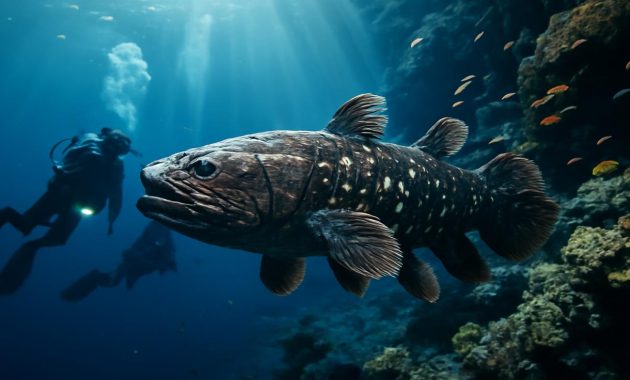
The first thing you notice are the eyes—two pale lanterns suspended in the dark, motionless, unblinking. For a heartbeat, the French diver thinks he’s looking at a fossilized skull wedged into a cliff wall. Then the creature moves, just barely, and the ocean’s past shivers into the present.
A Night the Ocean Remembered Its Past
The water off North Sulawesi, Indonesia, was ink-black and heavy against the dive lights. It was just after midnight, the hour when the reef’s day shift has gone to ground and the night creatures rise from their hiding places. French diver and underwater photographer Luc Moreau floated in the darkness, his bubbles rising in soft, silver ropes.
He had come here to chase rumors.
For years, fishermen had spoken in low voices about a strange “king fish” that sometimes surfaced, dying, in their nets. Long-bodied, with ghostly blue scales and stiff, winglike fins, it did not look like anything they could sell at the market. Most believed it brought bad luck. They threw it back to the sea.
Marine biologists had another word for it: coelacanth.
A “living fossil.” A species that had vanished from the fossil record 66 million years ago, along with the dinosaurs, only to turn up unexpectedly in a South African fish market in 1938. Since then, this deep-sea relic had been confirmed in only a few places on Earth. But here, in Indonesian waters, it was more myth than fact, a rumor that drifted like plankton in scientific circles.
Few had seen one alive. No one had ever photographed one here.
Moreau checked his depth gauge: 108 meters and holding. The reef wall loomed like a shadowy cathedral, its buttresses dropping into endless blue-black. His dive team’s lamps swept in careful arcs, picking out coral overhangs and sponge-choked ledges, searching for eyeshine—a glimmer of light that might betray something watching from the dark.
Then, beyond the edge of his beam, two pale orbs floated into view.
A Creature That Refused to Stay Extinct
The animal emerged from the gloom with such unhurried majesty that time seemed to slow around it. Its body was thick and muscular, armored in large, enamel-like scales the color of bruised cobalt. Each scale caught and scattered the divers’ lights in broken shards of blue and silver.
For a moment, nobody moved. Their breathing roared in their ears, loud and clumsy, like the sound of some other species intruding on the wrong century.
Coelacanth, Moreau’s mind supplied, but the word felt too small for what was in front of him. The fish hovered vertically against the wall, head tipped slightly down, as if leaning in to listen to the heartbeat of the Earth. Its paired fins—fleshy, lobe-like, each supported by bone structures eerily similar to the bones in a human arm—stirred the water in slow, deliberate sweeps.
This was not the sleek, quicksilver outline of a modern predator. This was architecture from another era: heavy, deliberate, built to endure crushing depths and geological ages.
Later, when scientists studied the footage, they would compare the Indonesian fish to its African relatives. The colors seemed a touch different, the patterns of spots unique, the head shape subtly distinct. But in that moment, 100 meters down in the cold dark, none of that mattered. What mattered was the feeling—sharp, electric, unmistakable—that the boundaries of time had just blurred.
The coelacanth turned one slow, assessing eye toward the nearest diver. Its jaw flexed once, showing a row of small, backward-curved teeth. Then, with an almost lazy shrug of its fins, it drifted sideways, disappearing into a crevice that looked much too narrow to hold it.
The divers exhaled as one. Cameras came up. Fingers trembled slightly on the shutter releases. The chase had begun.
The Dive That Almost Didn’t Happen
This encounter in Indonesian waters was a moment decades in the making—and one that, in all likelihood, should not have happened at all.
Deep dives to 100 meters and beyond are not gentle adventures. At those depths, each breath carries a calculated risk. Gases behave differently. Human judgment blurs at the edges. Time has to be managed with the ruthlessness of a space mission. Every minute spent with the coelacanth was a minute stolen from their decompression schedule, a debt they would have to repay on the way up.
The French team had almost canceled the expedition. Funding was thin; equipment failures had plagued the first attempts. Local fishermen were skeptical, shrugging off questions with a mixture of politeness and superstition. “Maybe long time ago,” one had told them. “My grandfather saw a fish like that. Deep. Not for people.”
But science is often a partnership between stubbornness and luck. A few blurry photos of dead Indonesian coelacanths had surfaced in the late 1990s and early 2000s, pulled from nets set far deeper than normal. That was enough to keep hope alive in a small circle of biologists and explorers.
Now, here it was. Alive. Breathing. Moving with the slow assurance of a creature that had survived multiple mass extinctions while entire civilizations had risen and fallen on land.
Moreau later described those minutes as “standing in a church built before language.” Everything felt both sacred and impossibly fragile. The divers knew they couldn’t chase the fish aggressively; a panicked coelacanth could wreck itself against the rocks or vanish into depths their equipment couldn’t follow.
Instead, they tried to make themselves small in the water, drifting parallel to the wall, allowing the animal to set the terms of the meeting.
The First Portraits of an Emblem in a New Sea
In those calm, suspended minutes, the cameras did their quiet work. Light strobed in the dark, brief white suns capturing millisecond fragments of history: the texture of the scales, the ghostly translucence of the fins, the way the tail moved not like a modern fish’s but like something that once walked.
Back at the surface, on a rocking boat under a paling sky, the divers crowded around the camera screens with the giddy disbelief of people who have just photographed a ghost and found, to their surprise, that it shows up perfectly in the frame.
This was more than proof. This was personality.
You could see the slight twist to the coelacanth’s jaw, the irregular constellation of pale spots scattered across its flank like the suggestion of a galaxy. You could see, in the way it angled its body to the reef, that it knew exactly where it belonged.
| Feature | Coelacanth | Most Modern Fish |
|---|---|---|
| Age of lineage | Over 400 million years | Usually under 100 million years |
| Fins | Lobed, with limb-like bones | Ray-finned, supported by spines |
| Preferred depth | 100–300 m, deep sea caves | Shallow to mid-water, varied |
| Reproduction | Live-bearing, very few young | Mostly egg-laying, more offspring |
| Conservation status | Threatened, extremely rare | Ranges from common to threatened |
The images that French divers brought home from Indonesia are now among the clearest evidence we have that this emblematic species is holding on in pockets of deep water far from its better-known African range. They show not a bizarre monster, but a patient, methodical animal going about its quiet, nightly business in the cold, dark layers beneath the reef.
An Oceanic Time Traveler
To understand why this encounter matters, you have to imagine the world in which the coelacanth’s ancestors first appeared.
The continents were unrecognizable. Forests as we know them did not yet exist. The first trees were just beginning to rise, their roots digging into raw, new soil. In the seas, strange armored fishes cruised above primitive corals. Somewhere in that alien ocean, coelacanths learned to hover in place with delicate movements of their fleshy fins, to feel their way along volcanic slopes and rocky caverns, to live slow and long in the cold dark.
Then, over unthinkable spans of time, almost everything changed—and they did not.
They refined their design, certainly. The scales hardened. The sensory systems sharpened. But the overall blueprint remained astonishingly stable. When paleontologists split open slabs of 400-million-year-old rock and reveal the fossil of an ancient coelacanth, the outline is unmistakable. Place that fossil alongside the French divers’ photographs from Indonesia, and the resemblance is close enough to feel uncanny.
We call them “living fossils” for that reason, but the term can be misleading. It suggests something static, frozen, as if these fish have just been waiting politely in an evolutionary waiting room for us to notice. In truth, coelacanths have been evolving all along—just with a kind of minimalism that puts our frenetic mammalian sprawl to shame.
They have survived asteroid impacts, ice ages, the rise and fall of entire oceanic ecosystems. Their strategy, if you can call it that, seems to be: find a niche that changes very slowly, and change even more slowly yourself.
Deep, cold caves along steep volcanic coasts. Temperatures that barely budge. Light that doesn’t reach. It’s here, in these twilight and midnight realms, that the coelacanth has threaded its way through the needle’s eye of extinction, again and again.
Meeting a Neighbor From Another Era
Part of why the French divers’ images feel so powerful is that they collapse this immense span of deep time into something intimate and almost domestic. There is a frame where the coelacanth’s head fills most of the shot, its broad lips slightly parted, the faint marbling of its skin visible in the strobe-lit detail.
It looks—dare we say it—curious.
Maybe that’s projection. But there is a sense, studying that face, of encountering not just a relic but a neighbor from a much older neighborhood of life on Earth. A creature that never signed up for our narratives of progress and advancement, but simply endured in its own quiet lane while the world above went about inventing agriculture, empires, and smartphones.
In the glow of the dive lights, suspended in black water, the coelacanth is not ancient history. It is fiercely, insistently present.
The Human Thread in a 400-Million-Year Story
The story the French team brought back from Indonesia is as much about people as it is about fish.
On shore, local communities had lived for generations with fragments of this story—half-remembered tales of strange, inedible fish hauled up from accidental depths, stories stitched into nighttime conversations and passed down with more mystery than detail. They had seen the same pale eyes, the same heavily scaled bodies, but in the harsh air of deck and dock, already dying.
Scientists, working with the language of data and peer review, had their own scattered pieces: a preserved specimen here, a blurred photograph there, DNA sequences hinting at separate lineages between African and Indonesian populations.
What the divers did was weave those pieces together underwater, in real time.
On the evening after the dive, as the boat rocked gently in the harbor light and the salt dried on their skin, the team visited the village whose fishermen had unwittingly become custodians of this deep-time secret. They passed around camera screens, pointing to the glowing images. Laughter and exclamations of recognition broke out.
“Yes!” an elder said, tapping the coelacanth’s image with a calloused finger. “That one. We told you.”
Now, for perhaps the first time, the fish could be seen not as a bad omen or useless catch, but as something rare and globally important. A living connection between these coastal communities and the oldest chapters of the ocean’s story.
Why One Set of Photographs Matters So Much
It’s easy, from the distance of a screen, to see these images as just another set of beautiful underwater photographs in a world suddenly full of them. But their quiet significance runs deeper.
For conservationists, the French divers’ encounter confirms that coelacanths are not only present in Indonesian waters but seemingly established, behaving in ways consistent with a resident population rather than lost strays. That matters when decisions are made about deep-sea mining, fishing limits, and protected areas.
For evolutionary biologists, each new observation of a living coelacanth—how it moves, where it rests, what depths it favors—adds a brushstroke to our picture of what early lobe-finned fishes might have been like. These are the creatures whose ancient cousins eventually took their first cautious steps onto land, setting in motion the chain of events that would lead, much later, to you sitting here reading about them.
And for the rest of us, these images offer something harder to measure but no less important: a recalibration of wonder.
In an age when satellites map the Earth’s surface down to the width of a sidewalk, when we can scroll through coral reefs and rainforests on our phones, it’s tempting to think we’ve finished the first draft of the planet’s story. The coelacanth appears in the frame and gently, implacably, corrects us.
The world is not done surprising us. There are still neighbors we haven’t properly met.
Guarding the Deep and the Old
In the years since the French team’s dive, the coelacanth’s Indonesian chapter has grown a little thicker, but only a little. That’s how it should be. This is not a species that benefits from the spotlight.
Coelacanths reproduce painfully slowly. Females carry their young inside them for years, giving birth to only a handful of fully formed juveniles. Their populations cannot withstand heavy fishing or habitat disturbance. A single unlucky trawl can wipe out a decade’s worth of reproductive effort.
The best thing we can do for them is, in some ways, the hardest: leave them alone. Protect the steep, deep walls and caves where they rest by day. Place sensible limits on deep net fishing that accidentally snags what it never meant to catch. Treat the dark, cold layers of the sea not as a frontier to be strip-mined, but as a library of irreplaceable stories still being written.
The French divers did not tag or handle the coelacanth they filmed in Indonesia. They didn’t need to. The images themselves were enough—proof of presence, a small window into behavior, a gentle nudge to the global imagination.
Some discoveries demand that we take more: samples, biopsies, GPS coordinates. This one seems to ask us to take something else instead—a shift in perspective, a little more humility before the age and complexity of the living systems we’re only beginning to understand.
On their last night in Indonesia, the team went back over their dive logs. Depths, times, gas mixtures, decompression stops. All the clinical notes necessary to make sense of a risky underwater operation. Between those careful lines, though, something less tangible threaded through: a sense of having been, briefly, in the presence of deep continuity.
Humans measure history in centuries. The coelacanth measures it in continents rearranged, in oceans opening and closing.
And yet, for a few minutes in the dark water off a small Indonesian village, those timelines overlapped. A group of air-breathing mammals in neoprene hovered face to face with a fish whose kin had watched the first forests rise. Lights flared. Cameras clicked. The ocean remembered aloud.
Far below, in the enduring quiet, the coelacanth turned back toward its stone-walled home and vanished from view, carrying 400 million years of memory into the dark.
Frequently Asked Questions
What exactly is a “living fossil”?
A “living fossil” is a modern species that closely resembles its ancient ancestors in the fossil record and appears to have changed relatively little over extremely long periods of evolutionary time. Coelacanths are a classic example, with fossils dating back over 400 million years that look strikingly similar to the fish alive today.
Why is the coelacanth so important to science?
Coelacanths are part of the lobe-finned fishes, the group that gave rise to the first vertebrates to walk on land. Studying them helps scientists understand the anatomy, movement, and lifestyle of early relatives that eventually led to amphibians, reptiles, birds, and mammals, including humans. They also offer insights into how species can persist relatively unchanged in stable, deep-sea environments.
How rare is it to see a coelacanth alive in the wild?
Extremely rare. Coelacanths live at depths of around 100–300 meters, often in underwater caves along steep volcanic slopes. These locations are challenging and dangerous to reach for divers, and the fish are few in number. Most known specimens were found dead or dying in deep fishing nets, which makes the French divers’ clear images of a healthy, free-swimming coelacanth in Indonesia especially remarkable.
Are Indonesian coelacanths different from African ones?
Yes. Genetic studies and morphological comparisons show that the Indonesian coelacanth population belongs to a distinct species from the better-known African coelacanths. They share a deep common ancestry but have been separated long enough to follow their own evolutionary paths, resulting in differences in coloration, patterning, and some anatomical details.
What threatens coelacanths today?
The main threats are accidental capture in deep-sea fishing nets, habitat disturbance along steep coastal walls and caves, and potential impacts from deep-sea mining or poorly regulated development. Their very slow reproduction makes them especially vulnerable; even low levels of additional mortality can be devastating over time.
How can people help protect species like the coelacanth?
Support for strong marine protected areas, especially in regions with deep reefs and underwater caves, is crucial. Responsible seafood choices that avoid deep-trawled species can indirectly reduce bycatch. And on a broader scale, backing scientific research and conservation policies that prioritize the long-term health of ocean ecosystems helps safeguard the hidden, ancient lineages that live out of sight but are vital to our planet’s story.