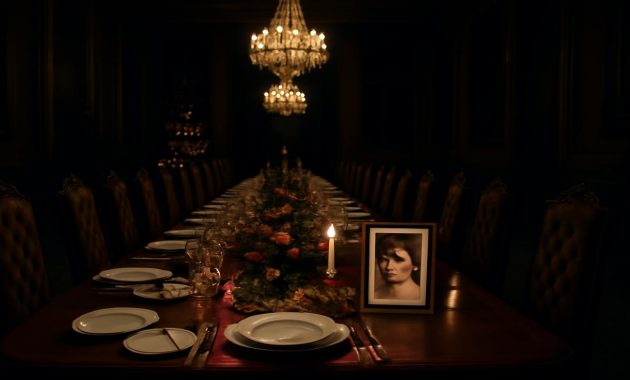
The snow outside the palace windows fell in soft, obedient sheets that December, the kind that hushes a city and makes the world feel briefly gentler. Inside, however, the air was brittle. Silver clinked a little too sharply against porcelain, footsteps echoed just a bit too loudly on polished floors, and conversation, where it existed at all, skimmed the surface like a stone thrown across a frozen pond. Somewhere in the middle of this carefully choreographed winter tableau walked a woman who was technically still a princess, but increasingly treated like a stranger at her own family’s table.
A Christmas at Sandringham That Felt Colder Than Winter
To the outside world, Christmas at Sandringham has always sounded like a royal dream: crackling fireplaces, polished banisters draped in greenery, church bells ringing across the Norfolk estate. But to the man in the royal kitchens watching everything from behind swinging doors, the 1996 holiday season told a very different story about Princess Diana’s final Christmas with the royal family.
Former royal chef Darren McGrady has spoken of that Christmas with a kind of stunned sadness, as if even now, years later, he still can’t quite reconcile the fairytale image with what he actually witnessed. Diana, the most photographed woman in the world, the princess whose laughter could light up a balcony, spent that holiday surrounded by people yet almost entirely alone. Not physically—there were courtiers and footmen and guests and family everywhere—but emotionally, she may as well have been wandering a vast, empty estate by herself.
The divorce from Prince Charles had been finalized only a few months earlier. The ink on the papers was dry, but the wounds were still raw—on all sides. Within palace corridors, the separation that had once been whispered about behind gloved hands was now official. Titles had shifted. Roles had changed. And with that, something else had changed too, something harder to name: a chill in how people looked at her, spoke to her, or chose not to speak to her at all.
McGrady remembers the atmosphere as “frosty,” not just in the way headlines later translated it—rejet glaçant, an icy rejection—but in the subtler details. A conversation that stopped when she entered the room. A pause at the doorway before someone remembered to include her. A chair slightly apart at a table that once had felt like a place of belonging. The chef saw what most of the world never would: a princess moving carefully through a house that once felt like home, now walking on emotional black ice.
The View from the Kitchen: One Princess, One Plate, and a Quiet Room
Downstairs, amid the steam from roasting meats and the sharp sweetness of brandy-soaked pudding, the kitchen had its own rituals. The chefs knew each royal’s preferences: who liked extra gravy, who avoided garlic, who preferred a lighter dessert. For years, cooking for Diana had meant paying attention to a woman who was often trying quietly to reclaim control over her own body after a long struggle with bulimia. She wasn’t just “the princess” to them; she was a person they had watched grow more fragile, then stronger, then more determined to stand alone.
McGrady recalls that Christmas as the moment when the gulf between Diana and the family upstairs became impossible to ignore. While laughter floated faintly down from the grand dining room, the chef carried trays to a much smaller, quieter space. One plate, one setting, one woman. The palace was full; her room was not.
Imagine it: the clatter from distant rooms, muffled through old stone walls. The scent of roast turkey drifting down the hall like a reminder of tradition she was no longer fully part of. Diana, who had once been the center of attention at royal gatherings—talked about, scrutinized, adored, resented—now sat in a smaller room, the door half-closed on the spectacle unfolding without her.
She had been given a choice, on paper at least. She was still invited. She could still appear at the right times, in the right outfits, at the right doors of the church. The formalities were intact. But hospitality is not made of invitations alone; it is made of warmth. And that, McGrady suggests, was in short supply. What remained was a kind of ceremonial inclusion—a place in the program, but no place in the mood.
The chef did what he could. Her favorite dishes. Lighter options when she wanted them. Something comforting, something familiar. But food, no matter how thoughtfully prepared, can only do so much when what’s missing is not a meal, but connection. The solitude in that small room was not the chosen solitude of someone reclaiming peace; it was the silence of someone being quietly edged out.
A Frosty Reception Behind Polished Doors
The phrase “frosty reception” suggests raised eyebrows, cool nods, conversations clipped short. But within royal walls, frost can be more refined, more precise. It might look like perfect politeness, flawless protocol, and a kind of well-bred distance so smooth that, to a casual observer, nothing would seem amiss.
To Diana, it must have felt like being gradually erased from a painting in which she had once been the central figure.
There had always been tensions, of course. Her charisma had long unsettled the quiet, tightly controlled gravity of the institution. Her habit of ignoring emotional arm’s-length rules—holding the hand of a patient with AIDS, kneeling to speak to a child, crying in public when the strain became too much—had made her both beloved and complicated. But after the separation and divorce, those tensions hardened.
That Christmas, as McGrady and the kitchen staff worked through the familiar seasonal choreography—preparing the traditional goose or turkey, the trimmings, the puddings lit with blue flames—he sensed how little tradition could do for a heart that felt unwelcome. Protocol continued as though nothing had changed. The queen’s schedule. The afternoon walk. The gifts exchanged on Christmas Eve. The church service at St. Mary Magdalene. Yet everything had changed, especially for Diana.
Perhaps she stepped into rooms and felt the air thicken. Maybe she caught the way a sentence died when she crossed a threshold. Maybe she laughed once, genuinely, and the sound hung a little too brightly in a space that no longer reflected it back.
In later years, as these stories emerged, people tried to make sense of the contradiction: how a woman so globally adored could feel so isolated in the one place that should have understood her best. But within a family that often processes pain through protocol, distance can feel safer than confrontation. The result, though, was the same—for Diana, the loneliest place in the world wasn’t a far-off hotel or anonymous city crowd. It was home, or what used to be home.
The Quiet Geography of Exile
Exile doesn’t always come with a boarding pass or a packed suitcase. Sometimes it looks like sitting at the same table, but no longer being truly heard. It looks like standing in the same family photo, but feeling like an afterthought. For Diana, that last Christmas at Sandringham seemed to map a new geography of her life: they were here, she was there, and the distance between those two points was measured not in miles but in glances.
Staff members noticed. Chefs do more than chop and stir; they observe, listening to the upstairs world through overheard remarks and the temperature of the atmosphere when trays are collected. McGrady could see the subtle reconfigurations: who sat where, who lingered to chat, who didn’t knock on certain doors anymore.
He later spoke of how difficult it was to reconcile that image of Diana—alone with her meal, forgotten by the festivities—with the woman the public thought they knew. This was the Diana of dazzling gowns and global tours, of thunderous applause on charity stages and flashbulbs capturing every step she took. Yet when the cameras were far away, on that winter day, what remained was a woman whose very presence made people uncomfortable, not because she had done something monstrous, but because she had stopped pretending.
The Last Christmas Before Everything Changed
In hindsight, knowing that Diana would die less than a year later in a Paris tunnel, that 1996 Christmas takes on an almost unbearable weight. It was her last holiday within the institution that had both elevated and wounded her. The last time she would walk those corridors under the steady gaze of portraits, the last time her footsteps would echo along hallways polished by generations of tradition.
Outside, the grounds would have stretched wide and quiet: winter fields, bare branches, the sky a washed-out gray that promised snow or sun, depending on its mood. Inside, the rooms glowed with soft lamps, candles, reflected light off crystal. The royal Christmas card image was all there, intact. And yet, hidden beneath that polished picture, a fracture line ran through the season.
Diana’s role in the royal machine had always been, in part, about illusion. The smiling princess waving from balconies. The glamorous mother of heirs. The dutiful wife beside her husband. By 1996, those illusions had been stripped away. She was no longer the smiling emblem of continuity, but a living reminder of everything that had gone wrong in a marriage designed to symbolize national stability.
Perhaps she looked out of a frosted window that year and sensed how finite it all was. This house. These rituals. This version of herself. Perhaps she thought of her boys—William and Harry—whom she loved fiercely, and how the traditions of their father’s world would one day shape them, too. It’s impossible to know exactly what passed through her mind in those quiet hours apart from the main festivities, but we can imagine the silence pressing in like a second winter.
McGrady’s memory of her being “on her own” isn’t just about physical isolation; it speaks to an emotional cornering. The public divorce, the endless headlines, the tug-of-war between palace and press had left her exposed. At Sandringham, that exposure took on a different shape: not flashes of cameras, but the careful avoidance of eyes.
The Meal, the Moment, the Memory
For the chef, the moment has stayed vivid. A plate carefully arranged. A knock on the door. Diana’s soft thank you. A brief exchange—maybe a question about the kitchen, maybe a small joke, both of them knowing that, down the hall, the feast continued without her.
He could offer an extra dessert, a favorite dish, add a little flourish to the garnish. But there was no way to cook away the loneliness. The room he stepped into was not grand; it was ordinary in a way that made the contrast almost shocking. Here was the most famous woman in the world, eating quietly, not at a spotlighted banquet table, but as if she were any other guest gently placed on the margins.
Years later, McGrady would share this story not with scandal in his voice, but with something that sounded more like disbelief and sorrow. How could a woman who changed the way the world saw royalty—who humanized it, softened it, cracked it open—have ended up spending her last royal Christmas almost as a ghost in her own story?
Inside vs. Outside: Two Very Different Dianas
Outside the palace gates, Britain that winter still saw Diana as a force of nature. Crowds pressed forward when she appeared at events. Headlines tracked her every outfit. Tabloids speculated endlessly about her future, her friendships, her love life. She was, in every sense, a global figure.
But inside Sandringham, the version of Diana that Christmas was smaller, quieter, stripped of the theater of crowds. A divorced princess without the buffer of adoration stood face-to-face with a family that values endurance over expression. She had been too vivid, too emotional, too honest in a world that prefers everything to be neatly pressed and almost entirely unspoken.
It’s here that the contrast becomes almost cinematic—outside, Christmas cards with a radiant Diana, old photographs of her sledding with the boys, charity visits where her gloved hand reached for someone else’s. Inside, a door half-shut, a single place set, the echo of distant laughter.
There is an aching universality in that contrast. Many people know what it is to walk into a family gathering where the welcome is thin, where old tensions sit at the table like additional, unnamed guests. Diana’s story, however extraordinary the setting, carries a familiar sting: rejection that doesn’t shout, but coolly withdraws.
A Brief Glimpse Through a Smaller Window
To understand the emotional weight of that Christmas, it helps to see Diana not as the icon, but as the woman behind it: someone who had fought an eating disorder, endured humiliation on a public stage, and tried painfully to build a sense of self that wasn’t entirely defined by her marriage. She had begun to speak her own truths, on camera and off, about feeling unloved, unheard, and unprotected.
This honesty, courageous to many outside the palace, was unsettling within it. Royal life often depends on silence—the things not said, the stories not told. Diana began breaking those unspoken rules. That breaking, in the end, would cost her her place at the table.
And so, in the kitchens, a chef watched her final Christmas unfold not as a grand, glittering moment, but as a quiet, almost domestic sadness. No slammed doors. No scenes. Just distance, set like fine china.
A Cold Room, A Warm Legacy
Looking back now, knowing the global outpouring of grief that would flood the streets after her death, it feels startling to picture her alone in that room at Sandringham. The millions who would one day line up with flowers and tears would have filled that space ten thousand times over. Yet in that moment, she sat with only a plate, a fork, and the unspoken understanding that her position in this world had shifted irrevocably.
The “rejet glaçant” that chef McGrady described doesn’t just belong to history; it echoes forward. It colors the way we think about Diana’s final months—her search for affection, her risk-taking, her hunger for a life beyond rigid expectation. It also challenges the storytelling around royalty itself. Behind the parades and balcony waves, there are rooms no cameras see, where someone can be deeply, acutely alone.
And yet, there is another side to this memory. However cold that last Christmas felt, it also shows the measure of Diana’s resilience. She came. She stepped into a house that had grown inhospitable, walked past the portraits, endured the pauses in conversation, and still moved through the day. She was not exiled by decree; she remained, right there in the heart of it, even as the emotional ground gave way beneath her feet.
In the end, what endures of Diana is not that solitary plate in a quiet room, but the immense, messy, luminous life she lived beyond it: the hands she held, the stigmas she shattered, the humanity she so insistently displayed. Still, thanks to the chef who watched from the wings, we also carry this smaller, sharper image—a princess at Christmas, not in a spotlight, but in the gentle gloom of separateness, feeling the cold long before she stepped out into that Paris night.
A Glimpse into That Winter Day
| Detail | What It Reveals |
|---|---|
| Diana dining alone in a smaller room | Her emotional and social distance from the main royal gathering. |
| Full Christmas schedule proceeding as normal upstairs | Tradition continued, even as relationships quietly fragmented. |
| Chef preparing her favorite, lighter dishes | A small act of care amid institutional coldness. |
| “Frosty” atmosphere at Sandringham | Tension expressed through distance rather than open conflict. |
| Diana’s last royal Christmas before her death | Turns an ordinary holiday into a poignant and symbolic farewell. |
FAQs About Princess Diana’s Last Christmas
Did Princess Diana really spend her last Christmas with the royals alone?
According to former royal chef Darren McGrady, Diana spent significant parts of that 1996 Christmas at Sandringham on her own, including meals served in a smaller, private room rather than fully integrated into the main family celebrations. She wasn’t physically isolated on the estate, but emotionally and socially she was markedly apart.
Why was the atmosphere described as “frosty” that year?
The “frosty” atmosphere stemmed from the recent formalization of her divorce from Prince Charles and the broader tensions between Diana and the royal household. While protocol was maintained and she was officially included, there was a noticeable emotional distance and coolness in personal interactions.
Was Diana still officially part of the royal family at that point?
By Christmas 1996, Diana was no longer married to Prince Charles and had lost the style “Her Royal Highness,” but she retained the title Princess of Wales as the mother of the future king. She remained connected to the royal family through her sons, even as her formal role was reduced.
Did the public know she was spending Christmas this way?
No. At the time, the public image of royal Christmas remained one of unity and tradition. Details about Diana’s solitude and the cold reception she experienced emerged later through accounts from insiders like McGrady.
How does this last Christmas influence how we see Diana today?
Knowing she spent her final royal Christmas largely alone adds a deeper layer of poignancy to her story. It reinforces the sense that, behind the glamour and public adoration, she often felt isolated and misunderstood within the institution, while also highlighting the quiet resilience with which she faced that loneliness.