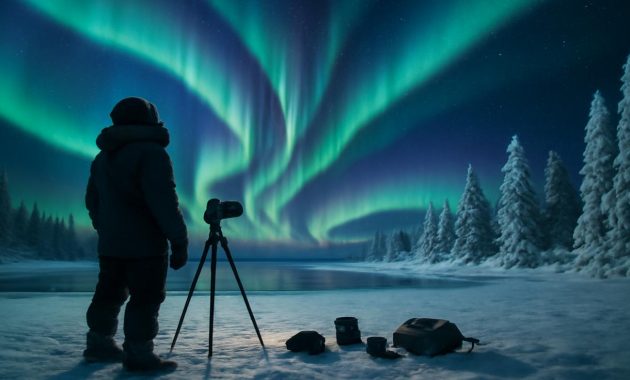
The sky was supposed to be ordinary that night. A flat gray over the Arctic coast, the kind of cloud lid that makes you wonder why you flew two thousand miles just to stare at disappointment. But then, close to midnight, the wind shifted. The clouds frayed apart like worn fabric, and there—quiet at first—came a green smudge over the northern horizon, as if someone had drawn a faint line with a phosphorescent marker. Ten minutes later, the sky was on fire. Curtains of emerald and violet folded and unfolded above the frozen bay, and my camera, which had been sulking on its tripod for hours, suddenly became the most important object in the world. That was the night I realized that seeing the northern lights is never about luck alone. It’s about reading a storm that begins on the sun, days away, and preparing your life around the chance to stand in the right darkness at the right moment.
Learning to Listen to the Sun
Most people think of the aurora as a surprise guest—a magical accident the sky throws when it feels generous. As a northern lights hunter, I see it as a conversation with a star that is both wild and wonderfully predictable, if you know how to listen.
Every aurora you’ve ever admired began as violence on the sun. Sunspots twisting like knots in a rope. Magnetic fields snapping and re-forming. Flares exploding with the energy of billions of nuclear bombs. Sometimes, those explosions throw out a bubble of charged gas called a coronal mass ejection, or CME, which then barrels toward Earth at millions of kilometers per hour.
From a distance, that sounds abstract, like space-weather jargon for scientists and satellite operators. But when you’re a hunter, those CMEs are your storm alerts, your snowplows on the highway of space. You learn to read the signs in the same way a sailor reads clouds or a farmer studies the soil. A big sunspot complex rotating into view. A long, filament-like flare snapping near the center of the solar disk. A warning that the sun has just thrown a punch in our direction.
In the days before a major solar storm, my life narrows into a simple ritual: sleep early, clear the next evenings, and start watching the numbers. It feels a bit like preparing for a long-distance race, except the track is the magnetic field surrounding our planet. And the finish line is the moment the sky finally tears open in color.
Building Your Solar Storm Toolkit
To miss nothing during the next solar storms, you need more than wishful thinking and a warm parka. You need a toolkit—half digital, half material—that can turn space weather into real-world decisions.
First comes the data. Space agencies and observatories constantly monitor the sun, tracking sunspots, flares, and CMEs. Their readings feed into live solar wind measurements closer to Earth. You don’t have to be a physicist to understand the basics, but you do need to recognize a few key values: how fast the solar wind is moving, how dense it is, and, critically, the Bz—its magnetic orientation. When Bz turns strongly southward, Earth’s magnetosphere opens up like a door, inviting the solar wind in. That’s the moment aurora hunters live for.
On my phone, I keep a small constellation of apps for space weather and aurora alerts. I skim them like the rest of the world scrolls social media. Instead of celebrity drama, I get solar wind speed spikes and Kp index forecasts. When a serious storm is brewing, these numbers begin to glow like warning buoys.
Then there is the physical gear, the tangible side of preparation. You don’t need professional equipment to experience the aurora, but you do need to respect the cold, the dark, and the relentlessness of waiting. I have a permanent “go bag” leaning against the wall near my door. If the solar wind suddenly turns favorable at midnight, I can be outside in ten minutes—dressed, packed, and ready.
| Item | Purpose |
|---|---|
| Layered thermal clothing | Stay outside for hours without freezing; easy to adjust when hiking or driving. |
| Insulated boots & wool socks | Protect your feet when standing still on snow or ice for long stretches. |
| Headlamp with red light mode | Preserves night vision while setting up gear or moving around safely. |
| Sturdy tripod | Keeps your camera steady for long exposures in wind and on uneven ground. |
| Camera with wide, fast lens | Captures the full sweep of the sky and the subtle structure of faint aurora. |
| Spare batteries & power bank | Cold drains power fast; backups keep cameras and phones alive. |
| Warm drink & snacks | Sustain your energy and patience on long, frigid vigils. |
That bag is a promise I make to myself: when the sky calls, I won’t waste precious minutes rummaging through drawers for gloves or charging a dead battery. Preparation is a kind of respect—both for the aurora and for your own future self, stumbling around in the dark.
Chasing Darkness and Distance
The most powerful solar storm in the world cannot compete with a single, badly placed streetlight. Light pollution is the silent thief of auroras, erasing delicate structures before your eyes ever have a chance to adapt. People often message me after a storm, saying, “The forecast was amazing, but I saw nothing.” The culprit, almost every time, is a sky washed in urban glow.
To prepare for the next wave of storms, get intimate with the darkness around you. Study maps of light pollution in your region. Talk to locals about quiet backroads and lakesides where the nearest town sits low on the horizon. Learn how far you need to drive to see the Milky Way. If you can see its hazy backbone stretching overhead, you’re in a good place to greet the aurora.
You don’t have to live in the Arctic either. During strong solar storms, the auroral oval can expand like a loosened belt, sliding far south of its usual haunts. I’ve watched the lights from coastal villages at 70° north, from forests near 60°, and from farm fields closer to 50°. In the biggest events, even mid-latitude cities can get a taste—green arcs resting low in the north, or pillars reaching up between stars that rarely see such company.
But darkness is only half the equation. The other half is distance—from buildings, from trees, from anything that clutters the sky. Part of the magic of a great aurora is how it redefines your sense of scale. You want to see the bands stretching from horizon to horizon, to feel the immensity of that invisible river of particles pouring into our atmosphere. An open horizon is like an invitation card: here, the sky is free to astonish you.
Before a promising storm, I often spend an afternoon scouting. I drive narrow roads, stop by frozen lakes, check how the northern horizon looks from different ridges. I note where passing cars will throw stray headlights, where city glows sit low behind hills, where a single lone cabin light might become an unwelcome flare in my long exposures. When night falls, there is no hesitation. I know exactly where I want to stand.
Reading the Sky in Real Time
All the numbers in the world can’t replace the simple act of looking up. During solar storms, space weather values can swing wildly. Forecasts that looked promising over dinner can collapse by midnight; nights that began quietly can erupt in color as dawn approaches. The sky is a live performance, and it rewards those who stay for the entire show.
On the ground, your first clue is often subtle. A faint grayish arch in the north that looks almost like a misplaced cloud. It doesn’t move fast or glow brightly. If you didn’t know better, you might ignore it. But then, after ten, twenty minutes, it begins to sharpen. A soft green emerges. The arch breaks into bands, as if someone tugged threads out of a fabric and let them hang. That’s usually when I call to whoever is with me: “It’s starting. Get ready.”
During strong storms, the changes can be startling. One moment, a quiet arc. The next, the entire sky filling with swirling drapery, pulsing as if in time with some distant cosmic heartbeat. If you’re staring only at your camera screen, you will miss the most beautiful part—the feeling that the sky is not a static painting but a living ocean, and you are standing at its shore.
This is why I always tell newcomers: take your pictures, yes—but also give yourself moments without technology. Let your eyes adjust fully to the dark. Feel how the snow crunches under your boots, how your breath makes little plumes that drift up toward that shimmering ceiling. Hear the tiny sounds: the squeak of ice, the distant hum of a car passing on a road you can’t see, the clicking of your friend’s shutter. All those sensations become woven into your memory of the aurora, and no photograph can quite replace that.
Photographing Without Losing the Moment
For many of us, the urge to capture the aurora is irresistible. We want proof, something to show the people who weren’t there. There’s a simple way to do this without turning the night into a technical stress test.
Before the storm season, practice with your camera in the dark—even if you’re just in a backyard or a park. Learn how to change ISO, aperture, and shutter speed with gloves on, without glaring at bright menus. Set up a basic low-light preset you can return to quickly. You’re not trying to win an award; you’re trying to ensure your gear doesn’t steal your attention away from the sky when things get wild.
When the aurora appears, start with a simple baseline: a wide lens, a high ISO, and a shutter speed between a few and about fifteen seconds, depending on how quickly the lights are moving. Too long, and the delicate folds blur into mush. Too short, and the image will be dark and noisy. Take a test shot, adjust gently, and then let the camera work while you keep your main attention on what’s happening above you.
I like to think of the camera as a quiet friend I’ve invited along. I check in with it now and then, adjust when needed, but I don’t let it dominate the evening. The real goal is to walk away knowing the story of that night in my bones, not just on my memory card.
Living on Solar Time
The more you chase the northern lights, the more your life begins to bend toward the rhythms of the sun. You start to notice the 11-year solar cycle, those slow swells and dips in solar activity that determine how often powerful storms roll our way. During the quieter years, the aurora feels rare and precious, a shy animal you might glimpse only a few times a season. During solar maximum, it can feel like a tide that keeps returning, again and again, inviting you back to the shore.
Preparing for the next solar storms isn’t just about having gear or apps. It’s about arranging your time and your expectations. Can you stay up late on a weeknight if the numbers suddenly spike? Are you willing to drive an hour out of town for a better sky? Will you cancel a casual plan with friends when the solar wind turns in your favor? These are small but real decisions, and over a season they shape how many magical nights you actually experience.
I’ve missed auroras because I was stubborn—too tired, too comfortable, too certain that “maybe it won’t be that good anyway.” Almost every time, someone sends me photos the next day, and I feel the same little sting of regret. So now, when the signs line up, I remind myself: you never regret going. You only regret staying home.
And yet, there’s a gentler side to this, too. Not every clear forecast becomes a show-stopping storm. Sometimes you spend hours under a quiet sky, your breath freezing in your scarf, your coffee cooling in the thermos, the aurora never quite rising above a faint whisper. Those nights are not failures. They’re part of the relationship. Like waiting for a wild animal that doesn’t appear, you learn patience, and you learn to love the cold silence itself—the stars, the moonlit snow, the sound of your own thoughts.
When the next big solar storms come—and they will—you’ll have a choice. You can treat them as a lucky accident, something to admire from a window if you happen to be awake. Or you can decide, right now, to be ready: to build your toolkit, scout your darkness, learn the language of the sun, and carve out space in your life for midnight adventures.
Below all the numbers and forecasts and gear lists, that’s what being a northern lights hunter really means. It means choosing, again and again, to step outside. To leave behind the screens and ceilings, and stand where nothing stands between you and a sky that is, quite literally, electrified. To miss nothing, you have to be willing to be there for everything—the quiet, the waiting, the nights that never ignite. Because when they finally do, when the sky bursts open and begins to move like a living thing, you’ll understand why every cold hour and every false alarm was worth it.
Somewhere above you, even now, the sun is twisting its magnetic knots, building potential like a held breath. So check your gear. Learn your routes to darkness. Pay just a bit more attention when someone mentions a solar flare on the news. One of these nights, that distant star will send us another storm, and the atmosphere over your own backyard may start to glow in colors you’ve never seen before.
When that happens, I hope you’re not looking at your phone wondering what you’re missing. I hope you’re already outside, boots in the snow or on the grass, neck craned back, watching the first faint arch rise in the north, knowing exactly what it means.
FAQ
How far south can I see the northern lights during strong solar storms?
During intense geomagnetic storms, the auroral oval can expand far beyond its usual range. Regions that normally sit well outside the aurora zone—sometimes even locations near 40–45° latitude—can see auroras low on the northern horizon or directly overhead. The stronger the storm, the farther from the poles the lights can appear.
Do I need a professional camera to enjoy the aurora?
No. Your eyes are the main event. A camera—whether a DSLR, mirrorless, or even a modern smartphone—can help you record the moment, but it is not essential. What matters most is getting to a dark place, giving your eyes time to adjust, and staying out long enough to catch changes in the sky.
What time of night is best for seeing the northern lights?
Auroras can happen at any time when it’s dark, but they often peak between late evening and the early hours of the morning. Many strong displays occur around local magnetic midnight, which can be slightly offset from clock midnight. On active nights, it’s worth checking the sky repeatedly from dusk until near dawn if you can.
Can clouds completely ruin an aurora chase?
Thick, unbroken cloud cover will block the aurora, but skies are often more dynamic than they first appear. Gaps can open, cloud layers can thin, and localized clear patches can drift overhead. It is common to begin a night under discouraging clouds and end it under a blazing sky. Watching satellite cloud imagery before heading out can help you decide where to go.
Is it dangerous to be outside during a solar storm?
For people on the ground, typical geomagnetic storms pose no direct physical danger. The main impacts are on satellites, radio communication, and power grids. On Earth’s surface, your biggest concerns are ordinary ones: cold temperatures, isolated locations, and safe travel on dark, possibly icy roads. With sensible preparation and clothing, an aurora hunt is no more hazardous than any other night-time outdoor activity.