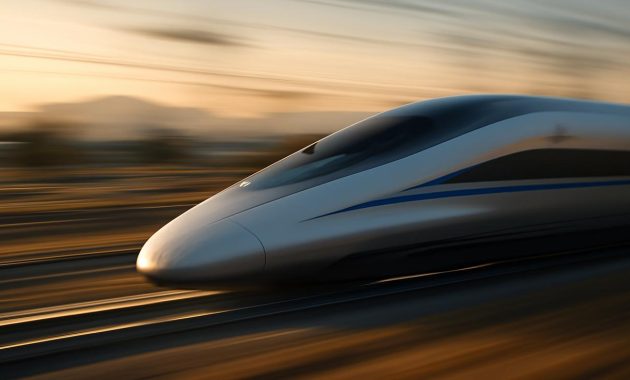
The train does not so much depart as it takes flight. There is no lurch, no clank of couplers, no complaint from steel wheels. Only a deepening hum, a soft press into the seat, and a barely perceptible shiver in the air as the landscape outside begins to stretch. Fields smear into green ribbons, buildings dissolve into smudges of glass and concrete, and the sky seems to lean closer to the sleek, silver body of the machine. Somewhere beneath your feet, magnets are wrestling with the earth itself, and in less than four minutes, you are traveling faster than any train in human history—603 kilometers per hour.
The Sound of Speed You Can Barely Hear
At 603 km/h, you expect drama. You brace for roar and rattle, for that familiar growl of machinery pushing against its limits. Instead, there is a quiet that feels almost intimate. The air conditioning sighs. A suitcase wheel ticks softly as the train curves ever so gently. A child across the aisle giggles at the cartoon on her screen, oblivious to the record being broken just outside her window.
The maglev—short for “magnetic levitation”—floats a few millimeters above its guideway, freed from the friction that haunts conventional trains. No wheels. No rails grinding against each other. Just a choreography of electromagnetic force: magnets in the track and magnets in the train, carefully tuned to repel, support, and propel. It’s less like transportation and more like controlled levitation, wrapped in aerodynamic skin.
From the window, the world is a continuous blur, yet the cabin feels oddly detached from the chaos of speed. It’s as if someone pressed fast-forward on reality while keeping the interior on calm, normal time. The subtle hushing sound—the soft, almost distant wind—reminds you that you are slicing through air at nearly two-thirds the cruising speed of a jetliner. But unlike an airplane, you are never more than a few meters from the earth, surfing a wave of invisible force.
Engineers will tell you this silence is not accidental. Every curve of the nose, every angle of the body, every panel alignment is sculpted to soothe the air as it rushes by, to coax the invisible currents around the train’s body rather than fight them. The faster you go, the more the air behaves like a stubborn, heavy fluid, resisting every intrusion. To reach 603 km/h on land, you must convince the air to cooperate. This train does that with the poise of a bird of prey diving at full speed, feathers aligned, wings tucked, utterly sure of its own shape.
Inside a Bullet of Air and Light
Step inside, and the first thing you notice is not the futuristic technology—it’s the warmth of small, familiar human moments. The soft fabric of the seats. The warm, almost amber lighting that makes metal and glass feel less clinical, more welcoming. The faint scent of coffee near the galley. The calm announcement over the speakers, delivered in a voice that could be reading the weather forecast, not introducing a marvel of modern engineering.
Your body expects to negotiate with motion—to handle the sway, the bumps, the low-frequency growls of acceleration and braking. Instead, your senses are left with little to latch onto. There’s acceleration, yes, a brief gentle push when the train surges from station speed toward the mind-bending upper ranges. But it’s more like a steady elevator glide than the jolt of a jet on a runway.
The floor barely trembles. The coffee in your cup forms a smooth, dark circle with only the faintest tremor. If you look closely, you can see the metal fixtures humming with a restrained energy, as if the whole interior is a shell wrapped around something far more intense, like a calm surface over an electric storm.
Outside, cameras and sensors stitch together a constant awareness of the track, the weather, the air pressure. Computer systems make instant, microscopic adjustments to the magnets’ strength. It is, in a very real sense, a conversation between train and track, a call-and-response of magnetic fields happening thousands of times each second—too fast for humans to see, but not too fast for us to trust.
| Feature | Next‑Gen Maglev | Conventional High‑Speed Train |
|---|---|---|
| Top Speed (test) | 603 km/h | 320–380 km/h |
| Contact with Track | No (magnetic levitation) | Steel wheels on rails |
| Ride Comfort | Extremely smooth, low vibration | Smooth but with noticeable vibration |
| Primary Noise Source | Aerodynamic (wind) | Wheels, rails, and aerodynamics |
| Maintenance Needs | Lower mechanical wear, higher systems complexity | More mechanical wear, mature systems |
The Day 603 Became a Number for the History Books
On the day the record was set, the air over the test track shimmered under a pale sky. Along the elevated guideway, cameras trailed the bullet-shaped train as it slid out of the station like a sleek silver fish leaving a quiet harbor. Inside one of the cars, engineers watched streams of data flow across screens: magnet temperatures, vibration readings, air pressure around the nose, the dance of energy consumption as speed climbed higher, and higher still.
150 km/h. 300 km/h. 400 km/h. The numbers rose quickly, but there was no sense of strain—only the clean, unstoppable line of acceleration. At 500 km/h, the train had already blown past most high-speed services in the world. The margin between possible and impossible shrank with each second.
Somewhere between 580 and 590 km/h, the air started to behave differently. Sound barriers had not shattered—those belong to the realm of supersonic jets—but the aerodynamic forces grew sharply. Microturbulence danced along the windows. The nose carved a pressure wave that raced ahead, compressing the air like an invisible snowplow. Yet the maglev remained steady, its control systems quietly trimming, nudging, refining.
Then the number appeared: 603 km/h. The fastest train speed ever recorded on any rail system on Earth.
For a moment, the number was just digits on a screen, a measured fact. But in that cabin, it was also something else: the tangible proof that a century-long dream—of racing across continents with the ease of closing your eyes—had just nudged itself further into reality. Applause broke out, not roaring but almost reverent. Someone exhaled a long-held breath. The train held the speed for a short, intense window of time, then eased back, like a sprinter gliding to a stop after crossing the finish line.
Outside, the guideway returned to stillness. The birds resumed their arcs in the sky; the wind whispered over the concrete pillars. But the record remained, etched into history at 603 km/h, a quiet but unmistakable statement of what we can coax from the marriage of magnetism, precision engineering, and sheer human persistence.
How Magnets Learned to Carry People
Maglev technology has been hovering—quite literally—on the edge of mainstream travel for decades. The idea is profoundly simple: use magnetic fields to both lift and move a vehicle. No rolling resistance. No mechanical contact. Just clean, frictionless gliding.
In practice, what happens beneath the floor of the train is anything but simple. Massive superconducting magnets—or advanced conventional electromagnets—run along the belly of the train. The guideway itself is lined with coils or magnetic plates. When switched on and tuned correctly, the magnets generate fields that push the train away from the track while simultaneously pulling it forward. It’s like a series of hands lifting and passing along a weight, always supporting, always guiding, never quite touching.
What makes this next-generation maglev so extraordinary is the finesse of its control. At 603 km/h, tiny misalignments, minor shifts in wind, small temperature changes in magnetic components—these all matter. The train’s brain has to respond in microseconds, holding the levitation gap steady, managing the lift so that the passengers feel nothing more dramatic than a gentle glide.
The result is a paradox: the faster it goes, the calmer it feels inside. Outside, physics is raging. Inside, you are reading a book, finishing a presentation, or staring out the window at a world reduced to a river of color.
Seven Minutes That Shrink a Country
Speed, on its own, is an abstract number. 603 km/h is impressive, but what does it actually mean for a traveler, for a country, for the shape of everyday life?
Imagine a route where the maglev will eventually operate in daily service, not at the record-setting 603 km/h, but at a still-astonishing operational speed around 500 km/h. A journey that once took over an hour by conventional high-speed rail could, in theory, shrink to half that. A drive that eats up a half-day becomes a casual, after-breakfast trip. Two cities that felt like distant cousins suddenly become next-door neighbors.
A commute that no one would have tolerated becomes feasible: living by the coast, working halfway inland, and spending less time in transit than someone stuck on an urban subway. The map does not change, but the lived distance between places collapses. Time, not geography, becomes the more negotiable dimension.
The psychological effect of this is difficult to overstate. When you can cross hundreds of kilometers in the time it takes to listen to an album, your sense of what is “far away” begins to dissolve. Family weekends expand in radius. Business trips contract into manageable slices of the day. University choices, job options, even friendships and romances stretch across regions with less resistance.
We often talk about digital technology “shrinking the world” through screens and networks. Maglev does something different: it shrinks the world physically. You still feel the journey. You still watch landscapes shift. But the distance no longer presses down on you as it used to. It becomes a detail, a number at the corner of your awareness, not the defining feature of your plans.
Speed with an Eye on the Planet
There is another layer to this story, quieter than the scream of speed headlines but just as vital: energy and the environment. High-speed travel has long been a tug-of-war between convenience and impact. Jets take us quickly across continents, but at a steep cost in carbon emissions. Cars offer freedom, but multiply congestion and pollution. Trains, especially electric ones, have always been the quieter, cleaner cousins—but could they be fast enough to redraw the map?
Maglevs propose an answer: yes, but intelligently. By removing wheel friction, they cut one of the largest sources of resistance. The remaining battle is primarily against air. This next-generation maglev is shaped with aerodynamic obsession—every edge sealed, every curve analyzed, every potential drag point smoothed. Engineered this way, it can move astonishingly fast for the energy it consumes, especially when powered by a decarbonizing grid.
Energy is still required, of course. There is no magic here, no perpetual motion. The guideway infrastructure is demanding to build and maintain. But compared with fleets of short-haul flights or expanding highways, a mature maglev network offers a tantalizing path: cross-country speed without the roaring, fuel-hungry wake of jet engines. A way to keep our bodies moving rapidly while our emissions curve, step by step, downward.
From Prototype to Everyday Miracle
The record-breaking 603 km/h run is, for now, a symbol—a promise more than a daily reality. The maglev that tore up the test track at that speed is a prototype, a testbed for technologies that will trickle into commercial service at somewhat more modest, but still breathtaking, velocities.
Bringing such a system into everyday life is less a matter of “Can we?” and more of “Will we?” It means building hundreds of kilometers of dedicated guideway, often elevated or tunneled, threading a near-perfect path through crowded cities and delicate landscapes. It demands political will, long-term investment, and a shared vision that says: yes, future generations deserve a way of moving faster, cleaner, smoother.
Yet if you zoom out and look at history, this is familiar terrain. Steam locomotives once terrified people, their 50 km/h speeds branded as unnatural. Early airplanes were dismissed as fragile stunts. The first high-speed rail lines were criticized as expensive vanity projects. And yet, slowly, with each success, we folded them into the fabric of everyday life. What was once a technological spectacle became the way we simply “get there.”
One day, perhaps not so far from now, a child might curl up against a maglev window, bored and impatient, asking, “Are we there yet?” while hurtling along at hundreds of kilometers an hour. For that child, the miracle will no longer be the speed itself but the normalcy of it. Just another ride. Another Sunday visit. Another commute.
The Human Heart at 603 km/h
As extraordinary as the physics is, the true measure of this train resides in quieter, more human questions. Who gets to ride it? Whose trips become easier? What opportunities blossom when the friction of distance is reduced? What stories will unfold in stations and carriages linked by invisible rivers of magnetism?
Think of the small moments: a grandparent stepping off a maglev, rested instead of exhausted, because the journey took an hour instead of four. A student able to attend a university once considered too far away. An entrepreneur who can visit suppliers and partners across a region between sunrise and dinner. A couple who maintain a long-distance relationship not through screens alone but through regular, feasible weekend journeys.
Speed, in the end, is a tool for time—our most stubbornly finite resource. At 603 km/h, what the maglev really offers is not an adrenaline rush but the possibility of more mornings at home, more evenings back with the people we love, more chances to see, in a single lifetime, more of the landscapes that make up our world.
And there is something almost poetic about how this is achieved. Not with louder engines or bigger explosions, but with quiet, ordered magnetic fields. With a train that whispers instead of roars. With an elegance of motion that feels, at its best, like gliding along a line drawn gently across the Earth.
Frequently Asked Questions
Is 603 km/h the speed passengers will experience in regular service?
No. The 603 km/h run was a test to explore the limits of the technology and gather data. Planned commercial services with this type of maglev typically operate at lower, but still extremely high, speeds—around 500 km/h—balancing safety, comfort, efficiency, and infrastructure demands.
Is riding a maglev at such high speed safe?
Yes, safety is central to maglev design. The train is guided and stabilized by the magnetic system and the dedicated guideway, reducing risks from track defects or wheel failures. Extensive testing, redundant systems, real-time monitoring, and strict operational limits all contribute to making high-speed maglev travel extremely safe.
How does maglev compare to flying in terms of comfort?
Maglev rides are generally smoother and quieter than flights. There is no turbulence, no takeoff or landing jolt, and cabin pressure remains close to normal ground levels. Acceleration and deceleration are controlled and gradual, and the absence of wheel-on-rail contact minimizes vibration.
Is maglev technology environmentally friendly?
Maglev systems are powered by electricity, so their environmental footprint depends on how that electricity is generated. When combined with low-carbon or renewable energy sources, maglev trains can offer a significantly cleaner alternative to cars and short-haul flights, especially given their energy efficiency at high speeds.
When will the general public be able to ride trains like this?
In some regions, commercial maglev services already exist at lower top speeds. Next-generation maglev lines using technologies proven in the 603 km/h tests are under development and construction. Exact timelines depend on each country’s infrastructure projects, funding, and regulatory approvals, but the shift from prototype to everyday travel is actively underway.