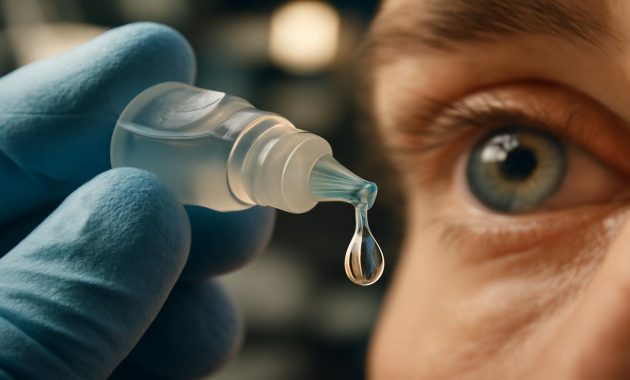
The first thing Anna noticed was the way the morning blurred. Steam from her coffee, the pale light on the kitchen tiles, the rim of her favorite mug—everything had softened, as if she’d stepped behind a foggy window. At 62, she had learned to shrug off small betrayals of the body, but this one carried a quiet panic. Her eyes had always been her way into the world: leaves in November sharp as etchings, her grandson’s eyelashes, the fine print of hand-written recipes. Now, the words in her book glowed halos. Streetlights at dusk fractured into starbursts. Her optometrist’s voice was gentle but final: “Early cataracts. Nothing dangerous yet. When they get worse, we’ll talk surgery.”
The Slow Fade We Rarely Talk About
Most of us imagine vision loss as something dramatic—an injury, a sudden blackout, a life split into before and after. In reality, the story is usually slower, like a dimmer switch being turned down in tiny, nearly invisible clicks.
Cataracts are the most common culprit. By the time we reach our sixties, more than half of us will have some clouding of the eye’s natural lens. It doesn’t hurt. It doesn’t arrive with drama. It just… dulls. Edges go soft. Colors flatten. Night driving becomes an exercise in courage. Some people start avoiding evening outings altogether, not because they are old, but because the glare from oncoming headlights feels like being hit with a flashlight in a dark room.
Inside the eye, that cloudiness lives in a tiny, clear disc of tissue: the lens. It sits behind the pupil, flexing all day long to keep the world in focus. To do that job, the lens has to be remarkably transparent, a living, almost glass-like window made of proteins arranged in delicate, crystalline order. Over decades, those proteins twist, clump, and yellow. The clear window turns into frosted glass.
For generations, the story of what comes next has been the same: wait until it’s bad enough, then have the lens removed and replaced with a plastic one. Cataract surgery is safe and common—but it’s still surgery. For millions of people across the world, that step is expensive, inaccessible, or simply terrifying. So they adapt instead. They read less. They drive less. They stop noticing details, then stop missing them.
But somewhere, in a quiet lab with humming machines and racks of cloudy vials, a different story has been taking shape—one in which the clear window of the eye can be polished, not replaced.
The Hidden Chemistry of a Clear View
To understand why a simple eye gel is stirring so much excitement, you have to peer into the microscopic architecture of the lens. Think of it as a tiny, living crystal built from proteins arranged like dancers in a perfectly choreographed formation. When those dancers hold their pose, light glides straight through. When they stumble or cluster, light scatters; the scene in front of you looks hazy and washed out.
Those missteps happen because lens proteins are built to last a lifetime—but nothing in a warm, wet, oxygen-rich environment stays perfect forever. Over time, the proteins undergo subtle chemical changes: they can be cross-linked, oxidized, or warped. Imagine old cellophane left on a sunny windowsill: it yellows, wrinkles, and loses its glassy clarity.
For decades, scientists assumed that once those proteins clumped and clouded, the damage was done. You couldn’t unwrinkle the cellophane; you could only remove it. That belief shaped everything about how we approached cataracts—accept the blur, then cut it out.
But over the last several years, researchers began noticing something curious in animals that seemed to resist lens clouding. Their eyes contained higher levels of certain small, oily molecules—compounds that, it turned out, could slip between tangled proteins and gently loosen them. The idea was revolutionary and deceptively simple: what if clouded lenses weren’t a one-way street? What if, with the right nudge, those proteins could be coaxed back toward their clear, glass-like state?
This question led to a family of molecules called sterols—natural fat-like substances that can move through cell membranes with surprising ease. Certain modified sterols, when dissolved into eye-friendly formulations, showed an almost magical behavior in early lab tests: they helped re-dissolve protein clumps in cloudy lenses from animals, and in some cases, restored transparency.
From Lab Bench to Clearer Morning Light
This is where the story shifts from chemistry to the quiet drama of translation—turning a promising molecule into something a grandmother could one day squeeze from a tube and gently blink into her own eyes.
A few research teams began to refine these sterol-based compounds and blend them into gels and drops designed to cling to the surface of the eye long enough to sink inward. The lens sits far behind the cornea, nestled like a seed inside the eye. Any medicine meant to reach it needs to withstand blinking, tears, and the eye’s natural tendency to flush out intruders.
The early human trials were cautious, small, and hopeful. Volunteers—many like Anna, living with early or moderate cataracts—were asked to apply the clear gel daily, often twice a day, for weeks or months. There were no lasers, no stitches, no hospital gowns. Just a cool droplet on the eye and the gentle blur of a blink.
Behind the scenes, machines measured the clarity of their lenses, the sharpness of their vision, the amount of light scattering inside their eyes. Some reported that night driving felt less frightening. Street signs snapped into better focus. Colors seemed to recover a lost intensity. Not miracles, not the instant perfection of surgical lens replacement—but a meaningful, lived difference in how the world looked and felt.
In the sterile language of scientific papers, that difference is described with charts and p-values. In the language of daily life, it sounds more like this: “I can see my grandson’s face more clearly when he runs across the yard.” Or, “I don’t dread driving to my book club after sunset anymore.”
The New Gel on the Edge of a Revolution
What makes this new wave of clear eye gels feel so quietly radical is not that they perform magic—it’s that they dare to rewrite what we thought was permanent. They challenge a core assumption: that once the proteins in the lens have clumped and clouded, our only option is replacement.
These gels don’t work like painkillers, quickly muting a signal. They operate more like patient housekeepers and repair crews. The active molecules are small and lipophilic—meaning they can slip through the eye’s outer layers and move toward the lens. Once there, they mingle with the clouded proteins, nudging them into more flexible, properly folded shapes and gently breaking apart some of the microscopic aggregates that scatter light.
Think of it as sending in a team of miniature glass restorers to a cathedral’s stained-glass window. They can’t replace every cracked pane or reverse every century of weathering, but they can polish, re-seat, and uncloud enough surfaces that the light coming through brightens noticeably.
This approach doesn’t pretend to turn back the biological clock completely. Age still leaves its fingerprints. But for people early in the journey of lens clouding, that partial restoration might be enough to delay or even sidestep surgery for years. For those in regions where surgical care is scarce, a tube of clear gel could mean the difference between functional sight and a world steadily fading to gray.
What’s especially striking is how quiet the experience is from the patient’s side. There’s no whir of surgical tools, no bandages. Just a small ritual added to the day: morning and evening, a moment of coolness on the eye, then back to the hum of ordinary life. In an era when medical miracles are often packaged as dramatic interventions, this one feels almost modest.
| Aspect | Traditional Cataract Surgery | Emerging Clear Eye Gel |
|---|---|---|
| Approach | Removes cloudy lens and replaces it with an artificial one | Aims to restore clarity of the natural lens by untangling protein clumps |
| Invasiveness | Requires surgery, incisions, and clinical setting | Non-surgical, applied as topical drops or gel |
| Recovery | Days to weeks of healing and follow-up | Minimal downtime; incorporated into daily routine |
| Access | Limited in low-resource settings; needs equipped facilities | Potentially easier to distribute globally once approved |
| Ideal Stage | Established or advanced cataracts | Mild to moderate clouding; early intervention |
Stories in the Blur and in the Clearing
Behind every data point in clinical trials lies a person, living out small, sensory transformations. A woman in her seventies who had started avoiding evening walks tells researchers she now watches the sunset again, the outline of trees no longer melting into indistinct smudges. A retired mechanic—long resigned to using extra lamps in his workshop—describes how the gleam on metal tools has come back, a thin, sharp line of reflected light that had quietly vanished years before.
For Anna, the change does not arrive like a lightning bolt. It creeps in sideways and almost shyly. Three weeks after she starts using the gel prescribed in a study, she notices the print in her morning paper looks darker, more decisive. She wonders if she has simply gotten used to it. A month later, standing by the kitchen window, she catches herself leaning closer to the glass to watch rain on the rose leaves, individual droplets suddenly edged again with clarity instead of fuzz.
Her grandson’s drawings taped to the fridge gain new depth; crayon lines she had previously perceived as blocks of color separate into playful, uneven strokes. On a rainy evening, driving home from a friend’s house, she braces herself for the familiar starburst of lights—and instead finds that the halos are there, but smaller, less blinding, cousins of their former selves.
She still has cataracts. Her lenses are not young again. An eye exam confirms that the clouding has not vanished but softened, thinned, reorganized. Her doctor shows her images of light scattering in her eye, tiny diagrams of speckled patterns that, to Anna, might as well be distant galaxies. “We’re not replacing anything,” the doctor says. “We’re helping your own lens behave more like it did years ago.”
What’s quietly radical here is not just the improved clarity, but the way it reshapes her choices. Surgery is no longer a looming inevitability right around the corner. It becomes a possibility she might choose later, or never, depending on how her eyes age and how well the gel holds the line against further clouding.
How Close Is This Future, Really?
Whenever something sounds almost too gentle, too easy—a gel instead of a scalpel—healthy skepticism is wise. Many of these lens-clearing formulations are still moving through trials and regulatory scrutiny. Some are in early stages, some more advanced; others are being refined after mixed or modest results.
Vision science rarely offers overnight revolutions. It works in increments: safer surgeries, better lenses, improved diagnostics, and now, perhaps, drugs that repair instead of remove. The molecules that look like heroes in a dish of protein clumps do not always behave perfectly inside the labyrinth of the eye. Some formulations fail to penetrate deeply enough. Others need months of consistent use before changes appear. A few may prove helpful only for certain types of lens clouding or at specific stages.
Yet the direction is unmistakable. We are stepping into an era where the question is no longer “Can we reverse any part of this process?” but “How much can we safely, meaningfully reverse?” And for once, the tools in play are not only high-tech lasers or custom implants, but also something as humble as a clear, viscous droplet that glides across the cornea in the time it takes to inhale.
For people in regions where cataract surgery remains out of reach—whether because of cost, distance, or lack of trained surgeons—the implications are immense. A medication that could be stored in a clinic fridge, administered at home, and shipped in boxes instead of surgical kits might change the landscape of global blindness more than any cutting-edge operating room.
Living in a World That Stays Sharper, Longer
It’s tempting to think of vision technology in terms of extremes: total blindness or perfect clarity, a dark screen or a high-definition display. Real life is subtler. It lives in gradients, in the difference between being able to read a bus number from across the street or needing to wait until it’s at the curb, between recognizing a friend’s face at twenty paces or ten.
The quiet revolution of a new clear eye gel does not promise superhuman sight. It offers something more grounded and arguably more precious: the hope of staying comfortably within the band of “good enough” vision for more years of life, without needing to cross the surgical threshold so quickly.
It also invites us to rethink what “aging eyes” means. For decades, we have accepted a trade: as our years increase, the sharpness of the world must naturally erode. Reading lamps get brighter, fonts get larger, and the idea of night driving becomes less appealing. If medicines can help the lens preserve its bittersweet transparency longer—if they can “de-cloud” the window just enough—we may start to see older adulthood as a stage where vision changes, but does not automatically dim to the point of concession.
Of course, none of this replaces the need for care: regular eye exams, monitoring for glaucoma, macular degeneration, and other conditions that cannot be smoothed away with a gel. These are different stories unfolding in parallel. But for the enormous share of people whose greatest barrier to crisp sight is a slowly frosting lens, the idea that their own natural lens can be coaxed back from the edge feels almost like getting permission to keep looking closely at the world—for longer.
If you stand at a window at twilight and pay attention, you can feel how much of your experience depends on clarity. The fine pattern of veins in a leaf backlit by the setting sun. The glint on a bird’s eye as it turns. The textural shift between distant hills and nearby branches. To restore even a slice of that richness without major surgery is not just a medical achievement; it’s an act of restoring intimacy with the world itself.
Questions People Often Ask About Clear Eye Gels for Cataracts
Can an eye gel really reverse cataracts?
Current research suggests that some experimental gels can reduce lens clouding in mild to moderate cataracts by helping untangle and reorganize lens proteins. They don’t “erase” cataracts completely or make the lens brand-new, but in some trials they have improved clarity and reduced light scatter enough to enhance everyday vision.
Will these gels replace cataract surgery?
They are more likely to complement surgery than replace it. For advanced cataracts, surgery will almost certainly remain the best option. Gels may help delay the need for surgery, improve early-stage cataracts, or offer an alternative where surgery is not accessible or desired.
Are these clear eye gels available at pharmacies now?
As of now, many of the most promising formulations are still in clinical trials or under review. Some over-the-counter products may market themselves for “lens health,” but the formulations that have shown the most potential for restoring clarity are not yet widely approved or standard-of-care. Always consult an eye specialist before trying any new product.
Are there side effects or risks?
Any medication applied to the eye can cause irritation, redness, or allergic reactions in some people. Because these gels are still being studied, researchers are carefully tracking side effects such as discomfort, changes in eye pressure, or interactions with other eye conditions. So far, many trials report good tolerability, but long-term safety is still being evaluated.
Who might benefit most from a lens-clearing gel?
People with early or moderate cataracts, especially those who find their vision bothersome but are not yet ready—or able—to undergo surgery, may benefit the most. In the future, gels might also be used preventively in higher-risk groups, depending on how ongoing research unfolds.
How long would someone need to use such a gel?
Most current trial protocols involve daily use over weeks or months. Because cataract formation is a gradual process, maintaining improvements could require long-term, consistent application, much like using drops for dry eye or glaucoma. The exact schedules will depend on the final approved products and individual response.
Should I wait for these gels instead of planning surgery?
If your vision is significantly impaired, especially if it affects safety (such as driving or navigating stairs), you should not delay proven treatments in the hope of future options. An eye doctor can help you weigh the severity of your cataracts, your lifestyle needs, and whether it makes sense to watch and wait or move ahead with surgery. For now, the gel-based revolution is promising, but it is still unfolding.