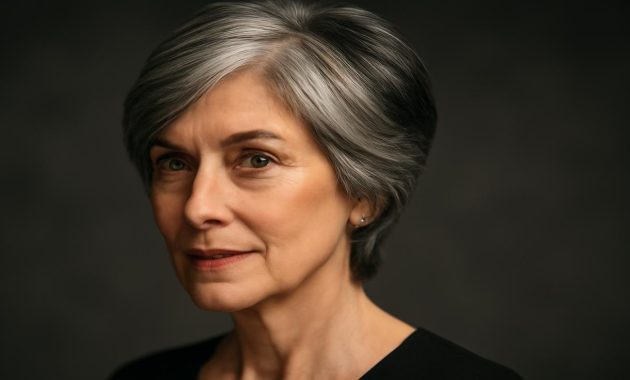
The first thing I notice is her laugh. It rises above the low salon hum of hairdryers, soft jazz, and murmured conversations—bright, unapologetic, and utterly alive. When she settles into my chair, she runs her fingers through her salt and pepper hair and says, half joking, half hopeful, “Do something with this. I’ve earned every one of these grays. I just don’t want them to make me disappear.”
I smile because I’ve heard this before. In fact, I hear it almost every day from women over 60 who walk in with stories woven into every strand of silver, smoky charcoal, and soft white. They come in carrying decades of color touch-ups, root cover sprays, and a secret suspicion that gray hair might be a quiet way the world tells women they’re no longer meant to be seen.
But then something magical happens. We tilt the mirror, play with the natural fall of their hair, consider the shape of their jaw, the angle of their cheekbones, the lift of their eyes. We talk about how they actually live: grandkids and gardens, city walks and long lunches, new loves and old friends. I show them how their salt and pepper is not an ending—but a new texture, a new light source, a new way to frame their face.
This is the part I love most: the moment gray hair stops being a problem to “fix” and starts becoming a material to sculpt. Over my twenty-something years as a hairdresser, I’ve watched women in their sixties, seventies, and eighties become bolder with their hair than they ever felt allowed to be at thirty. And when it comes to salt and pepper hair, there are certain cuts that don’t just work—they sing.
The Soft Pixie: When Gray Becomes Light
She came in with a shoulder-length bob that had been dyed the same warm brown for the last decade. Her roots, a cool mix of silver and deep charcoal, were coming in strong. “I can’t keep up with this anymore,” she whispered, like a confession. “But I’m afraid if I let it go, I’ll look…old.”
We decided on a soft pixie.
Not the severe, spiky pixie of the 1990s, but a gentle, textured version: longer at the top, feathered around the ears, with the hairline at the neck left slightly soft and blurred. Her salt and pepper hair became a living canvas—silver catching the light on top, darker grays adding depth at the roots, like moonlight and shadow dancing together.
A pixie cut on salt and pepper hair is one of my secret weapons for women over 60. The shorter length lifts the face, exposing the grace of the jawline, the sparkle in the eyes, the curve of the neck. It turns gray into light—literally. Salt and pepper hair reflects more than it absorbs; in a shorter cut, that reflectivity makes the hair look fuller, richer, and more intentional.
The key is softness. I always avoid hard, straight lines at the forehead or sideburns. Instead, I use point-cutting (tiny scissor snips into the ends) and razor-softening to give the cut movement. We keep the top a little longer and wispy, so she can push it forward for a playful fringe, sweep it to the side for softness, or tousle it for an airy, bedhead ease.
When we were done, she touched her hair, eyes wide. “I look like me,” she said. “But upgraded.” And then, that laugh again—only this time, lighter.
The Mid-Length Shag: Movement, Air, and Attitude
Some women sit down and say, “Don’t you dare cut it short.” Their hair has been with them through children, careers, divorce, travel, health scares. Cutting it off feels like erasing a timeline. For them, the mid-length shag on salt and pepper hair can be a revelation.
Imagine shoulder-grazing hair, neither long nor short, with soft layers that begin around the cheekbones and gently tumble down. The layers are invisible at first glance—nothing choppy or harsh—but you see them in the way the hair moves when they turn their head. Salt and pepper strands slip over and under each other, flashes of silver catching daylight or café lighting, the darker hairs adding shadow and body.
On gray hair, a shag is less about rock-and-roll rebellion and more about texture and air. The right layering lets your natural wave (even that soft, barely-there bend) come through. It stops salt and pepper hair from looking like “one solid block” and instead turns it into something alive—like wind on water.
For women over 60, I love a collarbone to just-below-shoulder length. It’s long enough to tuck behind the ears, tie loosely at the nape, or pin up for a dinner out, but short enough that the hair doesn’t drag the face down. We often add a long, side-swept fringe that blends into the rest of the layers, lifting the eye area and softening forehead lines without hiding them. There’s something deeply dignified about a face that doesn’t hide—and hair that frames it with kindness.
Salt and pepper hair can sometimes feel wiry or dry, especially at the ends. Layering, when done gently, actually helps. We remove the heaviest, oldest, most fragile ends while leaving strength where it matters. Then, with the right styling—a little lightweight cream, maybe a touch of mousse—the hair becomes an easy, lived-in halo of gray and charcoal, soft enough to run your hands through.
The Silver Bob: Clean Lines, Quiet Drama
There’s a woman who comes to see me every six weeks, always in a navy trench coat, always with lipstick in a deep berry shade. Her hair is cut into a sleek bob that hovers just above her shoulders, and when she steps into the salon, heads turn. Not because she’s loud or flashy, but because there’s a quiet drama in her presence. Her hair is part of that.
The classic bob for salt and pepper hair is one of the purest forms of elegance I know. There’s nowhere to hide: the line has to be clean, the shape has to honor the neck and jaw, and the gray has to shine in its natural complexity. But when it works, it’s breathtaking.
For women over 60, I like to soften the traditional blunt bob. Instead of a hard, ruler-straight line, I create a very slight curve that follows the collarbone or just brushes the jaw. Sometimes, I angle the front a touch longer than the back to elongate the neck. We can add the lightest hint of layering at the very bottom, only to remove weight and help the hair move, but the headset remains strong and structured.
Salt and pepper hair in a bob becomes architecture. The darker strands add depth, especially at the nape, while the silver pieces near the face act like built-in highlights, brightening the skin. When the hair swings, it has weight and purpose. When it’s tucked behind one ear, it reveals earrings, a neck, a story.
Some of my clients worry that a bob means daily blow-drying. It doesn’t have to. On gray hair, I often encourage a softer finish: a gentle air-dry with a round brush only at the front, or a rough-dry followed by a wide-tooth comb. The goal is not perfection, but intention—the difference between “I woke up and didn’t care” and “I woke up and chose this.”
The Long, Layered Silver Veil: Yes, You Can Keep Your Length
Every now and then, a woman with waist-length gray hair walks into my salon, and someone—another client, a passerby—whispers, “Wow.” There is still a myth clinging to the air that women “of a certain age” must cut their hair short, as if age and length cannot coexist gracefully. I’ve never believed that.
Long salt and pepper hair can be startlingly beautiful, but it does need the right shape. Without it, it can look heavy and tired. With subtle, thoughtful cutting, it becomes a silver veil, catching the light like threads of silk.
For women who want to keep their length, I focus on two things: weight distribution and face-framing. I start by trimming the ends enough to remove the most damaged, frayed hairs. Then I carve out long, soft layers—nothing too short that might lead to frizz, but enough that the hair doesn’t hang in one motionless sheet.
A crucial element is the front. I often design gentle, cascading layers that start around the cheekbones or just below, depending on the client’s features. These pieces fall naturally forward when the hair is worn down, creating a curtain of silver and smoke that embraces the face rather than hiding it. If she prefers to tie her hair back, these front layers slip free, giving softness to a ponytail or bun.
Maintenance is about respect more than effort. Long, salt and pepper hair thrives with moisture: hydrating conditioners, occasional masks, and minimal heat styling. Embracing the natural texture—whether straight, wavy, or curly—keeps it looking modern instead of forced. When she walks out of the salon, hair rippling in the light, there’s no question whether long hair “belongs” to her age. It belongs to her, full stop.
How Different Cuts Bring Out the Best in Salt and Pepper Hair
| Cut Style | Best For | Effect on Salt & Pepper Hair | Maintenance Level |
|---|---|---|---|
| Soft Pixie | Fine to medium hair, strong facial features | Turns gray into a luminous, textured highlight; adds lift and lightness | High salon frequency, low daily styling |
| Mid-Length Shag | Straight to wavy hair, those wanting movement without losing too much length | Enhances natural texture; makes salt & pepper look multidimensional and airy | Moderate trims, easy day-to-day styling |
| Silver Bob | Most hair types; ideal for those who love clean lines | Creates a graphic frame that highlights the natural contrast of gray tones | Regular salon shaping, simple styling routine |
| Long, Layered Cut | Thicker hair; those emotionally attached to length | Softens heaviness, adds flow; gray looks romantic and fluid | Less frequent cuts, more focus on at-home care |
The Fringe Question: Bangs, Or No Bangs?
There is a moment, almost like an intake of breath, when the word “fringe” or “bangs” enters the chat. Some women visibly light up. Others stiffen. In the mirror, they glance at their forehead, their eyes, the faint lines traced by decades of laughter, worry, and surprise.
Here’s what I tell them: bangs are not about hiding. They are about balance.
On salt and pepper hair, a carefully cut fringe can be transformative. A soft, wispy fringe that just kisses the eyebrows can pull attention to the eyes and brighten the upper half of the face. Because gray hair reflects light, bangs in shades of silver, cloud white, and slate create a gentle halo around the eye area, like a built-in soft-focus filter.
For women over 60, I tend to avoid thick, heavy, straight-across bangs that demand daily styling and strict control. Instead, I prefer:
- Long, side-swept bangs that merge into the rest of the cut and can be brushed back on “off” days.
- Soft, curtain bangs—slightly parted in the middle—that frame the forehead without chopping it in half.
- Barely-there micro-layers at the hairline that give the illusion of lightness rather than a full fringe.
The most important thing is how you feel when that hair falls across your forehead. Does it feel like play, or like work? Does it make you lift your chin a little higher? A good fringe should be an invitation, not an obligation.
Color, Shine, and Care: Making Gray Look Intentional
Salt and pepper hair has its own internal color story—no tube of dye can quite replicate it. But that doesn’t mean you’re limited to “take it or leave it.” Subtle enhancements can make your gray look more deliberate, more luminous, more you.
Sometimes, I add just a hint of lowlights—a whisper of smoky charcoal or soft taupe—to enhance depth at the nape or around the face. Not enough to cover the gray, just enough to create contrast so the lighter pieces look brighter. Think of it as shading a drawing: you’re not repainting the picture, just intensifying what’s already there.
Then there’s shine. Gray hair can sometimes look matte or dull, not because it’s inherently lifeless, but because the cuticle—the outer layer of the hair—tends to be drier and more raised with age. A good cut is the first step; healthy ends reflect more light. The second step is care: hydrating shampoos, conditioners that smooth without weighing down, and occasional gloss or toner to neutralize any unwanted yellow tones.
I often tell my clients that embracing gray doesn’t mean abandoning color; it just shifts how we use it. Sometimes, the “color” is simply a clear gloss that makes the salt and pepper gleam like polished stone. Sometimes, it’s a barely visible veil of ash that cools down warmth left by old dye. The goal is always the same: to make your hair look like it belongs on your head, not in a magazine box.
Living with Your New Salt and Pepper Cut
The real test of a haircut is not how it looks when you leave the salon. It’s how it behaves in your bathroom mirror at 7 a.m., with your own two hands and your actual schedule.
When I cut salt and pepper hair for women over 60, I always ask: “How many minutes are you willing to spend on this every morning?” And then I cut to that answer, not to an imaginary life with infinite time and patience.
A beautifully cut pixie might need a quick finger-tousle with a pea-sized amount of styling cream. A mid-length shag can often be left to air dry, with just a little scrunching to encourage wave. A bob might want a once-over with a round brush and dryer for important days and a simple tuck-and-go on others. Long, layered hair might call for a bit of serum on the ends and a loose braid at night to prevent tangles.
What matters is that your cut supports the life you actually live: gardening, caregiving, traveling, reading, volunteering, flirting. Hair should never feel like a costume you’re obliged to maintain. It should feel like something that supports the way you move through the world.
The women who are happiest with their salt and pepper hair are the ones who treat it as a partnership. They trim it when it needs trimming. They moisturize it like they do their skin. They protect it from harsh sun and scorching tools. And in return, their hair becomes an ally—a shimmering frame that evolves with them instead of fighting them.
Gray as a Statement, Not a Surrender
One afternoon, a woman in her late sixties sat in my chair and told me she’d spent thirty years coloring her hair the same shade of chestnut brown. “It suited me,” she said, “until it didn’t. Lately, I look in the mirror and see someone trying to be my younger self. And I’m not her. I’m this self. I want hair that tells the truth but still looks beautiful.”
So we did it. We transitioned her slowly—blending out the line of demarcation, softening the difference between old dye and new growth, cutting in a mid-length shape that supported the mix of tones coming through. When the last of the chestnut finally left her ends, we celebrated like we’d just completed a long hike and reached the summit.
“I thought gray meant giving up,” she told me later. “But actually, this feels like I finally opted in—to myself.”
That, for me, is the heart of it. Salt and pepper hair after 60 isn’t about rules or limitations. It’s about choosing the shapes and textures that amplify who you’ve become. It’s about standing in front of a mirror and seeing not a list of flaws to manage, but a map of all the lives you’ve lived—and deciding to frame it beautifully.
Whether you find yourself drawn to a luminous pixie, a breezy shag, a sculpted bob, or a long, layered curtain of silver, the most beautiful cut is always the one that makes you feel vividly present in your own skin. Your hairdresser’s scissors are just a tool. The real art is the life you bring to the chair.
FAQ: Enhancing Salt and Pepper Hair After 60
Will cutting my hair shorter make my gray look harsher?
Not if the cut is soft and tailored. Shorter cuts like soft pixies or gentle bobs can actually make gray look brighter and more intentional. Harshness usually comes from rigid, straight lines or overly heavy fringes, not from length alone.
Can I keep some color and still embrace my gray?
Absolutely. Many women choose subtle lowlights or toners to enhance their natural salt and pepper pattern rather than cover it. Think of color as a way to refine your gray, not erase it.
How often should I get my gray hair cut?
For pixies and structured bobs, every 4–7 weeks is ideal to maintain shape. For mid-length shags and long, layered cuts, every 8–12 weeks is usually enough, depending on how fast your hair grows and how precise you like your style.
How do I prevent my gray hair from looking yellow or dull?
Use gentle, sulfate-free shampoos, limit high heat from styling tools, and ask your hairdresser about occasional glosses or toners. A mild violet or blue-toned product, used sparingly, can counteract yellowing.
Is it true that gray hair is always coarse and unmanageable?
Not always. Gray hair can be fine, coarse, straight, or curly—just like pigmented hair. It often feels drier due to changes in the cuticle, but with the right cut, hydration, and minimal heat styling, it can be soft, shiny, and very manageable.
What’s the easiest cut to style at home?
A mid-length shag or softly layered bob is often the most forgiving. They grow out gracefully, look good with natural texture, and usually require only a quick dry and a bit of light styling product.
How do I know which cut will flatter my face the most?
Bring photos of styles you like, and talk honestly with your hairdresser about your lifestyle, texture, and comfort level. A good stylist will look at your bone structure, hair density, and gray pattern to suggest shapes—pixie, shag, bob, or long layers—that harmonize with your features instead of competing with them.