The first thing you notice is the tangle. Not the steaming mug of coffee at the corner of your vision, not the soft glow of your laptop screen, not even the swatch of color samples pinned to the mood board on the wall. It’s the cables—those plastic vines looping and knotting across your desk, pooling in corners, snagging on your notebook, catching at your sleeve. You attempt to pull the laptop closer and a phone charger slithers off the edge, dragging a portable drive with it. Somewhere beneath all of this, your actual desk is waiting, but right now it feels like your workspace has been quietly taken hostage by cords you keep promising to organize “this weekend.”
The Day the Cables Took Over
Most designers can tell you the moment they realized their cables had won. Maybe it happened on a deadline morning, when every second mattered and the stylus pen disappeared under a nest of black plastic. Or maybe it happened late at night, when the only light came from a monitor and a lonely desk lamp, and every shadow on the work surface seemed to trace the outline of one more unnecessary charging cord.
For Lena—a freelance UX designer who worked from a tiny city apartment—it happened when she spilled a glass of water. It tumbled over in slow motion, catching on a headphone cable, bouncing against the base of a monitor stand, and then finally tipping, releasing a shimmering spill that raced toward the power strip.
“I remember just staring at the mess,” she told me, laughing about it months later. “The water was easy to clean up. The cables were not. I had five different chargers on my desk, a ring light cable, two HDMI cords, and a mystery wire I didn’t even recognize. It felt like the mess was multiplying when I wasn’t looking.”
The thing about cables is that they never arrive fully tangled. They start as straight, promised things. Neatly coiled in the box. Gentle loops held together with tiny twist ties. And then, slowly, they turn. You plug in just one more, and another, and another, until your workspace resembles the back of a TV in a discount electronics store. No matter how minimal your design aesthetic, no matter how much you love clean lines and white space, cables will always attempt to colonize your desk.
Designers—who live in that space between function and beauty—feel this more than most. Their tools are digital, but their craft is also visual. A messy desk doesn’t just feel distracting; it looks wrong, like an unfinished wireframe or a layout with the margins off by a fraction. And yet, when a designer friend tells you the solution to this creeping chaos involves… toilet paper rolls, you can’t help but pause.
The Cardboard Secret Designers Whisper About
There’s a certain delight in hearing that the people who create seamless digital experiences and elegant user interfaces are secretly hoarding cardboard tubes in their drawers. It feels like a confession, the type you share when the meeting has ended and screens are closed.
“Honestly, it’s the least glamorous thing I’ve done for my workspace,” said Leo, a senior product designer who swears by what he calls “the cardboard roll trick.” “I spend my days obsessing over pixel alignment and micro-interactions, and then I turn around and organize my cables with the same cardboard that used to live in my bathroom. But it works. And it’s weirdly satisfying.”
The trick is disarmingly simple: take the empty cardboard roll at the center of your toilet paper or paper towel, and instead of throwing it away, turn it into a little tunnel for your cable. Or into a tiny storage sleeve for the long cords you only use sometimes. Or into a series of labeled compartments, lined up neatly in a drawer, giving every cable its own private parking space.
Designers love it not simply because it’s cheap or accessible, but because it aligns perfectly with the way they think about their work. It’s about constraints. About taking something plain and overlooked and reimagining what it can do. A cable lying across a desk is clutter. A cable sliding through a cardboard roll, cut and styled to fit the space, starts to feel like intention.
And intention is where everything changes.
Why This Scrappy Little Tube Works So Well
Part of the beauty of the cardboard roll trick is that it speaks to core design values: reduction, clarity, and flow. Ask a designer to explain it and they won’t just tell you it “keeps cords together.” They’ll frame it like a layout problem solved in three dimensions.
- It tames visual noise: A cluster of loose cables introduces a lot of visual interruption—lines heading in all directions, overlapping and tangling. Containing them in a neutral-colored tube reduces that chaos to a single, clean shape.
- It establishes hierarchy: Instead of eleven cables competing for attention, you see just one element: a subtle cylinder that recedes into the background, letting the essential tools—the notebook, the keyboard, the tablet—be the focal point.
- It creates a path: Cables now run where you want them to. A cardboard roll can act like a tiny tunnel guiding cords along the back of the desk, down a table leg, or into a drawer.
Then there’s the tactile aspect, the way the cardboard itself feels in your hand—light, rough, decisive. It slices easily with a craft knife or scissors, accepting customization without protest. No plastic snapping, no tools required, no measuring rail systems. Just you, a roll, and an idea of how you want your space to feel.
Designers, who spend their days inside glossy, glowing interfaces, often crave this kind of analog problem solving. Wrangling cables with a cardboard roll can feel almost like sketching. Imperfect but immediate. Human-scaled. You can see the change instantly: where there was once a spreading net of wires, there is now a single soft cylinder hugging them into place.
Crafting Calm: How to Turn Rolls Into Order
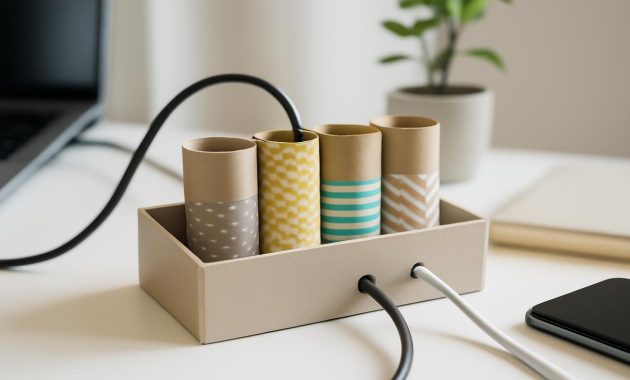
If you sift through a designer’s workspace after they’ve fallen in love with this trick, you’ll notice their cardboard rolls never look quite the same. Some are short and stubby, others long and slim. Some are wrapped in washi tape, others painted to match the desk, a few labeled in neat tiny letters: “USB-C,” “Camera,” “Backup Drive.” The beauty lies not just in the idea, but in how easily it adapts to your particular mess.
Imagine the surface of your desk right now. The laptop, the phone charger, the lamp, maybe a monitor or two. Underneath, cables slip and cross paths. Here’s how those unassuming cardboard tubes can start restoring calm:
- The under-desk tunnel: Cut a paper towel roll in half lengthwise, then secure it under the back edge of your desk with double-sided tape or small brackets. Feed multiple cables through it, and suddenly the wild cascade of wires dangling at knee level disappears. They now exit discreetly near the power strip.
- The single-line sleeve: For that one cable that must cross your desk—the laptop charger, for example—slide it through a plain roll and trim the cardboard so it’s just slightly shorter than the visible part of the cable. The line becomes thicker, cleaner, softer on the eye.
- The drawer grid: Line up a series of rolls upright in a shallow box or drawer. Drop one coiled cable inside each roll. No more rummaging; the moment your hand touches the cardboard, you know you’ve arrived in the right compartment.
There’s a small, quiet pleasure in the process itself. The sound of scissors working through cardboard. The soft, papery rasp as you slide a cable inside. It’s the kind of low-stakes tinkering that feels almost meditative after a morning of high-focus design sprints.
It might seem almost too low-tech to be taken seriously. But that tension—between the digital sophistication of your tools and the homespun simplicity of your cable management—is exactly what gives this trick its charm. It’s a reminder that not every elegant solution requires an app or a specialty purchase. Sometimes, it’s hiding in your recycling bin.
Designing the Look: Making It Actually Beautiful
Here’s where the trick shifts from “functional hack” to something designers genuinely love: you can style it. The cardboard roll might begin as a utility item, but it doesn’t have to stay that way. It can be as minimal or expressive as you want—another canvas in your workspace.
Consider the palette of your desk. Maybe you’ve chosen a warm wooden top, black accessories, and a soft beige wall. Your cardboard rolls can join that visual conversation instead of interrupting it. Some designers wrap them in kraft paper, others use monochrome washi tape, a few go for full color-blocked patterns. And then there are the people who lean into the raw cardboard look, embracing its honesty.
The point is not to turn your cable organizers into art projects (unless that sounds fun); it’s to treat them with the same quiet care you give to any other element you let live on your desk. An organized workspace doesn’t have to look sterile. It can feel alive, idiosyncratic, personal—while still giving your eye the clean lines it craves.
Below is a simple way to think about your options when choosing how to use these little cylinders in your setup:
| Use Case | Roll Type | Visual Effect |
|---|---|---|
| Single cable across desk | Short toilet paper roll, trimmed | Clean, softened line with minimal visual noise |
| Multiple cables behind monitor | Long paper towel roll | Single neutral tube instead of many scattered lines |
| Cable storage in drawer | Several upright rolls in a box | Simple grid of compartments, easy to scan |
| Visible desk accessory | Decorated roll (paint, tape, labels) | Intentional, styled, part of the overall desk aesthetic |
That’s the quiet genius of this approach: it scales from invisible to expressive, depending on how much you want it to stand out.
Why Designers Reach for Cardboard Before Buying Gadgets
There’s no shortage of cable management products in the world: sleek plastic channels, adhesive clips, fabric sleeves, modular trays that clamp onto the edge of your desk. Many of them are genuinely useful, beautifully designed, even satisfying to install. And yet, many designers find themselves reaching for the cardboard roll first.
Part of it is sustainability. Working in digital realms creates a strange relationship with material things. You spend your days making intangible products while physical objects pile up around you—devices, adapters, packaging. Repurposing cardboard rolls can feel like a small, tangible way to push back against that accumulation, to give something an extra life before it disappears into the bin.
Another part is speed. The time between “I should really do something about this cable mess” and “look, it’s better now” is delightfully short. No shipping, no measuring for the perfect product, no waiting. Just: finish the paper towel, rescue the roll, solve the problem.
But the deeper reason, the one designers rarely say out loud, has to do with ownership of their environment. A store-bought solution is someone else’s idea, elegantly executed. A cardboard roll hack is yours—responsive, immediate, altered by your hand. It’s design thinking in miniature: notice the friction, imagine a better flow, prototype quickly, iterate if needed.
When you slide those tamed cables behind your monitor or under your desk, you’re not just hiding a mess. You’re making a decision about how you want your workspace to feel. Calm, intentional, a little inventive. Not perfect, but resolved.
The Quiet Ritual of Reuse
There’s something almost ritualistic about it once you start. Every time a toilet paper roll appears, you pause at the bin. Do I need another cable sleeve? Another drawer compartment? Could I trim this into two small organizers instead of one? It’s a tiny moment of resourcefulness tucked into an ordinary day.
For some designers, this becomes a kind of anchor between bigger, more complex projects. While a major interface redesign might stretch on for weeks, a cardboard roll hack is over in minutes—a small, complete story with a beginning, middle, and satisfying end. It’s tangible progress you can see and touch, especially on days when digital work feels abstract or slow-moving.
And over time, the rolls themselves become markers of attention. Each one says: I noticed this little friction point and did something about it. I took ten minutes to make my environment kinder to my eyes and hands and focus. In a world that constantly pushes for more—more apps, more tools, more devices—it’s a small but meaningful act to choose less. Less clutter. Less visual noise. Less stuff bought to manage the stuff you already own.
Living With Less Tangle
There’s a morning, sometime after you’ve tried the cardboard roll trick, when you sit down at your desk and notice what’s missing. You set your coffee down and nothing snags. You slide your laptop an inch to the left and no cable topples something else. The space around you feels clear, and your brain, quietly, responds in kind.
The cables are still there, of course—they always will be, as long as work depends on glowing rectangles and powered tools. But they’ve been guided, softened, tucked out of sight where it matters. They no longer shout over your ideas or claim more space on the desk than they deserve.
That’s the small magic hiding in an empty cardboard roll. It doesn’t pretend to erase complexity or promise a once-and-for-all organizational epiphany. It just nudges your workspace a little closer to the way you want it to feel: thoughtful, grounded, welcoming to the next sketch, the next prototype, the next wild idea that spills across the screen.
In a profession obsessed with the newest and most refined, the cardboard roll trick is a quiet reminder that not every solution has to be polished to gleam. Sometimes, the most designerly thing you can do is spot the potential in the simplest materials, and let them help you make room for what really matters: the work itself, unfolding across a desk that finally feels like yours again.
FAQ
Does the cardboard roll trick work for thicker cables?
Yes, within reason. Standard toilet paper rolls fit most charging and peripheral cables. For thicker monitor or power cords, paper towel rolls or slightly widened slits along the roll can help. If a cable feels forced, size up rather than squeezing it in.
Will cardboard rolls look cheap on a carefully designed desk?
They don’t have to. You can trim them neatly, wrap them in matching tape or paper, or hide them behind your monitor or under the desk. Many designers keep the cardboard completely out of sight, using it only for under-desk routing or drawer storage.
Is it safe to run multiple cables through one cardboard roll?
For low-voltage data and charging cables, yes. Avoid cramming too many cords tightly together, and keep high-heat power adapters and transformers separate. The goal is gentle guidance, not compression.
How long do cardboard rolls last before needing replacement?
Used in drawers or tucked under the desk, they can last many months or even years. Rolls that sit on the desktop or get handled frequently may soften over time, but swapping them out is easy—and costs nothing.
What if I eventually upgrade to a commercial cable organizer?
You still gain from starting with cardboard. It lets you experiment with routes, lengths, and groupings before you invest in a permanent system. Many designers keep a mix: a sleek commercial tray under the desk, and humble cardboard compartments in drawers for spare cables.