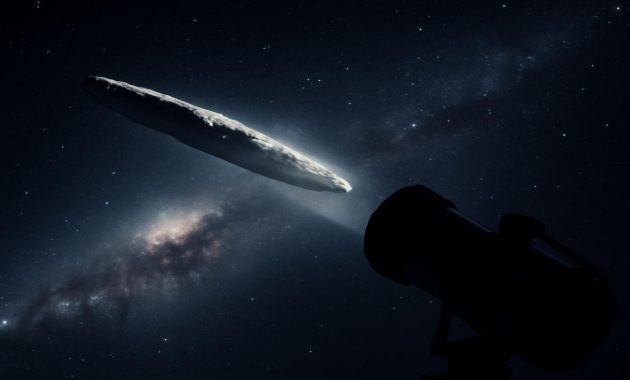
The alert came just after midnight, slipping into the quiet like a stone through glass. A junior astronomer at a small observatory in Chile watched a thin line of data crawl across his monitor, paused with his coffee halfway to his lips, and frowned. The numbers were wrong—too fast, too tilted, too foreign. He blinked, recalibrated, checked again. Still wrong. Outside, the Atacama Desert lay under a frost of stars, but on his screen something else had appeared: an object, not from here, coming in hard and fast.
A Visitor at Impossible Speed
It is easy to imagine space as stillness: the vacant hush between stars, a great unchanging darkness. The reality is closer to a vast, swirling ocean, alive with motion you rarely notice until something crashes through the surface. That night, the “crash” wasn’t a sound, but a pattern—the way the newcomer’s path sliced across the solar system’s plane at an angle that made astronomers sit up in their chairs.
This object, now the focus of observatories around the globe, is moving faster than anything of its kind we’ve ever seen approaching the inner solar system. Its speed alone first gave it away, like spotting a single car doing three times the limit on a quiet highway. When scientists calculated the numbers, the answer made the hairs on the back of their necks rise.
Most comets and asteroids bound to our Sun lumber along at a respectable cosmic pace—dozens of kilometers per second. But this newcomer is racing toward us at a record-breaking speed, enough that the Sun’s gravity can bend its path, but not capture it. It won’t settle into orbit. It will graze our neighborhood and keep going, vanishing back into the dark between the stars.
That, more than anything else, is what has astronomers whispering the word “interstellar” with a mixture of awe and caution. We are not watching a local wanderer flare briefly and fade. We are watching a traveler from another solar system cutting through our sky, like a distant stranger running through a town square without slowing down.
The Moment the Data Broke the Rules
Every discovery story begins with a moment when reality refuses to fit the template. For this one, it started as a small, bright dot drifting against the star field—a standard “moving object” candidate picked up by automated surveys that sweep the skies every clear night. Software flagged it, logged its position, and compared it to known asteroids and comets. No match. That, in itself, was not unusual. New small bodies are found all the time.
But then the follow-up observations came in. Different telescopes, different nights, same result: the object’s path refused to curve the way it should if the Sun owned it. Astronomers fed its coordinates into orbital calculation software. The output was staggering: the object was moving so fast that the Sun, for all its colossal mass, could only slightly bend its trajectory.
It was on a hyperbolic orbit—a sling-shot path that doesn’t loop back. This is the unmistakable signature of something not born from the gentle, flattened disk of rocks and ice that formed our planets. This is the mark of a wanderer that has spent eons adrift between the stars.
In the control rooms and offices where the data converged, the atmosphere shifted from routine to electric. People who had studied orbital mechanics for decades found themselves quietly re-checking their math, then emailing colleagues in other time zones with subject lines that simply read: “You need to see this.”
Within days, what started as a tiny anomaly in a night’s worth of survey data became an international campaign. Telescopes pivoted. Observation schedules were rewritten. The clock, everyone knew, was already ticking. An object traveling this fast would not linger long in view.
How Do We Know It’s From Somewhere Else?
To understand why scientists are convinced this object is an interstellar visitor, it helps to picture gravity as a kind of invisible well. Anything born in our solar system—asteroids, comets, dwarf planets—lives somewhere inside the Sun’s gravitational basin. Even the farthest, faintest icy remnant still loops around our star, however slowly.
Those loops, whether they are tight ellipses like Earth’s orbit or long stretched paths like a distant comet’s, all share an important feature: they’re bound. Their total energy is negative. They may be fragile and easily disturbed, but they are still prisoners of the Sun.
This new object is not a prisoner; it’s a passerby. When scientists calculated its “eccentricity”—a measure of how stretched its orbit is—the number came back greater than 1. That places it firmly in hyperbolic territory, the kind of path that belongs to an object on a one-time flyby.
Its speed at far distances, what astronomers call its “excess velocity,” is simply too high to have originated here. The Sun can accelerate local objects, but only so much. This one arrived already overclocked, as if thrown out of another star’s neighborhood with a powerful gravitational kick long ago.
The discovery fits into a short but thrilling chapter of astronomical history. We have seen visitors like this before—enigmatic objects whose strange speeds and shapes announced they were outsiders. Each time, the encounter was fleeting, leaving more questions than answers. This new traveler is faster than any of them, a record-breaker that forces us to rethink what might be drifting between the stars.
First Glimpses of a Stranger
If you could step inside the control room of one of the big observatories tonight, you would see quiet urgency at work. A wall-sized monitor is tiled with images, each one a different frozen moment of the same patch of sky. To an untrained eye, those images look nearly identical—salt-and-pepper static sprinkled with faint smears of light. But astronomers know where to look.
They blink the frames back and forth, a human and software collaboration honed by years of practice. The stars stay put; the visitor creeps forward, one tiny step per exposure. It’s not much to go on, but small shifts are enough to refine its orbit, to predict when and where it will next be seen, and how close it will come.
Color data start to trickle in. Is its surface charcoal-dark or sun-bleached? Does it reflect light like a dusty comet or a rocky asteroid? Early hints suggest a complex, mottled body—possibly an elongated chunk of rock or ice that has been battered by countless micro-collisions and bathed in harsh cosmic radiation during an unimaginable journey.
There is a strange intimacy to these first measurements. We cannot touch this object; we cannot send a spacecraft to greet it in time. Yet as photons that have bounced from its surface travel across millions of kilometers to land in the glass and mirrors of our telescopes, we are literally reading its story in ancient sunlight.
That story may contain clues about a star we will never see up close, a planetary system whose planets, if they exist, are too faint to detect from here. In a way, the object is a tiny emissary: a piece of somewhere else that fate and gravity have delivered to our doorstep for a brief, tantalizing visit.
How This Flyby Compares
With each passing night, scientists are filling in a portrait of this object’s behavior—its speed, its path, its angle of attack. To get a feel for just how extreme it is, it helps to compare it with things we know well.
| Object / Mission | Type | Typical / Recorded Speed (km/s) | Bound to the Sun? |
|---|---|---|---|
| Earth in orbit | Planet | ~30 | Yes |
| Typical long-period comet | Comet | 10–70 near the Sun | Yes |
| Fast interplanetary asteroid | Asteroid | Up to ~40 | Yes |
| Human-made probe (Voyager 1) | Spacecraft | ~17 (leaving solar system) | Effectively escaping |
| New interstellar visitor | Natural object | Faster than any previous interstellar object at approach | No — one-time flyby |
Even in this simplified comparison, the newcomer stands out. It is not merely fast by local standards; it is carrying velocity that the Sun did not give it, a kind of inherited momentum from a life lived elsewhere. To the scientists running the numbers, it’s as if they’ve intercepted a runner already mid-marathon, sprinting through stadium after stadium without stopping.
A Quiet Visitor, Not a Threat
When news of something “racing toward us” makes its way into headlines, it is natural to feel a flicker of unease. We are, after all, a species with a long and sometimes superstitious relationship with fiery objects in the sky. But in this case, the thing to hold onto is simple: this object is not on a collision course with Earth.
Its orbit, how steeply it cuts through the plane of the planets, and how fast it is moving make a direct impact extraordinarily unlikely. By the time its path brings it anywhere near our neighborhood, it will still be separated from us by distances too vast to comprehend in everyday terms—millions, tens of millions of kilometers.
From the ground, even at its closest approach, it will not blaze overhead like a cinematic fireball. If you step outside on a clear night and look up, you won’t notice anything new. Only with sensitive telescopes, cameras taking long, patient exposures, will its faint trace be discernible at all.
In truth, the only things at risk from this encounter are our existing theories. Every new data point challenges what we think we know about how other planetary systems form and evolve. If this speeding visitor looks, chemically, very different from our comets and asteroids, it will suggest that other stars build their worlds in ways we haven’t yet imagined. If it looks surprisingly similar, that, too, is profound—hinting that the recipe for planets, and perhaps for the building blocks of life, might be universal.
What Makes It So Fast?
Several stories could explain the object’s astonishing speed, and part of the excitement lies in trying to untangle which is true.
One possibility is that it was born in the outer reaches of another solar system, a small icy or rocky body orbiting a distant star much like our own. In that far-off system, a dance of gravity—perhaps involving a giant planet like Jupiter—could have flung it outward with enough energy to break free entirely. Over millions or billions of years, it would then drift through interstellar space, nudged now and then by passing stars or the weak tides of the galaxy itself, until at last it wandered into our Sun’s domain.
Another scenario imagines a more violent past. Perhaps the object is a splinter from a catastrophic collision: two early planets in some distant system smashing together, spraying debris into space. Some of that shattered material, left without a stable orbit, would be ripe for ejection. Our visitor could be one of those fragments, carrying in its mineral veins the echo of a long-ago planetary disaster.
There is even the possibility that it has been accelerated not only by single events but by cumulative gravitational hand-offs—a complex itinerary of near-misses with stars, planets, and clouds of gas that steadily pumped up its speed. Like a stone skipped across an invisible pond, each encounter would give it a small change in direction, a slight boost or brake, until finally it arrived here, moving too fast for us to do more than watch it pass.
Whatever its origin story, the outcome is the same: this object is on a one-way track through our solar system, its momentum long ago set by forces we are only beginning to reconstruct from the faint data we can collect.
What We Hope to Learn Before It Vanishes
There is something both thrilling and heartbreaking about studying a visitor we will never see again. In the laboratories and observatories focusing their instruments on this speeding speck, there is a shared urgency: learn as much as possible, as fast as possible.
Scientists are dissecting its light to search for clues about its surface composition. Does it bear the familiar icy signature of water, carbon dioxide, or more exotic ices? Does it reflect the muted tones of silicate rock, metals, or organic-rich dust? Each spectral line, each subtle color shift can serve as a fingerprint of the conditions in the star system it once called home.
They are also watching for changes. As the object swings closer to the Sun, solar radiation may begin to warm and alter its surface. If there is ice, jets of gas could erupt, forming a faint coma or tail. If it is mostly rock, the heat might instead cause cracking, outgassing, or none of the above. How it responds will reveal much about its structure and history.
The dynamics of its orbit are a lesson in themselves. Tiny deviations from the predicted path can reveal non-gravitational effects—subtle pushes from escaping gas or dust—that help characterize its behavior. Every bit of motion is a message.
Meanwhile, theorists are using this real-world example to refine models of planet formation and system evolution. Interstellar visitors are not a cosmic accident; they are a natural byproduct of planetary systems being born, reshaped, and occasionally torn apart. By counting them, by measuring their properties, we can start to understand how often worlds like ours might emerge elsewhere, and how frequently their debris drifts through the galaxy.
Even after the object has faded from our telescopes, the data will live on—pored over for years, compared to future discoveries, becoming part of the slowly growing population of known interstellar travelers. With each one, our sense of the galaxy’s shared material culture grows clearer. We are beginning to see not just isolated islands of stars, but a web of exchanged fragments, a quiet trade of rocks and ice bridging the light-years.
Watching the Galaxy Breathe
There is a moment, when you step outside on a cold, transparent night and let your eyes adjust, when the sky ceases to be a ceiling and becomes a depth. Stars that were once just bright pinpricks take on layers. Some you know are nearby, in cosmic terms. Others, fainter and more stubborn, lie unimaginably far away. Between them is darkness we still tend to think of as empty.
But the discovery of a fast, interstellar object racing toward us is a reminder that the space between stars is not a dead void. It is more like the wind between mountains, carrying seeds, dust, and the occasional surprise. Planetary systems are not sealed terrariums; they are leaky, exchanging material over vast timescales, bits and pieces slipping loose and wandering.
Every now and then, one of those wanderers crosses our path. Sometimes we notice, as we have now. More often, they likely pass unseen, too small or too distant to catch our attention. Yet with each one we detect, our understanding of what it means to live in a galaxy deepens. We are not just bound to our Sun. We are, in a subtle way, part of a larger conversation conducted in rock and ice.
In the coming weeks and months, as astronomers continue to track this blazing visitor, most of humanity will go about life unaware. The tides will roll in and out. Birds will thread their migrations along ancient routes. City lights will wash out all but the brightest stars over much of the world. And high above, far beyond the reach of weather or wings, a small, silent object from another solar system will carve a swift, invisible arc through our sky.
It will not stay. It does not need to. Its significance lies not in its lingering, but in the simple fact of its existence. For a brief moment, amid billions of years and billions of stars, our paths have crossed. In the faint light it reflects, we can read a story that began somewhere utterly else—and be reminded that, in a galaxy full of restless worlds, we are not as alone, or as isolated, as the night sometimes makes us feel.
FAQ
Is this object going to hit Earth?
No. Based on current orbital calculations, the object will not come anywhere near a collision course with Earth. It will pass at a very safe distance, millions of kilometers away.
Can we see it with the naked eye?
No. Even at its closest approach, the object will be far too faint to see without powerful telescopes. For most people, the encounter will be something they read about, not something they can watch directly.
How do scientists know it is from another solar system?
The key evidence is its hyperbolic orbit and very high incoming speed. These measurements show it is not gravitationally bound to the Sun and must have originated beyond our solar system.
Could it be an alien spacecraft?
There is no evidence suggesting it is artificial. All observations so far are consistent with a natural object, like a comet or asteroid fragment, shaped and launched by the normal processes that occur in planetary systems.
Will we ever send a spacecraft to an object like this?
Not to this one—it’s moving too fast and was discovered too late for us to mount a mission in time. However, scientists are actively studying mission concepts that could intercept or fly by future interstellar visitors if they are detected early enough.
What can we learn from an interstellar object?
By studying its composition, behavior, and trajectory, we can learn about the chemistry and dynamics of other planetary systems. It offers a rare, physical sample—observed at a distance—of material formed around another star.
Will we see more of these visitors in the future?
Yes. As sky surveys become more sensitive and cover the sky more frequently, we expect to discover many more interstellar objects. Each new visitor will help build a clearer picture of how common they are and what they’re made of.